
Powder Induction and Dispersion Systems Market Size, Trends & Growth by 2034
Coverage: by Application (Food and Beverages, Pharmaceuticals, Cosmetics and Personal Care, Chemical); Process (Continuous Processing, Batch Processing); Mixing Type (In-Tank, In-Line) , and Geography (North America, Europe, Asia Pacific, and South and Central America)
- Status : Data Released
- Report Code : TIPRE00005369
- Category : Manufacturing and Construction
- No. of Pages : 150
- Available Report Formats :


- Last update date : September 07, 2026


2025 Market Size
US$ 2.87 Bn
Base year value
2034 Forecast
US$ 4.21 Bn
Projected by 2034
CAGR 2026-2034
4.93 %
Growth rate
Addressable Market
US$ 33.11 Bn
(2026-2034)
The powder induction and dispersion systems market was valued at US$ 2.87 Billion in 2025 and is projected to reach US$ 4.21 Billion by 2034, expanding at a CAGR of 4.93% during 2026–2034. The market includes systems that introduce, wet, disperse, dissolve, and homogenize powders into liquid streams across industrial processing environments. Demand is shaped by requirements for consistent formulations, reduced agglomeration, controlled powder handling, and improved process efficiency.
North America is expected to maintain a strong position through 2034, supported by established food processing, pharmaceutical manufacturing, and specialty chemical production. Adoption is reinforced by labor optimization, hygienic processing requirements, dust control, and modernization of batch and continuous production lines. Increasing interest in energy-efficient equipment and automated powder handling should support replacement and expansion investments.
Powder Induction and Dispersion Systems Market Assessment and Insights
- North America: North America is estimated to hold a 34–38% share in 2025 and expand at a CAGR of 4.6–5.2% during 2026–2034, supported by mature processing infrastructure, automation, and equipment replacement.
- US: The US accounts for approximately 78–82% of North America's 2025 market and is projected to grow at a CAGR of 4.5–5.1%, supported by automated processing and hygienic production.
- Europe: Europe is estimated to hold a 27–31% share in 2025 and grow at a CAGR of 4.4–5.0%, led by Germany, the UK, France, Italy, and Spain, where process efficiency and regulatory compliance influence investment.
- Asia Pacific: Asia Pacific is estimated to account for a 20–24% share in 2025 and expand at a CAGR of 6.5–7.2%, led by China, Japan, South Korea, India, and Australia as processing capacity modernizes.
- Largest Segment: Food and Beverages is estimated to hold a 34–38% market share in 2025 and expand at a CAGR of 5.0–5.5%, supported by high-volume ingredient processing.
- High Growth Segment: Pharmaceuticals is estimated to hold a 20–24% market share in 2025 and grow at a CAGR of 5.8–6.5%, driven by precision and hygienic processing.
- Key companies analyzed in detail: ADMIX INC.; Axiflow Technologies, Inc.; Hayward Gordon ULC; IDEX Corporation; John Bean Technologies Corporation; Joshua Greaves and Sons Ltd.; NORITAKE CO., LIMITED; Silverson Machines, Inc.; SPX FLOW, Inc.; ystral gmbh maschinenbau + processtechnik.
Source: The Insight Partners' analysis based on proprietary research, government publications, company annual reports, investor presentations, industry databases, and expert interviews.
The powder induction and dispersion systems market has evolved from conventional powder dumping and mechanical agitation toward controlled induction, vacuum-assisted wetting, high-shear dispersion, and integrated process control. Equipment increasingly combines powder handling, liquid circulation, shear generation, and monitoring within compact process configurations. This evolution addresses recurring formulation problems such as floating powders, fisheyes, agglomeration, dust generation, and inconsistent hydration across food, pharmaceutical, cosmetic, and chemical production.
The powder induction and dispersion systems market size is expected to benefit from future demand for equipment that integrates digital controls, hygienic construction, energy optimization, and scalable process architectures. Emerging manufacturing hubs in the Asia Pacific are expected to provide new installation opportunities, while established North American and European processors will emphasize retrofit and replacement projects. Regulatory requirements concerning worker exposure, product hygiene, cleaning validation, and process consistency should reinforce investment in enclosed and controllable powder induction technologies.
Powder Induction and Dispersion Systems Market Report Scope
| Report Attribute | Details |
|---|---|
| Market size in 2025 | US$ 2.87 Billion |
| Market Size by 2034 | US$ 4.21 Billion |
| Global CAGR (2026 - 2034) | 4.93% |
| Historical Data | 2021-2024 |
| Forecast period | 2026-2034 |
Powder Induction and Dispersion Systems Market Analysis
Powder induction equipment demand is highly dependent on formulation complexity, production volume, powder nature, and necessary dispersion quality. Food companies apply such equipment for proteins, starch, stabilizers, sweeteners, and functional components, and pharmaceutical and cosmetic companies need equipment for controlled processing of active and auxiliary powders. Chemical companies also demand equipment for handling hard-to-wet powders and high-viscosity fluids.
The value chain covers powder and ingredients providers, equipment suppliers, process engineers, system integrators, plant owners, distributors, and maintenance contractors. Supply factors are driven by stainless steel manufacturing, pumps, electric motors, seals, controls, and high shear components. Nowadays, customers prefer buying complete systems in terms of capacity, cleaning, energy consumption, maintenance needs, and integration criteria and not only the equipment itself based on purchase price.
Competitive positioning within the powder induction and dispersion systems market is influenced by process know-how, equipment configurability, geographic reach, application engineering, and aftermarket support. ADMIX INC. has a strong portfolio covering sanitary and industrial powder induction, while Ystral GmbH Maschinenbau + Prozesstechnik emphasizes vacuum-assisted and inline dispersion technologies. Silverson Machines, Inc. competes through high-shear mixing and dispersion capabilities across several processing industries.
SPX FLOW combines mixing, fluid handling, and process technologies, while IDEX Corporation participates through fluid-management and process-equipment capabilities. As highlighted in the powder induction and dispersion systems market report, Axiflow Technologies, Inc., Hayward Gordon ULC, John Bean Technologies Corporation, Joshua Greaves and Sons Ltd., and NORITAKE CO., LIMITED provide additional specialized and regional competition. Investment is increasingly directed toward automation, hygienic design, inline processing, and systems that improve energy and material utilization.
● REPORT CUSTOMIZATION
Tailor This Report To Align With Your Specific Business Requirements
This report can be customized to align precisely with your business objectives, scope, and target markets. Customization options include tailored segmentation, geography, competitive analysis, and strategic insights to support informed decision-making.
Customize This Report →WHAT YOU CAN ADJUST
- ● Segmentations
- ● Geography
- ● Competitive Analysis
- ● Language Preferences
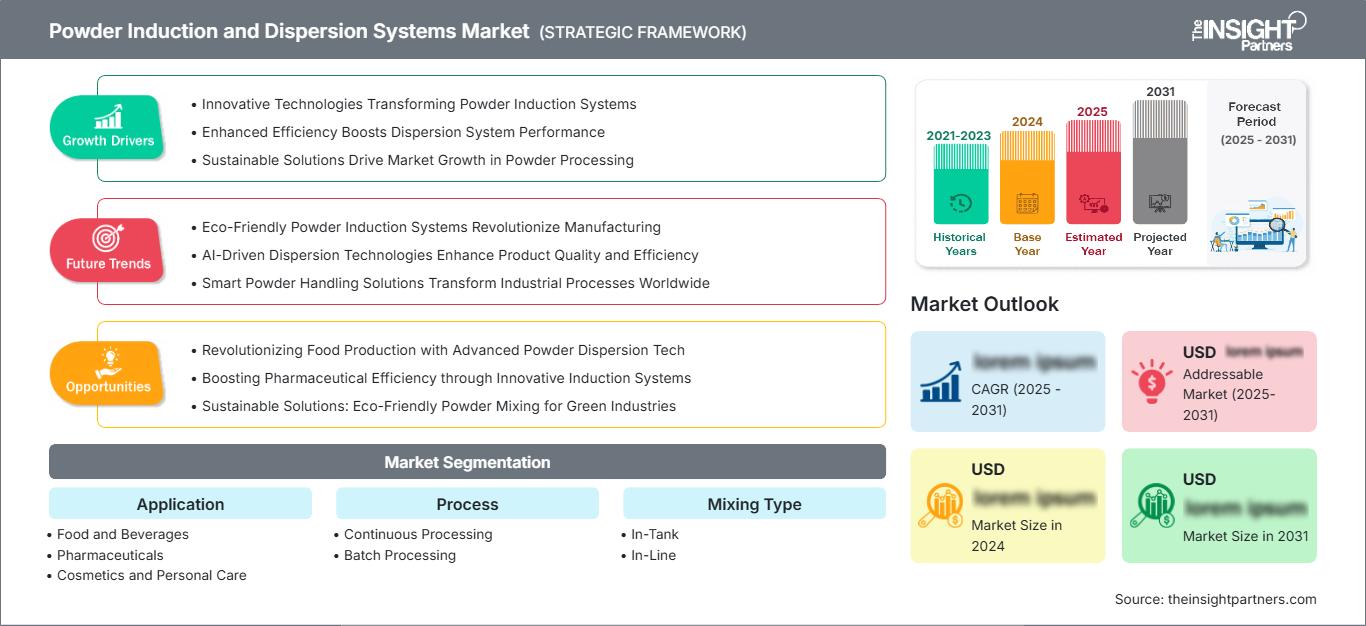
Powder Induction and Dispersion Systems Market: Strategic Insights
Regional Insights
North America powder induction and dispersion systems market
North America is estimated to account for 34–38% of the global powder induction and dispersion systems market in 2025 and is projected to grow at a CAGR of 4.6–5.2% through 2034. The United States constitutes the biggest market within the region, owing to the presence of existing food, pharmaceutical, personal care, and specialty chemicals manufacturing facilities. Canada comes in through food processing and industrial uses, while Mexico provides modernization potential.
Processors are looking for technologies such as enclosed powders handling, automated induction, and consistent dispersion since they offer better ways to handle materials without the need for manual intervention and ensure consistency in batches. Current facilities are also employing retrofitted systems to modernize the mixing process without replacing an entire production line.
U.S. powder induction and dispersion systems market
The US represents approximately 78–82% of North America's 2025 powder induction and dispersion systems market and is projected to expand at a CAGR of 4.5–5.1% through 2034. Strong pharmaceutical, food, beverage, cosmetic, and chemical production supports equipment demand, particularly for automated powder incorporation and hygienic processing.
ADMIX INC., IDEX Corporation, SPX FLOW, and other suppliers serve applications ranging from ingredient hydration to chemical dispersion. Food processors increasingly use inline systems for faster incorporation, while pharmaceutical producers prioritize controlled, cleanable, and repeatable operations. Replacement of manual powder addition remains an important modernization pathway.
Europe powder induction and dispersion systems market
Europe is estimated to hold a 27–31% of the powder induction and dispersion systems market share in 2025 and is projected to grow at a CAGR of 4.4–5.0%. Germany is the leading regional market, supported by advanced process engineering and a strong industrial equipment base.
The UK continues to invest in efficient food, beverage, pharmaceutical, and personal care production. Germany emphasizes automation, engineering precision, and energy efficiency. France, Italy, and Spain provide demand through food processing, cosmetics, pharmaceuticals, and specialty chemicals, with manufacturers increasingly prioritizing hygienic equipment, controlled powder handling, and reduced process variability.
APAC powder induction and dispersion systems market
APAC is estimated to represent 20–24% of the global powder induction and dispersion systems market in 2025 and is projected to grow at a CAGR of 6.5–7.2%. China is the leading market, followed by Japan, South Korea, India, and Australia.
Industrial expansion, pharmaceutical manufacturing, packaged food production, and rising investment in modern processing facilities support adoption. China and India provide substantial capacity-expansion opportunities, while Japan and South Korea emphasize precision and automation. Australia supports demand through food and industrial processing modernization.
Middle East & Africa powder induction and dispersion systems market
The Middle East & Africa powder induction and dispersion systems market is projected to grow at a CAGR of 5.8–6.6%, supported by food-security investment, pharmaceutical manufacturing, and industrial diversification. Saudi Arabia leads regional demand, followed by the UAE and South Africa.
Saudi Arabia and the UAE are expanding modern food-processing infrastructure, while South Africa provides an established industrial base. Equipment capable of reducing powder losses, improving water and energy utilization, and supporting hygienic production is increasingly relevant across new processing facilities.
Segmentation Analysis
Application
Application is projected to expand at a CAGR of 5.0–5.5% during 2026–2034. Food and beverages represent the largest application base because manufacturers frequently incorporate powders such as proteins, starches, stabilizers, sweeteners, and functional ingredients. Pharmaceuticals and personal care require higher process control, while chemicals demand robust systems for challenging powder-liquid formulations.
- Food and Beverages: Food and Beverages represents the largest application base, supported by ingredient hydration, stabilizer incorporation, protein dispersion, and demand for repeatable formulations across high-volume processing operations.
- Pharmaceuticals: Pharmaceuticals require precise powder incorporation, hygienic construction, controlled processing conditions, and repeatability, making enclosed and highly controllable induction technologies strategically important for formulation quality.
- Cosmetics and Personal Care: Cosmetics and Personal Care uses powder induction for pigments, thickeners, active ingredients, and functional additives, with manufacturers emphasizing smooth dispersion, formulation consistency, and clean processing.
- Chemical: Chemical applications include pigments, additives, polymers, minerals, and specialty formulations, requiring equipment capable of handling difficult wetting behavior, high solids loading, and demanding viscosity conditions.
Process
Process is expected to grow at a CAGR of 4.7–5.3% during 2026–2034. Batch processing remains important because of formulation flexibility and widespread installed infrastructure, while continuous processing is gaining interest where high throughput, consistent quality, and reduced processing time are priorities.
- Continuous Processing: Continuous Processing supports high-throughput manufacturing by maintaining controlled powder addition and liquid flow, reducing intermediate handling and enabling consistent production across extended operating cycles.
- Batch Processing: Batch Processing remains widely adopted because it accommodates multiple formulations, variable production volumes, and established vessel configurations while providing processors with flexibility for product changeovers.
Mixing Type
Mixing Type is projected to expand at a CAGR of 5.1–5.7% during 2026–2034. Selection increasingly depends on formulation viscosity, required shear, throughput, plant layout, and whether processors prioritize flexible batch production or continuous material flow. Integrated induction and dispersion are gaining importance.
- In-Tank: In-Tank systems remain important for flexible batch production, particularly where manufacturers need to incorporate powders directly into existing vessels and maintain compatibility with established mixing infrastructure.
- In-Line: In-Line systems are gaining adoption where processors prioritize rapid powder wetting, shorter processing cycles, controlled shear, and continuous production with reduced intermediate handling.
Opportunity Snapshot
| Application | Revenue Contribution (High/Medium/Low) | Trend Tag | Adoption Stage |
| Food and Beverages | High | Ingredient Hydration | Mature |
| Pharmaceuticals | Medium | Precision Dispersion | Scaling |
| Cosmetics and Personal Care | Medium | Texture Control | Scaling |
| Chemical | Medium | High-Solid Dispersion | Scaling |
Powder Induction and Dispersion Systems Market Growth Drivers and Impact Analysis
Rising demand for controlled powder wetting
Wetting of powders is gaining significance because producers are dealing with increasingly complicated compositions, including proteins, hydrocolloids, pigments, active ingredients, and functional additives. Traditional surface addition results in floatables, agglomerates, dust, and poor wetting, leading to increased reprocessing and elongated processing time. Induction technologies involve the introduction of powders into carefully managed liquid streams and can even include wetting along with high shear mixing. The economic influence is at its greatest when formulation uniformity is important for the final product requirements or further manufacturing processes. Improved operator control and reduced exposure to airborne powders can also provide an economic advantage to food and pharmaceutical companies.
Expansion of hygienic and automated processing
Manufacturers within the food, pharmaceuticals, and cosmetics industry are focusing more and more on hygienic design of machinery, process automation, and consistent production conditions. Induction powders can help achieve these goals through a reduction of manual dumping of powders, dust minimization, and incorporation into automated processes. Stainless steel, cleanability of parts, controllable feed rate, and programmable control are becoming more important in terms of buying considerations. Commercial significance is seen in plant efficiency as automation eliminates the need for repetitive work by operators without changing formulation consistency. As the facilities are upgraded by the processors, equipment incorporating both induction, dispersion, pumping, and process control will minimize interfaces and hence create opportunities for equipment vendors.
Pressure to reduce processing energy and material losses
Energy and materials efficiency will become significant considerations in equipment selection in view of the need for manufacturers to become more efficient economically while minimizing waste. Efficient induction and dispersion have the potential of minimizing mixing time, increasing the efficiency of using the powder, and avoiding reprocessing due to improper wetting and agglomeration. An inline process would minimize transfers between intermediate stages and would allow the process to flow seamlessly through various processing stages. This consideration will apply to various industries like foods, chemicals, pharmaceuticals, and cosmetics, although the extent of efficiency will depend on such factors as viscosity and the level of solids in the formulation, as well as the production volume.
Powder Induction and Dispersion Systems Market Future Trends
Intelligent process monitoring and adaptive dispersion
The powder induction and dispersion systems market trends are moving toward connected equipment capable of monitoring flow, pressure, temperature, power consumption, and processing conditions. In future applications, these kinds of data feeds will be used to detect discrepancies and modify the process settings in relation to powder characteristics and formulations. Adaptive controls can help minimize variations that occur in the case of any changes in the properties of the raw material for different batches. Moreover, digital interconnection will provide an opportunity for predictive maintenance by detecting any abnormalities in the pump, seals, and motors before any breakdown disrupts the production process. Centralized dashboards will provide an opportunity for comparison of several processing lines and facilities for larger manufacturers.
Greater integration of inline processing architectures
Inline processing will become more relevant when manufacturers need a decreased residence time, greater throughput, and uniform product specifications. Future equipment designs will incorporate features such as powder introduction, fluid circulation, induction, wetting, dispersion, and processing further down the line, all in one compact and continuous system. In some cases, this kind of design can minimize the number of transfer operations and decrease the chances of contamination or loss of material. Manufacturers of pharmaceuticals and specialty chemicals will especially benefit from this kind of design if they are concerned about controlled residence time and shear conditions. Manufacturers of food products and beverages can use such systems for large-volume batches that need frequent production. Suppliers will differentiate on their modular equipment that can scale to accommodate different flow rates and solids concentrations.
Powder Induction and Dispersion Systems Market Opportunities
Expansion of pharmaceutical processing capacity in Asia
The region of Asia offers great potential to suppliers because of the growth in pharmaceutical manufacturing capabilities in India, China, South Korea, and other parts of Asia. The new plants will be able to incorporate closed powder induction and dispersion systems right from the engineering phase, thereby avoiding problems with the installation of such systems in existing vessels. Formulations that need active ingredient incorporation, as well as excipient and suspending agent incorporation, can offer great potential for sales. Technical service, validation support, and hygienic design support could play a big part in the buying decision. The opportunity is most appropriate for companies that can deliver on pharmaceutical standards as well as have scalable options for various batch sizes.
Digital retrofit programs for established processing plants
The powder induction and dispersion systems market Forecasts point toward an expanding retrofit opportunity as established processors seek productivity improvements without replacing complete production lines. The existing plants may incorporate automatic induction systems, sensors, variable speed drives, control systems, and inline dispersion devices around the existing tanks and pipelines. The retrofit solutions may focus on addressing issues such as slow rate of powder mixing, variations in hydration, dusting, or a high level of manual labor involved in the processes. The manufacturers, who have the knowledge about the equipment in place, can design the modules that would not increase downtime for the plant. This solution would also generate ongoing business opportunities through maintenance, replacement parts, software updates, and process optimization.
Frequently Asked Questions

- Comprehensive Market Sizing and Forecast Analysis
- Detailed Segmentation Analysis
- In-Depth Market Dynamics Assessment
- Regional and Country-Level Insights
- Competitive Landscape and Company Benchmarking
- Strategic Business Intelligence
Recent Reports
Testimonials

The Insight Partners' SCADA System Market report is comprehensive, with valuable insights on current trends and future forecasts. The team was highly professional, responsive, and supportive throughout. We are very satisfied and highly recommend their services.
RAN KEDEM Partner, Reali Technologies LTDs
I requested a report on a very specific software market and the team produced the report in a few days. The information was very relevant and well presented. I then requested some changes and additions to the report. The team was again very responsive and I got the final report in less than a week.
JEAN-HERVE JENN Chairman, Future Analytica
We worked with The Insight Partners for an important market study and forecast. They gave us clear insights into opportunities and risks, which helped shape our plans. Their research was easy to use and based on solid data. It helped us make smart, confident decisions. We highly recommend them.
PIYUSH NAGPAL Sr. Vice President, High Beam Global
The Insight Partners delivered insightful, well-structured market research with strong domain expertise. Their team was professional and responsive throughout. The user-friendly website made accessing industry reports seamless. We highly recommend them for reliable, high-quality research services
YUKIHIKO ADACHI CEO, Deep Blue, LLC.
This is the first time I have purchased a market report from The Insight Partners.While I was unsure at first, I visited their web site and felt more comfortable to take the risk and purchase a market report.I am completely satisfied with the quality of the report and customer service. I had several questions and comments with the initial report, but after a couple of dialogs over email with their analyst I believe I have a report that I can use as input to our strategic planning process.Thank you so much for taking the extra time and making this a positive experience.I will definitely recommend your service to others and you will be my first call when we need further market data.
JOHN SUZUKI President and Chief Executive Officer, Board Director, BK Technologies
I wish to appreciate your support and the professionalism you displayed in the course of attending to my request for information regarding to infectious disease IVD market in Nigeria. I appreciate your patience, your guidance, and the fact that you were willing to offer a discount, which eventually made it possible for us to close a deal. I look forward to engaging The Insight Partners in the future, all thanks to the impression you have created in me as a result of this first encounter.
DR CHIJIOKE ONYIA MANAGING DIRECTOR, PineCrest Healthcare Ltd.Reason to Buy
- Informed Decision-Making
- Understanding Market Dynamics
- Competitive Analysis
- Identifying Emerging Markets
- Customer Insights
- Market Forecasts
- Risk Mitigation
- Boosting Operational Efficiency
- Strategic Planning
- Investment Justification
- Tracking Industry Innovations
- Aligning with Regulatory Trends





 Get Free Sample for