
Pro AV Market Size, Growth & Trends by 2034
Coverage: by Offering (Product, Service); Industry Vertical (Corporate, Entertainment, Hospitality, Retail, Transportation, Others) , and Geography (North America, Europe, Asia Pacific, and South and Central America)
- Status : Data Released
- Report Code : TIPRE00009535
- Category : Electronics and Semiconductor
- No. of Pages : 150
- Available Report Formats :


- Last update date : October 13, 2026


2025 Market Size
US$ 93.93 Bn
Base year value
2034 Forecast
US$ 164.44 Bn
Projected by 2034
CAGR 2026-2034
6.42 %
Growth rate
Addressable Market
US$ 1,168.84 Bn
(2026-2034)
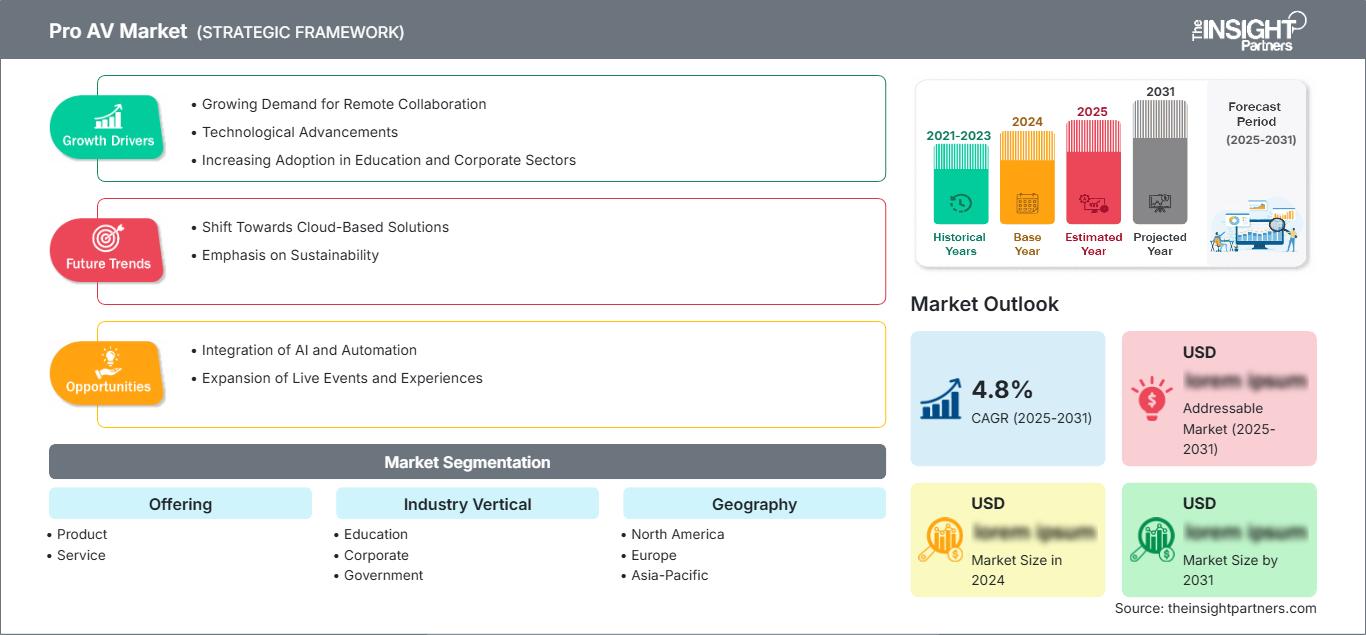
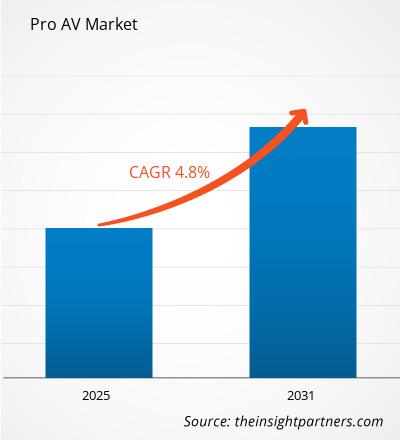
The pro av market size is valued at US$ 93.93 Billion in 2025 and is projected to reach US$ 164.44 Billion by 2034, registering a CAGR of 6.42% during 2026–2034. The industry is being shaped by enterprise collaboration, immersive presentation environments, digital signage, unified communications, and increasingly software-defined AV infrastructure. Investment is shifting toward integrated systems that combine displays, audio, control, networking, collaboration, analytics, and managed services within scalable deployment models.
North America remains a structurally important region, supported by mature corporate AV estates, sophisticated higher-education facilities, government modernization, hospitality technology upgrades, and large-scale entertainment venues. Regional expansion is expected at an estimated 6.0%–6.8% CAGR from 2026–2034, supported by replacement cycles, hybrid workplace requirements, cloud-managed AV, and demand for higher-resolution commercial displays and intelligent collaboration environments.
Pro AV Market Assessment and Insights
- North America: North America is expected to represent 34%–38% pro av Market share in 2025, supported by established corporate and institutional deployments, and grow at a 6.0%–6.8% CAGR between 2026–2034 as organizations modernize AV infrastructure.
- US: The US is estimated at 27%–31% share in 2025, with enterprise collaboration, higher education, hospitality, digital signage, and entertainment installations supporting a 5.9%–6.7% CAGR between 2026–2034.
- Europe: Europe is estimated to hold 25%–29% share in 2025 and expand at a 5.7%–6.5% CAGR between 2026–2034, led by Germany, the UK, France, Italy, and Spain through workplace digitization and public-sector modernization.
- Asia Pacific: Asia Pacific is estimated at 25%–29% share in 2025 and is projected to grow at a 7.0%–7.8% CAGR between 2026–2034, led by China, Japan, South Korea, India, and Australia.
- Largest Segment: Product is estimated at 58%–62% market share in 2025, reflecting substantial hardware deployment, with a 5.9%–6.6% CAGR from 2026–2034.
- High Growth Segment: Service is estimated at 38%–42% market share in 2025, supported by integration and managed AV demand, with a 7.0%–7.8% CAGR from 2026–2034.
- Key companies analyzed in detail: AVI Systems Inc.; AVI-SPL, Inc.; BenQ Corporation; Bose Corporation; Diversified Communications; Ford Audio-Video, LLC; Legrand AV Inc.; LG Electronics Inc.; Samsung Electronics Co., Ltd.; Whitlock; Barco NV; Crestron Electronics, Inc.; Shure Incorporated.
Source: The Insight Partners' analysis based on proprietary research, government publications, company annual reports, investor presentations, industry databases, and expert interviews.
The pro av Market has moved beyond individual hardware solutions to integrate environments involving high-definition screens, networked sound, video conferencing, room control, content management, and cloud management. There is thus a trend towards modular platforms, standard interfaces, embedded processing, and software-driven monitoring of systems. Display makers have been developing the system-on-chip concept, while integrators are focusing on lifecycle services, integration, cybersecurity, and remote management. All these trends are making the industry less dependent on distinct categories of hardware and more focused on overall architecture of solutions.
Further development in the pro av Market will most likely take place in the interface between AV infrastructure and digital transformation initiatives. Deployments currently being implemented in India, Southeast Asia, the Middle East, and some European public sector projects are expanding the scope of potential customers. Attention to energy efficiency, accessibility, cybersecurity, and responsible electronic procurement policies is becoming an influence on equipment choices. The focus of investment will now shift towards low-power displays, management, wireless collaboration, intelligent scheduling, and service agreements protecting technology assets through long cycles of use.
Pro AV Market Report Scope
| Report Attribute | Details |
|---|---|
| Market size in 2025 | US$ 93.93 Billion |
| Market Size by 2034 | US$ 164.44 Billion |
| Global CAGR (2026 - 2034) | 6.42% |
| Historical Data | 2021-2024 |
| Forecast period | 2026-2034 |
Pro AV Market Analysis
Pro av market growth will continue to benefit from the change of workspaces towards collaborative spaces. There is an increasing need for rooms that will cater to on-site, remote, and hybrid workers, without a complex setup process. The demand for solutions arises from education, through the use of interactive displays and lecture-capture systems to enable blended learning. There are also needs for hospitality, in which digital signage and entertainment systems enhance guest experience. Networked displays are being used in retail for coordination of promotions and in government facilities for secure communication and control room systems.
The supply chain in the pro av Market involves producers of components, displays and audio equipment providers, software providers, distributors, integrators, consultants, installers, and managed service providers. Software aspects are increasingly important in supply dynamics, since users prefer products that can connect to other products and not standalone devices. The availability of semiconductors, prices of display panels, logistics costs, and the availability of qualified technicians will still be key project considerations.
Competitive positioning in the pro av Market is becoming more and more dependent on the ability to integrate hardware with software and professional services. AVI-SPL, Inc. and Diversified Communications focus on integrated workspace and experience solutions, while AVI Systems Inc. and Ford Audio-Video, LLC provide their customers with design, installation, and support services. Legrand AV Inc. and Crestron Electronics, Inc. enhance the infrastructure and control environment, while Shure Incorporated and Bose Corporation offer audio technology solutions. It shows a trend towards creation of comprehensive AV ecosystems instead of individual purchases.
In addition, investments in the pro av Market are now made in manufacturers that can combine display technology, wireless collaboration, cloud management and interoperability within an ecosystem. LG Electronics Inc., Samsung Electronics Co., Ltd., BenQ Corporation and Barco NV compete using display technology innovations, while service providers are differentiating through analytics, operations management and global delivery capabilities. Partnership strategies become very important as customers demand integration of their AV systems with collaboration platforms, enterprise network, identity and facility management systems.
● REPORT CUSTOMIZATION
Tailor This Report To Align With Your Specific Business Requirements
This report can be customized to align precisely with your business objectives, scope, and target markets. Customization options include tailored segmentation, geography, competitive analysis, and strategic insights to support informed decision-making.
Customize This Report →WHAT YOU CAN ADJUST
- ● Segmentations
- ● Geography
- ● Competitive Analysis
- ● Language Preferences
Pro AV Market: Strategic Insights
Regional Insights
North America pro av market
The pro av Market report shows that North America is estimated to account for 34%–38% share in 2025 and is expected to expand at a 6.0%–6.8% CAGR through 2034. Mature corporate campuses, higher education, healthcare facilities, government buildings, sports venues, and transportation infrastructure provide a broad replacement and expansion base. The US remains the principal contributor, while Canada benefits from institutional modernization and commercial development.
The demand for enterprise has become more dependent on hybrid collaboration, room standardization, digital signage, and IT centralization. Buyers have also been concerned about cybersecurity, device monitoring, and predictable lifecycle costs. The AVIXA indices for 2025 have shown that there has been consistent growth in the North American AV business even amid challenges in labor, tariffs, and supply chain.
U.S. pro av Market
The US is estimated to represent 27%–31% of North America's 2025 share and is projected to grow at a 5.9%–6.7% CAGR through 2034. Corporate headquarters, universities, hotels, retailers, government facilities, entertainment venues, and transportation hubs continue to invest in sophisticated presentation and communication environments. Major integrators and technology vendors maintain extensive US deployment capabilities.
The focus of application priorities is moving more towards hybrid meeting rooms, command centers, digital signage, immersive experiences, and wireless presentation solutions. Customers are heading towards standardizing their rooms through templates for easier implementation in large property networks. Managed AV solutions have also gained traction with organizations wanting remote management and speedy problem-solving without growing their technical teams. The presence of technology providers and enterprise clients further confirms the status of the country as the dominant North American deployment region.
Europe pro av Market
The pro av Market forecast shows that Europe is estimated to hold 25%–29% share in 2025 and is projected to grow at a 5.7%–6.5% CAGR through 2034. Germany leads the pack, with the UK, France, Italy, and Spain following. Modernization of corporations, education technology, refurbishment of hospitality, digitization of retail, and public infrastructure projects provide sustained demand. Increasingly, energy efficiency and procurement rules impact equipment choices.
The UK retains a high level of demand for enterprise collaboration, live events, higher education, and professional services. Germany has benefited from industrial facilities, corporate campuses, trade shows, and technology-driven manufacturing environments. France is buoyed by public sector modernization, hospitality, culture, and enterprise solutions. Italy and Spain have growing demand from tourism, retail, education, and commercial refurbishments with integrators blending digital signage, conferencing, audio, and management.
APAC pro av Market
APAC is estimated at 25%–29% share in 2025 and is expected to record a 7.0%–7.8% CAGR through 2034. While China dominates the scale of regions, Japan, South Korea, India, and Australia contribute to technology-focused demand. The investments made by industry, smart city projects, educational digitalization, hospitality investments, and business expansion will help with deployment.
China can take advantage of extensive industrial and infrastructural work, Japan — of the modernization of business and institutions, and South Korea — of the advanced electronics ecosystem. India can become an important region of growth through office growth, educational technology, hospitality, and technology-driven infrastructure. Australia sustains demand in business, government, educational, and entertainment applications. Regional digital infrastructure initiatives encourage AVs connectivity further.
Middle East & Africa pro av Market
Middle East and Africa represent a smaller but increasingly strategic deployment base, with demand supported by hospitality, tourism, government facilities, airports, entertainment destinations, and smart infrastructure. The region is expected to grow at a 6.2%–7.0% CAGR, with the UAE serving as a leading technology and integration hub.
Opportunities abound in Saudi Arabia due to its focus on infrastructure development, tourism, and destination developments. Opportunities in the UAE arise from quality hospitality services, exhibitions, corporate centers, and smart building. South Africa still plays a significant role in the installation of facilities related to corporate, educational, governmental, and entertainment purposes, whereas the other parts of MEA are selective opportunities arising from infrastructure development.
Segmentation Analysis
Offering
Offering is divided into Product and Service. The combined segment structure reflects the industry's movement from equipment procurement toward integrated lifecycle delivery. Product remains the larger component because displays, projectors, audio systems, conferencing hardware, control devices, and supporting infrastructure are required in virtually every deployment. However, services are gaining strategic weight as customers seek design expertise, installation, commissioning, monitoring, maintenance, and technology refresh planning. The overall offering segment is expected to expand at a 6.0%–6.7% CAGR from 2026–2034.
- Product: Displays, projectors, professional audio, conferencing equipment, control hardware, and supporting infrastructure remain foundational purchases, with demand increasingly favoring network-ready, energy-efficient, interoperable equipment.
- Service: Design, integration, installation, commissioning, support, managed services, and lifecycle consulting are becoming strategically important as customers seek predictable performance and lower internal technology-management burdens.
Industry Vertical
Industry Vertical includes Education, Corporate, Government, Hospitality, and Retail. These sectors differ in deployment objectives, procurement cycles, infrastructure maturity, and content requirements. Corporate customers prioritize collaboration and productivity, education emphasizes interactive learning, government focuses on secure communications, hospitality emphasizes guest experience, and retail prioritizes customer engagement. The segment is expected to progress at a 6.2%–6.9% CAGR from 2026–2034, with service intensity increasing across major verticals.
- Education: Universities, colleges, schools, and training facilities increasingly require interactive displays, lecture capture, wireless presentation, and flexible learning spaces that support both physical and remote participation.
- Corporate: Enterprises are standardizing meeting rooms, collaboration spaces, executive briefing centers, and digital signage while prioritizing interoperability, centralized management, user simplicity, and consistent experiences across locations.
- Government: Public agencies deploy secure presentation, command-and-control, conferencing, and information-display systems, with procurement increasingly emphasizing reliability, accessibility, cybersecurity, lifecycle support, and operational continuity.
- Hospitality: Hotels, resorts, conference properties, and entertainment venues use AV systems to improve guest engagement, meeting capabilities, digital signage, in-room entertainment, and immersive experiences.
- Retail: Retailers deploy digital signage, interactive kiosks, customer-facing displays, audio, and centrally managed content to improve merchandising consistency and create measurable in-store engagement.
Opportunity Snapshot
| Industry Vertical | Revenue Contribution (High/Medium/Low) | Trend Tag (MAX 2 words) | Adoption Stage (Emerging/Scaling/Mature) |
| Education | Medium | Hybrid Learning | Scaling |
| Corporate | High | Smart Collaboration | Mature |
| Government | Medium | Secure Command | Scaling |
| Hospitality | High | Guest Experience | Scaling |
| Retail | Medium | Digital Signage | Mature |
Pro AV Market Growth Drivers and Impact Analysis
Expansion of Hybrid and Flexible Collaboration Infrastructure
Hybrid work is changing the design criteria for professional AV environments because meeting rooms must provide consistent experiences for participants regardless of location. Enterprises are replacing basic conferencing setups with integrated cameras, microphones, displays, room-control systems, wireless presentation, and scheduling interfaces. This shift increases the value of installation expertise because compatibility and user experience depend on system-level configuration rather than individual device performance. Large organizations are also standardizing room designs across offices to reduce training requirements and simplify support. For integrators, standardized architectures create opportunities for repeat deployments, centralized monitoring, and recurring service agreements. For manufacturers, compatibility with leading collaboration platforms is increasingly important. The result is a demand environment in which AV infrastructure becomes a productivity technology rather than an isolated facilities purchase.
Increasing Adoption of Immersive Displays and Digital Signage
Large-format displays, fine-pitch LED, interactive screens, and sophisticated digital signage are expanding beyond traditional presentation environments. Retailers use displays to coordinate campaigns and improve customer engagement, while hospitality operators integrate screens into lobbies, meeting facilities, guest rooms, and entertainment spaces. Corporate organizations are adopting immersive visualization for executive communication, training, design reviews, and experience centers. Public institutions also require high-visibility information systems for transportation, civic communication, and cultural venues. These applications raise the importance of brightness, resolution, content management, installation flexibility, and remote administration. Manufacturers that combine display hardware with cloud platforms can create differentiated solutions, while integrators benefit from complex installation and content-management requirements. The shift toward experience-led environments is therefore expanding the role of AV from functional communication to customer-facing and brand-oriented applications.
Growth of Managed AV and Lifecycle Service Models
The increasing complexity of installed AV systems is encouraging customers to outsource monitoring, maintenance, support, and optimization. Enterprises operating large portfolios often face difficulties maintaining specialized technical staff across every site, creating demand for managed-service arrangements. Remote diagnostics can identify equipment failures, configuration problems, and performance issues before they disrupt important meetings or events. Service providers can also coordinate technology refreshes, firmware management, security controls, and asset inventories across distributed facilities. This model creates more predictable operating expenditure and strengthens customer retention for integrators. Manufacturers can participate through certified service ecosystems and cloud-connected management platforms. As AV environments become more network dependent, service contracts increasingly overlap with IT operations, creating opportunities for providers that can bridge audiovisual engineering, networking, cybersecurity, and workplace technology.
Pro AV Market Future Trends
AI-Enabled Room Intelligence
The pro av Market trends show that artificial intelligence is expected to become more deeply embedded in professional AV environments through automated framing, speaker tracking, transcription, noise suppression, room analytics, and intelligent device management. Future systems are likely to use contextual information to optimize meeting-room settings without requiring manual intervention. Cameras and microphones can increasingly identify active participants, while software can summarize usage patterns and recommend capacity adjustments or equipment upgrades. AI-enabled diagnostics may also predict failures by monitoring device behavior and network conditions. Privacy and governance requirements will remain important because intelligent AV systems can process audio, video, and behavioral information. Successful deployments will therefore combine automation with explicit data controls, local processing where appropriate, and enterprise security frameworks. The strongest long-term opportunity lies in practical AI features that reduce friction rather than simply adding automation for demonstration purposes.
Cloud-Managed and Software-Defined AV Ecosystems
Cloud management is likely to reshape how organizations deploy and operate distributed AV environments. Instead of configuring every device independently, administrators can increasingly provision, monitor, update, and troubleshoot equipment through centralized platforms. Software-defined control can also make room functionality more adaptable as organizations change collaboration applications, content requirements, or physical layouts. This model supports multi-site standardization and reduces dependence on on-site intervention. It also creates opportunities for analytics based on device health, room utilization, service events, and energy consumption. Cybersecurity will become a central purchasing criterion as more AV devices connect to enterprise networks and cloud services. Vendors that provide secure authentication, role-based access, encrypted communications, and transparent update mechanisms will be better positioned as professional AV increasingly becomes an integrated component of enterprise technology infrastructure.
Pro AV Market Opportunities
AV-as-a-Service for Distributed Enterprises
AV-as-a-Service represents an opportunity for providers to convert large capital purchases into predictable technology-service relationships. Enterprises with many offices can obtain standardized room configurations, monitoring, maintenance, software updates, and lifecycle replacement through recurring contracts. This approach can reduce procurement complexity and provide clearer technology budgets while giving providers greater visibility into installed assets and future upgrade requirements. The opportunity is especially relevant for organizations expanding through multiple locations or operating mixed generations of equipment. Providers can differentiate by offering service-level commitments, remote diagnostics, asset analytics, cybersecurity support, and technology refresh planning. Manufacturers can strengthen this model by designing products for remote configuration and monitoring. As customer expectations shift from equipment ownership toward performance outcomes, recurring service structures could become an important route for improving utilization and extending relationships.
Emerging-Market Integration for Smart Infrastructure Projects
Emerging economies offer opportunities where new buildings can incorporate connected AV infrastructure during initial construction rather than relying on costly retrofits. India, Southeast Asia, the Middle East, and selected African markets are developing offices, educational facilities, hotels, retail destinations, transportation hubs, and public infrastructure that require presentation and communication technology. Integrators can capture value by combining AV with networking, room controls, digital signage, building management, and centralized operations. Local partnerships are important because procurement practices, installation capabilities, language requirements, and service expectations vary considerably. Equipment suppliers can also benefit from modular designs that simplify deployment and maintenance. Projects with strong energy-efficiency objectives may favor LED displays, intelligent power management, and remote monitoring. These conditions create opportunities for vendors that can provide scalable architectures rather than isolated hardware products.
Frequently Asked Questions

- Comprehensive Market Sizing and Forecast Analysis
- Detailed Segmentation Analysis
- In-Depth Market Dynamics Assessment
- Regional and Country-Level Insights
- Competitive Landscape and Company Benchmarking
- Strategic Business Intelligence
Recent Reports
Testimonials

The Insight Partners provided valuable market intelligence that supported our global go-to-market strategy. Their team was professional, responsive, and attentive to our feedback, providing thoughtful analysis and helpful methodological clarifications throughout the project.
Junmo Kim Chief Financial Officer (CFO), Enertech Co., Ltd.
The Insight Partners' SCADA System Market report is comprehensive, with valuable insights on current trends and future forecasts. The team was highly professional, responsive, and supportive throughout. We are very satisfied and highly recommend their services.
RAN KEDEM Partner, Reali Technologies LTDs
I requested a report on a very specific software market and the team produced the report in a few days. The information was very relevant and well presented. I then requested some changes and additions to the report. The team was again very responsive and I got the final report in less than a week.
JEAN-HERVE JENN Chairman, Future Analytica
We worked with The Insight Partners for an important market study and forecast. They gave us clear insights into opportunities and risks, which helped shape our plans. Their research was easy to use and based on solid data. It helped us make smart, confident decisions. We highly recommend them.
PIYUSH NAGPAL Sr. Vice President, High Beam Global
The Insight Partners delivered insightful, well-structured market research with strong domain expertise. Their team was professional and responsive throughout. The user-friendly website made accessing industry reports seamless. We highly recommend them for reliable, high-quality research services
YUKIHIKO ADACHI CEO, Deep Blue, LLC.
This is the first time I have purchased a market report from The Insight Partners.While I was unsure at first, I visited their web site and felt more comfortable to take the risk and purchase a market report.I am completely satisfied with the quality of the report and customer service. I had several questions and comments with the initial report, but after a couple of dialogs over email with their analyst I believe I have a report that I can use as input to our strategic planning process.Thank you so much for taking the extra time and making this a positive experience.I will definitely recommend your service to others and you will be my first call when we need further market data.
JOHN SUZUKI President and Chief Executive Officer, Board Director, BK Technologies
I wish to appreciate your support and the professionalism you displayed in the course of attending to my request for information regarding to infectious disease IVD market in Nigeria. I appreciate your patience, your guidance, and the fact that you were willing to offer a discount, which eventually made it possible for us to close a deal. I look forward to engaging The Insight Partners in the future, all thanks to the impression you have created in me as a result of this first encounter.
DR CHIJIOKE ONYIA MANAGING DIRECTOR, PineCrest Healthcare Ltd.Reason to Buy
- Informed Decision-Making
- Understanding Market Dynamics
- Competitive Analysis
- Identifying Emerging Markets
- Customer Insights
- Market Forecasts
- Risk Mitigation
- Boosting Operational Efficiency
- Strategic Planning
- Investment Justification
- Tracking Industry Innovations
- Aligning with Regulatory Trends





 Get Free Sample for