
Radiofrequency-Based Aesthetic Devices Market 2026-2034 | Growth & Forecast
Coverage: By Product Type (Radiofrequency Generators/Systems, Electrodes, Applicators, Cartridges, Accessories); Technology (Monopolar RF, Bipolar RF, Multipolar RF, Fractional RF, Hybrid RF); Application (Skin Tightening, Wrinkle Reduction, Body Contouring, Cellulite Reduction); End User (Dermatology Clinics, Beauty Centers, Hospitals, Home Users); and Geography
- Status : Data Released
- Report Code : TIPRE00042211
- Category : Life Sciences
- No. of Pages : 150
- Available Report Formats :


- Last update date : January 14, 2026


2025 Market Size
US$ 1.59 Bn
Base year value
2034 Forecast
US$ 3.80 Bn
Projected by 2034
CAGR 2026-2034
10.16 %
Growth rate
Addressable Market
US$ 23.95 Bn
(2026-2034)
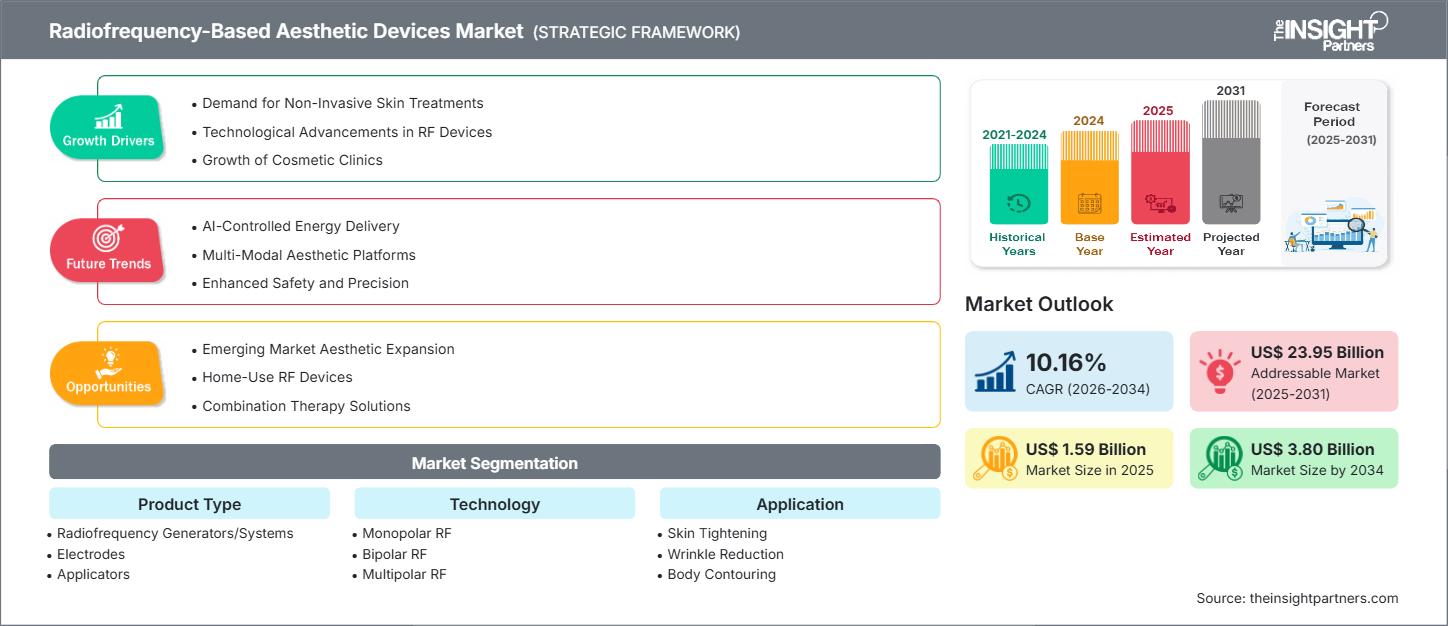
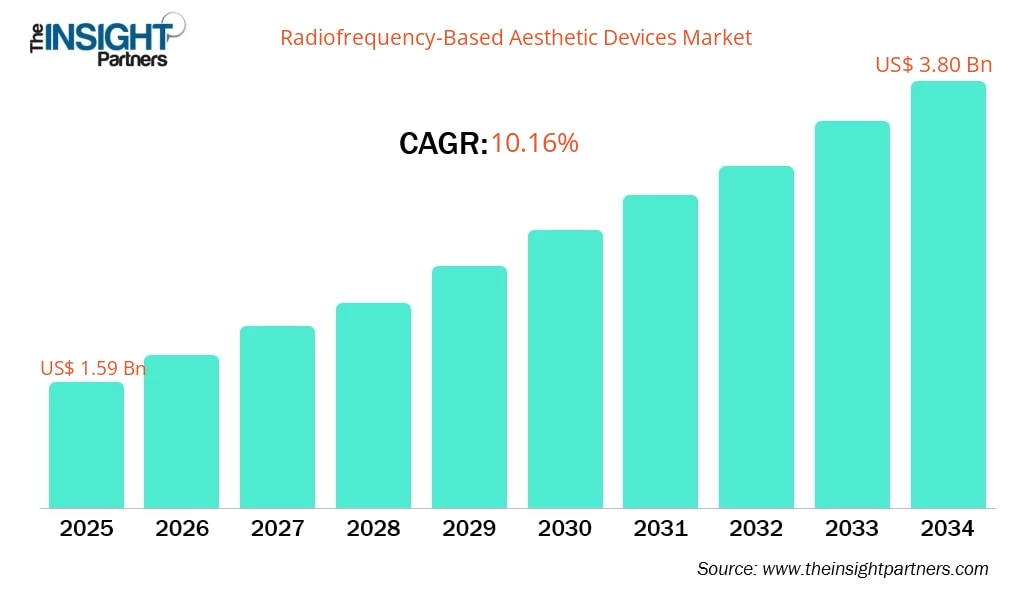
The radiofrequency-based aesthetic devices market size is expected to reach USD 3.80 billion by 2034 from USD 1.59 billion in 2025, growing at a CAGR of 10.16% during the forecast period 2026–2034.
Radiofrequency-Based Aesthetic Devices Market Analysis
The market is expanding rapidly due to mounting Demand for non-invasive cosmetic treatments, growing awareness of skin rejuvenation, and advancements in RF modalities. The convergence of AI and smart sensors in RF platforms is improving treatment accuracy and patient outcomes. Moreover, the increasing population of older people and growing disposable incomes are driving the implementation of aesthetic treatments across the world.
Radiofrequency-Based Aesthetic Devices Market Overview
Radiofrequency-based aesthetic devices use RF energy to heat the dermal layers and stimulate collagen production for better skin texture. These devices are applied for skin tightening, wrinkle decrease, body reshaping, as well as treatment for cellulite. The market contains both professional systems for clinics and handheld units for home application. RF technology is popular for its safety, reduced downtime, and ability to work with all types of skin.
Market Assessment and Insights
- Global market for Radiofrequency-Based Aesthetic Devices was valued at US$ 1.59 Billion in 2025
- Annual market size is expected to reach US$ 3.80 Billion by 2034
- Total addressable market (TAM) during 2026-2034 is projected to reach approximately US$ 23.95 Billion
- Market is anticipated to register a CAGR of 10.16% during the forecast period
- The United States represents a key market, supported by Demand for Non-Invasive Skin Treatments, Technological Advancements in RF Devices, Growth of Cosmetic Clinics, as well as evolving industry dynamics
- Market analysis covers North America, Europe, Asia-Pacific, South and Central America, Middle East and Africa, with growth evaluated across the forecast period
- Market opportunities such as Emerging Market Aesthetic Expansion, Home-Use RF Devices, Combination Therapy Solutions are expected to influence market dynamics and addressable market
- Report profiles industry participants, including Cutera?United States, ?Alma Lasers?Israel, ?Lumenis?Israel, ?Cynosure?United States, ?Venus Concept?Canada, ?BTL Aesthetics?Czech Republic, ?InMode?Israel, ?Solta Medical?United States, ?Lutronic?South Korea, while analyzing competitive strategies and innovation developments
-
Source: The Insight Partners' analysis based on proprietary research, government publications, company annual reports, investor presentations, industry databases, and expert interviews.
● REPORT CUSTOMIZATION
Tailor This Report To Align With Your Specific Business Requirements
This report can be customized to align precisely with your business objectives, scope, and target markets. Customization options include tailored segmentation, geography, competitive analysis, and strategic insights to support informed decision-making.
Customize This Report →WHAT YOU CAN ADJUST
- ● Segmentations
- ● Geography
- ● Competitive Analysis
- ● Language Preferences
Radiofrequency-Based Aesthetic Devices Market: Strategic Insights
-
Get Top Key Market Trends of this report.This FREE sample will include data analysis, ranging from market trends to estimates and forecasts.
Radiofrequency-Based Aesthetic Devices Market Drivers and Opportunities
Market Drivers:
- Increased Demand for Non-Surgical Treatments: People want treatments that do not require much recovery time and have less risk.
- Technological Developments: Advances in fractional RF, hybrid RF-laser technology, and AI-based protocols are enhancing effectiveness and safety.
- Aging Population: Increasing numbers of middle-aged and older populations across the world are growing Demand for anti-aging solutions.
- Increasing Aesthetic Consciousness: Social media popularity and beauty fashion are fueling Demand for cosmetic augmentation.
Market Opportunities:
- Growth in Developing Markets: Asia-Pacific and Latin America provide high growth prospects based on increasing incomes and aesthetic sensitivity.
- Home-Use Devices: Growing consumer demand for home treatments offers market opportunities for smaller, easy-to-use RF devices.
- Integration with IoT and AI: Personalized treatment protocols and real-time monitoring of smart RF systems are becoming increasingly popular.
Radiofrequency-Based Aesthetic Devices Market Report Segmentation Analysis
The radiofrequency-based aesthetic devices market share is analyzed across various segments to provide a clearer understanding of its structure, growth potential, and emerging trends. Below is the standard segmentation approach used in most industry reports:
By Product Type:
- Radiofrequency Generators/Systems: These are the primary generators of RF energy utilized in aesthetic treatments. They have different outputs of power, frequency ranges, and compatibility with various applicators, to make it possible to have customized procedures for skin tightening, contouring, and rejuvenation.
- Electrodes: Electrodes are the critical elements that provide RF energy to the skin. They are designed in different shapes and configurations for precise targeting of specific treatment areas and depths, thus providing accuracy and safety.
- Applicators: Applicators are tools or handpieces that are mounted on RF systems specifically for certain applications, like facial rejuvenation, body contouring, or reduction of cellulite. They affect the comfort and efficacy of treatment.
- Cartridges: Cartridges are disposable units applied within RF devices that typically involve specialized electrodes or sensors. They facilitate uniform delivery of energy and are designed for various skin types and treatment objectives.
- Accessories: These are systems of cooling, gels, and other support devices that facilitate better RF treatment results as well as patient comfort.
By Technology:
- Monopolar RF: Monopolar RF technology delivers energy from a single electrode to a grounding pad, penetrating deeper layers of the skin. It is widely used for body contouring and deep tissue tightening.
- Bipolar RF: Bipolar RF uses two electrodes to deliver energy between them, targeting superficial layers. It is preferred for facial treatments and wrinkle reduction due to its controlled depth and safety.
- Multipolar RF: Multipolar RF utilizes more than one electrode at the same time to deliver energy uniformly. It provides better coverage and is suited for covering extensive areas.
- Fractional RF: Fractional RF provides energy in a grid-like fashion to create micro-injuries that cause stimulation of collagen production with the preservation of surrounding tissue. It best suits skin resurfacing and the treatment of scars.
- Hybrid RF: Hybrid RF combines RF with other modalities, such as laser or ultrasound, to enhance treatment outcomes. These systems offer multi-layered rejuvenation and improved versatility.
By Application:
- Skin Tightening: RF energy stimulates collagen and elastin production, leading to firmer, more youthful skin. It is commonly used on the face, neck, and abdomen.
- Wrinkle Reduction: RF treatments smooth fine lines and wrinkles by improving skin elasticity and texture, offering a non-invasive alternative to injectables.
- Body Contouring: RF devices simultaneously target fat cells and constrict the skin, allowing for the reshaping of regions such as the thighs, arms, and waist.
- Cellulite Reduction: RF energy improves circulation and breaks down fat deposits, reducing the appearance of cellulite and enhancing skin smoothness.
By End User:
- Dermatology Clinics: Professional-grade RF systems are widely used in dermatology clinics for advanced aesthetic treatments, offering high precision and safety.
- Beauty Centers: Beauty centers implement RF devices for cosmetic treatments like skin rejuvenation and body sculpting for use across a wide consumer market.
- Hospitals: Hospitals integrate RF technology into dermatology and plastic surgery departments for comprehensive aesthetic care.
- Home Users: Portable RF devices designed for personal use are gaining popularity among consumers seeking convenient and cost-effective skincare solutions.
By Geography:
- North America
- Europe
- Asia Pacific
- Latin America
- Middle East & Africa
Radiofrequency-Based Aesthetic Devices Market Report Scope
| Report Attribute | Details |
|---|---|
| Market size in 2025 | US$ 1.59 Billion |
| Market Size by 2034 | US$ 3.80 Billion |
| Global CAGR (2026 - 2034) | 10.16% |
| Historical Data | 2021-2024 |
| Forecast period | 2026-2034 |
| Segments Covered |
By Product Type
|
| Regions and Countries Covered |
North America
|
| Market leaders and key company profiles |
|
Radiofrequency-Based Aesthetic Devices Market Players Density: Understanding Its Impact on Business Dynamics
The Radiofrequency-Based Aesthetic Devices Market is growing rapidly, driven by increasing end-user demand due to factors such as evolving consumer preferences, technological advancements, and greater awareness of the product's benefits. As demand rises, businesses are expanding their offerings, innovating to meet consumer needs, and capitalizing on emerging trends, which further fuels market growth.
Radiofrequency-Based Aesthetic Devices Market Share Analysis by Geography
Asia Pacific is expected to grow fastest in the coming years. Emerging markets in Latin America, the Middle East, and Africa also have many untapped opportunities for radiofrequency-based aesthetic device providers to expand.
The radiofrequency-based aesthetic devices market shows a different growth trajectory in each region due to factors such as healthcare infrastructure, regulatory environment, aesthetic awareness, and disposable income levels. Below is a summary of market share and trends by region:
1. North America
- Market Share: Holds the largest market share due to high adoption of aesthetic procedures and advanced healthcare infrastructure.
- Key Drivers:
- Technological innovation in RF platforms
- High disposable income and consumer spending on cosmetic treatments
- Strong Presence of key players and clinical expertise
- Trends: Increasing use of fractional RF and hybrid RF-laser systems for skin rejuvenation and body contouring.
2. Europe
- Market Share: Significant share driven by regulatory support and consumer awareness.
- Key Drivers:
- Demand for non-invasive treatments
- Presence of leading RF device manufacturers
- Growing preference for personalized skincare solutions
- Trends: Growth in home-use RF devices and integration of AI for customized treatment protocols.
3. Asia Pacific
- Market Share: Fastest-growing region owing to the expanding middle class and medical tourism.
- Key Drivers:
- Rising aesthetic awareness among younger demographics
- Government-supported healthcare investments
- Rapid urbanization and increasing access to dermatology services
- Trends: Adoption of portable and multifunctional RF devices for both clinical and personal use.
4. Latin America
- Market Share: Emerging market with growing Demand for aesthetic procedures.
- Key Drivers:
- Urbanization and rising disposable income
- Expansion of private aesthetic clinics
- Influence of beauty culture and social media
- Trends: Preference for cost-effective and minimally invasive RF treatments, especially in Brazil and Mexico.
5. Middle East and Africa
- Market Share: Developing market with strong growth potential due to rising healthcare investments.
- Key Drivers:
- Healthcare infrastructure expansion
- Increasing Demand for cosmetic dermatology
- Growing interest in anti-aging and skin-tightening solutions
- Trends: Adoption of advanced RF dermatology devices in integrated care models, including luxury wellness centers and aesthetic hospitals.
Radiofrequency-Based Aesthetic Devices Market Players Density: Understanding Its Impact on Business Dynamics
High Market Density and Competition
Competition is intensifying due to the Presence of major vendors such as Cutera, Alma Lasers, Lumenis, Cynosure, Venus Concept, BTL Aesthetics, InMode, Solta Medical, and Lutronic. Regional and niche players also contribute to the crowded market landscape.
This competitive environment pushes vendors to differentiate through:
- Integration of RF with other modalities like laser and ultrasound
- Development of AI-powered RF platforms for personalized treatments
- Expansion into home-use RF devices for consumer convenience
- Strategic partnerships with clinics and distributors
Opportunities and Strategic Moves
- Invest in R&D to develop safer and more effective RF technologies
- Collaborate with dermatology clinics and aesthetic centers to expand market reach
- Leverage digital platforms for consumer education and product marketing
Major Companies operating in the Radiofrequency-Based Aesthetic Devices Market are:
- Cutera United States
- Alma Lasers Israel
- Lumenis Israel
- Cynosure United States
- Venus Concept Canada
- BTL Aesthetics Czech Republic
- InMode Israel
- Solta Medical United States
- Lutronic South Korea
Disclaimer: The companies listed above are not ranked in any particular order.
Radiofrequency-Based Aesthetic Devices Market News and Recent Developments
- Cutera Inc. initiates strategic restructuring to strengthen its financial foundation. Cutera Inc. announced a pre-packaged Chapter 11 restructuring plan to reduce its debt by nearly $400 million and raise $65 million in new capital from existing lenders. The company will continue to operate normally during the 60-day court-supervised process and expects to emerge as a private company backed by leading investment firms. Cutera reaffirmed its commitment to innovation and customer service, with continued support for its RF-based platforms such as Secret RF, truSculpt, and AviClear.
- Cynosure Lutronic introduces XERF™ RF System for structural skin tightening. In September 2025, Cynosure launched the XERF™ RF System, designed to deliver non-invasive structural skin tightening without needles or downtime. The system targets sagging skin and loss of firmness, offering a new solution for aging concerns.
Radiofrequency-Based Aesthetic Devices Market Report Coverage and Deliverables
The "Radiofrequency-Based Aesthetic Devices Market Size and Forecast (2026–2034)" report provides a detailed analysis of the market covering the following areas:
- Radiofrequency-Based Aesthetic Devices Market size and forecast at global, regional, and country levels for all the key market segments covered under the scope
- Radiofrequency-Based Aesthetic Devices Market trends, as well as market dynamics such as drivers, restraints, and key opportunities
- Detailed PEST and SWOT analysis
- Radiofrequency-Based Aesthetic Devices Market analysis covering key market trends, global and regional framework, major players, regulations, and recent market developments
- Industry landscape and competition analysis covering market concentration, heat map analysis, prominent players, and recent developments in the Radiofrequency-Based Aesthetic Devices Market
- Detailed company profiles
Frequently Asked Questions

- Comprehensive Market Sizing and Forecast Analysis
- Detailed Segmentation Analysis
- In-Depth Market Dynamics Assessment
- Regional and Country-Level Insights
- Competitive Landscape and Company Benchmarking
- Strategic Business Intelligence
Recent Reports
Testimonials

The Insight Partners' SCADA System Market report is comprehensive, with valuable insights on current trends and future forecasts. The team was highly professional, responsive, and supportive throughout. We are very satisfied and highly recommend their services.
RAN KEDEM Partner, Reali Technologies LTDs
I requested a report on a very specific software market and the team produced the report in a few days. The information was very relevant and well presented. I then requested some changes and additions to the report. The team was again very responsive and I got the final report in less than a week.
JEAN-HERVE JENN Chairman, Future Analytica
We worked with The Insight Partners for an important market study and forecast. They gave us clear insights into opportunities and risks, which helped shape our plans. Their research was easy to use and based on solid data. It helped us make smart, confident decisions. We highly recommend them.
PIYUSH NAGPAL Sr. Vice President, High Beam Global
The Insight Partners delivered insightful, well-structured market research with strong domain expertise. Their team was professional and responsive throughout. The user-friendly website made accessing industry reports seamless. We highly recommend them for reliable, high-quality research services
YUKIHIKO ADACHI CEO, Deep Blue, LLC.
This is the first time I have purchased a market report from The Insight Partners.While I was unsure at first, I visited their web site and felt more comfortable to take the risk and purchase a market report.I am completely satisfied with the quality of the report and customer service. I had several questions and comments with the initial report, but after a couple of dialogs over email with their analyst I believe I have a report that I can use as input to our strategic planning process.Thank you so much for taking the extra time and making this a positive experience.I will definitely recommend your service to others and you will be my first call when we need further market data.
JOHN SUZUKI President and Chief Executive Officer, Board Director, BK Technologies
I wish to appreciate your support and the professionalism you displayed in the course of attending to my request for information regarding to infectious disease IVD market in Nigeria. I appreciate your patience, your guidance, and the fact that you were willing to offer a discount, which eventually made it possible for us to close a deal. I look forward to engaging The Insight Partners in the future, all thanks to the impression you have created in me as a result of this first encounter.
DR CHIJIOKE ONYIA MANAGING DIRECTOR, PineCrest Healthcare Ltd.Reason to Buy
- Informed Decision-Making
- Understanding Market Dynamics
- Competitive Analysis
- Identifying Emerging Markets
- Customer Insights
- Market Forecasts
- Risk Mitigation
- Boosting Operational Efficiency
- Strategic Planning
- Investment Justification
- Tracking Industry Innovations
- Aligning with Regulatory Trends





 Get Free Sample for