
Railway Maintenance Machinery Market Demand, Trends & Forecast by 2034
Coverage: By Product Type (Tamping Machine, Stabilizing Machinery, Rail Handling Machinery, Ballast Cleaning Machine, Others); Application (Ballast Track, Non-ballast Track); Sales Market (New Sales, Aftermarket Sales) , and Geography (North America, Europe, Asia Pacific, and South and Central America)
- Status : Data Released
- Report Code : TIPRE00021540
- Category : Manufacturing and Construction
- No. of Pages : 150
- Available Report Formats :


- Last update date : September 02, 2026


2025 Market Size
US$ 6.05 Bn
Base year value
2034 Forecast
US$ 9.68 Bn
Projected by 2034
CAGR 2026-2034
5.37 %
Growth rate
Addressable Market
US$ 71.37 Bn
(2026-2034)
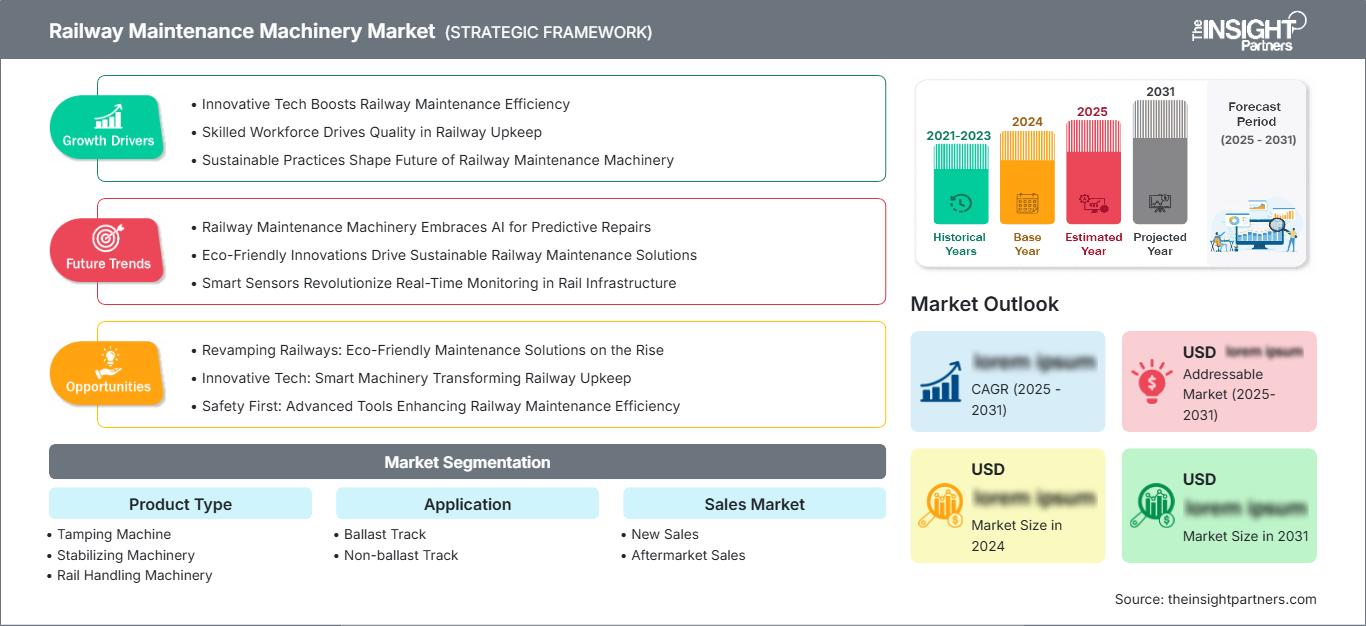
The railway maintenance machinery market is positioned for sustained expansion as railway operators prioritize track reliability, asset life extension, and maintenance productivity. The market is valued at US$ 6.05 Billion in 2025 and is projected to reach US$ 9.68 Billion by 2034, advancing at a CAGR of 5.37% from 2026 to 2034. Demand is supported by railway modernization, increasing traffic intensity, and continued deployment of mechanized maintenance systems.
North America is expected to maintain a substantial position, with the railway maintenance machinery market size supported by aging freight infrastructure, recurring track rehabilitation programs, and federal investment in passenger and freight rail. The region is estimated to expand at a 5.2–5.8% CAGR between 2026 and 2034, as operators increasingly prioritize mechanized tamping, ballast treatment, inspection efficiency, and reduced track possession time.
Railway Maintenance Machinery Market Assessment and Insights
- North America: The region is estimated to account for 23–26% share in 2025 and expand at a 5.2–5.8% CAGR between 2026 and 2034, supported by freight network maintenance, infrastructure renewal, and safety-oriented track programs.
- US: The US represents approximately 70–74% of North America's 2025 share and is projected to grow at a 5.3–5.7% CAGR between 2026 and 2034, supported by freight corridors and passenger rail modernization.
- Europe: Europe is estimated at 28–30% share in 2025, with a 4.3–4.8% CAGR between 2026 and 2034. Germany, France, the UK, Italy, and Spain remain important markets because of extensive rail networks and recurring track renewal requirements.
- Asia Pacific: Asia Pacific is estimated at 34–37% share in 2025 and is expected to register a 6.2–6.8% CAGR between 2026 and 2034, led by China, Japan, India, and South Korea through network expansion and modernization.
- Largest Segment: Tamping Machine is estimated to hold a 35–39% market share in 2025, with a 5.4–5.9% CAGR from 2026 to 2034, reflecting its essential role in restoring track geometry.
- High Growth Segment: Ballast Cleaning Machine is estimated at 17–21% share in 2025 and is projected to grow at a 6.0–6.6% CAGR from 2026 to 2034, driven by ballast recycling and drainage requirements.
- Key companies analyzed in detail: China Railway Construction Corporation Limited, China State Railway Group Co., Ltd., System 7 Rail, Railsupport GmbH, Harsco Corporation, MER MEC S.p.A., Geatech Group S.r.l., Plasser & Theurer Export von Bahnbaumaschinen Gesellschaft m.b.H., Sinara-Transport Machines Holding, Fluor Corporation, and Coril Holdings Ltd.
Source: The Insight Partners' analysis based on proprietary research, government publications, company annual reports, investor presentations, industry databases, and expert interviews.
The railway maintenance machinery market has evolved from predominantly mechanical track correction toward integrated equipment combining high-output tamping, stabilization, ballast processing, measurement, and digital monitoring. The modern machine tends to use more automation in terms of geometry measurement, computer-aided control systems, high speeds, and ergonomic improvements for the operators. The company of Plasser & Theurer has recorded the highest revenue in 2025 of €731 million with the order intake of €1 billion, which shows the demand for the equipment, along with delivery capability.
For the forecast period, investment will go into the machines that minimize possession time, enhance maintenance accuracy, and reduce operating requirements in the machine life cycle. The new railway lines in Asian, Middle Eastern, and selected Latin American markets will provide an opportunity for the equipment manufacturers, whereas established railway networks in Europe and North America will focus on replacement and upgrading of the existing machinery.
Railway Maintenance Machinery Market Report Scope
| Report Attribute | Details |
|---|---|
| Market size in 2025 | US$ 6.05 Billion |
| Market Size by 2034 | US$ 9.68 Billion |
| Global CAGR (2026 - 2034) | 5.37% |
| Historical Data | 2021-2024 |
| Forecast period | 2026-2034 |
Railway Maintenance Machinery Market Analysis
The railway maintenance machinery market growth is closely linked to the condition and utilization intensity of railway infrastructure. Demand originates from railway infrastructure owners, national operators, maintenance contractors, and specialized track service providers. The value chain includes machinery manufacturers, hydraulic and transmission manufacturers, sensor manufacturers, software providers, rail installation companies, and after-sales service companies. Tamping, stabilizing, ballast cleaning, and rail handling will continue to be of great importance in ensuring the proper alignment and sound structure of the railway.
Ballast track requires repetitive mechanized surfacing and ballast management because repeated weight application changes the alignment, level, and structure of the railway track. High-speed and highly utilized tracks will require more mechanization due to smaller tolerance levels and reduced possession time. Thus, railways are increasingly inclined towards machines that are able to combine measuring and maintenance functions, and the suppliers are working on such service packages.
Competitive positioning increasingly depends on equipment productivity, machine availability, digital control capabilities, and lifecycle support rather than equipment delivery alone. The railway maintenance machinery market analysis indicates that established manufacturers with broad machine portfolios can address multiple maintenance stages, while specialized companies compete through niche technology, engineering services, and regional customization. Plasser & Theurer, Harsco Corporation, MER MEC S.p.A., and Geatech Group S.r.l. occupy differentiated positions across machinery, inspection, grinding, and maintenance-related technologies.
China Railway Construction Corporation Limited and China State Railway Group Co., Ltd. benefit from the scale of China's railway ecosystem, while Sinara-Transport Machines Holding serves specialized railway equipment requirements in its operating markets. Companies such as Railsupport GmbH, System 7 Rail, and Coril Holdings Ltd. provide more focused capabilities. Investment is increasingly directed toward automation, predictive diagnostics, machine utilization, and aftermarket services, creating opportunities for suppliers able to demonstrate measurable reductions in maintenance time and operating costs, as highlighted in the Railway Maintenance Machinery Market Report.
● REPORT CUSTOMIZATION
Tailor This Report To Align With Your Specific Business Requirements
This report can be customized to align precisely with your business objectives, scope, and target markets. Customization options include tailored segmentation, geography, competitive analysis, and strategic insights to support informed decision-making.
Customize This Report →WHAT YOU CAN ADJUST
- ● Segmentations
- ● Geography
- ● Competitive Analysis
- ● Language Preferences
Railway Maintenance Machinery Market: Strategic Insights
Regional Insights
North America Railway Maintenance Machinery Market
North America is estimated to represent 23–26% of the Railway Maintenance Machinery Market share in 2025, with the regional market projected to expand at a 5.2–5.8% CAGR from 2026 to 2034. The US has regional dominance with respect to demand, driven by freight network corridors, old infrastructure track assets, passenger railways, and the periodic need for geometry correction machinery. The contributions from Canada include the renewal and maintenance of freight network assets that cater to industrial corridors.
Machine productivity, reliability, and low possession periods are becoming more significant within the regional procurement landscape. The railway companies and contractors have begun using high-capacity tamping and stabilization, ballast cleaning, and measurement machines in situations where maintenance periods are limited by heavy train traffic. This, along with infrastructure spending and investment by the federal government, as well as passenger railways, will keep up demand for replacement.
U.S. Railway Maintenance Machinery Market
The U.S. accounts for approximately 70–74% of North America's 2025 Railway Maintenance Machinery Market share and is projected to expand at a 5.3–5.7% CAGR from 2026 to 2034. The demand will be driven by freight railroads, passenger lines, and major infrastructure projects, which require track maintenance through mechanical means.
There are advantages due to the level of activity in freight railways and a focus on track safety and capacity. Suppliers such as Harsco Corporation cater to the infrastructure contractors as well as railroad companies and there is the use of more sophisticated tamping, ballasting, rail inspection, and measurement techniques as a result of increased maintenance schedules.
Europe Railway Maintenance Machinery Market
Europe is estimated to hold 28–30% share of the Railway Maintenance Machinery Market in 2025, with a projected 4.3–4.8% CAGR from 2026 to 2034. Germany continues to be one of the dominant markets in terms of railway, followed by the UK, France, Italy, and Spain, wherein existing traditional, high-speed, freight, and metro railways are in need of routine maintenance through the use of machinery.
The UK relies on the need for rail renewal and investments in resilient networks, Germany relies on its huge rail infrastructure base and modernization efforts, whereas France sustains its demand in terms of maintenance of high-speed and traditional networks. Italy and Spain need special machinery for maintenance of their mixed railway operations, which include high-speed corridors.
APAC Railway Maintenance Machinery Market
APAC is estimated to account for 34–37% share of the Railway Maintenance Machinery Market in 2025 and is projected to grow at a 6.2–6.8% CAGR from 2026 to 2034, making it the leading regional market. China remains dominant, while Japan, South Korea, India, and Australia contribute substantial equipment demand.
China's extensive railway network supports large-scale maintenance requirements, while India is expanding and modernizing its rail infrastructure. Japan and South Korea emphasize precision and reliability across mature networks, whereas Australia has strong freight-oriented maintenance requirements. Industrial expansion, network electrification, high-speed rail investment, and government infrastructure programs are expected to sustain equipment procurement.
Middle East & Africa Railway Maintenance Machinery Market
The Middle East and Africa Railway Maintenance Machinery Market represents a smaller but developing opportunity, with regional demand supported by railway construction, freight corridors, mining logistics, and urban transport investment. Saudi Arabia and the UAE are leading Gulf markets, while South Africa remains important for freight and mineral transportation.
The region is projected to expand at approximately 4.8–5.4% CAGR from 2026 to 2034. Saudi Arabia leads emerging investment, supported by infrastructure diversification and transport development. The UAE continues railway expansion, while South Africa requires equipment for freight-network rehabilitation. Rest-of-MEA demand is linked to mining, ports, cross-border corridors, and new railway construction.
Segmentation Analysis
Product Type
Product Type remains central to procurement decisions because each machine addresses a distinct stage of track maintenance. The segment is projected to expand at a 5.1–5.7% CAGR from 2026 to 2034, according to the Railway Maintenance Machinery Market Forecast. Tamping machines remain essential for geometry correction, while stabilizing and ballast-cleaning systems support structural performance. Rail-handling machinery serves installation, renewal, and replacement activities, creating demand across both mature and expanding networks.
- Tamping Machine: Tamping equipment maintains track geometry by repositioning ballast beneath sleepers. High utilization on heavily trafficked routes supports recurring replacement demand and encourages automation, measurement integration, and higher productivity.
- Stabilizing Machinery: Dynamic stabilization equipment improves ballast consolidation following tamping operations. Its strategic importance increases on routes where immediate traffic reopening requires predictable track settlement and improved post-maintenance stability.
- Rail Handling Machinery: Rail handling equipment supports rail replacement, installation, loading, and positioning. Demand follows track renewal programs and is particularly relevant where contractors seek faster material handling with lower manual intervention.
- Ballast Cleaning Machine: Ballast cleaning systems remove fouled material and restore drainage and support characteristics. Their strategic role is increasing as infrastructure owners prioritize lifecycle extension instead of complete track-bed replacement.
Application
Application demand is influenced by track structure, traffic intensity, axle loading, maintenance standards, and permissible possession periods. The segment is projected to grow at a 5.3–5.9% CAGR from 2026 to 2034. Ballast Track represents the principal equipment base because tamping, stabilization, and ballast treatment are fundamental to maintaining conventional railway infrastructure.
- Ballast Track: Ballasted infrastructure requires regular geometry correction, consolidation, and ballast conditioning. Extensive conventional freight and passenger networks therefore, sustain demand for tamping, stabilizing, and cleaning machinery.
- Non-ballast Track: Non-ballast systems require specialized maintenance approaches focused on slab condition, alignment, fastening systems, and precision inspection. Adoption is associated particularly with high-speed and urban rail infrastructure.
Sales Market
Sales Market dynamics reflect the maturity of railway networks and the availability of specialized maintenance contractors. The segment is expected to grow at a 4.9–5.6% CAGR from 2026 to 2034, reflecting key Railway Maintenance Machinery Market Trends. New Sales are supported by network expansion and fleet modernization, while Aftermarket Sales benefit from recurring servicing, component replacement, refurbishment, and machine-life extension.
- New Sales: New machinery purchases are driven by railway expansion, fleet modernization, productivity requirements, and replacement of technologically obsolete equipment. Automated functions and digital measurement capabilities strengthen procurement consideration.
- Aftermarket Sales: Aftermarket activity includes spare parts, maintenance, refurbishment, upgrades, and technical services. Recurring requirements create a stable revenue stream as operators seek to extend machinery operating life and improve fleet availability.
Opportunity Snapshot
| Application | Revenue Contribution (High/Medium/Low) | Trend Tag | Adoption Stage |
| Ballast Track | High | Geometry Correction | Mature |
| Non-ballast Track | Medium | Slab Maintenance | Scaling |
Railway Maintenance Machinery Market Growth Drivers and Impact Analysis
Rail Network Expansion and Capacity Enhancement
The development of the network of passenger, freight, metro, and high-speed rail will increase the number of installations that need mechanized maintenance. The building of new railway lines will generate demand for railway machinery used in construction and maintenance operations. Traffic expansion will lead to demand for geometry correction, railway stabilization, ballasting, and railway inspection. Countries such as China, India, Saudi Arabia, and European nations are making efforts to increase their railway capacity, providing chances for machinery companies that will be able to provide services of construction and maintenance. The effect is not limited only to the sale of machines, but there is also demand for spare parts, maintenance, training of personnel, etc., and this allows the equipment companies to create service infrastructure in regions where railway lines are developed.
Higher Railway Traffic Intensity and Asset Utilization
Frequent use of trains and increased loads on axles lead to faster degradation of rail geometry and ballast state, which increases the need for frequent and advanced maintenance. Freight routes are especially vulnerable to heavy loading, which may cause increased settlements and alignment issues as well as ballast contamination. For passenger and high-speed railroads, it becomes even more critical to maintain proper geometric tolerances due to safety and quality-of-ride considerations. This means that there is an increasing need for equipment capable of executing the required maintenance in a timely manner without compromising the accuracy of measurements. Consequently, the effect is a move from procurement of simple equipment to highly productive machines that feature automated control and diagnostics systems. Such suppliers will find themselves in better competitive standing through shorter working cycles, better machine availability and maintenance quality.
Mechanization of Labor-Intensive Maintenance Activities
Traditionally, railway maintenance has been highly labor-intensive, especially in relation to material handling, ballast modification, testing, and small-scale track adjustments. Shortage of skilled labor, safety considerations, and the need to minimize time spent on track occupation are pushing towards increased mechanization. Automation of tamping, stabilization, rail handling, and measurement systems could result in fewer laborers needed for repetitive tasks, as well as improved process consistency. The effect is especially important in mature markets, where railway companies have to deal with expensive labor and strict possession limitations. Machinery could help standardize maintenance processes within large geographically dispersed networks, ensuring process repeatability. This market demand can be addressed by building control systems, sensors, diagnostics capabilities, and operator assistance features into machinery. Eventually, the focus on productivity will lead to the choice of equipment providing lifecycle cost savings, not only lower purchase prices.
Railway Maintenance Machinery Market Future Trends
Digital Track Geometry and Condition Intelligence
It seems that digitalization will change the selection of machinery by integrating track measurements, maintenance operations, and assets' records. The future equipment platforms are likely to integrate machine-mounted sensors, automatic geometry detection, a location system, and maintenance records connected to the cloud infrastructure. This platform can help railway companies see how the state of the track changes after each maintenance operation and detect the patterns of deterioration. Then predictive analytics could be used to organize maintenance operations not on schedule but according to the state of the assets. From the viewpoint of machinery manufacturers, software will become an additional competitive advantage along with mechanical performance. It will also be important for data interoperability as railway companies control equipment provided by different suppliers and should have uniform data about their assets.
Low-Emission and Energy-Efficient Maintenance Fleets
Environmental requirements are likely to influence the next generation of maintenance machinery, particularly in densely populated areas and rail systems with explicit decarbonization targets. Manufacturers can pursue lower fuel consumption through efficient hydraulic systems, optimized power management, regenerative technologies, and alternative powertrains where operating conditions permit. Battery-electric or hybrid auxiliary systems may initially appear in selected functions rather than replacing large diesel power units completely. Noise reduction will also become relevant for night maintenance near residential areas. Procurement decisions may therefore increasingly incorporate energy consumption, emissions, acoustic performance, and serviceability alongside conventional productivity metrics. This transition creates opportunities for component suppliers and machinery manufacturers with expertise in electrification, power electronics, energy storage, and thermal management. Adoption will vary according to machine size, duty cycle, infrastructure availability, and local regulatory requirements.
Railway Maintenance Machinery Market Opportunities
Regional Service and Refurbishment Platforms
A significant opportunity exists in establishing regional service centers that combine spare-parts inventories, diagnostics, refurbishment, operator training, and field engineering. Railway machinery often operates for extended periods, making lifecycle support an important procurement consideration. Suppliers can increase customer retention by locating service capabilities near major rail corridors and offering planned refurbishment packages before equipment reaches critical downtime thresholds. Such platforms can also support older machinery through control-system upgrades, sensor replacement, hydraulic refurbishment, and productivity enhancements. The railway maintenance machinery forecasts indicate that aftermarket-oriented business models can become increasingly important as operators seek to maximize existing fleet utilization while controlling capital expenditure. Manufacturers that combine original equipment expertise with localized service capacity can create recurring revenue streams and reduce customer dependence on multiple independent maintenance providers.
Specialized Machinery for Emerging Rail Corridors
Emerging railway corridors in Asia, the Middle East, Africa, and selected Latin American markets offer opportunities for suppliers that tailor machinery packages to specific infrastructure conditions. New networks may require equipment capable of supporting commissioning, early-stage maintenance, and subsequent operational servicing. Suppliers can differentiate through modular machine configurations, regional training programs, multilingual technical documentation, and flexible financing structures. Local partnerships with contractors and railway maintenance organizations can accelerate market access while providing knowledge of track standards, climate conditions, and operating practices. The opportunity is not limited to new machinery because newly commissioned networks will generate recurring requirements for spare parts, refurbishment, calibration, and technical support. Companies that establish a local ecosystem early can develop stronger customer relationships and improve their ability to participate in future network expansion programs.
Frequently Asked Questions

- Comprehensive Market Sizing and Forecast Analysis
- Detailed Segmentation Analysis
- In-Depth Market Dynamics Assessment
- Regional and Country-Level Insights
- Competitive Landscape and Company Benchmarking
- Strategic Business Intelligence
Recent Reports
Testimonials

The Insight Partners' SCADA System Market report is comprehensive, with valuable insights on current trends and future forecasts. The team was highly professional, responsive, and supportive throughout. We are very satisfied and highly recommend their services.
RAN KEDEM Partner, Reali Technologies LTDs
I requested a report on a very specific software market and the team produced the report in a few days. The information was very relevant and well presented. I then requested some changes and additions to the report. The team was again very responsive and I got the final report in less than a week.
JEAN-HERVE JENN Chairman, Future Analytica
We worked with The Insight Partners for an important market study and forecast. They gave us clear insights into opportunities and risks, which helped shape our plans. Their research was easy to use and based on solid data. It helped us make smart, confident decisions. We highly recommend them.
PIYUSH NAGPAL Sr. Vice President, High Beam Global
The Insight Partners delivered insightful, well-structured market research with strong domain expertise. Their team was professional and responsive throughout. The user-friendly website made accessing industry reports seamless. We highly recommend them for reliable, high-quality research services
YUKIHIKO ADACHI CEO, Deep Blue, LLC.
This is the first time I have purchased a market report from The Insight Partners.While I was unsure at first, I visited their web site and felt more comfortable to take the risk and purchase a market report.I am completely satisfied with the quality of the report and customer service. I had several questions and comments with the initial report, but after a couple of dialogs over email with their analyst I believe I have a report that I can use as input to our strategic planning process.Thank you so much for taking the extra time and making this a positive experience.I will definitely recommend your service to others and you will be my first call when we need further market data.
JOHN SUZUKI President and Chief Executive Officer, Board Director, BK Technologies
I wish to appreciate your support and the professionalism you displayed in the course of attending to my request for information regarding to infectious disease IVD market in Nigeria. I appreciate your patience, your guidance, and the fact that you were willing to offer a discount, which eventually made it possible for us to close a deal. I look forward to engaging The Insight Partners in the future, all thanks to the impression you have created in me as a result of this first encounter.
DR CHIJIOKE ONYIA MANAGING DIRECTOR, PineCrest Healthcare Ltd.Reason to Buy
- Informed Decision-Making
- Understanding Market Dynamics
- Competitive Analysis
- Identifying Emerging Markets
- Customer Insights
- Market Forecasts
- Risk Mitigation
- Boosting Operational Efficiency
- Strategic Planning
- Investment Justification
- Tracking Industry Innovations
- Aligning with Regulatory Trends





 Get Free Sample for