
Reciprocating Air Compressor Market Growth, Share & Trends by 2034
Coverage: By Product (Portable, Stationary); Type (Single-acting, Double-acting); End-user (Oil and Gas, Food and Beverage, Manufacturing, Healthcare, Mining, Energy, Others) , and Geography (North America, Europe, Asia Pacific, and South and Central America)
- Status : Data Released
- Report Code : TIPRE00013830
- Category : Manufacturing and Construction
- No. of Pages : 150
- Available Report Formats :


- Last update date : September 02, 2026


2025 Market Size
US$ 6.05 Bn
Base year value
2034 Forecast
US$ 8.37 Bn
Projected by 2034
CAGR 2026-2034
3.67 %
Growth rate
Addressable Market
US$ 65.49 Bn
(2026-2034)
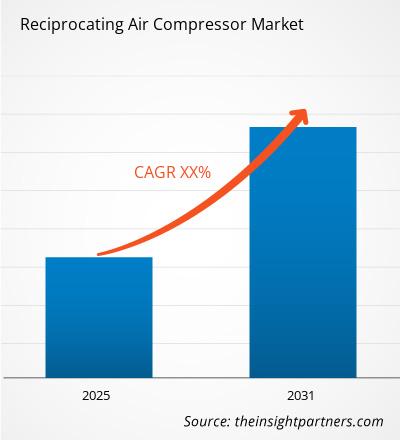
The reciprocating air compressor market is projected to grow from US$ 6.05 Billion in 2025 to US$ 8.37 Billion by 2034, registering a CAGR of 3.67% during 2026–2034. Demand is supported by continued use of piston-based compression in manufacturing, oil and gas, food and beverage, healthcare, mining, and energy applications that require durable pressure delivery and reliable compressed air supply.
North America remains a significant contributor to reciprocating air compressor market size because of mature manufacturing capacity, shale-related service demand, food processing investment, and replacement of aging compressed air systems. The region is expected to grow at a CAGR of 3.1–3.7% during 2026–2034 as buyers prioritize reliability, service availability, and lifecycle efficiency in small, medium, and heavy-duty air compression installations.
Reciprocating Air Compressor Market Assessment and Insights
- North America: North America is estimated to hold 24–28% share in 2025 and grow at a CAGR of 3.1–3.7% between 2026–2034, led by manufacturing upgrades, oilfield services, food processing, and maintenance demand.
- US: The US is estimated to contribute 78–84% of North American demand in 2025 and grow at a CAGR of 3.2–3.8% during 2026–2034.
- Europe: Europe is estimated to hold 20–24% share in 2025 and grow at a CAGR of 2.8–3.4%, led by Germany, the UK, France, Italy, and Spain.
- Asia Pacific: Asia Pacific is estimated to hold 36–40% share in 2025 and grow at a CAGR of 4.1–4.8%, driven by China, India, Japan, South Korea, and Australia.
- Largest Segment: Stationary compressors are estimated to hold 62–66% share in 2025 and grow at a CAGR of 3.3–3.9%, supported by plant air systems and continuous industrial operations.
- High Growth Segment: Healthcare is estimated to hold 7–10% share in 2025 and grow at a CAGR of 4.5–5.2%, supported by medical air, laboratory, and pharmaceutical production needs.
- Key companies analyzed in detail: Atlas Copco AB, BelAire Compressor, ELGi Equipments Limited, Emerson Electric Co., Hertz Kompressoren GmbH, Ingersoll Rand Inc., KAESER KOMPRESSOREN SE, Kirloskar Pneumatic Company Limited, Kobe Steel, Ltd., and Sullair, LLC.
Source: The Insight Partners' analysis based on proprietary research, government publications, company annual reports, investor presentations, industry databases, and expert interviews.
Technology evolution is centered on lower vibration, improved cooling, oil-free configurations, direct-drive designs, better controls, and easier maintenance access. The reciprocating air compressor market has matured from basic workshop machines into application-specific systems serving duty cycles from portable service work to stationary plant air. The production process is becoming more dependent on standardizing packages, local service networks, and component design, which ensures lower downtime without pushing users into expensive compression systems.
The demand for the future will lie in emerging industrial zones, healthcare manufacturing centers, and energy infrastructure projects which require compressed air at high pressures or intermittently. Funding is being made available for predictive maintenance, digital controls, and efficient motor systems. Environmental legislation on workplace safety, energy use, and air pollution will push old compressors to be replaced.
Reciprocating Air Compressor Market Report Scope
| Report Attribute | Details |
|---|---|
| Market size in 2025 | US$ 6.05 Billion |
| Market Size by 2034 | US$ 8.37 Billion |
| Global CAGR (2026 - 2034) | 3.67% |
| Historical Data | 2021-2024 |
| Forecast period | 2026-2034 |
Reciprocating Air Compressor Market Analysis
The reciprocating air compressor market growth is supported by demand for dependable compressed air in production lines, workshops, laboratories, food plants, field service units, and energy facilities. The purchaser’s preference for reciprocating compressors includes cases where pressure is high, flow is low or moderate, intermittent use is desired, and initial investment is important compared to continuous high-volume production. The value chain encompasses compressor manufacturers, motor providers, valve and piston component providers, distributors, renting companies, service companies, and end-user industries.
Supply is still driven by machining capability, steel and motor prices, distribution capabilities, and aftermarket services. Portable reciprocating compressors cater to construction, maintenance, and field repairs, whereas stationary compressors are used in plant utilities and process air. Lubricated reciprocating compressors enjoy a pricing advantage in normal industry operations but are increasingly being questioned in applications such as food processing, beverages, pharmaceutical, medical and laboratory industries due to clean air issues.
reciprocating air compressor market analysis shows a competitive landscape divided between global compressor groups and regional specialists with strong dealer networks. Atlas Copco AB, Ingersoll Rand Inc., ELGi Equipments Limited, KAESER KOMPRESSOREN SE, Sullair, LLC, Hertz Kompressoren GmbH, Kobe Steel, Ltd., Kirloskar Pneumatic Company Limited, Emerson Electric Co., and BelAire Compressor compete through efficiency, reliability, service response, package breadth, and application engineering.
Investment trends favor product portfolios that combine rugged compressors with monitoring, preventive service, and energy audits. Large vendors strengthen positions through acquisitions and regional service expansion, while specialists compete on price, availability, and fit-for-purpose equipment. Strategic differentiation increasingly depends on lifecycle cost, spare-part access, warranty confidence, distributor training, and the ability to support both replacement demand and new industrial projects.
● REPORT CUSTOMIZATION
Tailor This Report To Align With Your Specific Business Requirements
This report can be customized to align precisely with your business objectives, scope, and target markets. Customization options include tailored segmentation, geography, competitive analysis, and strategic insights to support informed decision-making.
Customize This Report →WHAT YOU CAN ADJUST
- ● Segmentations
- ● Geography
- ● Competitive Analysis
- ● Language Preferences
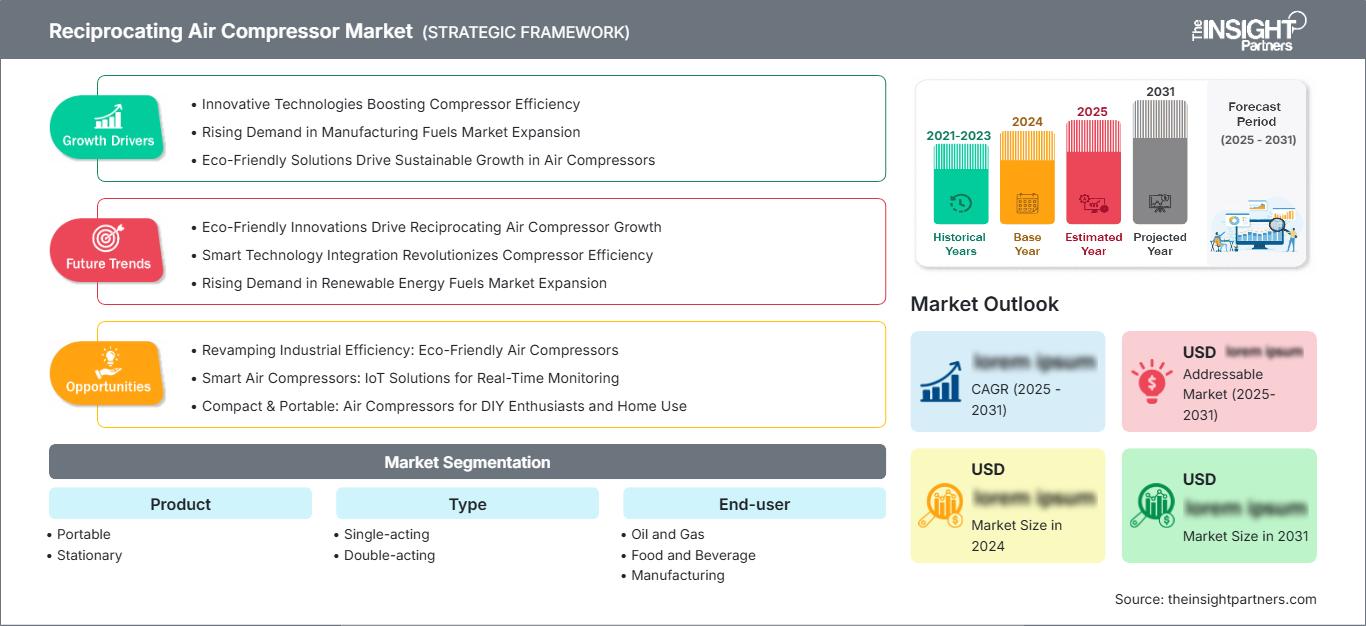
Reciprocating Air Compressor Market: Strategic Insights
Regional Insights
North America reciprocating air compressor market
North America is estimated to account for 24–28% reciprocating air compressor market share in 2025 and grow at a CAGR of 3.1–3.7% during 2026–2034. Demand is driven by manufacturing maintenance, automobile repairs, oil field services, food processing, utilities, and light industrial users requiring consistent compressed air at prices lower than those charged for larger, more expensive rotary systems.
The replacement demand is significant due to the high life expectancy of the existing compressor and being upgraded on the basis of increasing cost of energy, leaks and downtime. The distributors and service network play an important role in procurement decisions, particularly for smaller customers. Cost of ownership, rather than initial cost, has become an important consideration.
U.S. reciprocating air compressor Market
The U.S. is estimated to represent 78–84% of North American demand in 2025 and grow at a CAGR of 3.2–3.8% through 2034. Demand comes from machine shops, automotive service, food plants, oil and gas support, laboratories, and general manufacturing facilities that require dependable intermittent compression.
Company presence is strong because Atlas Copco AB, Ingersoll Rand Inc., Sullair, LLC, BelAire Compressor, and KAESER KOMPRESSOREN SE operate through broad sales and service channels. Application trends include two-stage shop air, portable service compressors, oil-free medical and laboratory air, and retrofit programs that replace aging piston units with better controls and lower-maintenance packages.
Europe reciprocating air compressor Market
Europe is estimated to hold 20–24% share in 2025 and grow at a CAGR of 2.8–3.4% during 2026–2034. Germany leads demand through machinery, automotive, chemicals, and manufacturing clusters that rely on efficient compressed air systems. The UK adds replacement demand from service industries, food processing, and workshops.
France, Italy, and Spain support demand through packaging, healthcare, specialty manufacturing, and agricultural processing. European buyers emphasize energy efficiency, quieter operation, workplace safety, and documented service performance. Compact stationary units, oil-free options, and digitally monitored packages are gaining attention as industrial operators align compressed air systems with sustainability and maintenance productivity goals.
APAC reciprocating air compressor Market
Asia Pacific is estimated to hold 36–40% share in 2025 and grow at a CAGR of 4.1–4.8% from 2026–2034. China leads regional demand due to manufacturing scale, infrastructure equipment production, and industrial maintenance activity.
India, Japan, South Korea, and Australia add demand through factories, mining support, healthcare production, and food processing. Industrialization, small enterprise growth, and expanding distributor networks support the adoption of both portable and stationary units. Cost sensitivity remains high, but users increasingly value reliability, energy savings, and after-sales service.
Middle East & Africa reciprocating air compressor Market
The Middle East and Africa reciprocating air compressor market is estimated to grow at a CAGR of 3.4–4.0% during 2026–2034. Saudi Arabia and the UAE lead adoption through oil and gas services, construction, utilities, and manufacturing diversification.
South Africa adds demand from mining, workshops, food processing, and maintenance services, while the Rest of MEA growth is linked to infrastructure and energy projects. Harsh operating conditions favor rugged units, reliable cooling, simple maintenance, and local service availability that can reduce downtime across remote sites.
Segmentation Analysis
Product
Product demand is expected to grow at a CAGR of 3.4–4.0% during 2026–2034. The reciprocating air compressor market scope includes portable and stationary systems serving different operating patterns. Portable models address field mobility and service work, while stationary systems deliver dependable air for workshops, factories, and process utilities. Buyers choose based on duty cycle, air pressure, service access, noise limits, and installation economics.
- Portable: Portable compressors support maintenance crews, construction sites, automotive repair, and field service applications where mobility, compact design, and short-duty operation are more important than continuous plant-level output.
- Stationary: Stationary compressors dominate revenue because factories, workshops, food plants, and healthcare-related facilities require fixed compressed air infrastructure with stable pressure delivery and serviceable long-life components.
Type
Type demand is expected to grow at a CAGR of 3.2–3.8% during 2026–2034. Single-acting and double-acting designs serve pressure, capacity, and duty-cycle requirements across industries. Selection depends on operating hours, compression ratio, maintenance tolerance, and process criticality. Single-acting units remain common in smaller installations, while double-acting systems are preferred where higher output and more balanced compression performance are needed.
- Single-acting: Single-acting compressors are valued for simpler construction, lower maintenance complexity, and suitability in workshops, small manufacturing, laboratories, and service applications with intermittent or moderate compressed air demand.
- Double-acting: Double-acting compressors provide higher capacity by compressing air on both piston strokes, making them strategically relevant for heavier industrial tasks requiring improved productivity and stable pressure performance.
End-user
End-user demand is expected to grow at a CAGR of 3.5–4.1% from 2026–2034. Industrial users apply piston compressors where durability, pressure capability, and straightforward service matter. Manufacturing remains broad-based, while oil and gas, food and beverage, healthcare, mining, and energy create application-specific demand for compressed air, instrument air, process support, cleaning, packaging, and auxiliary power across operating sites.
- Oil and Gas: Oil and gas users require rugged compressors for pneumatic tools, maintenance, instrumentation, and field support, especially where portability, high pressure, and dependable operation matter in demanding sites.
- Food and Beverage: Food and beverage facilities use compressed air for packaging, conveying, cleaning, and process support, with a growing preference for cleaner-air configurations and controlled maintenance practices.
- Manufacturing: Manufacturing users represent the broadest base, applying compressors for tools, automation, assembly, finishing, and plant utilities where uptime and predictable pressure supply support productivity.
- Healthcare: Healthcare demand includes medical air, laboratories, dental systems, and pharmaceutical production support, where air purity, reliability, redundancy, and documented maintenance are increasingly important.
- Mining: Mining applications require robust compressors for equipment maintenance, drilling support, ventilation-related tasks, and remote operations where durability and field serviceability influence purchasing decisions.
- Energy: Energy users deploy compressors in power plants, renewables maintenance, utilities, and auxiliary systems where dependable air supports controls, cleaning, and equipment operation.
Opportunity Snapshot
| End-user | Revenue Contribution | Trend Tag | Adoption Stage |
| Oil and Gas | High | Field Pressure | Mature |
| Food and Beverage | Medium | Clean Air | Scaling |
| Manufacturing | High | Plant Uptime | Mature |
| Healthcare | Medium | Medical Air | Scaling |
| Mining | Medium | Remote Duty | Mature |
| Energy | Medium | Utility Support | Scaling |
Reciprocating Air Compressor Market Growth Drivers and Impact Analysis
Industrial Maintenance and Replacement Demand
There is a wide installed base of piston compressors that drives repeat purchases and servicing within workshops, factories, food plants, mines, and utilities. Most operators run the old equipment until the energy wastage, leaks, vibrations, or failure becomes too expensive to ignore. Upgrading them to modern reciprocating compressors leads to higher duty-cycle reliability, fewer disruptions due to servicing, and a more efficient compressed air delivery system. This influence builds up slowly but steadily because compressed air is one of the most basic utilities in an industrial setting.
Expansion of Small and Mid-Sized Manufacturing
The smaller to medium-sized manufacturing organizations continue to be vital customers since they require cost-effective compressed air for the purposes of their machinery, such as tools, assembly, packaging, cleaning, and automation. This type of equipment is suitable for plants that require reliable pressure and yet are unable to justify the installation of a larger rotary system. The industrial expansion in the region of Asia Pacific, the practice of reshoring in North America, and the upgrading of workshops are increasing this category of customers. This influence is noticeable from the demands for compact stationary compressors, two-stage compressors, and those that are easier to maintain.
Clean-Air Requirements in Regulated End Uses
Those involved in food and beverage production, healthcare, laboratories, and pharmaceuticals are giving greater consideration to air quality, contamination prevention, and maintenance. This does not reduce the need for pistons, but it shifts purchasing priorities towards oil-free operation, efficient filtration, less moisture danger, and reliable back-up. The effect is an increased selling price and improved service dependency in controlled environments. Suppliers that can communicate about air quality, pressure consistency, and maintenance standards are capable of making themselves distinct from the competition in terms of price.
Reciprocating Air Compressor Market Future Trends
Digital Monitoring for Smaller Compressor Rooms
Reciprocating air compressor market trends point toward wider use of simple digital monitoring in small and mid-sized compressor rooms. Future technologies will monitor running hours, temperature, vibrations, servicing frequency, and the pressure response behavior without having an elaborate automation infrastructure. These factors will enable the scheduling of maintenance activities ahead of time to prevent failure, minimize downtime, and allow comparisons between duty cycles and system design. Piston compressor manufacturers who make the monitoring technology affordable can increase the lifecycle benefits of their products and preserve their aftermarket business relationship.
Higher Efficiency Direct-Drive and Low-Maintenance Designs
Product development for the future will involve direct drives, enhanced motors, reduced lubrication requirements, cooling, and a decreased number of service points. This is in response to consumers looking for piston compressors that can offer cost benefits without regular servicing or waste of energy. The direct drive technology eliminates the loss associated with belts and the need for servicing, and improved materials increase reliability under tough conditions. This will be significant in developing markets and cost-conscious establishments because they will benefit from efficiency without the need to upgrade their compressor technology.
Reciprocating Air Compressor Market Opportunities
Service-Led Upgrades for Aging Installed Bases
Reciprocating air compressor market Forecasts indicate opportunity in service-led upgrade programs that identify inefficient, aging, or poorly maintained compressor installations. Distributors can use audits to recommend replacement, filtration upgrades, leak repair, and maintenance contracts. This approach is attractive because many buyers do not track compressed air costs closely until downtime or energy bills increase. Suppliers can capture recurring revenue by bundling equipment, parts, monitoring, and service visits. The opportunity is strongest in workshops, food processing, manufacturing, and healthcare-related facilities where compressor failure disrupts direct operations.
Portable Compressors for Construction and Remote Operations
Portable reciprocating compressors create opportunities in construction, mining support, agriculture, utilities, and field maintenance where mobility and rugged pressure supply are essential. Users in remote locations often value simple mechanical designs, repairability, and local parts availability more than advanced controls. Suppliers can expand by offering compact models with better fuel or power efficiency, corrosion-resistant tanks, and service kits suited to harsh sites. Rental channels also create demand because contractors prefer access over ownership for seasonal or project-based compressed air needs.
Frequently Asked Questions

- Comprehensive Market Sizing and Forecast Analysis
- Detailed Segmentation Analysis
- In-Depth Market Dynamics Assessment
- Regional and Country-Level Insights
- Competitive Landscape and Company Benchmarking
- Strategic Business Intelligence
Recent Reports
Testimonials

The Insight Partners provided valuable market intelligence that supported our global go-to-market strategy. Their team was professional, responsive, and attentive to our feedback, providing thoughtful analysis and helpful methodological clarifications throughout the project.
Junmo Kim Chief Financial Officer (CFO), Enertech Co., Ltd.
The Insight Partners' SCADA System Market report is comprehensive, with valuable insights on current trends and future forecasts. The team was highly professional, responsive, and supportive throughout. We are very satisfied and highly recommend their services.
RAN KEDEM Partner, Reali Technologies LTDs
I requested a report on a very specific software market and the team produced the report in a few days. The information was very relevant and well presented. I then requested some changes and additions to the report. The team was again very responsive and I got the final report in less than a week.
JEAN-HERVE JENN Chairman, Future Analytica
We worked with The Insight Partners for an important market study and forecast. They gave us clear insights into opportunities and risks, which helped shape our plans. Their research was easy to use and based on solid data. It helped us make smart, confident decisions. We highly recommend them.
PIYUSH NAGPAL Sr. Vice President, High Beam Global
The Insight Partners delivered insightful, well-structured market research with strong domain expertise. Their team was professional and responsive throughout. The user-friendly website made accessing industry reports seamless. We highly recommend them for reliable, high-quality research services
YUKIHIKO ADACHI CEO, Deep Blue, LLC.
This is the first time I have purchased a market report from The Insight Partners.While I was unsure at first, I visited their web site and felt more comfortable to take the risk and purchase a market report.I am completely satisfied with the quality of the report and customer service. I had several questions and comments with the initial report, but after a couple of dialogs over email with their analyst I believe I have a report that I can use as input to our strategic planning process.Thank you so much for taking the extra time and making this a positive experience.I will definitely recommend your service to others and you will be my first call when we need further market data.
JOHN SUZUKI President and Chief Executive Officer, Board Director, BK Technologies
I wish to appreciate your support and the professionalism you displayed in the course of attending to my request for information regarding to infectious disease IVD market in Nigeria. I appreciate your patience, your guidance, and the fact that you were willing to offer a discount, which eventually made it possible for us to close a deal. I look forward to engaging The Insight Partners in the future, all thanks to the impression you have created in me as a result of this first encounter.
DR CHIJIOKE ONYIA MANAGING DIRECTOR, PineCrest Healthcare Ltd.Reason to Buy
- Informed Decision-Making
- Understanding Market Dynamics
- Competitive Analysis
- Identifying Emerging Markets
- Customer Insights
- Market Forecasts
- Risk Mitigation
- Boosting Operational Efficiency
- Strategic Planning
- Investment Justification
- Tracking Industry Innovations
- Aligning with Regulatory Trends





 Get Free Sample for