
Tire Recycling Market Trends, Size & Forecast by 2034
Tire Recycling Market Size and Forecasts (2021 - 2034), Global and Regional Share, Trends, and Growth Opportunity Analysis Report Coverage : by Product (Rubber, TDF, TDA, Carbon Black); Process (Mechanical Shredding, Ambient Grinding, Pyrolysis); Type (Service, Material); End-use Industry (Automotive, Construction, Manufacturing); and Geography (North America, Europe, Asia Pacific, and South and Central America)
- Status : Data Released
- Report Code : TIPRE00040488
- Category : Manufacturing and Construction
- No. of Pages : 150
- Available Report Formats :


- Last update date : August 06, 2026


2025 Market Size
US$ 7.29 Bn
Base year value
2034 Forecast
US$ 9.57 Bn
Projected by 2034
CAGR 2026-2034
3.07 %
Growth rate
Addressable Market
US$ 76.55 Bn
(2026-2034)
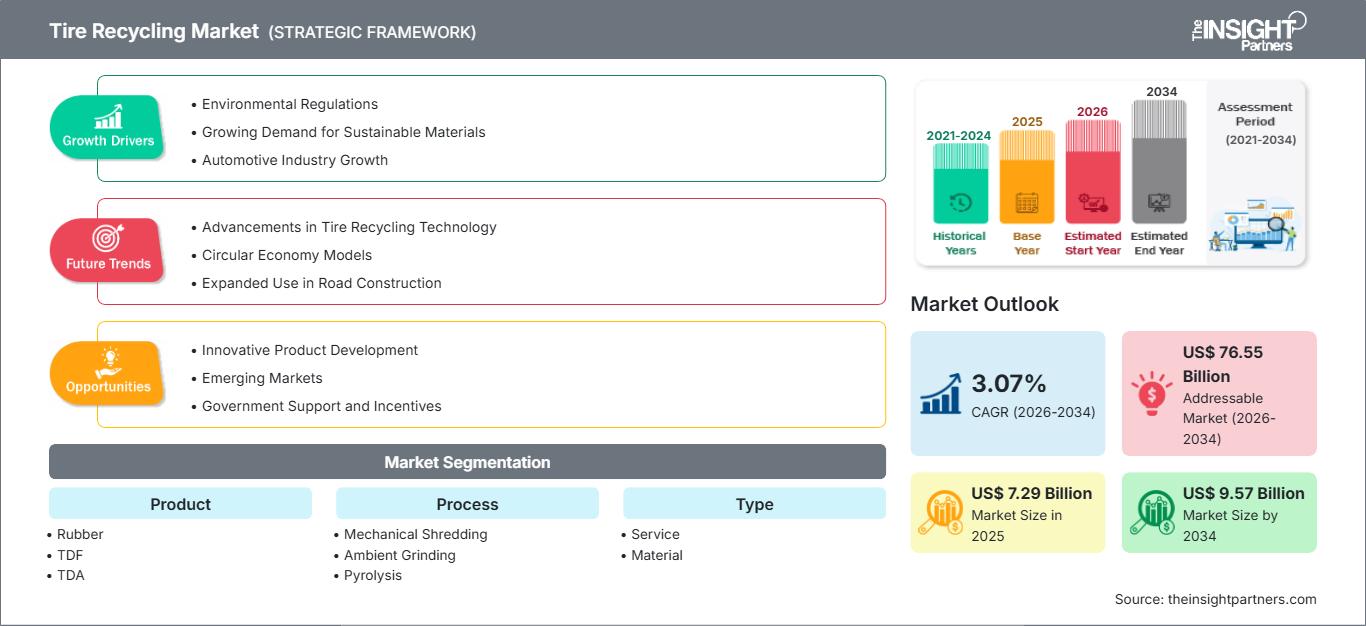
The global Tire Recycling Market is projected to grow from US$ 7.29 Billion in 2025 to US$ 9.57 Billion by 2034, registering a CAGR of 3.07% during 2026–2034. The market reflects steady expansion as end-of-life tire collection, processing, and material recovery systems mature across automotive, construction, and manufacturing value chains.
Across North America, Tire Recycling Market size is supported by a modeled CAGR range of 2.8–3.3% through 2034, reflecting mature collection networks and rising infrastructure use of rubber-modified asphalt. State-level landfill restrictions, producer responsibility programs, and demand for tire-derived aggregate in civil engineering are reinforcing stable regional procurement.
Tire Recycling Market Assessment and Insights
- North America accounted for 31–34% share in 2025 and is expected to grow at a CAGR range of 2.8–3.3% during 2026–2034, supported by high ELT utilization and rubberized asphalt adoption.
- US represented 78–82% of North America in 2025 and is projected to grow at 2.7–3.2%, led by collection density and civil infrastructure applications.
- Europe held 25–28% share in 2025 and may grow at 2.9–3.4%, with Germany, the UK, France, Italy, and Spain leading regulated circular material recovery.
- Asia Pacific captured 30–33% share in 2025 and is likely to grow at 3.4–3.9%, driven by China, India, Japan, South Korea, and Australia.
- Largest Segment Rubber held 36–39% market share in 2025 and is expected to grow at 3.0–3.5%, reflecting broad use in asphalt, molded products, and surfaces.
- High Growth Segment Pyrolysis held 12–15% market share in 2025 and is projected to grow at 4.2–4.8%, supported by recovered carbon black and oil demand.
- Key companies analyzed in detail: Liberty Tire Recycling, LLC; Genan Holding A/S; ResourceCo Pty Ltd; GRP Limited; Lehigh Technologies, Inc.; Entech, Inc.; Emanuel Tire, LLC; BDS Tire Recycling, Inc.; Contec S.A.; CRM Rubber Manufacturers, Inc.
Source: The Insight Partners' analysis based on proprietary research, government publications, company annual reports, investor presentations, industry databases, and expert interviews.
The technology of adopting new shredding systems has moved this industry from being disposal-led to engineering products that have well-defined performance requirements. Shredding still forms the main technology behind the preparation of feedstock, while ambient grinding, rubber powder and pyrolysis processes are enhancing the value obtained from each tire. The production process itself is changing as processing firms adopt sorting, steel separation and testing to satisfy the needs of other industries.
Over the forecast period, the Tire Recycling Market report highlights benefits from emerging urban infrastructure programs, tighter landfill controls, and investment in regional processing hubs. Growth is expected to be strongest where road agencies accept recycled rubber specifications and where manufacturers can qualify recovered carbon black or rubber powder in repeatable formulations. These tailwinds should improve contract visibility and reduce dependence on low-margin disposal fees.
Tire Recycling Market Report Scope
| Report Attribute | Details |
|---|---|
| Market size in 2025 | US$ 7.29 Billion |
| Market Size by 2034 | US$ 9.57 Billion |
| Global CAGR (2026 - 2034) | 3.07% |
| Historical Data | 2021-2024 |
| Forecast period | 2026-2034 |
Tire Recycling Market Analysis
Tire Recycling Market share is being shaped by vehicle parc expansion, replacement tire demand, and stricter end-of-life tire handling rules. In the U.S., 79% of end-of-life tires entered recycling and reclaiming markets in 2023, while more than 250 million tires are generated annually, indicating a large addressable feedstock base.
The ecosystem brings together tire dealers, municipal programs, haulers, processors, compounders, road authorities, cement kilns, and manufacturers. The supply dynamics are getting better with processors switching from a revenue model through spot collection to an off-take model of material, particularly crumb rubber, tire-derived aggregates, tire-derived fuel, and recovered carbon black.
Tire Recycling Market analysis shows a moderately consolidated competitive landscape in developed regions and fragmented collection networks in emerging markets. Liberty Tire Recycling, LLC expanded its U.S. footprint through acquisition activity, whereas Genan Holding A/S, Contec S.A. and ResourceCo Pty Ltd concentrate on recycling higher value materials, engineered rubber and fuels for industrial uses.
Areas of investment include automation, contamination prevention, consistent pyrolysis operations and certification. Those companies that have a reliable source of feedstock, access to tire retailers and end users are well positioned in terms of protecting their profit margins. The strategic positioning of firms is more about meeting the requirements of buyers than tire collection.
● REPORT CUSTOMIZATION
Tailor This Report To Align With Your Specific Business Requirements
This report can be customized to align precisely with your business objectives, scope, and target markets. Customization options include tailored segmentation, geography, competitive analysis, and strategic insights to support informed decision-making.
Customize This Report →WHAT YOU CAN ADJUST
- ● Segmentations
- ● Geography
- ● Competitive Analysis
- ● Language Preferences
Tire Recycling Market: Strategic Insights
Regional Insights
North America Tire Recycling
North America represented 31–34% of the Tire Recycling Market share in 2025 and is forecast to grow at a CAGR range of 2.8–3.3% during 2026–2034. The area is supported by well-developed collection networks, limitations of landfills, and widespread use of tire-derived aggregate for drainage, lightweight fill, and landfill engineering purposes. U.S. infrastructure spending, along with recycling grants at the state level, is aiding trials on rubber-modified asphalt applications.
Processors are focusing on the production of high-value crumb rubber, molded goods, and carbon black due to the lower risk of being affected by fluctuating tire-derived fuel markets. The regional supply chain continues to be service-oriented; however, material income is growing as public authorities and companies are conducting specification tests on recycled material.
U.S. Tire Recycling Market
The U.S. Tire Recycling Market forecast is supported by the country’s dominant position, accounting for 78–82% of North America in 2025, and an expected CAGR of 2.7–3.2% over the forecast period. Market prospects are reinforced by the generation of more than 250 million end-of-life tires annually and a reported 79% utilization rate across recycling and reclaiming markets, providing a substantial and recurring feedstock base for processors and downstream manufacturers.
The presence of companies is highly correlated with collection concentration, tire dealers, and transportation routes. Companies such as Liberty Tire Recycling, LLC, Emanuel Tire, LLC, BDS Tire Recycling, Inc., CRM Rubber Manufacturers, Inc., and Lehigh Technologies, Inc. offer products for applications including rubberized asphalt, playground surface, molded items, and automobile compounds.
Europe Tire Recycling Market
Europe Tire Recycling Market forecast indicates that the region held 25–28% share in 2025 and is projected to grow at a CAGR range of 2.9–3.4% over the forecast period. Germany is the leading country, supported by advanced sorting, industrial rubber demand, and strict waste hierarchy implementation. The UK continues to use recycled rubber in surfaces and construction, while monitoring export quality and local processing capacity.
France, Italy and Spain provide additional demand through road surfacing, molded rubber, and fuel replacement in cement kilns. Traceability and recovered material quality improvements are being achieved in Europe by processors like Genan Holding A/S and Contec S.A. Consistent regulations make procurement easier, but energy costs and logistics remain influential factors in Tire Recycling operations.
APAC Tire Recycling Market
APAC Tire Recycling Market trends indicate the region captured 30–33% share in 2025 and is forecast to grow at 3.4–3.9%, making it the fastest regional market. China leads due to vehicle population, tire manufacturing scale, and expanding circular economy policies. Japan and South Korea emphasize material quality, while India and Australia are building formal collection and processing capacity.
Industrial triggers include road construction, cement manufacturing, rubber products manufacturing, and alternative carbon needs. There is inconsistent policy implementation, thus making good companies concentrate on producing verified products and entering into agreements regarding the purchase of the products. Adoption of Tire Recycling in APAC is related to both industrial needs and the formal collection process.
Middle East & Africa Tire Recycling Market
Middle East & Africa Tire Recycling Market is projected to grow at a CAGR range of 3.1–3.6% through 2034. Saudi Arabia and the UAE lead regional activity as waste management modernization aligns with infrastructure, logistics, and energy diversification plans. South Africa anchors demand in tire-derived fuel, rubber products, and regulated waste programs.
Other segments of the MEA market are still at the early stage and depend on municipal waste collection, diversion from landfills, and fuel replacement by industries. The use of aggregates from tires is promising for major civil engineering applications, and pyrolysis projects should be organized professionally in terms of feedstock procurement and emissions reduction.
Segmentation Analysis
Product
By Product, the carbon black segment is expected to grow at a CAGR range of 3.0–3.5% during 2026–2034. Tire Recycling Market activity across products is widening as processors move from commodity outputs toward engineered rubber, tire-derived fuel, aggregate, and recovered carbon black. Demand is strongest where specifications, testing, and repeatable quality enable public procurement or industrial substitution.
- Rubber remains the largest product as crumb and micronized rubber are used in asphalt, playground surfaces, molded goods, mats, and automotive compounds requiring consistent particle size.
- TDF serves cement kilns and industrial boilers where energy value, steel content, and emissions compliance determine acceptance against coal, petcoke, or biomass alternatives.
- TDA is strategically important in civil engineering because it offers lightweight fill, drainage, vibration control, and landfill applications where performance standards are clearly defined.
- Carbon Black is gaining attention as pyrolysis improves recovered carbon quality for rubber, plastics, coatings, and masterbatch applications seeking lower-carbon material inputs.
Process
By Process, the Pyrolysis segment is forecast to grow at a CAGR range of 3.1–3.7% during 2026–2034. Tire Recycling Market trends indicate that mechanical routes dominate current volumes because they are proven, scalable, and compatible with most downstream applications. Pyrolysis is expanding from pilot activity toward commercial qualification, but economics depend on uptime, feedstock quality, emissions control, and offtake certainty.
- Mechanical Shredding provides primary size reduction and steel liberation, making it essential for TDF, TDA, crumb rubber production, and downstream processing efficiency.
- Ambient Grinding supports finer rubber powders without cryogenic cooling, serving asphalt modification, molded goods, flooring, and industrial rubber applications with moderate energy intensity.
- Pyrolysis converts tires into oil, gas, steel, and recovered carbon black, creating higher-value pathways where environmental permitting and product certification are robust.
Type
By Type, the service segment is projected to grow at a CAGR range of 2.9–3.4% during 2026–2034. Tire Recycling Market share remains supported by service revenues because collection, sorting, and compliance documentation are essential for municipalities, retailers, and fleet operators. Material revenues are increasing as processors secure buyers for crumb rubber, TDA, TDF, and recovered carbon products.
- Service includes collection, transportation, processing, compliance reporting, and program management, giving recyclers recurring revenue linked to tire generation and regulatory obligations.
- Material covers saleable recycled outputs, where margin improvement depends on product purity, particle size control, certification, and stable industrial or public-sector demand.
End-use Industry
By End-use Industry, the automotive segment is anticipated to grow at a CAGR range of 3.0–3.6% during 2026–2034. Tire Recycling Market trends indicate that automotive, construction, and manufacturing customers are shifting from opportunistic use toward qualified recycled inputs. Adoption is strongest where recycled materials lower cost, improve durability, reduce landfill exposure, or support measurable sustainability commitments.
- Automotive uses recycled rubber and recovered carbon materials in mats, seals, underbody parts, molded goods, and compounds where performance validation supports procurement.
- Construction is the most strategic end-use, using rubberized asphalt, TDA, drainage layers, acoustic barriers, surfaces, and lightweight fill for infrastructure durability.
- Manufacturing absorbs crumb rubber, powders, and carbon-rich outputs into industrial goods, plastics, coatings, and composite applications requiring dependable supply and specifications.
Opportunity Snapshot
| End-use Industry | Revenue Contribution | Trend Tag | Adoption Stage |
| Automotive | Medium | Compound Validation | Scaling |
| Construction | High | Rubber Asphalt | Mature |
| Manufacturing | Medium | Carbon Recovery | Emerging |
Tire Recycling Market Growth Drivers and Impact Analysis
Landfill Diversion and Circular Economy Regulation
Regulatory pressure is the most durable demand driver because whole tires are difficult to landfill safely and create fire, vector, and leachate risks. Extended producer responsibility systems, state tire fees, and landfill bans convert unmanaged waste into predictable collection flows. The market impact is twofold: processors gain feedstock visibility, and downstream buyers face stronger incentives to accept certified recycled materials. In mature regions, regulation shifts Tire Recycling Market growth from a disposal service into a circular materials platform, improving long-term contracting and enabling capital investment in higher-quality outputs.
Infrastructure Demand for Rubberized Materials
Increasingly, road authorities and construction companies are assessing crumb rubber, rubberized asphalt, and tire-derived aggregate regarding durability, drainage, noise absorption, and lightweight fill properties. The relevance of the project to the Tire Recycling industry is great since infrastructure projects could take up very large quantities consistently and reliably, once the standards are set. This will be an additional market besides consumer applications where processing facilities could dependably schedule their capacity. Procurement by public bodies also makes the private sector less wary of assessing tire-derived raw materials in their applications.
Technology Upgrades in Material Recovery
With improvements in automation, enhanced separation technology, ambient grinding, and pyrolysis, greater value is being extracted from each tire. Enhanced separation technology and control over particle size result in more consistent crumb rubber; meanwhile, pyrolysis can yield oil, gas, steel, and recovered carbon black. The effect in the market rests with consistency over innovation: companies meeting specification requirements will have access to industrial markets commanding higher margins. With maturity in qualification standards, Tire Recycling will become more competitive on performance and compliance with emission standards rather than volume of collection alone.
Tire Recycling Market Future Trends
Recovered Carbon Black Qualification
The next chapter in Tire Recycling will revolve around recovered carbon black as tire manufacturers, plastics processors, and coatings makers search for more carbon-efficient alternatives to furnace black. Moving forward will demand better management of ash, particle shape, volatiles, and dispersion properties. Progress will be defined by qualification processes with compounders as opposed to press releases about capacity. Businesses that achieve consistency in their pyrolysis processes and laboratory testing, along with long-term purchase contracts can take recovered carbon black out of niche applications and into industrial procurement.
Digital Traceability for Tire-Derived Materials
The importance of the traceability system is likely to increase as both government bodies and industrial purchasers require assurance of provenance, route of processing, recycling percentage, and environmental impact. The use of digital manifests, batch testing, and chain-of-custody auditing could help eliminate contamination fears and substantiate the claims related to green procurement. The Traceability System is likely to serve as a distinguishing factor for Tire Recycling companies when competing for business from infrastructure, automotive, and manufacturing industries.
Tire Recycling Market Opportunities
Scaling Rubber-Modified Asphalt Procurement
Road programs provide a practical option for an investment since rubber-modified asphalt is capable of utilizing significant amounts of crumb rubber while increasing the durability and sound performance of roads in selected cases. Tire Recycling Forecasts must focus on areas with approved pavement mixes, life cycle cost analysis, and specifications. It is important that the recyclers increase the efficiency of collection through collaboration with the asphalt producers, state DOTs, and construction companies while drafting specifications. This will prove to be true when there are tire fee funds available.
Integrated Processing Hubs Near Tire Generation Centers
The establishment of hubs adjacent to metro centers where tires will be produced will help in lowering costs for hauling, increasing feedstock stability, and facilitating several product flows from the same site. For the investor, he needs to ensure that his chosen location will provide collection density, accessibility through rail or road transport, certainty regarding zoning and the location of asphalt, cement, rubber, or manufacturing customers. The best scenario will not rely on one customer as the service charges and the material value will be balanced out.
Recent Developments
- July 2026: Liberty Tire Recycling, a portfolio company of I Squared Capital, a leading independent global infrastructure investor, today announced a major expansion of its Gulf Coast operations through the acquisition of All American Tire, Colt Tire Recycling, and Genan, Inc (US subsidiary of Genan A/S).
- October 2025: Continental is integrating even more renewable and recycled materials into its tire production. Committed to the principles of the circular economy, the tire manufacturer is also motivating its suppliers to increasingly develop and provide sustainable materials to manufacture tires. While Continental's share of renewable and recycled materials in tire production averaged 26 percent in 2024, the company's goal is to increase this figure to at least 40 percent within the next five years.
- May 2026: Empire State Development announced a $2.36 million investment in six technology research projects that will increase the reuse, retreading, and recycling of end-of-life tires generated in New York State. ESD’s investment includes $1.4 million in state funding through the NYS Waste Tire Program, which is managed by the REMADE Institute®. REMADE was selected to develop and administer the program in 2025 on behalf of ESD.
Frequently Asked Questions

- Comprehensive Market Sizing and Forecast Analysis
- Detailed Segmentation Analysis
- In-Depth Market Dynamics Assessment
- Regional and Country-Level Insights
- Competitive Landscape and Company Benchmarking
- Strategic Business Intelligence
Recent Reports
Testimonials

The Insight Partners provided valuable market intelligence that supported our global go-to-market strategy. Their team was professional, responsive, and attentive to our feedback, providing thoughtful analysis and helpful methodological clarifications throughout the project.
Junmo Kim Chief Financial Officer (CFO), Enertech Co., Ltd.
The Insight Partners' SCADA System Market report is comprehensive, with valuable insights on current trends and future forecasts. The team was highly professional, responsive, and supportive throughout. We are very satisfied and highly recommend their services.
RAN KEDEM Partner, Reali Technologies LTDs
I requested a report on a very specific software market and the team produced the report in a few days. The information was very relevant and well presented. I then requested some changes and additions to the report. The team was again very responsive and I got the final report in less than a week.
JEAN-HERVE JENN Chairman, Future Analytica
We worked with The Insight Partners for an important market study and forecast. They gave us clear insights into opportunities and risks, which helped shape our plans. Their research was easy to use and based on solid data. It helped us make smart, confident decisions. We highly recommend them.
PIYUSH NAGPAL Sr. Vice President, High Beam Global
The Insight Partners delivered insightful, well-structured market research with strong domain expertise. Their team was professional and responsive throughout. The user-friendly website made accessing industry reports seamless. We highly recommend them for reliable, high-quality research services
YUKIHIKO ADACHI CEO, Deep Blue, LLC.
This is the first time I have purchased a market report from The Insight Partners.While I was unsure at first, I visited their web site and felt more comfortable to take the risk and purchase a market report.I am completely satisfied with the quality of the report and customer service. I had several questions and comments with the initial report, but after a couple of dialogs over email with their analyst I believe I have a report that I can use as input to our strategic planning process.Thank you so much for taking the extra time and making this a positive experience.I will definitely recommend your service to others and you will be my first call when we need further market data.
JOHN SUZUKI President and Chief Executive Officer, Board Director, BK Technologies
I wish to appreciate your support and the professionalism you displayed in the course of attending to my request for information regarding to infectious disease IVD market in Nigeria. I appreciate your patience, your guidance, and the fact that you were willing to offer a discount, which eventually made it possible for us to close a deal. I look forward to engaging The Insight Partners in the future, all thanks to the impression you have created in me as a result of this first encounter.
DR CHIJIOKE ONYIA MANAGING DIRECTOR, PineCrest Healthcare Ltd.Reason to Buy
- Informed Decision-Making
- Understanding Market Dynamics
- Competitive Analysis
- Identifying Emerging Markets
- Customer Insights
- Market Forecasts
- Risk Mitigation
- Boosting Operational Efficiency
- Strategic Planning
- Investment Justification
- Tracking Industry Innovations
- Aligning with Regulatory Trends





 Get Free Sample for