
Recycling Equipment and Machinery Market Share, Growth & Demand by 2034
Coverage: By Product (Baler Presses, Shredders, Shears, Granulators, Agglomerators, Extruders, Others); Material (Plastic, Metal, Wood, Rubber, Paper and Cardboard, Others), and Geography (North America, Europe, Asia Pacific, and South and Central America)
- Status : Data Released
- Report Code : TIPRE00014971
- Category : Manufacturing and Construction
- No. of Pages : 150
- Available Report Formats :


- Last update date : September 10, 2026


2025 Market Size
US$ 33.02 Bn
Base year value
2034 Forecast
US$ 54.02 Bn
Projected by 2034
CAGR 2026-2034
5.62 %
Growth rate
Addressable Market
US$ 394.52 Bn
(2026-2034)
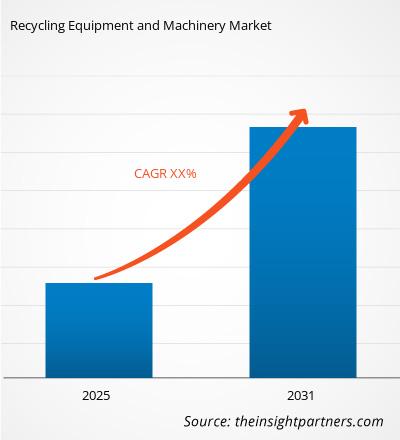
The recycling equipment and machinery market was valued at US$ 33.02 Billion in 2025 and is projected to reach US$ 54.02 Billion by 2034, registering a CAGR of 5.62% from 2026 to 2034. Growth reflects rising investment in material recovery infrastructure, stricter waste-management requirements, increasing secondary-material utilization, and modernization of recycling facilities. Demand is broadening from conventional metal and paper processing toward plastics, electronic waste, batteries, and mixed-material recovery systems.
North America is expected to expand at a 5.0–5.7% CAGR between 2026–2034, supported by the replacement of aging material-recovery equipment and increasing demand for automated sorting and processing. Extended producer responsibility programs, landfill diversion objectives, and investment in domestic secondary-material supply are strengthening the recycling equipment and machinery market size across the region.
Recycling Equipment and Machinery Market Assessment and Insights
- North America: North America is estimated to account for 24–28% share in 2025, growing at a 5.0–5.7% CAGR between 2026–2034, supported by facility modernization, automation, plastics recovery, and domestic secondary-material supply initiatives.
- US: The US represents approximately 80–84% of North American demand in 2025, growing at a 5.1–5.8% CAGR between 2026–2034, supported by infrastructure replacement and recycling investment.
- Europe: Europe is estimated to hold 27–31% share in 2025, expanding at a 5.3–6.0% CAGR between 2026–2034, led by Germany, the UK, France, Italy, and Spain through circular-economy regulation.
- Asia Pacific: Asia Pacific is estimated at 31–35% share in 2025, advancing at a 6.2–7.0% CAGR between 2026–2034, led by China, Japan, India, South Korea, and Australia through manufacturing and waste infrastructure.
- Largest Segment: Metal is estimated to hold 35–39% market share in 2025, with a 5.0–5.7% CAGR between 2026–2034, reflecting established scrap-processing and material-recovery operations.
- High Growth Segment: Plastic is estimated to hold 20–24% market share in 2025, expanding at a 6.5–7.3% CAGR between 2026–2034, driven by recovery targets and recycled-content requirements.
- Key companies analyzed in detail: ANDRITZ Group; CP Manufacturing Inc.; Danieli Centro Recycling S.r.l.; Forrec S.r.l.; General Kinematics Corporation; Idromec S.p.A.; LEFORT Group; MTB Recycling; Shred-Tech Corporation; Vecoplan AG.
Source: The Insight Partners' analysis based on proprietary research, government publications, company annual reports, investor presentations, industry databases, and expert interviews.
The sector is moving from individual mechanical processes to complete recycling lines that include shredding, sorting, granulating, baling, and process lines specific to the material type. Machine manufacturers are focusing increasingly on the optimization of throughput, energy usage, ability to handle contamination, and maintenance needs. Automation of material feeding and monitoring is gaining significance since recyclers will increasingly be handling heterogeneous material streams. The modularity in the equipment design enables operators to increase capacity without having to scrap the existing plant.
Future investments in the sector should focus on plastics, metals, construction materials, electronics waste, and batteries that offer improved economics. Asia-Pacific will see capacity additions owing to its manufacturing intensity and waste infrastructure development, whereas Europe will continue to be significant for technological development due to its circular economy goals. Operators in North America need to focus on modernizing their equipment, increasing automation, and recycling domestically.
Recycling Equipment and Machinery Market Report Scope
| Report Attribute | Details |
|---|---|
| Market size in 2025 | US$ 33.02 Billion |
| Market Size by 2034 | US$ 54.02 Billion |
| Global CAGR (2026 - 2034) | 5.62% |
| Historical Data | 2021-2024 |
| Forecast period | 2026-2034 |
Recycling Equipment and Machinery Market Analysis
Demand for the recycling equipment and machinery market growth is linked to increasing waste generation, material scarcity, landfill constraints, and the economic value of recovered commodities. The ecosystem is composed of collection companies, transfer stations, material-recovery facilities, scrap processors, recyclers, equipment manufacturers, integrators, and buyers of secondary materials. Demand for equipment is thus not only based on volumes of wastes and the like, but also on commodity pricing, levels of contamination, labor, and processing economics.
There are two trends regarding supply: one is that there is a move toward integrated equipment packages that can handle feedstocks of varied quality. There is a continued need for shredders and balers to reduce waste to size and densify it. Granulators, shears, agglomerators, and extruders are used for specific material recovery needs. Manufacturers differentiate their products based on automation, durability, energy efficiency, efficiency of throughput, and service support. The operators favor multi-feedstock capability in the equipment.
Competitive positioning in the recycling equipment and machinery market analysis depends on product breadth, engineering capabilities, installed base, geographic service coverage, and specialization by material. ANDRITZ Group has strengthened its recycling portfolio through acquisitions and partnerships, while Danieli Centro Recycling S.r.l. and LEFORT Group maintain strong metal-processing capabilities. Both Vecoplan AG and Forrec S.r.l. specialize in shredders and material-processing equipment, while CP Manufacturing Inc. and General Kinematics Corporation focus on sorting and processing machines.
More money is being invested in automation, high throughput, and purification of recovered materials. Shred-Tech Corporation and MTB Recycling provide specialized solutions for shredding and recycling purposes, whereas Idromec S.p.A. specializes in metal-processing machines. Manufacturers of processing equipment are also adding more services to their portfolio since maintenance, spare parts, and efficiency optimization can significantly impact the economics of operations. Strategic emphasis has therefore shifted from machinery production to full process line engineering.
● REPORT CUSTOMIZATION
Tailor This Report To Align With Your Specific Business Requirements
This report can be customized to align precisely with your business objectives, scope, and target markets. Customization options include tailored segmentation, geography, competitive analysis, and strategic insights to support informed decision-making.
Customize This Report →WHAT YOU CAN ADJUST
- ● Segmentations
- ● Geography
- ● Competitive Analysis
- ● Language Preferences
Recycling Equipment and Machinery Market: Strategic Insights

Regional Insights
North America recycling equipment and machinery market
North America is estimated to represent 24–28% share in 2025 and expand at a 5.0–5.7% CAGR between 2026–2034. The US dominates regional demand because of its large installed recycling infrastructure, extensive metal-scrap industry, packaging waste volumes, and growing need to modernize material-recovery facilities. Canada contributes through municipal recycling, forestry-related material recovery, metals, and industrial waste processing.
Investment is increasingly directed toward automated sorting, higher-throughput shredding, baling, and plastics recovery. Labor shortages encourage operators to reduce manual intervention, while landfill constraints and producer-responsibility initiatives improve the economics of material recovery. Equipment suppliers benefit from replacement demand because older systems often require greater maintenance and deliver lower recovery yields. Regional buyers increasingly assess machines according to lifecycle cost, energy consumption, uptime, and recovered-material quality rather than initial purchase price.
U.S. recycling equipment and machinery Market
The US represents approximately 80–84% of North American recycling equipment and machinery Market demand in 2025 and is projected to grow at a 5.1–5.8% CAGR between 2026–2034. Demand exists primarily for municipal recycling, scrap metal processing, plastics recycling, construction materials, and industrial wastes. Some suppliers include CP Manufacturing Inc., General Kinematics Corporation, Shred-Tech Corporation, and Vecoplan AG, among others. Modernization becomes especially significant for plants that want to achieve higher rates of recovery but do not want proportionate growth in labor. Optics sorting, automatic feeding, more sophisticated shredding, and better baling technologies can help achieve this goal. Private recycling firms are also looking for machines that can be used with various types of feedstocks, depending on changing market conditions.
Europe recycling equipment and machinery market
Europe is estimated to hold 27–31% share of the recycling equipment and machinery Market in 2025, growing at a 5.3–6.0% CAGR between 2026–2034. Germany is the leading market, supported by a mature waste-management infrastructure and industrial recycling. The UK, France, Italy, and Spain also provide substantial demand through packaging recovery, metals, plastics, municipal waste, and circular-economy investment.
Germany benefits from established sorting and processing infrastructure, while the UK is increasing investment in domestic recycling capacity as policymakers seek greater resource recovery. France is strengthening packaging and producer-responsibility systems, creating demand for processing capacity. Italy and Spain are expanding separate collection, material recovery, and industrial recycling infrastructure. Across the region, regulations emphasizing recyclability, recycled content, traceability, and landfill diversion should support equipment investment and encourage operators to improve recovered-material quality.
APAC recycling equipment and machinery market
APAC represents approximately 31–35% of the recycling equipment and machinery Market share in 2025 and is expected to expand at a 6.2–7.0% CAGR between 2026–2034. China leads regional demand, followed by Japan, South Korea, India, and Australia. Manufacturing concentration creates substantial industrial scrap streams, while urbanization increases municipal waste-processing requirements.
China benefits from extensive manufacturing and metals-processing activity, while India is increasing its recycling infrastructure and formal processing capacity. Japan and South Korea emphasize resource efficiency and advanced material recovery, whereas Australia is investing in domestic recycling capacity. Regional policies supporting waste reduction, secondary materials, and resource security should encourage equipment modernization. Demand is strongest for shredders, balers, sorting systems, granulators, and integrated processing lines.
Middle East & Africa recycling equipment and machinery Market
The Middle East and Africa recycling equipment and machinery market is expected to expand at a 4.5–5.3% CAGR between 2026–2034, with Saudi Arabia leading regional demand, followed by the UAE and South Africa. Infrastructure development, industrial diversification, metals recovery, packaging waste, and municipal waste management are creating equipment opportunities.
Saudi Arabia and the UAE are developing large-scale sustainability and waste-management programs, while South Africa has an established scrap and recycling ecosystem. The rest of MEA offers opportunities through urbanization, construction, mining, and industrial waste. Demand favors robust machinery capable of operating in demanding environments, with shredders, balers, shears, and material-processing equipment supporting resource recovery and landfill-diversion objectives.
Segmentation Analysis
Product
The Product segment is projected to expand at a 5.7–6.5% CAGR between 2026–2034 in the Recycling Equipment and Machinery Market as recyclers replace fragmented equipment with integrated processing lines. Product selection increasingly depends on feedstock characteristics, desired output quality, throughput, energy consumption, and maintenance requirements. Equipment capable of continuous operation and rapid configuration changes has greater strategic value for facilities processing variable waste streams.
- Baler Presses: Baler Presses compact recovered materials into transportable units, reducing storage and logistics costs. Demand remains strong across paper, cardboard, plastics, metals, and municipal recovery facilities requiring efficient downstream handling.
- Shredders: Shredders provide primary or secondary size reduction for plastics, metals, wood, rubber, and mixed waste. Their versatility makes them foundational equipment for facilities handling heterogeneous feedstocks.
- Shears: Shears process bulky metallic materials and industrial scrap by applying high-force cutting action. Their durability and throughput make them important for vehicle, structural-metal, and heavy-scrap recycling operations.
- Granulators: Granulators reduce pre-shredded materials into controlled particle sizes, supporting plastics processing and preparation for downstream separation or reprocessing. Consistent particle dimensions improve material handling and product quality.
- Agglomerators: Agglomerators densify lightweight plastic films and similar materials before further processing. They improve feed consistency and facilitate efficient handling where low bulk density would otherwise limit throughput.
- Extruders: Extruders convert prepared plastic feedstock into reusable material through controlled melting and homogenization. Demand is linked to recycled-content requirements and manufacturers seeking greater incorporation of recycled polymers.
Material
The Material segment is expected to grow at a 5.6–6.4% CAGR between 2026–2034 in the Recycling Equipment and Machinery Market, reflecting different recovery economics and processing requirements across feedstocks. Metal remains the largest material category because of established scrap markets, while plastics are attracting investment as regulators and manufacturers seek higher recycled content. Equipment suppliers increasingly develop configurations optimized for material-specific contamination, density, and wear characteristics.
- Plastic: Plastic recycling requires shredding, granulation, washing, densification, and extrusion, depending on polymer type. Investment is increasing in processing systems that improve purity and produce consistent recycled feedstock for manufacturers.
- Metal: Metal recycling relies heavily on shearing, shredding, baling, and separation equipment. Established scrap markets and the economic value of recovered ferrous and nonferrous metals support sustained machinery demand.
- Wood: Wood recycling equipment processes construction waste, pallets, forestry residues, and industrial wood streams. Shredding and sizing systems enable recovered material to enter panel manufacturing, biomass, or other secondary applications.
- Rubber: Rubber recycling uses shredding and granulation to convert tires and industrial rubber products into reusable material. Processing efficiency and particle-size consistency influence downstream applications such as molded products and infrastructure.
- Paper and Cardboard: Paper and cardboard recycling depends on collection, sorting, baling, and material preparation. High-volume packaging streams sustain demand for efficient baling and handling systems that reduce transport and storage requirements.
Opportunity Snapshot
| Material | Revenue Contribution (High/Medium/Low) | Trend Tag | Adoption Stage |
| Plastic | High | Recycled Content | Scaling |
| Metal | High | Scrap Recovery | Mature |
| Wood | Medium | Biomass Feedstock | Scaling |
| Rubber | Medium | Tire Recovery | Scaling |
| Paper and Cardboard | High | Fiber Recovery | Mature |
Recycling Equipment and Machinery Market Growth Drivers and Impact Analysis
Stricter Circularity Rules Increase Processing Capacity Requirements
Environmental regulations are shifting waste management from disposal toward measurable recovery and secondary-material use. The European Union recycled 48.1% of municipal waste in 2024, up from 43.0% in 2014, demonstrating the long-term effect of stronger collection and recovery systems. Such progress requires machinery capable of processing larger and more diverse material streams. Packaging rules and extended producer responsibility schemes further encourage investment in sorting, baling, shredding, and material-specific processing. The commercial impact is greater demand for equipment upgrades rather than simply additional collection capacity. Operators increasingly need higher recovery yields, better contamination control, and documented material outputs. Suppliers that provide integrated equipment and process optimization can therefore benefit as recycling facilities transition toward more stringent performance expectations.
Critical-Material Security Supports Advanced Recycling Investment
There is more demand for securing secondary sources of critical materials, and this has made investments in advanced recycling equipment more appealing. According to the International Energy Agency, recycling plays a crucial role in supplying lithium, nickel, cobalt, copper, and rare earth materials, especially with the development of clean energy technologies. This is a new business opportunity that extends beyond traditional municipal recycling. More specialized equipment will be needed for recycling batteries, electronic waste, and industrial materials. The market effect on equipment is seen from the changing trend towards higher value feedstocks, where the recovery of materials reduces exposure to primary commodities. Equipment suppliers can capitalize on this by upgrading mechanical systems to prepare feedstock and those compatible with subsequent processes.
Labor Constraints Accelerate Recycling Automation
Recycling plants have come under growing pressure to increase productivity in terms of their throughput, while ensuring minimal labor needs and variability. Sorting and material handling by hand could limit the capacity of such facilities, especially where there are considerable variations in the composition of the waste material from one collection period to another. Automation through automated feeding, continuous shredding, automated sensing, sorting, baling, and monitoring can help in minimizing reliance on repetitive manual tasks. This effect is more pronounced in developed markets where there exist existing facilities that require only minor productivity gains. The quality of products is also made more reliable as a result. As such, equipment manufacturers have been working towards incorporating controls and diagnostic systems into conventional mechanical equipment.
Recycling Equipment and Machinery Market Future Trends
Digital Process Optimization Becomes a Core Equipment Differentiator
The recycling equipment and machinery market trends are increasingly centered on digital monitoring, predictive maintenance, automated control, and data-driven process optimization. Future recycling plants are likely to connect shredders, balers, conveyors, granulators, and separation equipment through centralized control systems that monitor throughput, energy use, operating temperatures, vibration, and wear. Machine data can support predictive maintenance and reduce unplanned downtime while helping operators identify bottlenecks. Digital interfaces may also enable remote technical support and performance benchmarking across multiple facilities. As recyclers manage more variable feedstock, adaptive control systems can adjust operating parameters to maintain throughput and output consistency. Equipment manufacturers that combine mechanical reliability with software-enabled monitoring can therefore differentiate their platforms through measurable operational performance rather than hardware specifications alone.
Material-Specific Processing Expands Beyond Conventional Waste Streams
Future investment will increasingly target specialized waste streams generated by electrification, renewable energy, and advanced manufacturing. End-of-life batteries, photovoltaic modules, electronic equipment, composite materials, and complex plastics contain recoverable resources but require different preparation and separation strategies from conventional municipal waste. The IEA estimates that around 1.2 million electric-vehicle batteries could reach the end of life in 2030 and approximately 14 million by 2040, highlighting the future scale of specialized processing requirements. Recycling machinery will consequently evolve toward modular systems capable of safe dismantling, controlled shredding, and precise material separation. Suppliers with adaptable equipment platforms can address emerging streams without abandoning established markets, creating opportunities for technology transfer between metals, plastics, electronics, and energy-transition applications.
Recycling Equipment and Machinery Market Opportunities
Localized Recycling Infrastructure in Emerging Manufacturing Economies
The recycling equipment and machinery market Forecasts indicate attractive opportunities in countries where industrialization and urbanization are expanding faster than formal recycling infrastructure. India is particularly relevant because its government has introduced financial incentives for critical mineral recycling from e-waste and spent lithium-ion batteries, including an INR 1,500 crore allocation. Similar localization strategies can stimulate demand for shredders, balers, granulators, and material-separation systems. Equipment suppliers can capture opportunities by establishing local service networks, adapting machinery to regional feedstocks, and partnering with recyclers and industrial manufacturers. Local assembly and component sourcing can also improve project economics and shorten delivery times. The strongest opportunities should arise where policy incentives, manufacturing growth, and limited domestic processing capacity coincide.
Integrated Processing Lines Improve Investment Economics
A second opportunity lies in supplying complete processing lines rather than isolated machines. Recycling facilities increasingly need coordinated systems that move materials from feeding and size reduction through separation, densification, and final preparation. Integrated solutions can reduce interface problems, improve throughput balancing, and simplify commissioning and maintenance. This approach is particularly valuable for new facilities processing plastics, metals, and mixed industrial waste, where equipment compatibility directly affects recovery economics. Suppliers can strengthen their position by offering engineering, installation, commissioning, spare parts, and lifecycle optimization as a unified package. For investors, integrated projects can provide clearer performance accountability because equipment capacity and material recovery objectives are assessed across the complete process. This model also creates recurring service opportunities after initial installation.
Frequently Asked Questions

- Comprehensive Market Sizing and Forecast Analysis
- Detailed Segmentation Analysis
- In-Depth Market Dynamics Assessment
- Regional and Country-Level Insights
- Competitive Landscape and Company Benchmarking
- Strategic Business Intelligence
Recent Reports
Testimonials

The Insight Partners' SCADA System Market report is comprehensive, with valuable insights on current trends and future forecasts. The team was highly professional, responsive, and supportive throughout. We are very satisfied and highly recommend their services.
RAN KEDEM Partner, Reali Technologies LTDs
I requested a report on a very specific software market and the team produced the report in a few days. The information was very relevant and well presented. I then requested some changes and additions to the report. The team was again very responsive and I got the final report in less than a week.
JEAN-HERVE JENN Chairman, Future Analytica
We worked with The Insight Partners for an important market study and forecast. They gave us clear insights into opportunities and risks, which helped shape our plans. Their research was easy to use and based on solid data. It helped us make smart, confident decisions. We highly recommend them.
PIYUSH NAGPAL Sr. Vice President, High Beam Global
The Insight Partners delivered insightful, well-structured market research with strong domain expertise. Their team was professional and responsive throughout. The user-friendly website made accessing industry reports seamless. We highly recommend them for reliable, high-quality research services
YUKIHIKO ADACHI CEO, Deep Blue, LLC.
This is the first time I have purchased a market report from The Insight Partners.While I was unsure at first, I visited their web site and felt more comfortable to take the risk and purchase a market report.I am completely satisfied with the quality of the report and customer service. I had several questions and comments with the initial report, but after a couple of dialogs over email with their analyst I believe I have a report that I can use as input to our strategic planning process.Thank you so much for taking the extra time and making this a positive experience.I will definitely recommend your service to others and you will be my first call when we need further market data.
JOHN SUZUKI President and Chief Executive Officer, Board Director, BK Technologies
I wish to appreciate your support and the professionalism you displayed in the course of attending to my request for information regarding to infectious disease IVD market in Nigeria. I appreciate your patience, your guidance, and the fact that you were willing to offer a discount, which eventually made it possible for us to close a deal. I look forward to engaging The Insight Partners in the future, all thanks to the impression you have created in me as a result of this first encounter.
DR CHIJIOKE ONYIA MANAGING DIRECTOR, PineCrest Healthcare Ltd.Reason to Buy
- Informed Decision-Making
- Understanding Market Dynamics
- Competitive Analysis
- Identifying Emerging Markets
- Customer Insights
- Market Forecasts
- Risk Mitigation
- Boosting Operational Efficiency
- Strategic Planning
- Investment Justification
- Tracking Industry Innovations
- Aligning with Regulatory Trends





 Get Free Sample for