
Remote Monitoring and Control Market Demand, Size & Forecast by 2034
Remote Monitoring and Control Market Size and Forecasts (2021 - 2034), Global and Regional Share, Trends, and Growth Opportunity Analysis Report Coverage : By Solutions (SCADA, Vibration Monitoring); Field Instruments (Level Transmitters, Pressure Transmitters, Temperature Transmitters, Intelligent Flow Meters); Industry (Oil & Gas, Chemical, Water & Wastewater Treatment, Metals & Mining, Food & Beverage, Power, Automotive, Others)
- Status : Data Released
- Report Code : TIPRE00039598
- Category : Electronics and Semiconductor
- No. of Pages : 150
- Available Report Formats :


- Last update date : September 02, 2026


2025 Market Size
US$ 29.92 Bn
Base year value
2034 Forecast
US$ 56.21 Bn
Projected by 2034
CAGR 2026-2034
7.26 %
Growth rate
Addressable Market
US$ 388.58 Bn
(2026-2034)
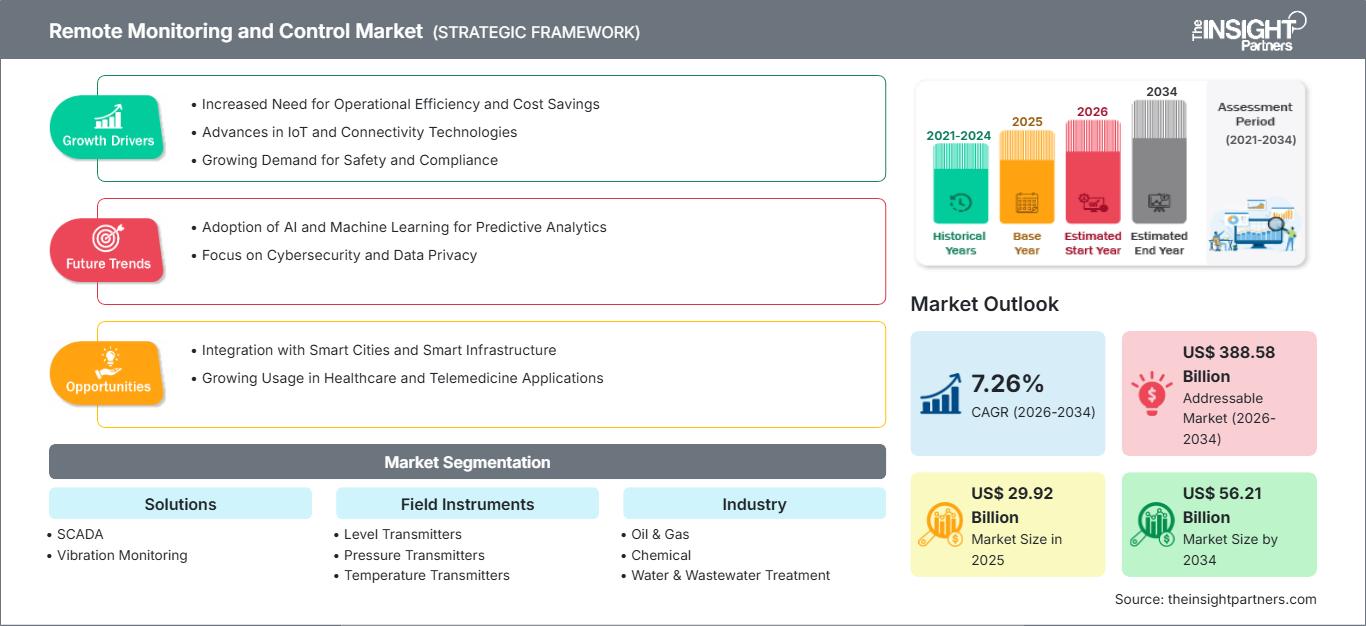
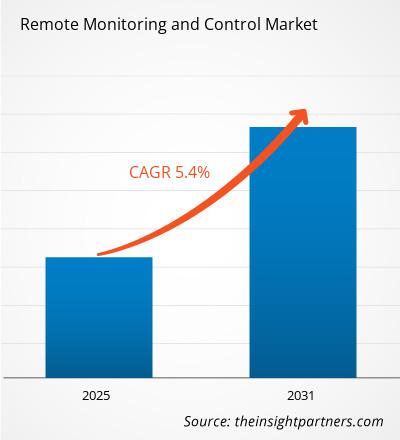
The remote monitoring and control market is projected to expand from US$ 29.92 Billion in 2025 to US$ 56.21 Billion by 2034, registering a CAGR of 7.26% during 2026–2034. The market encompasses supervisory control platforms, vibration monitoring, intelligent transmitters, and connected industrial instrumentation that enable distributed assets to be observed, diagnosed, and controlled with reduced dependence on onsite intervention across process and discrete industries.
North America remains a technologically mature adoption center, supported by modernization of aging industrial infrastructure, increased deployment of connected field instrumentation, and demand for centralized operational visibility. The remote monitoring and control market size is expected to advance at an estimated 6.8–7.4% CAGR between 2026 and 2034, with utilities, oil and gas operators, and advanced manufacturing facilities strengthening investments in secure remote operations.
Remote Monitoring and Control Market Assessment and Insights
- North America: North America is expected to command a 27–31% share in 2025 and expand at a 6.8–7.4% CAGR between 2026–2034, supported by industrial modernization, distributed energy assets, and cybersecurity-focused control upgrades.
- US: The US is projected to represent 72–76% of North America in 2025, growing at a 6.9–7.5% CAGR between 2026–2034, led by utilities, energy infrastructure, and process industries.
- Europe: Europe is estimated at a 22–25% share in 2025, advancing at a 6.2–6.9% CAGR between 2026–2034, with Germany, the UK, France, and Italy supporting automation modernization and energy-efficiency initiatives.
- Asia Pacific: Asia Pacific is expected to hold a 32–36% share in 2025 and register a 7.8–8.6% CAGR between 2026–2034, led by China, Japan, South Korea, and India through manufacturing digitization and infrastructure investment.
- Largest Segment: Solutions is estimated to hold a 58–62% market share in 2025, with a 7.1–7.8% CAGR between 2026–2034, reflecting broad SCADA deployment across asset-intensive operations.
- High Growth Segment: Field Instruments is estimated at a 38–42% market share in 2025, growing at a 7.6–8.3% CAGR between 2026–2034, driven by smart sensing and instrumentation replacement.
- Key companies analyzed in detail: Emerson Electric Co., Honeywell International Inc., Siemens AG, Schneider Electric SE, ABB Ltd, General Electric Co., Rockwell Automation, Inc., Yokogawa Electric Corporation, Endress+Hauser AG, and Fuji Electric Co., Ltd.
Source: The Insight Partners' analysis based on proprietary research, government publications, company annual reports, investor presentations, industry databases, and expert interviews.
From individual control rooms, industrial monitoring is gradually moving into connected systems that have SCADA systems combined with edge gateways, intelligent instrumentation, and analytics. Remote access will enable geographical dispersion of assets, while wireless instrumentation will simplify installation in hard-to-reach areas. The SCADA systems developed by Emerson demonstrate the move towards a connected cloud system, a mobile interface, and interoperable field devices.
During the forecast period, investment will be increasingly focused on modernization rather than full replacement. Interoperable systems, secure remote access, and analytics-capable instrumentation can be expected to be the priorities for utilities, mining companies, water organizations, and manufacturing processes. Emerging industrial economies will make the greatest contribution through the adoption of a connected control system during new construction.
Remote Monitoring and Control Market Report Scope
| Report Attribute | Details |
|---|---|
| Market size in 2025 | US$ 29.92 Billion |
| Market Size by 2034 | US$ 56.21 Billion |
| Global CAGR (2026 - 2034) | 7.26% |
| Historical Data | 2021-2024 |
| Forecast period | 2026-2034 |
Remote Monitoring and Control Market Analysis
Industrial digitization is a primary contributor to remote monitoring and control market growth, particularly where operators manage geographically dispersed or hazardous assets. The ecosystem spans sensors and transmitters, communications infrastructure, RTUs, SCADA software, edge computing, control platforms, analytics, cybersecurity, systems integration, and lifecycle services. Demand is strongest where downtime, safety exposure, or manual inspection creates measurable operational costs.
Supply dynamics increasingly favor vendors capable of integrating heterogeneous legacy equipment with modern cloud and edge environments, reflecting key Remote Monitoring and Control Market Trends. Intelligent pressure, temperature, level, and flow instruments provide higher-quality data for centralized decision-making, while vibration monitoring supports condition-based maintenance. Standardized industrial protocols also reduce integration barriers, allowing operators to preserve installed assets while adding remote visibility and advanced analytics without extensive plant redesign.
Competitive positioning is increasingly shaped by platform breadth, installed-base compatibility, cybersecurity, and software capabilities rather than hardware specifications alone. The remote monitoring and control market analysis therefore, considers integrated offerings particularly relevant because Emerson, Honeywell, Siemens, Schneider Electric, ABB, and Rockwell Automation combine automation platforms with field technologies. Yokogawa, Endress+Hauser, and Fuji Electric strengthen competition through instrumentation and process-control specialization.
Investment in strategy is trending towards the cloud-enabled SCADA, edge computing, artificial intelligence diagnostics, and lifecycle software. Honeywell incorporated generative AI features in its Production Intelligence suite in 2025, thus showcasing the trend of using natural language for operational analysis and troubleshooting. The vendors now consider cybersecurity, interoperability, and analytics as an integral part of the automation system architecture.
● REPORT CUSTOMIZATION
Tailor This Report To Align With Your Specific Business Requirements
This report can be customized to align precisely with your business objectives, scope, and target markets. Customization options include tailored segmentation, geography, competitive analysis, and strategic insights to support informed decision-making.
Customize This Report →WHAT YOU CAN ADJUST
- ● Segmentations
- ● Geography
- ● Competitive Analysis
- ● Language Preferences
Remote Monitoring and Control Market: Strategic Insights
Regional Insights
North America remote monitoring and control market
North America is estimated to represent 27–31% of the 2025 remote monitoring and control market and expand at a 6.8–7.4% CAGR through 2034. US accounts for a significant share of regional demand, whereas Canada plays a part by way of energy, mining, utilities, and infrastructure upgrades. Older industrial assets need instrument upgrades, security, connectivity, and control from one central location. Renewable distributed power generation also leads to the need for coordinating operations remotely within geographically dispersed locations.
Increasing use of edge gateways and cloud-based SCADA by industrial firms to connect old instruments with new analytical layers is one trend. The growing importance of cybersecurity favors a layered approach with remote access, rather than open connection of operational networks. Hence, utilities, oil and gas, chemicals, and manufacturing are key purchasers, with spending focused on lifecycle extensions, asset management, alarms, and predictive maintenance.
U.S. remote monitoring and control Market
The US represents approximately 72–76% of North American remote monitoring and control market demand in 2025 and is expected to grow at 6.9–7.5% CAGR through 2034. The demand base includes electric power generation, oil & gas, water infrastructure, chemicals, mining, and high-tech manufacturing. Federal and state infrastructure programs will also drive the modernization of distributed utility assets and industrial facilities needing improved visibility of operations.
There are several companies that have exposure to industrial automation technologies within the US, including Emerson, Honeywell, Siemens, Schneider Electric, ABB, Rockwell Automation, and General Electric Co. Utilities are deploying central monitoring of distributed renewable energy assets, while manufacturers are adopting connected instrumentation in order to decrease unscheduled downtime. Water and wastewater are another critical application space, especially when labor is limited.
Europe remote monitoring and control Market
Europe is estimated to hold a 22–25% of the remote monitoring and control market share in 2025 and grow at a 6.2–6.9% CAGR, with Germany leading regional demand. Industrial decarbonization, energy-efficiency requirements, process automation, and replacement of aging control infrastructure support adoption. The region also places strong emphasis on cybersecurity, interoperability, and resilient industrial communications.
The UK and Germany represent important adoption centers, with the UK emphasizing utility modernization, distributed energy management, and water infrastructure. Germany benefits from its large industrial automation base and concentration of automotive, chemicals, machinery, and process manufacturing. France, Italy, and Spain add demand through utilities, manufacturing, water systems, and energy-intensive industries, while European suppliers strengthen regional technology availability.
APAC remote monitoring and control Market
APAC is projected to account for 32–36% of 2025 remote monitoring and control market demand and expand at 7.8–8.6% CAGR, making it the leading regional growth center. China remains the largest contributor, followed by Japan, South Korea, India, and Australia. Manufacturing expansion and industrial automation support instrumentation demand.
China benefits from factory digitization, Japan from mature automation replacement, and South Korea from advanced electronics and process industries. India is increasing investment in smart infrastructure, water systems, power, and manufacturing, while Australia has strong mining applications. Government-backed industrial digitalization and infrastructure programs reinforce regional adoption.
Middle East & Africa remote monitoring and control Market
Middle East and Africa remote monitoring and control market is expected to grow at 6.6–7.4% CAGR, with Saudi Arabia leading regional demand through energy, utilities, and industrial diversification. The UAE supports adoption through smart infrastructure and digitally managed facilities, while South Africa contributes mining and power applications. Remote operations are particularly valuable where sites are geographically dispersed or exposed to harsh operating conditions.
Energy remains the principal regional application base, but water infrastructure and industrial diversification are broadening demand. Saudi Arabia and the UAE are investing in digitally enabled industrial facilities, while South Africa requires modernization of mining and utility assets. The Rest of MEA presents selective opportunities where remote supervision can address workforce, distance, and reliability constraints.
Segmentation Analysis
Solutions
Solutions represent the largest component category and are expected to grow at a 7.1–7.8% CAGR during 2026–2034. SCADA remains foundational for supervisory visibility, while vibration monitoring expands the diagnostic layer. The remote monitoring and control market scope increasingly includes software capable of integrating legacy systems, edge data, alarms, analytics, and remote operational workflows within one architecture.
- SCADA: SCADA remains central to centralized supervision, alarm management, historical visualization, and remote control. Its strategic importance increases as industrial operators connect distributed assets while preserving existing controllers, RTUs, and field networks.
- Vibration Monitoring: Vibration monitoring supports condition-based maintenance for rotating equipment, particularly pumps, compressors, turbines, motors, and production machinery. Integration with analytics improves early fault detection and prioritizes maintenance interventions.
Field Instruments
Field Instruments are forecast to expand at a 7.6–8.3% CAGR during 2026–2034, reflecting increasing demand for accurate, connected measurements at the asset level. Smart transmitters and meters generate richer datasets, enabling remote diagnostics, calibration visibility, asset health assessment, and improved process optimization.
- Level Transmitters: Level transmitters support continuous inventory and process monitoring across tanks, vessels, wastewater systems, and production equipment, helping operators detect abnormal conditions without frequent onsite inspection.
- Pressure Transmitters: Pressure transmitters remain critical for process safety and equipment performance, with intelligent diagnostics improving measurement reliability and enabling earlier identification of process deviations.
- Temperature Transmitters: Temperature transmitters provide essential process measurements across chemicals, power, food processing, and manufacturing, supporting control-loop stability and remote equipment health assessment.
- Intelligent Flow Meters: Intelligent flow meters combine measurement with diagnostics and digital communication, supporting accurate material accounting, process optimization, leak detection, and centralized operational visibility.
Industry
Industry demand is expected to grow at a 7.0–7.8% CAGR during 2026–2034. Adoption differs by asset criticality, regulatory exposure, workforce distribution, and automation maturity. Oil and gas and power remain significant users, while water, mining, chemicals, and food processing broaden the application base.
- Oil & Gas: Remote monitoring supports pipelines, production sites, terminals, compressors, and processing facilities where distance and safety requirements make centralized supervision strategically important.
- Chemical: Chemical plants use connected monitoring to maintain precise process conditions, improve safety response, and strengthen visibility across hazardous production environments.
- Water & Wastewater Treatment: Connected instruments and SCADA help operators manage pumping, treatment, reservoirs, and distribution assets while reducing reliance on continuous onsite staffing.
- Metals & Mining: Mining operators use remote monitoring across conveyors, pumps, crushers, processing equipment, and geographically dispersed sites to improve maintenance coordination and operational continuity.
- Food & Beverage: Food processors apply connected instrumentation to temperature, pressure, flow, and production processes where consistency, hygiene, traceability, and efficient equipment utilization are priorities.
- Power: Power operators require continuous monitoring across generation, substations, and distributed assets, with remote control supporting faster response and centralized fleet management.
- Automotive: Automotive plants integrate monitoring into highly automated production environments, using instrumentation and analytics to improve equipment availability and process consistency.
Opportunity Snapshot
| Industry | Revenue Contribution | Trend Tag | Adoption Stage |
| Oil & Gas | High | Asset Visibility | Mature |
| Chemical | High | Process Safety | Mature |
| Water & Wastewater Treatment | Medium | Utility Digitization | Scaling |
| Metals & Mining | Medium | Remote Mining | Scaling |
| Food & Beverage | Medium | Process Traceability | Scaling |
| Power | High | Fleet Control | Mature |
| Automotive | Medium | Smart Factory | Mature |
Remote Monitoring and Control Market Growth Drivers and Impact Analysis
Distributed Assets Require Centralized Operational Visibility
Increased geographic distribution of assets has increased the commercial value of central monitoring. Renewable energy production, pipelines, remote pumping stations, mining facilities, and distributed manufacturing plants have often required operators to manage different sites through centralized control centers. Remote designs decrease the reliance on physical inspections and increase response and maintenance coordination. This effect is especially pronounced in situations where there is much time required to reach the destination or where there are adverse access conditions. Connectivity via cloud computing and edge gateways also means that companies can collect data from disparate systems without having to change all their legacy controllers. This offers an effective route to modernize the assets of a company for real improvement in performance.
Industrial Cybersecurity Is Reshaping Remote Access Architecture
Cybersecurity is evolving from a post-installation attribute to a design criterion for remote operation. Increasingly, industrial enterprises are mandating that certain capabilities, such as authentication, network segmentation, encryption, monitoring of privileged activity, and resilience, be implemented before they permit any kind of remote access to their operational technologies. The procurement decision dynamic will thus change, since more and more often, potential customers will want to evaluate automation vendors for their capability of building cybersecurity features into their SCADA, edge, instrumentation, and communications solutions. The commercial implications go beyond that of simply selling cybersecurity software. They also include the ability to provide secure gateways, managed services, hardened devices, and architectural modernization. Operators are thus being increasingly challenged with regard to governance of their industrial infrastructure.
Instrumentation Intelligence Improves Maintenance Economics
Smarter field devices are changing the nature of monitoring from mere measurements to asset intelligence. Contemporary devices are capable of offering diagnostic information, configuration information, information about the health of the device, and more process information in addition to primary measurements. In this way, it helps maintainers troubleshoot problems before the technician gets to the equipment. This effect has the most pronounced impact in facilities where instrument malfunctions can disrupt production or cause safety issues. The combination of vibration monitoring and analysis helps implement condition-based maintenance programs, whereby instead of conducting maintenance purely based on time, companies can conduct maintenance based on the condition of the equipment.
Remote Monitoring and Control Market Future Trends
Edge Intelligence Will Move Decision-Making Closer to Assets
Edge intelligence will be more valuable in the future, when industries start looking for quick reactions without having to transmit their raw data on a constant basis to central systems. Local processing will allow identifying any anomalies, classifying the state of machinery, and triggering pre-planned actions while retaining connections with the rest of the enterprise IT systems. This approach will be especially helpful for remotely located, limited-bandwidth areas and safety-critical situations. The cooperation of Emerson and SiMa.ai, which started in 2026, is an example of how industrial computing evolves towards physical AI abilities on the shop floors and remote facilities.
Mobile Operations Will Become a Standard Supervisory Layer
It is expected that mobile interfaces will be an inevitable extension of supervisory applications and will no longer be a matter of choice. There will come a point where field operators will need alarms, asset data, work instructions, routing data, and certain control capabilities without being tied down to stationary operator consoles. This trend can be seen from the recently upgraded DeltaV SaaS SCADA mobile interface by Emerson, which launched in January 2026. The future of mobile access could well include role-based mobile access, offline capability, location-based workflow, and maintenance alerts.
Remote Monitoring and Control Market Opportunities
Modernizing Legacy Sites Through Interoperable Edge Gateways
A substantial opportunity exists in brownfield facilities that cannot economically replace installed controllers, sensors, and communications systems. Suppliers can create value by deploying interoperable gateways capable of collecting information from multiple industrial protocols and securely forwarding selected datasets to modern SCADA, analytics, or enterprise platforms. This approach reduces disruption and allows customers to modernize incrementally. The remote monitoring and control market Forecasts should therefore consider brownfield integration as an important commercial pathway because industrial customers frequently prioritize continuity of production over complete system replacement. Investment should focus on protocol support, cybersecurity, edge storage, device management, and integration tooling. Vendors that simplify deployment across mixed equipment environments can address customers seeking digital modernization while protecting existing capital investments.
Remote Operations Centers for Distributed Infrastructure
For those organizations that have a dispersed fleet of assets, remote operations centers provide an appealing investment avenue. Utilities, water companies, renewables players, pipelines, and mining entities can bring all their alarms, asset data, performance metrics, and maintenance concerns into a centralized operating environment. In some cases, such centers will help with specialized skills management across various locations, minimizing duplicative efforts at the local level. The greatest potential exists where there is growth in asset concentration beyond the number of technical experts. To be successful, these initiatives need proper segmentation of monitoring and control, reliable communication, cybersecurity governance, and appropriate escalation. Suppliers will be able to distinguish themselves by bundling control room software, analytics, field devices, mobility, and lifecycle services.
Frequently Asked Questions

- Comprehensive Market Sizing and Forecast Analysis
- Detailed Segmentation Analysis
- In-Depth Market Dynamics Assessment
- Regional and Country-Level Insights
- Competitive Landscape and Company Benchmarking
- Strategic Business Intelligence
Recent Reports
Testimonials

The Insight Partners' SCADA System Market report is comprehensive, with valuable insights on current trends and future forecasts. The team was highly professional, responsive, and supportive throughout. We are very satisfied and highly recommend their services.
RAN KEDEM Partner, Reali Technologies LTDs
I requested a report on a very specific software market and the team produced the report in a few days. The information was very relevant and well presented. I then requested some changes and additions to the report. The team was again very responsive and I got the final report in less than a week.
JEAN-HERVE JENN Chairman, Future Analytica
We worked with The Insight Partners for an important market study and forecast. They gave us clear insights into opportunities and risks, which helped shape our plans. Their research was easy to use and based on solid data. It helped us make smart, confident decisions. We highly recommend them.
PIYUSH NAGPAL Sr. Vice President, High Beam Global
The Insight Partners delivered insightful, well-structured market research with strong domain expertise. Their team was professional and responsive throughout. The user-friendly website made accessing industry reports seamless. We highly recommend them for reliable, high-quality research services
YUKIHIKO ADACHI CEO, Deep Blue, LLC.
This is the first time I have purchased a market report from The Insight Partners.While I was unsure at first, I visited their web site and felt more comfortable to take the risk and purchase a market report.I am completely satisfied with the quality of the report and customer service. I had several questions and comments with the initial report, but after a couple of dialogs over email with their analyst I believe I have a report that I can use as input to our strategic planning process.Thank you so much for taking the extra time and making this a positive experience.I will definitely recommend your service to others and you will be my first call when we need further market data.
JOHN SUZUKI President and Chief Executive Officer, Board Director, BK Technologies
I wish to appreciate your support and the professionalism you displayed in the course of attending to my request for information regarding to infectious disease IVD market in Nigeria. I appreciate your patience, your guidance, and the fact that you were willing to offer a discount, which eventually made it possible for us to close a deal. I look forward to engaging The Insight Partners in the future, all thanks to the impression you have created in me as a result of this first encounter.
DR CHIJIOKE ONYIA MANAGING DIRECTOR, PineCrest Healthcare Ltd.Reason to Buy
- Informed Decision-Making
- Understanding Market Dynamics
- Competitive Analysis
- Identifying Emerging Markets
- Customer Insights
- Market Forecasts
- Risk Mitigation
- Boosting Operational Efficiency
- Strategic Planning
- Investment Justification
- Tracking Industry Innovations
- Aligning with Regulatory Trends





 Get Free Sample for