
Residential Solar Shading Systems Market Size, Trends & Demand by 2034
Coverage: By Product Type (Fabric Solar Shading Systems, Aluminum Solar Shading Systems); Application (Indoor Solar Shading Systems, Outdoor Solar Shading Systems) , and Geography (North America, Europe, Asia Pacific, and South and Central America)
- Status : Data Released
- Report Code : TIPRE00023233
- Category : Manufacturing and Construction
- No. of Pages : 150
- Available Report Formats :


- Last update date : September 17, 2026


2025 Market Size
US$ 16.89 Bn
Base year value
2034 Forecast
US$ 30.75 Bn
Projected by 2034
CAGR 2026-2034
6.89 %
Growth rate
Addressable Market
US$ 215.26 Bn
(2026-2034)
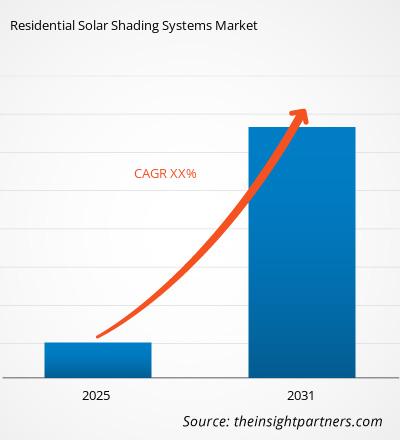
The residential solar shading systems market is projected to grow from US$ 16.89 billion in 2025 to US$ 30.75 billion by 2034, registering a CAGR of 6.89% from 2026 to 2034. Demand is rising as homeowners, architects, and builders adopt fabric and aluminum systems to reduce glare, improve thermal comfort, and support energy-efficient residential design.
Across North America, the residential solar shading systems market size is supported by high renovation spending, expanding smart-home penetration, and rising attention to cooling loads in detached and multifamily housing. The regional market is expected to grow at a CAGR of 6.3–6.9% from 2026 to 2034, helped by automated shades, outdoor shading upgrades, and premium window treatment replacement cycles.
Residential Solar Shading Systems Market Assessment and Insights
- North America: North America accounted for 31–35% share in 2025 and is expected to grow at a CAGR of 6.3–6.9% between 2026 – 2034, supported by smart shade adoption and remodeling activity.
- US: The U.S. represented 79–83% of North America share in 2025 and is projected to grow at a CAGR of 6.4–7.0% between 2026 – 2034.
- Europe: Europe held 29–33% share in 2025 and is forecast to grow at a CAGR of 6.1–6.7% between 2026 – 2034, led by Germany, the UK, France, Italy, and Spain.
- Asia Pacific: Asia Pacific accounted for 24–28% share in 2025 and is projected to grow at a CAGR of 7.2–8.0% between 2026 – 2034, led by China, Japan, India, South Korea, and Australia.
- Largest Segment: Fabric solar shading systems led with 56–60% market share in 2025 and a CAGR of 6.4–7.0% between 2026 – 2034 due to broad indoor usage and design flexibility.
- High Growth Segment: Outdoor solar shading systems held 42–46% share in 2025 and are expected to grow at a CAGR of 7.3–8.1% between 2026 – 2034.
- Key companies analyzed in detail: Hunter Douglas, Lutron Electronics Co., Inc., Kawneer Company, Inc., WAREMA Renkhoff SE, Draper, Inc., EFCO Corporation, Skyco Shading Systems, Inc., Insolroll Window Shading Systems, Duco Ventilation and Sun Control, and Altex.
Source: The Insight Partners' analysis based on proprietary research, government publications, company annual reports, investor presentations, industry databases, and expert interviews.
The industry has shifted from simple decorative window dressings to performance-driven building envelope applications. Motorized fabrics, exterior venetian blinds, pergola awnings, and aluminum louvers are now being selected to address daylighting, privacy, and cooling requirements simultaneously. Suppliers are further refining manufacturing capabilities using recyclable materials, better tolerances for fabrics, motorized systems, and customizable products to cut down production cycles for retrofit residential and new construction projects.
Funding in the future will come from warmer summers, energy renovations, and urban residential developments. The energy performance requirements of Europe, smart home enhancements in North America, and apartment construction in the Asia Pacific region all drive the need for shading solutions that offer both aesthetic appeal and quantifiable comfort results. Funding will become increasingly focused on connected systems, exterior shading, and modular systems.
Residential Solar Shading Systems Market Report Scope
| Report Attribute | Details |
|---|---|
| Market size in 2025 | US$ 16.89 Billion |
| Market Size by 2034 | US$ 30.75 Billion |
| Global CAGR (2026 - 2034) | 6.89% |
| Historical Data | 2021-2024 |
| Forecast period | 2026-2034 |
Residential Solar Shading Systems Market Analysis
The residential solar shading systems market growth is driven by cooling-cost awareness, larger glazed façades, and the need to reduce indoor heat gain without limiting daylight. Consumers also want automated shades and shading for outside use, which can be controlled along with lighting, HVAC, and security systems. With the increasing use of space cooling by buildings, the role of shading in passive efficiency is growing.
Supply chain comprises manufacturers of textile mills, aluminum extruders, motors, control systems, installers, architects, and home improvement stores. Customization in fabrication is increasing, but the process is getting easier with the help of configurators and standard mounting systems, helping to minimize measurement mistakes and installation time. While higher-end products need professional specification, easy-to-use DIY smart shades are growing in demand from middle-class consumers.
Market overview highlights the change in competition toward integrated daylight management. Hunter Douglas and Lutron Electronics Co., Inc. compete in automated interior shades, whereas WAREMA Renkhoff SE, Kawneer Company, Inc., and Duco Ventilation and Sun Control offer services in exterior and façade shading. Draper, Inc., Insolroll Window Shading Systems, Skyco Shading Systems, Inc., EFCO Corporation, and Altex offer services in project-based residential and light commercial applications.
Investment trends favor smart controls, exterior heat protection, and fabric innovation. Vendors are positioning around energy efficiency, design customization, and installer productivity rather than price alone. Partnerships with smart-home platforms are also becoming more important as homeowners expect natural light control to integrate with scenes, occupancy routines, and mobile applications.
● REPORT CUSTOMIZATION
Tailor This Report To Align With Your Specific Business Requirements
This report can be customized to align precisely with your business objectives, scope, and target markets. Customization options include tailored segmentation, geography, competitive analysis, and strategic insights to support informed decision-making.
Customize This Report →WHAT YOU CAN ADJUST
- ● Segmentations
- ● Geography
- ● Competitive Analysis
- ● Language Preferences
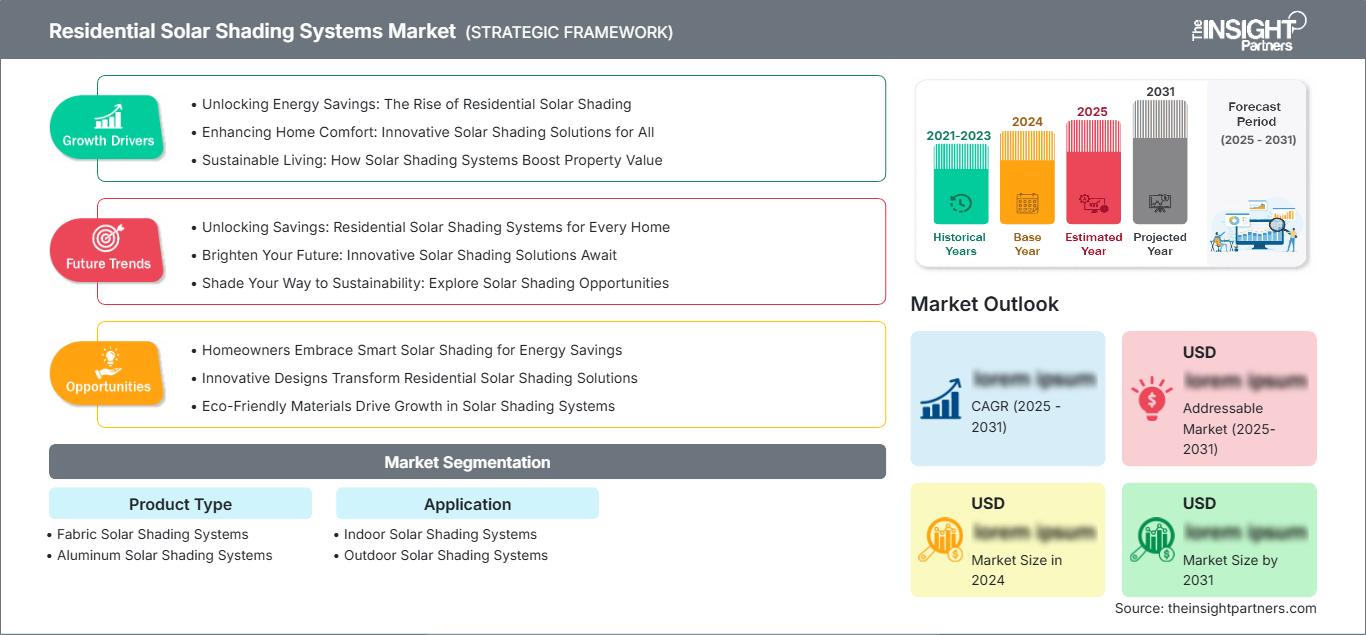
Residential Solar Shading Systems Market: Strategic Insights
Regional Insights
North America Residential Solar Shading Systems Market
North America held 31–35% residential solar shading systems market share in 2025 and is projected to grow at a CAGR of 6.3–6.9% through 2034. The market benefits from high detached-home renovation activity, large window replacement spending, and rising adoption of automated interior shades in premium households.
In the U.S. and Canada, outdoor living spaces are creating demand for awnings, pergola shades, and patio systems. Lutron’s lower-priced Caséta smart shades and Hunter Douglas PowerView upgrades show how suppliers are expanding automation beyond luxury projects into broader residential channels.
U.S. Residential Solar Shading Systems Market
The U.S. accounted for 79–83% of North America share in 2025 and is expected to grow at a CAGR of 6.4–7.0% from 2026 to 2034. Demand is strongest in retrofit-heavy states where heat, glare, and premium remodeling converge with smart-home adoption.
Application trends favor indoor roller and honeycomb shades for daylight control, while exterior awnings and aluminum shading systems are gaining traction in sunbelt housing. Company presence is broad, with Hunter Douglas, Lutron Electronics Co., Inc., Draper, Inc., EFCO Corporation, and Skyco Shading Systems, Inc. addressing different value tiers.
Europe Residential Solar Shading Systems Market
Europe held 29–33% share in 2025 and is forecast to expand at a CAGR of 6.1–6.7% between 2026 and 2034. Germany leads due to strong exterior shading culture, renovation policy, and companies such as WAREMA Renkhoff SE and Duco Ventilation and Sun Control serving high-performance building envelopes.
The UK market is supported by shading retrofits for overheating control, while France, Italy, and Spain benefit from hot summers and residential balcony, terrace, and façade shading demand. EU building rules that prioritize lower energy use and solar-ready construction reinforce the adoption of passive shading strategies.
APAC Residential Solar Shading Systems Market
Asia Pacific accounted for 24–28% share in 2025 and is projected to grow at a CAGR of 7.2–8.0% from 2026 to 2034. China leads volume demand through apartment construction and façade upgrades, while Japan and South Korea favor automated indoor systems.
India and Australia are expanding through heat protection, premium housing, and energy-conscious renovations. Urban density, rising air-conditioning use, and stronger interest in passive cooling support fabric shades, exterior louvers, and aluminum systems suited to multifamily developments.
Middle East & Africa Residential Solar Shading Systems Market
The Middle East & Africa is expected to grow at a CAGR of 6.8–7.6% during 2026–2034. Saudi Arabia and the UAE lead as villa projects, luxury apartments, and outdoor living spaces require high-performance shading for heat and glare control.
South Africa and the Rest of MEA are adoption markets where cost-effective awnings, screens, and aluminum shading systems address solar exposure and comfort. Infrastructure-linked housing growth and energy-efficiency awareness create opportunities, although affordability differences keep penetration uneven.
Segmentation Analysis
Product Type
Product Type is projected to grow at a CAGR of 6.5–7.2% from 2026 to 2034. The market scope covers fabric-based interior and exterior shades as well as aluminum louvers, blinds, and structural systems. Product choice depends on façade exposure, design intent, durability needs, and automation compatibility.
- Fabric Solar Shading Systems: Fabric systems lead residential adoption because roller shades, screens, awnings, and curtains provide glare control, privacy, and design flexibility across both retrofit and new-build applications.
- Aluminum Solar Shading Systems: Aluminum systems are preferred for exterior durability, façade integration, and long service life, especially in apartments, villas, balconies, and homes requiring stronger heat protection.
Application
Application is forecast to grow at a CAGR of 6.9–7.6% from 2026 to 2034. Indoor systems remain widely adopted due to low installation complexity, while outdoor systems are gaining faster momentum because exterior shading blocks solar heat before it reaches glazing and improves cooling efficiency.
- Indoor Solar Shading Systems: Indoor systems dominate everyday use through roller shades, blinds, curtains, and smart window treatments that balance privacy, daylight, aesthetics, and convenience inside living spaces.
- Outdoor Solar Shading Systems: Outdoor systems are strategically important because awnings, pergolas, exterior screens, and louvers reduce heat gain at the façade, supporting passive cooling and outdoor living comfort.
Opportunity Snapshot
| Application | Revenue Contribution | Trend Tag | Adoption Stage |
| Indoor Solar Shading Systems | High | Smart Control | Mature |
| Outdoor Solar Shading Systems | Medium | Heat Blocking | Scaling |
Residential Solar Shading Systems Market Growth Drivers and Impact Analysis
Rising Residential Cooling Pressure and Overheating Risk
The combination of higher temperatures during the summer and bigger glazed windows is making passive cooling techniques more necessary in residential houses. According to the International Energy Agency, buildings consume around 30 percent of the total energy consumption across the world, and it is expected that there will be a rise in cooling requirements in the coming years. Shading systems play a direct role in this context as they stop any increase in temperature by controlling the solar radiation.
Smart-Home Integration Expanding Addressable Demand
Automated shading is transitioning from being installed in high-end luxury homes to becoming available at lower residential pricing levels. With Lutron’s Caséta smart blinds available at $399 for normal sizes, we see that top-tier providers are bringing down entry-level pricing while maintaining app-based, scheduling, and voice control. This will have market implications in increasing customer demand, not only through custom integrators but directly from people looking to automate their homes. Additionally, incorporating lighting, heating, ventilation, and air conditioning systems increases the value perception of shading systems.
Energy Renovation Policies Supporting Building Envelope Upgrades
Policy frameworks are increasingly putting shading on the agenda in relation to energy efficiency in homes. The updated EU directive on the Energy Performance of Buildings has taken effect in 2024 with an aim to achieve a carbon-neutral building stock in 2050. There is also a significant retrofitting problem in Europe, with the majority of buildings built prior to current performance standards. These frameworks make the economic case for shading, along with insulation, windows, solar readiness, and ventilation, even more compelling.
Residential Solar Shading Systems Market Future Trends
Matter-Based Interoperability for Connected Sun Shading
Residential solar shading systems market trends increasingly point toward interoperable controls. WAREMA’s Xeenos product range, designed to control blinds, shutters, awnings, and light through Matter, indicates that shading will connect more easily with leading smart-home ecosystems. Over the forecast period, standardized connectivity can reduce installer complexity and consumer hesitation. This will help motorized shading operate with lighting, climate, and security routines while improving adoption in renovation projects where homeowners want flexible control without proprietary fragmentation.
Exterior Shading as a Passive Cooling Design Standard
Outside shading should become an essential comfort item rather than just a façade option in warmer residential environments. Shading screens, louvered panels, awnings, and motorized shutters are less susceptible to overheating because they block the sun’s radiation prior to its penetration through the windows, compared to some interior-only options. Developers will more and more often specify outside solutions for homes with big windows, balconies, and terraces. This development favors manufacturers that could marry architecture, aerodynamics, motorization, and minimal maintenance needs.
Residential Solar Shading Systems Market Opportunities
Retrofit Packages for Existing Homes and Apartments
Residential solar shading systems market Forecasts point to strong retrofit potential because existing homes often lack passive cooling upgrades. Suppliers can create standardized packages that combine measurement support, fabric selection, motor options, and installation guidance for apartments and detached houses. This approach can reduce project complexity and improve conversion through dealers, home improvement stores, and online channels. The opportunity is strongest where rising electricity bills, heatwaves, and renovation incentives encourage homeowners to invest in comfort without major structural changes.
Premium Outdoor Living and Climate Comfort Solutions
Patios, balconies, gardens, and terraces are becoming extensions of residential living space, creating demand for weather-resistant shading systems. Awnings, pergola shades, sun sails, and exterior screens allow households to use outdoor areas for longer periods while controlling heat and glare. Manufacturers can capture value by offering modular outdoor systems with lighting, sensors, wind controls, and coordinated fabrics. The opportunity spans premium villas, urban balconies, and suburban homes seeking comfort, privacy, and design consistency.
Frequently Asked Questions

- Comprehensive Market Sizing and Forecast Analysis
- Detailed Segmentation Analysis
- In-Depth Market Dynamics Assessment
- Regional and Country-Level Insights
- Competitive Landscape and Company Benchmarking
- Strategic Business Intelligence
Recent Reports
Testimonials

The Insight Partners' SCADA System Market report is comprehensive, with valuable insights on current trends and future forecasts. The team was highly professional, responsive, and supportive throughout. We are very satisfied and highly recommend their services.
RAN KEDEM Partner, Reali Technologies LTDs
I requested a report on a very specific software market and the team produced the report in a few days. The information was very relevant and well presented. I then requested some changes and additions to the report. The team was again very responsive and I got the final report in less than a week.
JEAN-HERVE JENN Chairman, Future Analytica
We worked with The Insight Partners for an important market study and forecast. They gave us clear insights into opportunities and risks, which helped shape our plans. Their research was easy to use and based on solid data. It helped us make smart, confident decisions. We highly recommend them.
PIYUSH NAGPAL Sr. Vice President, High Beam Global
The Insight Partners delivered insightful, well-structured market research with strong domain expertise. Their team was professional and responsive throughout. The user-friendly website made accessing industry reports seamless. We highly recommend them for reliable, high-quality research services
YUKIHIKO ADACHI CEO, Deep Blue, LLC.
This is the first time I have purchased a market report from The Insight Partners.While I was unsure at first, I visited their web site and felt more comfortable to take the risk and purchase a market report.I am completely satisfied with the quality of the report and customer service. I had several questions and comments with the initial report, but after a couple of dialogs over email with their analyst I believe I have a report that I can use as input to our strategic planning process.Thank you so much for taking the extra time and making this a positive experience.I will definitely recommend your service to others and you will be my first call when we need further market data.
JOHN SUZUKI President and Chief Executive Officer, Board Director, BK Technologies
I wish to appreciate your support and the professionalism you displayed in the course of attending to my request for information regarding to infectious disease IVD market in Nigeria. I appreciate your patience, your guidance, and the fact that you were willing to offer a discount, which eventually made it possible for us to close a deal. I look forward to engaging The Insight Partners in the future, all thanks to the impression you have created in me as a result of this first encounter.
DR CHIJIOKE ONYIA MANAGING DIRECTOR, PineCrest Healthcare Ltd.Reason to Buy
- Informed Decision-Making
- Understanding Market Dynamics
- Competitive Analysis
- Identifying Emerging Markets
- Customer Insights
- Market Forecasts
- Risk Mitigation
- Boosting Operational Efficiency
- Strategic Planning
- Investment Justification
- Tracking Industry Innovations
- Aligning with Regulatory Trends





 Get Free Sample for