
Ride-On Mower Market Share, Growth & Forecast by 2034
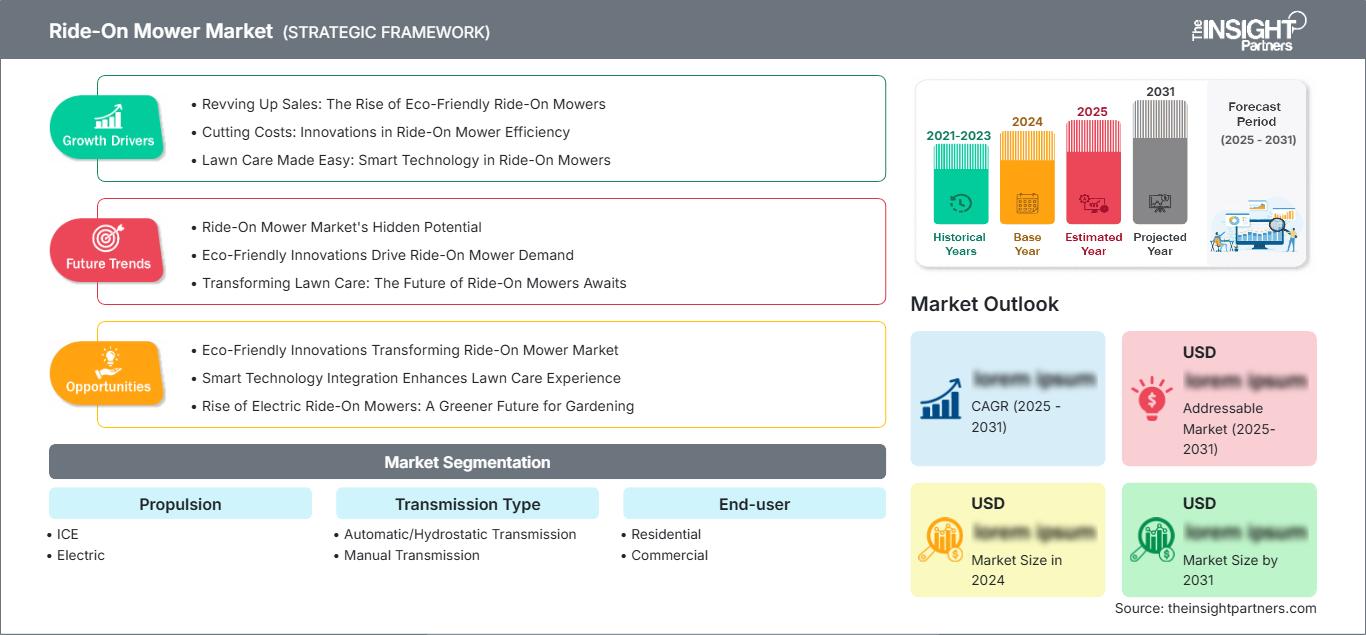
Coverage: By Propulsion (ICE, Electric); Transmission Type (Automatic/Hydrostatic Transmission, Manual Transmission); End-user (Residential, Commercial) , and Geography (North America, Europe, Asia Pacific, and South and Central America)
- Status : Data Released
- Report Code : TIPRE00019438
- Category : Manufacturing and Construction
- No. of Pages : 150
- Available Report Formats :


- Last update date : September 15, 2026


2025 Market Size
US$ 6.32 Bn
Base year value
2034 Forecast
US$ 8.41 Bn
Projected by 2034
CAGR 2026-2034
3.23 %
Growth rate
Addressable Market
US$ 66.90 Bn
(2026-2034)
The global Ride-On Mower market was valued at US$ 6.32 billion in 2025 and is expected to reach US$ 8.41 billion by 2034; it is estimated to record a CAGR of 3.23% during 2026-2034.
Ride-On Mower Market Assessment and Insights
- North America: North America is estimated to hold a 31–35% share in 2025 and expand at a 4.10–4.50% CAGR between 2026–2034, supported by extensive residential lawns, commercial landscaping, replacement purchases, and established equipment distribution networks.
- US: The US represents approximately 78–82% of North America's 2025 share, with a 4.00–4.40% CAGR between 2026–2034, reflecting strong residential and professional turf-care equipment demand.
- Europe: Europe is estimated at a 27–30% share in 2025, advancing at a 3.30–3.80% CAGR between 2026–2034. Germany, the UK, France, Italy, and Spain support demand through professional grounds maintenance and environmental equipment preferences.
- Asia Pacific: Asia Pacific is estimated to account for 21–24% of the 2025 market, growing at a 5.20–5.80% CAGR between 2026–2034. China, Japan, India, South Korea, and Australia provide the principal demand centers.
- Largest Segment: Residential end users are estimated to represent a 55–60% market share in 2025, expanding at a 3.40–3.80% CAGR between 2026–2034, supported by property maintenance requirements.
- High Growth Segment: Electric propulsion is estimated at a 14–18% market share in 2025, with a 9.00–10.00% CAGR between 2026–2034, driven by lower operating noise and maintenance requirements.
- Key companies analyzed in detail: ANDREAS STIHL AG and Co. KG, Ariens Company, Briggs & Stratton Corporation, Deere & Company, Husqvarna AB, Honda Motor Co., Ltd., Kubota Corporation, STIGA S.p.A., The Toro Company, and Victa Lawncare Pty Ltd.
Source: The Insight Partners' analysis based on proprietary research, government publications, company annual reports, investor presentations, industry databases, and expert interviews.
The ride-on mower market has evolved from conventional gasoline-powered lawn tractors toward equipment differentiated by cutting-deck configuration, steering geometry, hydrostatic drivetrains, and operator ergonomics. Zero-turn designs have made maneuverability easier to achieve, whereas electric designs are making way for reduced maintenance needs and silent operations. More manufacturers are balancing their offerings between gasoline-based products and battery-run products, resulting in a slow shift in technologies as opposed to a complete revolution in technology.
Future innovation will focus on the integration of more diagnostics, electronics, batteries, and autonomous cutting systems. Equipment is being modified to suit smaller commercial spaces and luxury homeowners, and developing nations present new opportunities due to growth in professional landscaping services. Governmental concerns regarding emissions and noise could push forward electric equipment adoption, but the cost of batteries, charging needs, capability on rough terrains, and service availability are still important purchase factors.
Ride-On Mower Market Report Scope
| Report Attribute | Details |
|---|---|
| Market size in 2025 | US$ 6.32 Billion |
| Market Size by 2034 | US$ 8.41 Billion |
| Global CAGR (2026 - 2034) | 3.23% |
| Historical Data | 2021-2024 |
| Forecast period | 2026-2034 |
Ride-On Mower Market Analysis
The ride-on mower market growth is principally connected with the need to reduce mowing time across large lawns, sports grounds, estates, municipal areas, and commercial properties. The equipment demand chain includes engines and motor manufacturers, transmissions, cutting decks, dealerships, rentals, landscaping contractors, and aftermarkets. Replacement demand is crucial since equipment used for mowing is characterized by regular seasons of usage and wear.
The supply chain factors include the availability of engines, the price of steel and aluminum, batteries, electronic control systems, tires, hydraulics, and stock levels at dealers. ICE equipment still has an installed base due to refueling routines and services. Electric variants are becoming popular when noise, local emission controls, maintenance requirements, and indoor usage affect purchasing choices. Thus, manufacturers provide multiple powertrains and do not limit themselves to just one technology.
The ride-on mower market analysis indicates a competitive structure combining diversified outdoor-power-equipment manufacturers with agricultural machinery specialists. Deere & Company, The Toro Company, Husqvarna AB, Kubota Corporation, Honda Motor Co., Ltd., ANDREAS STIHL AG and Co. KG have wide reach and brand awareness. The Ariens Company and the Briggs & Stratton Corporation rely on their residential and professional equipment ecosystem, while STIGA S.p.A. and Victa Lawncare Pty Ltd. rely on their regional positioning.
Innovation and strategic investments are becoming more and more focused on the development of electric motors, productivity of operators, automation, and modular systems. The direction of the development was shown by the company Deere & Company in 2025 with the autonomous battery-powered commercial mower, equipped with computer vision and a camera for commercial landscaping. The competition, consequently, will shift from the power of engines to the cost of operations.
● REPORT CUSTOMIZATION
Tailor This Report To Align With Your Specific Business Requirements
This report can be customized to align precisely with your business objectives, scope, and target markets. Customization options include tailored segmentation, geography, competitive analysis, and strategic insights to support informed decision-making.
Customize This Report →WHAT YOU CAN ADJUST
- ● Segmentations
- ● Geography
- ● Competitive Analysis
- ● Language Preferences
Ride-On Mower Market: Strategic Insights
Regional Insights
North America ride-on mower market
North America is estimated to hold a 31–35% of the ride-on mower market share in 2025 and expand at a 4.10–4.50% CAGR between 2026–2034. There are several assets that positively influence this area: suburban properties, landscaping companies, sports fields, golf courses and local turf regulations. Cycles of replacements play an essential role since current users compare new machines based on such factors as cutting productivity, reliability, maneuverability and conditions for financial support. Commercial businesses take into account fuel efficiency and downtime as well while choosing the equipment.
The main market in the region is the US market due to the developed dealer base and availability of lawn tractors and zero-turn mowers. Another positive factor is Canada, where there are residential acres, institutional turf and landscaping operations. Electric machines are gaining popularity in the region due to their improvement in terms of battery power and cutting quality. There are some influences on the replacement cycle like interest rates, consumer spending, weather and equipment stocks.
U.S. ride-on mower Market
The US is estimated to represent 78–82% of North America's 2025 market, with a 4.00–4.40% CAGR through 2034. Demand is concentrated among suburban homeowners, landscaping contractors, municipalities, golf facilities, and institutional property managers. Large lawn areas favor riding configurations because they reduce operator time compared with walk-behind equipment. As highlighted in the ride-on mower market report, Deere & Company, The Toro Company, Husqvarna AB, and other established brands maintain extensive product coverage.
Application requirements increasingly influence configuration choices. Residential customers prioritize comfort, deck width, maneuverability, warranty support, and purchase price, whereas commercial users emphasize productivity, durability, service response, and utilization rates. Electric zero-turn products are gaining visibility, while gasoline models continue to dominate many high-use applications. Labor availability also supports investment in productive equipment, and autonomy is beginning to enter professional landscaping through camera-based systems and remote monitoring technologies.
Europe ride-on mower Market
Europe represents an estimated 27–30% share of the ride-on mower market in 2025, with a 3.30–3.80% CAGR between 2026–2034. The UK and Germany are leading markets, followed by France, Italy, and Spain. Equipment selection increasingly reflects operating noise, emissions, property density, maneuverability, and lifecycle maintenance considerations. Professional landscaping and municipal grounds management remain important demand sources.
The UK maintains demand across estates, sports grounds, commercial properties, and professional contractors, while Germany combines residential gardening with institutional landscaping requirements. France and Italy benefit from large private gardens, tourism properties, agricultural estates, and professional grounds maintenance. Spain adds demand from hospitality, municipalities, and water-conscious landscaping practices. Across the region, electric propulsion is receiving greater consideration as manufacturers expand battery platforms and users evaluate quieter operation and reduced local emissions.
APAC ride-on mower Market
APAC is estimated to hold a 21–24% share in 2025 and grow at a 5.20–5.80% CAGR through 2034. China dominates the opportunity in the region, with Japan, South Korea, India, and Australia offering unique sources of demand. Opportunities exist in landscaping, hospitality, golf course maintenance, institutions and professional grounds management.
Expanding industrial activities and landscaping activities are helping to broaden the potential market for the product. The Australian market presents current demand for equipment suitable for large residential and rural areas, while India and China present long-term opportunities in urban landscaping and professional landscaping. In Japan and South Korea, preference is towards equipment that is smaller and technology-intensive.
Middle East & Africa ride-on mower Market
The Middle East and Africa represent a smaller but developing opportunity, with Saudi Arabia, the UAE, and South Africa serving as important markets. The region is estimated to expand at a 4.00–4.60% CAGR between 2026–2034, supported by hospitality projects, golf courses, urban landscaping, and municipal green-space investments.
Saudi Arabia and the UAE benefit from large-scale infrastructure and tourism development, while South Africa has established residential, agricultural-estate, and commercial landscaping applications. The rest of MEA remains fragmented, with adoption concentrated around institutional and premium properties. High temperatures, dust exposure, water-management requirements, and service availability influence equipment specifications and ownership economics.
Segmentation Analysis
Propulsion
Propulsion is expected to remain strategically important as manufacturers balance established gasoline platforms with battery-powered alternatives. The segment is projected to expand at a 4.70–5.10% CAGR between 2026–2034. ICE machines retain advantages in long-duration operation and rapid refueling, while electric platforms increasingly compete through reduced routine maintenance, lower noise, and simplified powertrain architecture. The transition will depend on battery economics, charging access, terrain, duty cycles, and product pricing.
- ICE: ICE equipment remains important for high-utilization applications requiring extended operating periods, rapid refueling, established service support, and proven performance across demanding terrain and large properties.
- Electric: Electric models are gaining strategic importance among noise-sensitive residential users and professional operators seeking lower routine maintenance, reduced local emissions, and compatibility with broader battery-powered equipment ecosystems.
Transmission Type
Transmission Type remains closely linked to operator experience, productivity, durability, and vehicle positioning. The segment is expected to register a 3.60–4.00% CAGR between 2026–2034. Hydrostatic systems are particularly suited to users requiring smooth speed control and frequent direction changes, whereas manual configurations retain relevance where purchase economics and mechanical simplicity are priorities. Transmission selection increasingly influences premium product differentiation.
- Automatic/Hydrostatic Transmission: Hydrostatic systems support smooth acceleration, variable ground speed, and frequent maneuvering, making them strategically important for residential comfort and professional mowing applications requiring precise control.
- Manual Transmission: Manual systems continue serving cost-conscious users and applications where straightforward mechanical operation is valued, although their relative strategic importance is constrained by growing preferences for easier controls.
End-user
End-user segmentation is expected to expand at a 3.50–3.90% CAGR between 2026–2034. Residential buyers provide substantial volume because of large-lot landscaping requirements, while commercial users generate demand for high-utilization equipment with greater productivity and durability. The ride-on mower market scope increasingly includes professional landscaping contractors, municipalities, hospitality properties, institutions, and sports facilities alongside traditional homeowners.
- Residential: Residential demand centers on suburban and rural properties where mowing speed, comfort, deck configuration, maneuverability, reliability, and total ownership cost determine purchasing decisions.
- Commercial: Commercial users prioritize productivity per labor hour, durability, service availability, fuel or electricity costs, operator ergonomics, and uptime, creating demand for higher-performance equipment and specialized configurations.
Opportunity Snapshot
| End-user | Revenue Contribution (High/Medium/Low) | Trend Tag (MAX 2 words) | Adoption Stage |
| Residential | High | Comfort Controls | Mature |
| Commercial | High | Fleet Productivity | Scaling |
Ride-On Mower Market Growth Drivers and Impact Analysis
Large-property landscaping and productivity requirements
Large lawns and commercial grounds create a fundamental productivity advantage for riding equipment because operators can cover greater areas with fewer passes and less physical effort. Residential estates, golf facilities, sports grounds, hospitality properties, municipalities, and landscaping contractors, therefore, remain important demand pools. For commercial operators, equipment productivity directly influences labor utilization, route scheduling, and contract economics. Rising labor costs can strengthen the business case for higher-capacity machines even when equipment acquisition prices increase. This effect is particularly relevant for contractors managing recurring mowing routes, where downtime has an immediate effect on service completion. As customers become more focused on total cost of ownership, manufacturers can differentiate through durable decks, efficient drivetrains, longer service intervals, comfortable operator platforms, and readily available replacement components.
Electrification and lower-maintenance powertrains
The use of electric propulsion has made another avenue of growth possible through the consideration of issues like noise, maintenance, and emissions. The use of battery power in riding mowers makes it easier to get rid of some maintenance considerations, as well as cut down on noise and makes them suitable for use in residential areas, schools, hospitals, hotels and many other places that require low levels of noise. This effect is not universal since battery cost, recharge time, energy density, terrain, and operating hours continue to matter as factors influencing purchase decisions. As such, companies like Toro have opted for the expansion of batteries through energy management.
Commercial labor constraints and automation
The availability of labor is now a strategic issue for commercial lawn care operations. Landscaping businesses have to finish the mowing operation during the limited periods of the year due to the contract and season, which makes the need for more efficient equipment to raise productivity per worker. Automation could increase this productivity formula by allowing assisted or autonomous operation of machines on predictable terrain. The Deere 2025 autonomous commercial mower is an example of how computer vision, cameras, internet connection, and battery-electric power could be incorporated into professional landscaping machines. This technology not only affects the sale of machinery but also fleet management and operator allocation.
Ride-On Mower Market Future Trends
Connected fleet management and predictive maintenance
The ride-on mower market trends will increasingly incorporate connected machine data into equipment ownership and fleet management. Future systems would be able to collect information regarding operating time, battery status, fault codes, blade usage, servicing period and location via mobile or cloud-based services. These data can be used by commercial organizations for scheduling servicing based on actual operating hours instead of predefined periods, which might decrease unnecessary downtime. On the other hand, residential models could implement less complex versions for maintenance alerts, diagnostics and dealer notifications. Finally, manufacturers could use these collected but anonymized data for improving engineering and reliability of components. As a result, connectivity would be a real service platform and not just an added extra one. Most promising areas would be professional fleets due to high equipment utilization.
Higher-performance electric platforms for demanding applications
Battery-powered riding equipment is forecast to evolve from being used primarily in high-end residential settings into being adopted commercially as battery technology advances. It seems reasonable to assume that the industry will focus on making battery packs more powerful, flexible regarding recharging, better managed thermally, and efficient mechanically in terms of energy transfer, along with becoming lighter in weight as well. Battery technology is also anticipated to evolve in the direction of modular designs, which would give consumers the ability to decide on the appropriate battery pack capacity based on property size and usage frequency, rather than having to purchase an industry-standard pack. In addition, manufacturers might include such features as regenerative capabilities, enhanced traction control, and improved energy distribution between traction and cutting.
Ride-On Mower Market Opportunities
Professional landscaping fleet electrification
The strongest investment opportunity lies in supplying electric equipment to commercial landscaping fleets with predictable routes and centralized maintenance. Operators can evaluate battery machines against measurable indicators such as operating hours, charging requirements, maintenance frequency, noise restrictions, and fuel expenditure. Manufacturers that provide complete fleet packages, including chargers, spare batteries, diagnostics, financing, training, and service contracts, can create stronger customer economics than those selling standalone machines. The ride-on mower market forecasts point toward gradual electrification rather than an immediate replacement cycle, making mixed fleets commercially relevant for several years. Suppliers can therefore target contractors transitioning selected routes first, especially around schools, healthcare campuses, hotels, municipal parks, and other locations where reduced noise and local emissions provide tangible operating benefits.
Compact professional machines for emerging landscaping markets
Emerging landscaping market segments offer the potential for manufacturers to design ride-on platform products that are appropriate for smaller property sizes, narrower access ways, and fragmented commercial applications. The potential exists in China, India, Southeast Asia, the Middle East, and some Latin American markets, where the growth of the hospitality industry, residential developments, institutional campuses, and urban landscapes will drive demand. Products in the market segment would need to focus on compactness, ease of operation, a reliable cooling system, accessibility for maintenance, and versatile attachments. The strategy may also include local or regional assembly of products as well as development of partnerships with landscaping contractors and dealers. These strategies would create demand opportunities without having to compete directly with the largest units from North America and Europe.
Frequently Asked Questions

- Comprehensive Market Sizing and Forecast Analysis
- Detailed Segmentation Analysis
- In-Depth Market Dynamics Assessment
- Regional and Country-Level Insights
- Competitive Landscape and Company Benchmarking
- Strategic Business Intelligence
Recent Reports
Testimonials

The Insight Partners provided valuable market intelligence that supported our global go-to-market strategy. Their team was professional, responsive, and attentive to our feedback, providing thoughtful analysis and helpful methodological clarifications throughout the project.
Junmo Kim Chief Financial Officer (CFO), Enertech Co., Ltd.
The Insight Partners' SCADA System Market report is comprehensive, with valuable insights on current trends and future forecasts. The team was highly professional, responsive, and supportive throughout. We are very satisfied and highly recommend their services.
RAN KEDEM Partner, Reali Technologies LTDs
I requested a report on a very specific software market and the team produced the report in a few days. The information was very relevant and well presented. I then requested some changes and additions to the report. The team was again very responsive and I got the final report in less than a week.
JEAN-HERVE JENN Chairman, Future Analytica
We worked with The Insight Partners for an important market study and forecast. They gave us clear insights into opportunities and risks, which helped shape our plans. Their research was easy to use and based on solid data. It helped us make smart, confident decisions. We highly recommend them.
PIYUSH NAGPAL Sr. Vice President, High Beam Global
The Insight Partners delivered insightful, well-structured market research with strong domain expertise. Their team was professional and responsive throughout. The user-friendly website made accessing industry reports seamless. We highly recommend them for reliable, high-quality research services
YUKIHIKO ADACHI CEO, Deep Blue, LLC.
This is the first time I have purchased a market report from The Insight Partners.While I was unsure at first, I visited their web site and felt more comfortable to take the risk and purchase a market report.I am completely satisfied with the quality of the report and customer service. I had several questions and comments with the initial report, but after a couple of dialogs over email with their analyst I believe I have a report that I can use as input to our strategic planning process.Thank you so much for taking the extra time and making this a positive experience.I will definitely recommend your service to others and you will be my first call when we need further market data.
JOHN SUZUKI President and Chief Executive Officer, Board Director, BK Technologies
I wish to appreciate your support and the professionalism you displayed in the course of attending to my request for information regarding to infectious disease IVD market in Nigeria. I appreciate your patience, your guidance, and the fact that you were willing to offer a discount, which eventually made it possible for us to close a deal. I look forward to engaging The Insight Partners in the future, all thanks to the impression you have created in me as a result of this first encounter.
DR CHIJIOKE ONYIA MANAGING DIRECTOR, PineCrest Healthcare Ltd.Reason to Buy
- Informed Decision-Making
- Understanding Market Dynamics
- Competitive Analysis
- Identifying Emerging Markets
- Customer Insights
- Market Forecasts
- Risk Mitigation
- Boosting Operational Efficiency
- Strategic Planning
- Investment Justification
- Tracking Industry Innovations
- Aligning with Regulatory Trends





 Get Free Sample for