Aerospace Data Recorders Market Size, Trends & Opportunities by 2034

Coverage: Aerospace Data Recorders Market covers analysis By Types (Cockpit Voice Recorders, Flight Data Recorders, Data Loggers, Quick Access Recorders) & Application (Commercial Aircrafts, Military Aircrafts)

  • Report Date : Mar 2026
  • Report Code : TIPTE100000694
  • Category : Aerospace and Defense
  • Status : Upcoming
  • Available Report Formats : pdf-format excel-format
  • No. of Pages : 150

The global aerospace data recorders market size is expected to reach US$ 3.69 billion by 2034 from US$ 2.11 billion in 2025. The market is anticipated to register a CAGR of 6.4% during 2026–2034.

Aerospace Data Recorders Market Analysis

The aerospace data recorders market is evolving rapidly as the industry shifts to high-fidelity data acquisition and extended storage. Growth is now driven by the need for real-time flight-to-ground streaming, in addition to post-accident investigation. New opportunities include developing deployable recorders that float and integrating satellite-based data recovery systems, which remove the need for physical retrieval in deep-sea environments. The ED-112A standards are transforming the market by demanding more durable and higher-capacity Cockpit Voice Recorders and Flight Data Recorders. Commercial aviation drives most of the demand; however, the military sector offers higher profits for specialized, rugged, and encrypted data loggers.

Aerospace Data Recorders Market Overview

The aerospace data recorders market involves designing, manufacturing, and integrating flight safety devices known as "black boxes." These systems capture high-resolution flight data, engine performance, and cockpit audio to support operational transparency and regulatory compliance. Strict rules from international aviation authorities like the FAA and EASA require these devices on many types of aircraft. As air traffic and fleet sizes increase, data recorders continue to play a key role in aviation safety. The market is moving away from traditional storage and toward advanced, cloud-based platforms that help with predictive maintenance and support full flight operations quality assurance (FOQA) programs.

Strategic Insights

Aerospace Data Recorders Market Drivers and Opportunities

Market Drivers:

  • Rising Air Traffic and Fleet Expansion Globally: As commercial airlines expand their routes and replace aging aircraft, there is a mass inflow of new orders requiring advanced data recording suites. This surge in fleet size is a primary driver for both line-fit and retrofit installations.
  • Stringent Regulatory Mandates for Flight Safety: International aviation organizations are now requiring longer recording times, such as the 25-hour CVR rule. As a result of these new regulations, operators are switching from older systems to modern, compliant recording equipment.
  • Technological Advancements in Real-Time Data Streaming: The shift toward digital healthcare for aircraft monitored via satellite has increased the scope of data recorders. Advancements now allow for live data transmission, which is transitioning from a specialized feature to a standard model for modern airline safety.

Market Opportunities:

  • Expansion in Next-Generation Aircraft Models: The development of eVTOL and urban air mobility platforms offers a significant opportunity for lightweight, low-power data recorders. These emerging markets require scalable, cost-effective solutions to meet new certification requirements.
  • Integration with AI and Predictive Maintenance Platforms: Integrating data recorders with AI-driven analytics results in seamless on-the-spot insights into engine health and fuel efficiency. Using these tools helps maintenance crews act early, which means planes spend less time on the ground.
  • Demand for High-Capacity, Lightweight Recorders: The trend for weight reduction in aerospace is a main driver for the demand for miniaturized, high-capacity solid-state recorders. These systems enable workflow optimization for maintenance teams while contributing to overall fuel efficiency.
Aerospace Data Recorders Market Report Segmentation Analysis

The aerospace data recorders market share is analyzed across various segments to provide a clearer understanding of its structure, growth potential, and emerging trends. Below is the standard segmentation approach used in most industry reports:

By Types:

  • Cockpit Voice Recorders (CVR)
  • Flight Data Recorders (FDR)
  • Data Loggers
  • Quick Access Recorders (QAR)

By Application:

  • Commercial Aircraft
  • Military Aircraft

By Geography:

  • North America
  • Europe
  • Asia Pacific
  • South & Central America
  • Middle East & Africa

Asia Pacific is the fastest-growing region in the aerospace data recorders market, driven by rapid fleet expansion, rising passenger traffic, and increasing investments in aviation infrastructure.

Market Report Scope

Aerospace Data Recorders Market Share Analysis by Geography

Asia Pacific is expected to grow fastest in the coming years. Emerging markets in South & Central America, the Middle East, and Africa also have many untapped opportunities for avionics and flight data monitoring providers to expand.

The aerospace data recorders market shows a different growth trajectory in each region due to factors such as aircraft fleet age, military modernization programs, regulatory safety mandates, and the expansion of commercial aviation networks. Below is a summary of market share and trends by region:  

1. North America

  • Market Share: Holds the largest market share due to early digital adoption, advanced aerospace infrastructure, and the presence of major manufacturers like Boeing and Lockheed Martin.
  • Key Drivers:
    • Widespread integration of Flight Operational Quality Assurance (FOQA) programs
    • Regulatory mandates for extended recording times (e.g., FAA 25-hour CVR requirements)
    • High defense expenditure on next-generation military aircraft and UAV data systems
  • Trends: Shift toward cloud-based data recovery and integrated satellite streaming to streamline post-flight analysis and enable real-time "black box in the cloud" capabilities.

2. Europe

  • Market Share: Driven by EASA-compliant software demand and significant investment in next-generation aerospace projects by Airbus and BAE Systems.
  • Key Drivers:
    • High safety governance policies and mandatory Eurocae ED-112A survivability standards
    • Robust demand for Flight Data Monitoring (FDM) services in commercial fleets
    • Increasing adoption of lightweight, combined CVFDR units for regional and business aviation
  • Trends: Increasing use of interoperable data platforms to support unified safety data exchange across European airspace and the development of deployable, float-away recorders.

3. Asia Pacific

  • Market Share: Fastest-growing region owing to rapid commercial fleet expansion and rising demand for air travel in China, India, and Southeast Asia.
  • Key Drivers:
    • Government-supported aviation infrastructure projects and "Made in China 2025" aerospace goals
    • Surge in low-cost carrier (LCC) capacity requiring streamlined maintenance tools
    • Growing military modernization and domestic aircraft production programs
  • Trends: Adoption of AI-driven recorders for automated maintenance scheduling, predictive health monitoring, and precise billing of flight hours for leased aircraft.

4. South and Central America

  • Market Share: Emerging market with a growing focus on regional jet manufacturing and airline fleet renewal.
  • Key Drivers:
    • Strong presence of regional manufacturers like Embraer driving domestic demand
    • Modernization of aging commercial fleets to comply with international ICAO safety standards
    • Expansion of private and corporate aviation sectors in Brazil and Mexico
  • Trends: Rising adoption of Wireless Quick Access Recorders (WQAR) to automate data offloading at regional airports, reducing manual maintenance labor for smaller operators.

5. Middle East and Africa

  • Market Share: Developing market with high growth potential, particularly within the luxury and long-haul carrier segments of the GCC.
  • Key Drivers:
    • Rapid expansion of wide-body fleets by major carriers like Emirates, Qatar Airways, and Etihad
    • National "Vision" plans and e-health/safety strategies focusing on advanced aviation hubs
    • Increasing investment in "Smart Airport" infrastructure and real-time flight tracking
  • Trends: Implementation of high-capacity, multi-functional recorders within integrated flight management systems, often featuring advanced encryption to ensure data sovereignty and security.
Aerospace Data Recorders Market Players Density: Understanding Its Impact on Business Dynamics

High Market Density and Competition

Competition is intensifying due to the presence of major aerospace vendors such as Honeywell International Inc., L3 Technologies, Inc., and Teledyne Technologies, Inc. Specialized innovators and regional players like FLYHT Aerospace Solutions Ltd. (Canada) and RUAG Holdings AG (Switzerland) also contribute to the crowded market landscape, driven by stringent global aviation safety mandates and the rise in next-generation aircraft deliveries.

This competitive environment pushes vendors to differentiate through:

  • Real-Time Data Streaming: Developing "Black Box in the Cloud" capabilities that allow flight data to be transmitted and stored during flight, ensuring immediate access to critical information regardless of wreckage recovery.
  • Integrated Recording Units: Consolidating multiple functions, including Cockpit Voice Recorders (CVR), Flight Data Recorders (FDR), and Data Link Recording, into a single, lightweight unit to reduce aircraft weight and installation complexity.
  • Enhanced Crash Survivability: Implementation of solid-state storage and ultra-rugged housing materials that surpass current ICAO and EASA standards for underwater location and thermal resistance.
  • AI-Driven Predictive Maintenance: Using machine learning tools to analyze recorded flight data helps detect equipment problems early and allows maintenance teams to adjust schedules before mechanical failures happen.

Opportunities and Strategic Moves

  • Partner with commercial airlines and defense agencies to update older fleets by installing new, high-capacity recorders that meet current digital communication standards and offer more data storage.
  • Incorporate blockchain technology for secure part traceability and data encryption, ensuring the integrity of flight records and protecting sensitive avionics information from rising cybersecurity threats.
Major Companies operating in the Aerospace Data Recorders Market:
  1. Honeywell International Inc. – United States
  2. L3 Technologies, Inc – United States
  3. Teledyne Technologies, Inc. – United States
  4. Curtiss-Wright Defense Solutions – United States
  5. Leonardo DRS – Italy/United States
  6. RUAG Holdings AG – Switzerland
  7. AstroNova Inc. – United States
  8. Universal Avionics Systems Corporation – United States
  9. FLYHT Aerospace Solutions Ltd. – Canada

Disclaimer: The companies listed above are not ranked in any particular order.

Aerospace Data Recorders Market News and Recent Developments
  • In January 2025, Flight Data Systems announced a licensing partnership with L3Harris Commercial Aviation Division for the SRVIVR25™ Cockpit Voice and Flight Data Recorders. This agreement grants Flight Data Systems the necessary license to download data from the SRVIVR25 cockpit voice recorder (CVR), flight data recorder (FDR), and combination cockpit voice flight data recorder (CVFDR) using the Flight Data Systems’ Handheld Multipurpose Tool (HHMPI™). This development improves data accessibility and maintenance efficiency for airlines, MRO providers, and operators while supporting regulatory compliance.
  • In April 2025, Boeing announced at MRO Americas its collaboration with Honeywell Aerospace Technologies to distribute the Honeywell Connected Recorder-25 (HCR-25), a 25-hour cockpit voice recorder (CVR) designed to significantly improve incident investigation capabilities. This innovative technology meets the 2024 FAA Reauthorization Act requirements, mandating that all commercial passenger aircraft be equipped with CVRs capable of recording the last 25 hours of flight data.
Aerospace Data Recorders Market Report Coverage and Deliverables

The "Aerospace Data Recorders Market Size and Forecast (2021–2034)" report provides a detailed analysis of the market covering below areas:

  • Aerospace Data Recorders Market size and forecast at global, regional, and country levels for all the key market segments covered under the scope
  • Aerospace Data Recorders Market trends, as well as market dynamics such as drivers, restraints, and key opportunities
  • Detailed PEST and SWOT analysis
  • Aerospace Data Recorders Market analysis covering key market trends, global and regional framework, major players, regulations, and recent market developments
  • Industry landscape and competition analysis covering market concentration, heat map analysis, prominent players, and recent developments in the Aerospace Data Recorders Market
  • Detailed company profiles
REGIONAL FRAMEWORK
World Geography

Have a question?

Analyst

Naveen

Naveen will walk you through a 15-minute call to present the report’s content and answer all queries if you have any.

Analyst   Speak to Analyst
  • Sample PDF showcases the content structure and the nature of the information with qualitative and quantitative analysis.
  • Request discounts available for Start-Ups & Universities
MARKET PLAYERS
  • Sample PDF showcases the content structure and the nature of the information with qualitative and quantitative analysis.
  • Request discounts available for Start-Ups & Universities
Report Coverage
Report Coverage

Revenue forecast, Company Analysis, Industry landscape, Growth factors, and Trends

Segment Covered
Segment Covered

Types & Application

Regional Scope
Regional Scope

North America, Europe, Asia Pacific, Middle East & Africa, South & Central America

Country Scope
Country Scope

US, Canada, Mexico, UK, Germany, Spain, Italy, France, India, China, Japan, South Korea, Australia, UAE, Saudi Arabia, South Africa, Brazil, Argentina

Frequently Asked Questions


What is the projected size and growth rate of the aerospace data recorders market?

The market is expected to grow from US$ 2.11 billion in 2025 to US$ 3.69 billion by 2034, registering a CAGR of 6.4% during 2026–2034.

Which segment generates the highest demand in the aerospace data recorders market?

Commercial aircraft make up the largest share of demand because of the size of airline operations. Military aircraft, on the other hand, offer higher profit margins due to specialized recorders that are rugged and use encryption.

What are the major product types included in the aerospace data recorders market?

The main products are Cockpit Voice Recorders (CVR), Flight Data Recorders (FDR), and Data Loggers and Quick Access Recorders (QAR). Each one plays a specific part in safety, operations, or maintenance.

Which region holds the largest market share, and which is growing the fastest?

North America leads the market as it adopted digital technology early and has strong regulations. Asia Pacific is growing the fastest, mainly due to rapid fleet growth and more people traveling by air.

What are the primary factors driving growth in the aerospace data recorders market?

The main factors driving growth are increasing global air traffic and fleet expansion, stricter flight safety rules like longer CVR recording requirements, and new technology in real-time and satellite data streaming.

Your Key Concerns Addressed - Question & Answer
Can I view a sample of the report before purchasing?

Yes! We provide a free sample of the report, which includes Report Scope (Table of Contents), report structure, and selected insights to help you assess the value of the full report. Please click on the "Download Sample" button or contact us to receive your copy.

Is analyst support included with the purchase?

Absolutely - analyst assistance is part of the package. You can connect with our analyst post-purchase to clarify report insights, methodology or discuss how the findings apply to your business needs.

What are the next steps once I place an order?

Once your order is successfully placed, you will receive a confirmation email along with your invoice.

• For published reports: You'll receive access to the report within 4-6 working hours via a secured email sent to your email.
• For upcoming reports: Your order will be recorded as a pre-booking. Our team will share the estimated release date and keep you informed of any updates. As soon as the report is published, it will be delivered to your registered email.

Can the report be tailored to suit my specific needs?

We offer customization options to align the report with your specific objectives. Whether you need deeper insights into a particular region, industry segment, competitor analysis, or data cut, our research team can tailor the report accordingly. Please share your requirements with us, and we'll be happy to provide a customized proposal or scope.

In what format is the report delivered?

The report is available in either PDF format or as an Excel dataset, depending on the license you choose.

The PDF version provides the full analysis and visuals in a ready-to-read format. The Excel dataset includes all underlying data tables for easy manipulation and further analysis.
Please review the license options at checkout or contact us to confirm which formats are included with your purchase.

How secure is the payment process on your platform?

Our payment process is fully secure and PCI-DSS compliant.

We use trusted and encrypted payment gateways to ensure that all transactions are protected with industry-standard SSL encryption. Your payment details are never stored on our servers and are handled securely by certified third-party processors.
You can make your purchase with confidence, knowing your personal and financial information is safe with us.

Do you provide special pricing for buying multiple reports?

Yes, we do offer special pricing for bulk purchases.
If you're interested in purchasing multiple reports, we're happy to provide a customized bundle offer or volume-based discount tailored to your needs. Please contact our sales team with the list of reports you're considering, and we'll share a personalized quote.

Can I connect with your team to discuss the report before buying?

Yes, absolutely.
Our team is available to help you make an informed decision. Whether you have questions about the report's scope, methodology, customization options, or which license suits you best, we're here to assist. Please reach out to us at sales@theinsightpartners.com, and one of our representatives will get in touch promptly.

Will I get a billing invoice upon purchase?

Yes, a billing invoice will be automatically generated and sent to your registered email upon successful completion of your purchase.
If you need the invoice in a specific format or require additional details (such as company name, GST, or VAT information), feel free to contact us, and we'll be happy to assist.

Is there support available if I can't access my report?

Yes, certainly.
If you encounter any difficulties accessing or receiving your report, our support team is ready to assist you. Simply reach out to us via email or live chat with your order information, and we'll ensure the issue is resolved quickly so you can access your report without interruption.

The Insight Partners performs research in 4 major stages: Data Collection & Secondary Research, Primary Research, Data Analysis and Data Triangulation & Final Review.

  1. Data Collection and Secondary Research:

As a market research and consulting firm operating from a decade, we have published many reports and advised several clients across the globe. First step for any study will start with an assessment of currently available data and insights from existing reports. Further, historical and current market information is collected from Investor Presentations, Annual Reports, SEC Filings, etc., and other information related to company’s performance and market positioning are gathered from Paid Databases (Factiva, Hoovers, and Reuters) and various other publications available in public domain.

Several associations trade associates, technical forums, institutes, societies and organizations are accessed to gain technical as well as market related insights through their publications such as research papers, blogs and press releases related to the studies are referred to get cues about the market. Further, white papers, journals, magazines, and other news articles published in the last 3 years are scrutinized and analyzed to understand the current market trends.

  1. Primary Research:

The primarily interview analysis comprise of data obtained from industry participants interview and answers to survey questions gathered by in-house primary team.

For primary research, interviews are conducted with industry experts/CEOs/Marketing Managers/Sales Managers/VPs/Subject Matter Experts from both demand and supply side to get a 360-degree view of the market. The primary team conducts several interviews based on the complexity of the markets to understand the various market trends and dynamics which makes research more credible and precise.

A typical research interview fulfils the following functions:

  • Provides first-hand information on the market size, market trends, growth trends, competitive landscape, and outlook
  • Validates and strengthens in-house secondary research findings
  • Develops the analysis team’s expertise and market understanding

Primary research involves email interactions and telephone interviews for each market, category, segment, and sub-segment across geographies. The participants who typically take part in such a process include, but are not limited to:

  • Industry participants: VPs, business development managers, market intelligence managers and national sales managers
  • Outside experts: Valuation experts, research analysts and key opinion leaders specializing in the electronics and semiconductor industry.

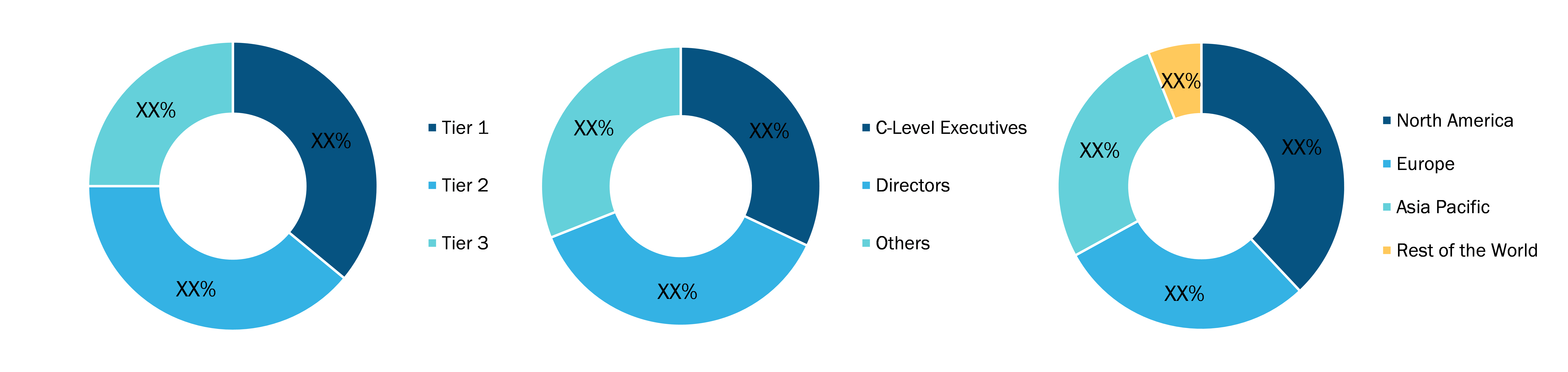
Below is the breakup of our primary respondents by company, designation, and region:
Research Methodology

Once we receive the confirmation from primary research sources or primary respondents, we finalize the base year market estimation and forecast the data as per the macroeconomic and microeconomic factors assessed during data collection.

  1. Data Analysis:

Once data is validated through both secondary as well as primary respondents, we finalize the market estimations by hypothesis formulation and factor analysis at regional and country level.

  • 3.1 Macro-Economic Factor Analysis:

We analyse macroeconomic indicators such the gross domestic product (GDP), increase in the demand for goods and services across industries, technological advancement, regional economic growth, governmental policies, the influence of COVID-19, PEST analysis, and other aspects. This analysis aids in setting benchmarks for various nations/regions and approximating market splits. Additionally, the general trend of the aforementioned components aid in determining the market's development possibilities.

  • 3.2 Country Level Data:

Various factors that are especially aligned to the country are taken into account to determine the market size for a certain area and country, including the presence of vendors, such as headquarters and offices, the country's GDP, demand patterns, and industry growth. To comprehend the market dynamics for the nation, a number of growth variables, inhibitors, application areas, and current market trends are researched. The aforementioned elements aid in determining the country's overall market's growth potential.

  • 3.3 Company Profile:

The “Table of Contents” is formulated by listing and analyzing more than 25 - 30 companies operating in the market ecosystem across geographies. However, we profile only 10 companies as a standard practice in our syndicate reports. These 10 companies comprise leading, emerging, and regional players. Nonetheless, our analysis is not restricted to the 10 listed companies, we also analyze other companies present in the market to develop a holistic view and understand the prevailing trends. The “Company Profiles” section in the report covers key facts, business description, products & services, financial information, SWOT analysis, and key developments. The financial information presented is extracted from the annual reports and official documents of the publicly listed companies. Upon collecting the information for the sections of respective companies, we verify them via various primary sources and then compile the data in respective company profiles. The company level information helps us in deriving the base number as well as in forecasting the market size.

  • 3.4 Developing Base Number:

Aggregation of sales statistics (2020-2022) and macro-economic factor, and other secondary and primary research insights are utilized to arrive at base number and related market shares for 2022. The data gaps are identified in this step and relevant market data is analyzed, collected from paid primary interviews or databases. On finalizing the base year market size, forecasts are developed on the basis of macro-economic, industry and market growth factors and company level analysis.

  1. Data Triangulation and Final Review:

The market findings and base year market size calculations are validated from supply as well as demand side. Demand side validations are based on macro-economic factor analysis and benchmarks for respective regions and countries. In case of supply side validations, revenues of major companies are estimated (in case not available) based on industry benchmark, approximate number of employees, product portfolio, and primary interviews revenues are gathered. Further revenue from target product/service segment is assessed to avoid overshooting of market statistics. In case of heavy deviations between supply and demand side values, all thes steps are repeated to achieve synchronization.

We follow an iterative model, wherein we share our research findings with Subject Matter Experts (SME’s) and Key Opinion Leaders (KOLs) until consensus view of the market is not formulated – this model negates any drastic deviation in the opinions of experts. Only validated and universally acceptable research findings are quoted in our reports.

We have important check points that we use to validate our research findings – which we call – data triangulation, where we validate the information, we generate from secondary sources with primary interviews and then we re-validate with our internal data bases and Subject matter experts. This comprehensive model enables us to deliver high quality, reliable data in shortest possible time.

Your data will never be shared with third parties, however, we may send you information from time to time about our products that may be of interest to you. By submitting your details, you agree to be contacted by us. You may contact us at any time to opt-out.