AI Inference Market Share & Demand Insights by 2031

AI Inference Market Size and Forecast (2021 - 2031), Global and Regional Share, Trend, and Growth Opportunity Analysis Report Report Coverage : by Computer type (GPU, FPGA and CPU), Deployment (CLoud, Edge, On-Premise), Application (Natural Language Processing, Computer vision, Machine learning) End-User (Healthcare, Automotive, Retail and E-Commerce, Finance and Manufacturing) and Geography

  • Report Date : Jan 2026
  • Report Code : TIPRE00042042
  • Category : Technology, Media and Telecommunications
  • Status : Upcoming
  • Available Report Formats : pdf-format excel-format
  • No. of Pages : 150

The AI Inference Market size is projected to reach US$ 230.48 billion by 2031 from US$ 81.25 billion in 2024. The market is expected to register a CAGR of 14.45% during 2025–2031.

AI Inference Market Analysis

The AI inference market is expected to grow strongly. This growth is mainly due to the wide use of generative AI models, the need for quick decisions, and improvements in edge computing. The market is expanding as a result of inference engines are being added to cloud platforms, new energy-saving hardware is being developed, and more companies are using AI for automation and personalization. Additionally, new AI designs like transformer models and large language models (LLMs) are increasing the need for fast and scalable inference solutions in many industries.

AI Inference Market Overview

AI inference refers to the process of deploying trained machine learning models to produce predictions or decisions on new data. This stage is the real-world deployment of AI models in actual environments to provide actionable insights. AI inference is an important aspect of major applications like autonomous cars, fraud detection, healthcare diagnostics, recommendation systems, and conversational AI. The market includes hardware pieces, including GPUs, TPUs, and ASICs, software tools such as TensorRT, ONNX, and Triton, and deployment choices across cloud, edge, and on-premises environments.

Strategic Insights
AI Inference Market Drivers and Opportunities

Market Drivers:

  • Growth of Generative AI and LLMs: The emergence of advanced AI systems and transformer-based models has sharply increased computational requirements, fueling innovation in both inference hardware and software.
  • Adoption of Edge Computing: Organizations are increasingly adopting AI inference at the edge to reduce latency, enhance data privacy, and facilitate real-time analytics across industries, including automotive, healthcare, and manufacturing.
  • Cloud-Based AI Infrastructure: Major public cloud providers, including AWS, Azure, and Google Cloud, have a continual and growing suite of inference platforms that are inherent to the cloud platform and that allow companies to deploy AI models on demand with very little investment in infrastructure.

Market Opportunities:

  • Energy-Efficient Chips for Inference: Major companies like NVIDIA, Intel, and AMD are building targeted chips that minimize power usage with great performance, opening new solutions in mobile and embedded AI spaces.
  • AI Inference-as-a-Service: Cloud providers offer managed inference services that allow small and medium businesses to implement AI capabilities without the need for extensive technical knowledge.
  • Integration with Enterprise Solutions: AI inference is being infused more deeply into ERP, CRM, and analytics software, fueling decision-making automation and improving total operating efficiency.
AI Inference Market Report Segmentation Analysis

The AI inference market share is analyzed across various segments to provide a clearer understanding of its structure, growth potential, and emerging trends. Below is the standard segmentation approach used in most industry reports:

By Compute Type:

  • GPU (Graphics Processing Unit): GPUs hold dominance in the AI inference market as a result of their unmatched parallel processing abilities. Breakthroughs like NVIDIA's Blackwell B200 and AMD's Instinct MI325X are constructing the future of high-performance inference processing.
  • FPGA & CPU: FPGAs and CPUs have applications in certain niche applications and low-power utilization where flexible use, lower latency, or strict power constraints exist.

By Deployment:

  • Cloud: Cloud deployment is preferable due to its scalability, cost-effectiveness, and provision to manage large-scale AI inference workloads geographically across environments.
  • Edge: Edge deployment is witnessing high growth due to the requirements of real-time processing of AI, low latency, and greater privacy in uses like autonomous cars and smart devices.
  • On-Premises: This deployment model is selected by organizations with stringent data governance, security requirements, or regulatory constraints that necessitate full control over data infrastructure.

By Application:

  • Natural Language Processing (NLP): Applied in chatbots, translation services, and voice assistants, NLP continues to be a major area for AI inference, supporting fast-growing models like large language models (LLMs).
  • Computer Vision: Used in facial recognition, medical imaging, surveillance, and industrial automation, computer vision inference requires high-speed processing and accuracy.
  • Machine Learning: AI inference is central to various machine learning applications, enabling model deployment across industries for classification, prediction, and decision-making.
  • Generative AI: This emerging application area includes AI-generated text, images, audio, and video. It demands powerful inference engines capable of real-time content creation.

By End-Use Industry:

  • Healthcare: Medical imaging, patient management systems, and drug discovery utilize AI inference in order to enable faster, more accurate clinical decision-making.
  • Automotive: AI inference powers real-time object detection, safe navigation, and interpretation of sensor data, and is the primary objective for the development of autonomous driving systems.
  • Retail & E-commerce: Retailers leverage AI inference for product recommendations, customer behavior analysis, and stock control.
  • Finance: In financial services, inference plays a central role in detecting fraud, risk modeling, and algorithmic trading, enabling real-time analytics and insight.
  • Manufacturing: AI inference supports predictive maintenance, quality inspection, and automation across smart factories, improving operational efficiency.

By Geography:

  • North America
  • Europe
  • Asia Pacific
  • South & Central America
  • Middle East & Africa

The AI inference market in the Asia Pacific is projected to witness the fastest growth during the forecast period, driven by rapid AI adoption in countries like China, India, Japan, and South Korea, along with increasing investments in edge and cloud infrastructure.

Market Report Scope
AI Inference Market Share Analysis by Geography

Asia Pacific is expected to grow fastest in the coming years. Emerging markets in South & Central America, the Middle East, and Africa also offer untapped opportunities for AI inference technology providers to expand.

The AI inference market shows different growth patterns across regions, influenced by factors such as digital infrastructure, regulatory frameworks, industry automation, and national AI strategies. Below is a summary of market share and trends by region:

1. North America

  • Market Share: Leaders in cloud infrastructure and early AI adoption.
  • Key Factors:
    • Presence of major technology companies (NVIDIA, Intel, Google, Amazon)
    • High demand for real-time analytics and business automation across industries
  • Trends: Shift to hybrid cloud environments and edge-native inference platforms to reduce latency and improve processing efficiency.

2. Europe

  • Market Share: Spurred by GDPR-compliant AI solutions and the region's focus on industrial automation.
  • Key Drivers:
    • Government-sponsored AI research and funding initiatives
    • Industrial applications for energy-efficient AI inference in manufacturing and logistics
  • Trends: Combining AI inference engines with IoT and robotics systems for predictive maintenance and intelligent factory operations.

3. Asia Pacific

  • Market Share: Fastest-growing region due to accelerated digital transformation and AI infrastructure investments.
  • Key Drivers:
    • Robust AI development and investment in nations such as China, India, and South Korea
    • Widespread deployment of mobiles and applications of embedded AI
  • Trends: Increased development and deployment of AI inference in smart city applications, healthcare diagnosis, and consumer devices.

4. South and Central America

  • Market Share: Emerging market with growing AI usage across industries.
  • Key Drivers:
    • Public-private partnerships to upgrade digital infrastructure
    • Greater availability of cloud-based AI solutions for SMEs
  • Trends: Implementation of AI inference in agriculture for yield maximization and logistics for route optimization and effectiveness.

5. Middle East and Africa

  • Market Share: Emerging market with high long-term growth prospects.
  • Key Drivers:
    • National-level AI plans and policy architectures
    • Spending on intelligent infrastructure and innovation clusters
  • Trends: Implementation of AI inference in industries such as energy, public safety, and urban services, as part of larger smart city and e-government initiatives.
AI Inference Market Players Density: Understanding Its Impact on Business Dynamics

High Market Density and Competition

Competition is intensifying due to the Presence of major vendors such as NVIDIA, Intel, AMD, Google, Amazon, and Microsoft. Regional and niche players like Graphcore (United Kingdom) and Tenstorrent (Canada) also contribute to the crowded market landscape.

This competitive environment pushes vendors to differentiate through:

  • Seamless integration with cloud and edge computing platforms
  • Scalable inference solutions suitable for enterprise-grade and consumer-grade applications
  • AI-powered automation to support real-time decision-making across verticals
  • Interoperability with major machine learning frameworks and open APIs

Opportunities and Strategic Moves

  • Collaborate with cloud service providers and enterprises to push AI adoption at scale
  • Embed AI/ML functionality for predictive analytics, personalized user experiences, and process automation

Major Companies operating in the AI Inference Market are:

  1. NVIDIA Corporation – United States
  2. Intel Corporation – United States
  3. Advanced Micro Devices, Inc. (AMD) – United States
  4. Google LLC – United States
  5. Amazon Web Services, Inc. – United States
  6. Microsoft Corporation – United States
  7. Qualcomm Technologies, Inc. – United States
  8. Alibaba Cloud – China
  9. Graphcore – United Kingdom
  10. Tenstorrent – Canada

Disclaimer: The companies listed above are not ranked in any particular order.

Other companies analyzed during the course of research:
  • Cerebras Systems
  • Mythic AI
  • Hailo
  • Groq
  • SambaNova Systems
  • Blaize
  • Gcore
  • Huawei Technologies Co., Ltd.
AI Inference Market News and Recent Developments
  • NVIDIA introduced DGX Spark, the world's smallest AI supercomputer delivering petaflop performance in a compact design. The first unit was hand-delivered to Elon Musk at SpaceX, showcasing its potential for advanced AI workloads in aerospace and robotics.
  • Intel unveiled Crescent Island, a new inference-optimized GPU for data centers. It focuses on energy efficiency and low latency, expanding Intel's AI accelerator portfolio to better compete in large-scale inference markets.
  • AWS launched Quick Suite, an agentic AI workspace that integrates research, business intelligence, and automation tools. This platform simplifies AI model deployment and supports rapid innovation across industries.
  • Azure deployed the world's first GB300 NVL72 cluster to power OpenAI workloads, enabling massive model inference with enhanced speed and scalability, strengthening Microsoft's leadership in AI infrastructure.
  • Qualcomm launched its fastest AI processors for Windows PCs and mobile devices, optimized for on-device inference. This supports real-time AI applications with reduced latency and improved privacy, advancing edge AI capabilities.
AI Inference Market Report Coverage and Deliverables

The "AI Inference Market Size and Forecast (2025–2031)" report provides a detailed analysis of the market covering below areas:

  • AI Inference Market size and forecast at global, regional, and country levels for all the key market segments covered under the scope
  • AI Inference Market trends, as well as market dynamics such as drivers, restraints, and key opportunities
  • Detailed PEST and SWOT analysis
  • AI Inference Market analysis covering key market trends, global and regional framework, major players, regulations, and recent market developments
  • Industry landscape and competition analysis covering market concentration, heat map analysis, prominent players, and recent developments in the AI Inference Market
  • Detailed company profiles
REGIONAL FRAMEWORK
World Geography

Have a question?

Analyst

Naveen

Naveen will walk you through a 15-minute call to present the report’s content and answer all queries if you have any.

Analyst   Speak to Analyst
  • Sample PDF showcases the content structure and the nature of the information with qualitative and quantitative analysis.
  • Request discounts available for Start-Ups & Universities
MARKET PLAYERS
  • Sample PDF showcases the content structure and the nature of the information with qualitative and quantitative analysis.
  • Request discounts available for Start-Ups & Universities
Report Coverage
Report Coverage

Revenue forecast, Company Analysis, Industry landscape, Growth factors, and Trends

Segment Covered
Segment Covered

This text is related
to segments covered.

Regional Scope
Regional Scope

North America, Europe, Asia Pacific, Middle East & Africa, South & Central America

Country Scope
Country Scope

This text is related
to country scope.

Frequently Asked Questions


Who are the major players in the AI inference market?

Prominent companies include NVIDIA, Intel, AMD, Google, Amazon Web Services, Microsoft, Qualcomm, Alibaba Cloud, Graphcore, and Tenstorrent. These vendors are driving innovation through strategic partnerships, advanced chip development, and AI service integration.

What are the key end-use industries for AI inference solutions?

AI inference is being adopted across healthcare (diagnostics, patient monitoring), automotive (autonomous systems), retail (recommendations), finance (risk modeling, fraud detection), and manufacturing (predictive maintenance, automation).

Which compute types are most prevalent in the AI inference market?

GPUs hold a dominant position due to their scalability and speed, followed by ASICs/TPUs for energy-efficient deployments. FPGAs and CPUs are used for low-latency and specialized applications.

What is the AI inference market, and what does it encompass?

The AI inference market refers to the segment of artificial intelligence focused on executing trained models in real-world environments to generate insights or predictions. It includes hardware (GPUs, TPUs, ASICs), software frameworks (TensorRT, ONNX), and deployment modes (cloud, edge, on-premises).

What is driving the growth of the AI inference market?

Key growth drivers include the surge in generative AI and LLM deployments, Demand for real-time decision-making, Proliferation of edge computing, and increasing enterprise integration of AI into automation workflows.

Your Key Concerns Addressed - Question & Answer
Can I view a sample of the report before purchasing?

Yes! We provide a free sample of the report, which includes Report Scope (Table of Contents), report structure, and selected insights to help you assess the value of the full report. Please click on the "Download Sample" button or contact us to receive your copy.

Is analyst support included with the purchase?

Absolutely - analyst assistance is part of the package. You can connect with our analyst post-purchase to clarify report insights, methodology or discuss how the findings apply to your business needs.

What are the next steps once I place an order?

Once your order is successfully placed, you will receive a confirmation email along with your invoice.

• For published reports: You'll receive access to the report within 4-6 working hours via a secured email sent to your email.
• For upcoming reports: Your order will be recorded as a pre-booking. Our team will share the estimated release date and keep you informed of any updates. As soon as the report is published, it will be delivered to your registered email.

Can the report be tailored to suit my specific needs?

We offer customization options to align the report with your specific objectives. Whether you need deeper insights into a particular region, industry segment, competitor analysis, or data cut, our research team can tailor the report accordingly. Please share your requirements with us, and we'll be happy to provide a customized proposal or scope.

In what format is the report delivered?

The report is available in either PDF format or as an Excel dataset, depending on the license you choose.

The PDF version provides the full analysis and visuals in a ready-to-read format. The Excel dataset includes all underlying data tables for easy manipulation and further analysis.
Please review the license options at checkout or contact us to confirm which formats are included with your purchase.

How secure is the payment process on your platform?

Our payment process is fully secure and PCI-DSS compliant.

We use trusted and encrypted payment gateways to ensure that all transactions are protected with industry-standard SSL encryption. Your payment details are never stored on our servers and are handled securely by certified third-party processors.
You can make your purchase with confidence, knowing your personal and financial information is safe with us.

Do you provide special pricing for buying multiple reports?

Yes, we do offer special pricing for bulk purchases.
If you're interested in purchasing multiple reports, we're happy to provide a customized bundle offer or volume-based discount tailored to your needs. Please contact our sales team with the list of reports you're considering, and we'll share a personalized quote.

Can I connect with your team to discuss the report before buying?

Yes, absolutely.
Our team is available to help you make an informed decision. Whether you have questions about the report's scope, methodology, customization options, or which license suits you best, we're here to assist. Please reach out to us at sales@theinsightpartners.com, and one of our representatives will get in touch promptly.

Will I get a billing invoice upon purchase?

Yes, a billing invoice will be automatically generated and sent to your registered email upon successful completion of your purchase.
If you need the invoice in a specific format or require additional details (such as company name, GST, or VAT information), feel free to contact us, and we'll be happy to assist.

Is there support available if I can't access my report?

Yes, certainly.
If you encounter any difficulties accessing or receiving your report, our support team is ready to assist you. Simply reach out to us via email or live chat with your order information, and we'll ensure the issue is resolved quickly so you can access your report without interruption.

The Insight Partners performs research in 4 major stages: Data Collection & Secondary Research, Primary Research, Data Analysis and Data Triangulation & Final Review.

  1. Data Collection and Secondary Research:

As a market research and consulting firm operating from a decade, we have published many reports and advised several clients across the globe. First step for any study will start with an assessment of currently available data and insights from existing reports. Further, historical and current market information is collected from Investor Presentations, Annual Reports, SEC Filings, etc., and other information related to company’s performance and market positioning are gathered from Paid Databases (Factiva, Hoovers, and Reuters) and various other publications available in public domain.

Several associations trade associates, technical forums, institutes, societies and organizations are accessed to gain technical as well as market related insights through their publications such as research papers, blogs and press releases related to the studies are referred to get cues about the market. Further, white papers, journals, magazines, and other news articles published in the last 3 years are scrutinized and analyzed to understand the current market trends.

  1. Primary Research:

The primarily interview analysis comprise of data obtained from industry participants interview and answers to survey questions gathered by in-house primary team.

For primary research, interviews are conducted with industry experts/CEOs/Marketing Managers/Sales Managers/VPs/Subject Matter Experts from both demand and supply side to get a 360-degree view of the market. The primary team conducts several interviews based on the complexity of the markets to understand the various market trends and dynamics which makes research more credible and precise.

A typical research interview fulfils the following functions:

  • Provides first-hand information on the market size, market trends, growth trends, competitive landscape, and outlook
  • Validates and strengthens in-house secondary research findings
  • Develops the analysis team’s expertise and market understanding

Primary research involves email interactions and telephone interviews for each market, category, segment, and sub-segment across geographies. The participants who typically take part in such a process include, but are not limited to:

  • Industry participants: VPs, business development managers, market intelligence managers and national sales managers
  • Outside experts: Valuation experts, research analysts and key opinion leaders specializing in the electronics and semiconductor industry.

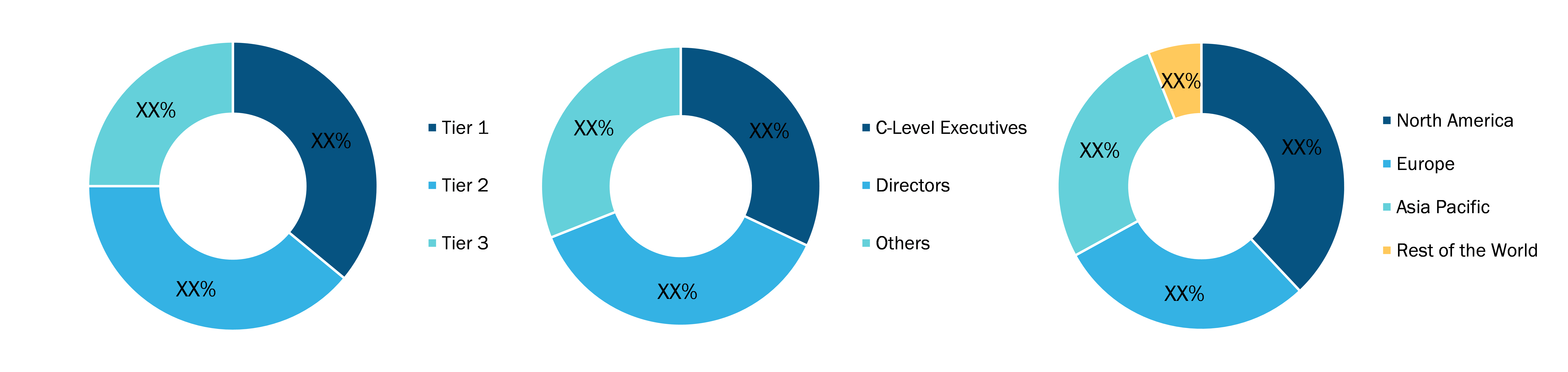
Below is the breakup of our primary respondents by company, designation, and region:
Research Methodology

Once we receive the confirmation from primary research sources or primary respondents, we finalize the base year market estimation and forecast the data as per the macroeconomic and microeconomic factors assessed during data collection.

  1. Data Analysis:

Once data is validated through both secondary as well as primary respondents, we finalize the market estimations by hypothesis formulation and factor analysis at regional and country level.

  • 3.1 Macro-Economic Factor Analysis:

We analyse macroeconomic indicators such the gross domestic product (GDP), increase in the demand for goods and services across industries, technological advancement, regional economic growth, governmental policies, the influence of COVID-19, PEST analysis, and other aspects. This analysis aids in setting benchmarks for various nations/regions and approximating market splits. Additionally, the general trend of the aforementioned components aid in determining the market's development possibilities.

  • 3.2 Country Level Data:

Various factors that are especially aligned to the country are taken into account to determine the market size for a certain area and country, including the presence of vendors, such as headquarters and offices, the country's GDP, demand patterns, and industry growth. To comprehend the market dynamics for the nation, a number of growth variables, inhibitors, application areas, and current market trends are researched. The aforementioned elements aid in determining the country's overall market's growth potential.

  • 3.3 Company Profile:

The “Table of Contents” is formulated by listing and analyzing more than 25 - 30 companies operating in the market ecosystem across geographies. However, we profile only 10 companies as a standard practice in our syndicate reports. These 10 companies comprise leading, emerging, and regional players. Nonetheless, our analysis is not restricted to the 10 listed companies, we also analyze other companies present in the market to develop a holistic view and understand the prevailing trends. The “Company Profiles” section in the report covers key facts, business description, products & services, financial information, SWOT analysis, and key developments. The financial information presented is extracted from the annual reports and official documents of the publicly listed companies. Upon collecting the information for the sections of respective companies, we verify them via various primary sources and then compile the data in respective company profiles. The company level information helps us in deriving the base number as well as in forecasting the market size.

  • 3.4 Developing Base Number:

Aggregation of sales statistics (2020-2022) and macro-economic factor, and other secondary and primary research insights are utilized to arrive at base number and related market shares for 2022. The data gaps are identified in this step and relevant market data is analyzed, collected from paid primary interviews or databases. On finalizing the base year market size, forecasts are developed on the basis of macro-economic, industry and market growth factors and company level analysis.

  1. Data Triangulation and Final Review:

The market findings and base year market size calculations are validated from supply as well as demand side. Demand side validations are based on macro-economic factor analysis and benchmarks for respective regions and countries. In case of supply side validations, revenues of major companies are estimated (in case not available) based on industry benchmark, approximate number of employees, product portfolio, and primary interviews revenues are gathered. Further revenue from target product/service segment is assessed to avoid overshooting of market statistics. In case of heavy deviations between supply and demand side values, all thes steps are repeated to achieve synchronization.

We follow an iterative model, wherein we share our research findings with Subject Matter Experts (SME’s) and Key Opinion Leaders (KOLs) until consensus view of the market is not formulated – this model negates any drastic deviation in the opinions of experts. Only validated and universally acceptable research findings are quoted in our reports.

We have important check points that we use to validate our research findings – which we call – data triangulation, where we validate the information, we generate from secondary sources with primary interviews and then we re-validate with our internal data bases and Subject matter experts. This comprehensive model enables us to deliver high quality, reliable data in shortest possible time.

Your data will never be shared with third parties, however, we may send you information from time to time about our products that may be of interest to you. By submitting your details, you agree to be contacted by us. You may contact us at any time to opt-out.