
AI Inference Market Size, Trends & Growth by 2034
AI Inference Market Size and Forecast (2021 - 2034), Global and Regional Share, Trend, and Growth Opportunity Analysis Report Report Coverage : by Computer type (GPU, FPGA and CPU), Deployment (CLoud, Edge, On-Premise), Application (Natural Language Processing, Computer vision, Machine learning) End-User (Healthcare, Automotive, Retail and E-Commerce, Finance and Manufacturing) and Geography
- Status : Data Released
- Report Code : TIPRE00042042
- Category : Technology, Media and Telecommunications
- No. of Pages : 150
- Available Report Formats :


- Last update date : August 12, 2026


2025 Market Size
US$ 120.01 Bn
Base year value
2034 Forecast
US$ 491.52 Bn
Projected by 2034
CAGR 2026-2034
16.96 %
Growth rate
Addressable Market
US$ 2,562.11 Bn
(2026-2034)
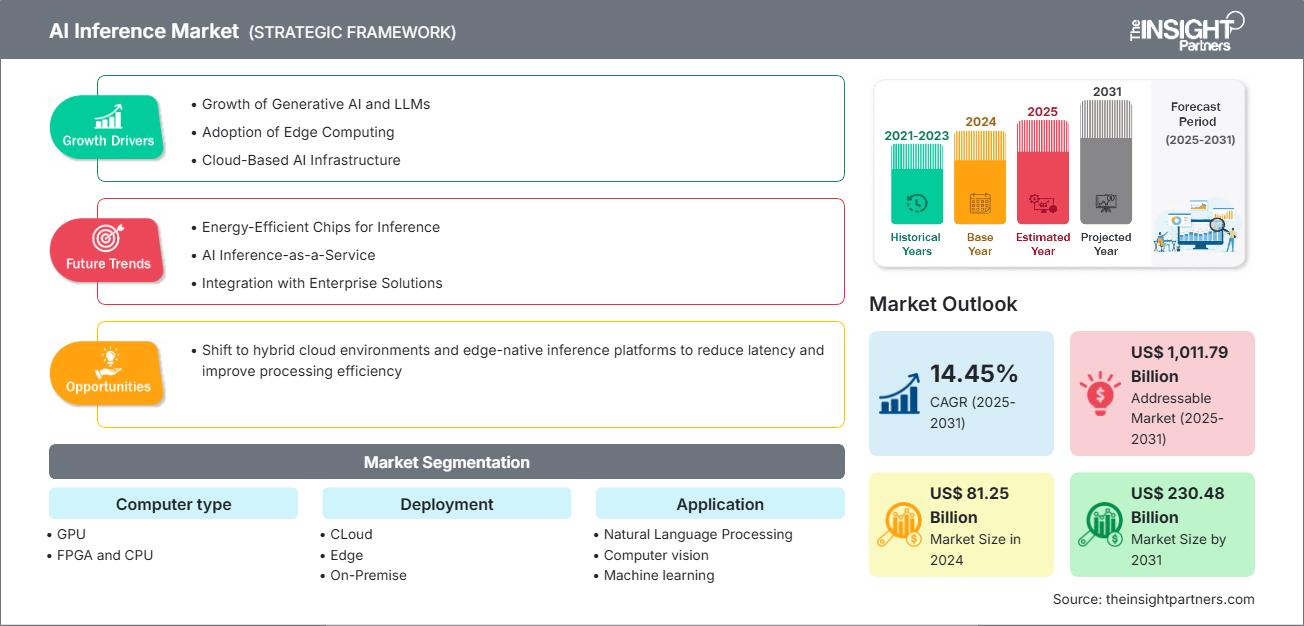
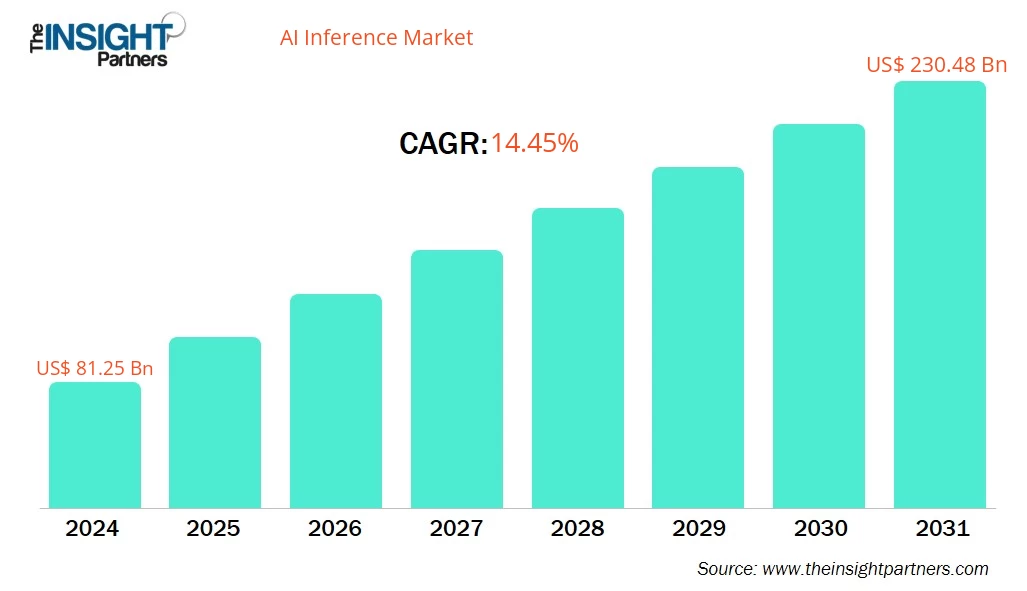
The AI inference market is projected to expand from US$ 120.01 Billion in 2025 to US$ 491.52 Billion by 2034, registering a CAGR of 16.96% during 2026–2034. The market growth is being driven by enterprises deploying trained models in a production setting, an increase in the implementation of real-time prediction solutions, and increasing needs for efficient inference capabilities in cloud, edge, and on-premises settings.
North America is the most developed demand hub due to hyperscale data centers, AI software ecosystems, sophisticated semiconductors, and robust enterprise adoption rates. North America AI Inference Market Size is bolstered by cloud AI platforms, AI PCs, healthcare diagnostics, finance automation, and autonomous mobility use cases which demand low latency and increased model throughput.
AI Inference Market Assessment and Insights
- North America: Share in 2025 is assessed at 39–42%, with CAGR between 2026–2034 of 15.5–17.5%, supported by hyperscaler infrastructure, semiconductor leadership, and enterprise AI modernization.
- US: Share of North America in 2025 is assessed at 78–82%, with CAGR between 2026–2034 of 15.8–17.8%, driven by cloud AI, defense, healthcare, and finance deployments.
- Europe: Share in 2025 is assessed at 22–25%, with CAGR between 2026–2034 of 14.5–16.5%, led by the UK, Germany, France, Italy, and Spain.
- Asia Pacific: Share in 2025 is assessed at 26–30%, with CAGR between 2026–2034 of 18.0–20.0%, led by China, Japan, South Korea, India, and Australia.
- Largest Segment: GPU accounted for an estimated 50–54% market share in 2025, with CAGR between 2026–2034 of 16.0–18.0%, due to broad use in cloud and data center inference.
- High Growth Segment: Edge deployment represented 18–22% market share in 2025, with CAGR between 2026–2034 of 19.0–21.0%, supported by industrial IoT, vehicles, devices, and privacy-sensitive workloads.
- Key companies analyzed in detail: NVIDIA Corporation, Intel Corporation, Advanced Micro Devices, Inc., Google LLC, Amazon Web Services, Inc., Microsoft Corporation, Qualcomm Technologies, Inc., Alibaba Cloud, Graphcore Limited, and Tenstorrent Inc.
Source: The Insight Partners' analysis based on proprietary research, government publications, company annual reports, investor presentations, industry databases, and expert interviews.
The market transitioned from experimentation based on accelerators to production infrastructure. While previous inference workload was confined to data centers, adoption will transition towards distribution due to a trade-off between latencies, costs, privacy, and energy savings. Market development in AI inference space is being driven by software stacks, memory bandwidths, model compression, and processor-based serving cost reduction per query.
The growth will be propelled by the sovereignty of AI, automation of enterprises, AI-based devices, and vertical implementations in industries that are governed by regulations. The use of cloud inference will be highly important as far as large-scale models are concerned, whereas edge and on-premises solutions will gain more ground wherever the latency is important.
AI Inference Market Report Scope
| Report Attribute | Details |
|---|---|
| Market size in 2025 | US$ 120.01 Billion |
| Market Size by 2034 | US$ 491.52 Billion |
| Global CAGR (2026 - 2034) | 16.96% |
| Historical Data | 2021-2024 |
| Forecast period | 2026-2034 |
AI Inference Market Analysis
The demand drivers for our product portfolio include generative AI assistants, computer vision inspection, fraud scoring, clinical decision support, and conversational commerce. Each of these application areas requires models to be run repeatedly post-training; hence, inference cost and latency are the key operational parameters. The supply chain includes semiconductor chips, memory, networking, software compilers, cloud instances, model serving platforms, and vertical applications.
Dynamics in the AI inference market report are affected by advanced packaging constraints, availability of high-speed memory chips, and regular refresh cycles of accelerators. According to the market report on inference, customers tend to develop a diversified portfolio of GPUs, CPUs, FPGAs, custom accelerators, and NPU inference at the edge.
NVIDIA Corporation takes the lead in competition by providing GPUs and inference software, whereas Advanced Micro Devices, Inc. and Intel Corporation compete on accelerators' capabilities, open ecosystems, and performance per dollar value. Custom silicon and managed cloud services for inference are provided by Google LLC and Amazon Web Services, Inc., whereas Microsoft Corporation builds up its AI infrastructure via cloud partnerships.
Market players place themselves according to not only their ability to produce specific hardware but also according to full-stack inference services. Qualcomm Technologies Inc. is specialized in devices and inference at the edge, whereas Alibaba Cloud has cloud services in China and Asia-based clouds. There are other companies which focus specifically on alternative architecture to serve the models and perform computations.
● REPORT CUSTOMIZATION
Tailor This Report To Align With Your Specific Business Requirements
This report can be customized to align precisely with your business objectives, scope, and target markets. Customization options include tailored segmentation, geography, competitive analysis, and strategic insights to support informed decision-making.
Customize This Report →WHAT YOU CAN ADJUST
- ● Segmentations
- ● Geography
- ● Competitive Analysis
- ● Language Preferences
AI Inference Market: Strategic Insights
Regional Insights
North America AI inference market
North America accounted for an estimated 39–42% share in 2025 and is expected to grow at a CAGR of 15.5–17.5% during 2026–2034. The region benefits from concentration of cloud providers, semiconductor design leadership, venture-backed AI software firms, and large enterprise budgets for production AI.
AI Inference Market Share in North America is backed by implementation of AI within healthcare imaging, fraud detection, retail personalization, and AI development tools. Large investments in building out data centers and availability of high performance accelerators enable organizations to scale inference workloads while providing enhanced performance and reliability.
U.S. AI inference Market
The U.S. represented an estimated 78–82% of North America in 2025 and is expected to grow at a CAGR of 15.8–17.8% during 2026–2034. Demand is led by hyperscalers, AI software vendors, federal programs, autonomous systems, and large financial institutions adopting real-time model deployment.
Company presence is especially strong, with NVIDIA Corporation, Intel Corporation, Advanced Micro Devices, Inc., Google LLC, Amazon Web Services, Inc., Microsoft Corporation, and Qualcomm Technologies, Inc. shaping infrastructure, chips, cloud platforms, and edge devices for high-volume inference workloads.
Europe AI inference Market
Europe accounted for an estimate of 22-25% in 2025 and will see a CAGR of 14.5-16.5% during the period 2026-2034. The UK excels in AI services and fintech, Germany leads in industrial AI inference in manufacturing, automotive systems, and engineering processes.
France, Italy, and Spain support the region through digitalization in the public sector, modernization of the healthcare industry, and automation of enterprises. The data governance focus of regulations promotes demand for on-premises and sovereign cloud inference among banks, healthcare companies, telecom companies, and government entities.
APAC AI inference Market
The Asia Pacific region has contributed around 26-30% of shares in 2025 and is estimated to witness growth at a CAGR of 18.0-20.0% from 2026 to 2034. The dominant volume in China includes cloud-based AI, smart manufacturing, surveillance analytics, and digital platforms; whereas, Japan and South Korea are developing their capabilities in robotics, automotive, and electronics.
On the other hand, India and Australia are focusing on enterprise AI, telecom analytics, and public cloud. Data centers, local semiconductor programs, AI-powered consumer electronics, and computer vision/NLP/ML inference are some factors driving regional growth.
Middle East & Africa AI inference Market
Middle East & Africa is expected to grow at a CAGR of 16.5–18.5% during 2026–2034. Saudi Arabia and the UAE are investing in AI infrastructure, smart cities, energy optimization, and sovereign cloud platforms, creating demand for scalable inference systems.
South Africa contributes through banking, telecom, mining, and retail analytics. Rest of MEA adoption remains selective but is improving as cloud availability, data center capacity, and digital government programs expand. Energy, infrastructure, and security applications are central to regional demand.
Segmentation Analysis
Computer Type
Computer Type is expected to grow at a CAGR of 16.0–18.0% during 2026–2034. The market scope across computer type is shaped by workload complexity, latency requirements, power budgets, and model architecture. GPU remains dominant, while CPU and FPGA retain relevance for cost-sensitive, deterministic, or specialized workloads.
- GPU: GPU demand is strongest in cloud and data center inference because parallel processing, mature software support, and high memory bandwidth help serve large models and high-volume enterprise applications.
- FPGA: FPGA systems support use cases requiring configurable acceleration, deterministic latency, and power efficiency, especially in telecom, industrial automation, defense, and embedded inference environments.
- CPU: CPU-based inference remains important for lighter models, batch workloads, legacy enterprise infrastructure, and applications where flexibility and deployment simplicity outweigh maximum acceleration needs.
Deployment
Deployment is expected to grow at a CAGR of 17.0–19.0% during 2026–2034. Cloud dominates large-scale inference, but edge and on-premise adoption are expanding as enterprises require lower latency, data control, and operational resilience. Deployment choices increasingly depend on cost per inference, regulation, and workload sensitivity.
- Cloud: Cloud deployment provides elastic capacity, managed model serving, and access to advanced accelerators, making it the preferred option for large language models and enterprise-scale AI services.
- Edge: Edge deployment supports real-time decisions near data sources, reducing latency and bandwidth costs for vehicles, industrial sensors, medical devices, retail systems, and smart infrastructure.
- On-Premise: On-premise deployment is favored by regulated enterprises needing data residency, security, predictable performance, and integration with private infrastructure for sensitive inference workloads.
Application
Application is expected to grow at a CAGR of 16.5–18.5% during 2026–2034. Natural language processing, computer vision, and machine learning workloads are expanding as enterprises embed AI into workflows, customer interfaces, and operational systems. Model serving efficiency is now a strategic factor in application economics.
- Natural Language Processing: NLP inference powers chatbots, summarization, translation, search, documentation, and customer support automation, with demand rising as enterprises adopt language models at scale.
- Computer vision: Computer vision inference supports inspection, diagnostics, surveillance, retail analytics, driver assistance, and robotics, requiring low latency and high throughput across cloud and edge environments.
- Machine learning: Machine learning inference remains broad across forecasting, recommendation, fraud detection, risk scoring, predictive maintenance, and personalization applications in enterprise and consumer markets.
End-User
End-User is expected to grow at a CAGR of 16.0–18.0% during 2026–2034. Adoption is strongest where decisions must be automated, personalized, or performed in real time. Healthcare, automotive, retail and e-commerce, finance, and manufacturing use inference to improve productivity, accuracy, safety, and customer responsiveness.
- Healthcare: Healthcare uses inference for imaging support, triage, clinical documentation, patient monitoring, and operational analytics, with deployment choices shaped by privacy, accuracy, and regulatory requirements.
- Automotive: Automotive inference supports driver assistance, cabin monitoring, predictive maintenance, simulation, and connected vehicle services, requiring high reliability and efficient edge processing.
- Retail and E-Commerce: Retail and e-commerce use inference for personalization, recommendation engines, inventory signals, visual search, pricing intelligence, and customer service automation across digital and store channels.
- Finance: Finance relies on inference for fraud detection, credit scoring, compliance surveillance, customer engagement, and real-time risk analytics, often favoring secure cloud or controlled on-premise environments.
- Manufacturing: Manufacturing applies inference to machine vision, defect detection, digital twins, predictive maintenance, robotics, and process optimization, with strong demand for edge and on-premise deployment.
Opportunity Snapshot
| End-User | Revenue Contribution | Trend Tag | Adoption Stage |
| Healthcare | High | Clinical AI | Scaling |
| Automotive | Medium | Vehicle Edge | Scaling |
| Retail and E-Commerce | High | Personalization | Mature |
| Finance | High | Fraud Scoring | Mature |
| Manufacturing | Medium | Visual Inspection | Scaling |
AI Inference Market Growth Drivers and Impact Analysis
Production AI Workloads Are Increasing Inference Demand
The shift in enterprise AI from pilot projects to production will drive more inference calls from customer service, code, search, analytics, image recognition, and workflow automation applications. Once deployed, each model requires repeat compute usage post-training. Costs shift from one-off exploration to continuous infrastructure utilization. The industry effects can be seen in cloud instance usage, purchase of accelerators, and use of optimization tools as firms look for quicker and cheaper predictions.
Edge AI Expands Low-Latency Deployment
The technology of Edge AI is gaining importance in automobiles, factories, hospitals, retail stores, cameras, and consumer electronics due to the fact that decisions have to be made close to the data source. Processing of all the data in the cloud leads to additional latency and high bandwidth consumption. Edge inference helps overcome these constraints by processing models on the device itself or at an edge of the network.
Cloud Providers Are Scaling Managed Inference Platforms
Cloud vendors are bundling acceleration technology, networking, model hosting software, security, and observability capabilities into inference-as-a-service solutions. Such solutions lower deployment challenges for companies that lack AI infrastructure know-how. At the same time, they enable users to scale their consumption based on demand and experiment with different model architectures. The result is an increase in the use of cloud inference services for language, recommendation, and automation use cases.
AI Inference Market Future Trends
Cost-Optimized Model Serving
AI inference market trends will increasingly focus on reducing cost per token, image, prediction, or transaction. Enterprises are expected to use quantization, sparsity, caching, batching, routing, and smaller task-specific models to reduce compute requirements. Hardware buyers will compare total serving economics instead of peak performance alone. This trend will benefit vendors that combine accelerators with mature software, monitoring tools, and workload-specific optimization across cloud, edge, and private infrastructure.
Sovereign and Private AI Inference
Regulated industries and governments are expected to increase demand for sovereign and private inference environments. Data residency, auditability, and control over sensitive information will influence architecture decisions in healthcare, banking, defense, public services, and critical infrastructure. This trend supports on-premise systems, regional cloud infrastructure, confidential computing, and enterprise-managed model serving. Vendors that address governance, security, and predictable performance will be better positioned for these workloads.
AI Inference Market Opportunities
Vertical AI Platforms for Regulated Industries
Specialized inference platforms for healthcare, finance, manufacturing, and government represent a high-value opportunity. These sectors need more than raw compute because deployment requires compliance, data controls, workflow integration, accuracy monitoring, and explainability. Providers that combine optimized infrastructure with domain-specific models, governance features, and service-level commitments can capture premium demand. The opportunity is strongest where inference supports measurable outcomes such as faster diagnosis, lower fraud losses, fewer defects, or improved case handling.
Edge Inference for Industrial and Device Ecosystems
Industrial and device ecosystems create opportunity for edge inference across robotics, cameras, sensors, medical devices, vehicles, and retail systems. Buyers want compact, power-efficient platforms that can run models reliably without constant cloud connectivity. This opens revenue pools for semiconductor vendors, embedded software providers, device manufacturers, and systems integrators. Adoption will accelerate where latency, safety, privacy, or network cost makes local processing economically superior to centralized inference.
Frequently Asked Questions

- Comprehensive Market Sizing and Forecast Analysis
- Detailed Segmentation Analysis
- In-Depth Market Dynamics Assessment
- Regional and Country-Level Insights
- Competitive Landscape and Company Benchmarking
- Strategic Business Intelligence
Recent Reports
Testimonials

The Insight Partners' SCADA System Market report is comprehensive, with valuable insights on current trends and future forecasts. The team was highly professional, responsive, and supportive throughout. We are very satisfied and highly recommend their services.
RAN KEDEM Partner, Reali Technologies LTDs
I requested a report on a very specific software market and the team produced the report in a few days. The information was very relevant and well presented. I then requested some changes and additions to the report. The team was again very responsive and I got the final report in less than a week.
JEAN-HERVE JENN Chairman, Future Analytica
We worked with The Insight Partners for an important market study and forecast. They gave us clear insights into opportunities and risks, which helped shape our plans. Their research was easy to use and based on solid data. It helped us make smart, confident decisions. We highly recommend them.
PIYUSH NAGPAL Sr. Vice President, High Beam Global
The Insight Partners delivered insightful, well-structured market research with strong domain expertise. Their team was professional and responsive throughout. The user-friendly website made accessing industry reports seamless. We highly recommend them for reliable, high-quality research services
YUKIHIKO ADACHI CEO, Deep Blue, LLC.
This is the first time I have purchased a market report from The Insight Partners.While I was unsure at first, I visited their web site and felt more comfortable to take the risk and purchase a market report.I am completely satisfied with the quality of the report and customer service. I had several questions and comments with the initial report, but after a couple of dialogs over email with their analyst I believe I have a report that I can use as input to our strategic planning process.Thank you so much for taking the extra time and making this a positive experience.I will definitely recommend your service to others and you will be my first call when we need further market data.
JOHN SUZUKI President and Chief Executive Officer, Board Director, BK Technologies
I wish to appreciate your support and the professionalism you displayed in the course of attending to my request for information regarding to infectious disease IVD market in Nigeria. I appreciate your patience, your guidance, and the fact that you were willing to offer a discount, which eventually made it possible for us to close a deal. I look forward to engaging The Insight Partners in the future, all thanks to the impression you have created in me as a result of this first encounter.
DR CHIJIOKE ONYIA MANAGING DIRECTOR, PineCrest Healthcare Ltd.Reason to Buy
- Informed Decision-Making
- Understanding Market Dynamics
- Competitive Analysis
- Identifying Emerging Markets
- Customer Insights
- Market Forecasts
- Risk Mitigation
- Boosting Operational Efficiency
- Strategic Planning
- Investment Justification
- Tracking Industry Innovations
- Aligning with Regulatory Trends





 Get Free Sample for