Area Rugs Market Size, Demand & Growth by 2034

Area Rugs Market Size and Forecast (2021 - 2034), Global and Regional Share, Trend, and Growth Opportunity Analysis Report Coverage: By Type (Wool, Nylon, Synthetic Fibers, and Others) and End-Use (Residential and Nonresidential)

  • Report Date : Feb 2026
  • Report Code : TIPRE00028150
  • Category : Consumer Goods
  • Status : Published
  • Available Report Formats : pdf-format excel-format
  • No. of Pages : 150

The global Area Rugs market size is projected to reach US$ 19.70 billion by 2034 from US$ 13.03 billion in 2025. The market is anticipated to register a CAGR of 4.7% during the forecast period 2026–2034. Key market dynamics include continued demand from residential remodeling, hospitality refresh cycles, and the rise of washable, stain-resistant, and made-to-order offerings. Additionally, the market is expected to benefit from omnichannel retail expansion, consumer preference for sustainable fibers (wool, jute, recycled PET), and manufacturer investments in faster, flexible production and distribution.

Area Rugs Market Analysis

The area rugs market analysis shows a transition from décor accents to modular design tools that define zones in open plans, boost acoustics, and deliver quick upgrades without permanent flooring changes, an attractive value proposition for homeowners, renters, and commercial operators alike. Strategically, leaders are doubling down on mass customization and speed (e.g., made‑to‑measure programs with 2–3‑week lead times), digital visualization, and washable constructions to reduce post‑purchase friction and returns. At the same time, portfolio rationalization is visible: vendors are focusing on high‑velocity looks (textural neutrals, warm earth tones, and geometric abstractions) and fiber engineering (solution‑dyed synthetics for stain resistance; natural fibers for sustainability narratives). Supply‑side moves, new distribution hubs, vertical integration in yarns, and selective M&A, aim to compress lead times and secure input costs. For market entry or expansion, the actionable playbook is: (1) target washable and pet‑friendly segments in mid‑market channels; (2) partner with large home‑improvement retailers on exclusive/private‑label capsules; and (3) build configurable SKUs (size/shape/edge finishes) backed by nimble US/EU fulfillment to meet designer and D2C expectations.

Area Rugs Market Overview

Area rugs serve as a major part of home décor and flooring. Demand correlates with housing turnover, renovation cycles, and the enduring consumer inclination to refresh interiors seasonally at low structural cost. Material innovation (washable synthetics, recycled fibers) and format evolution (runners, oversized, contour shapes) have broadened use cases across living rooms, bedrooms, corridors, and hospitality public spaces. Retail is omnichannel: marketplaces and home‑improvement chains drive volume, while specialty brands and designer collaborations set trends. Sustainability themes, ethical sourcing, durability, and circularity, continue to shape assortments and brand storytelling. For instance, the market in the US benefit from frequent interior refreshes, DIY culture, and robust home‑improvement retail. Private‑label exclusives, designer collaborations, and fast shipping set expectations. Consumers favor washable, pet‑friendly, and sustainable options, while trade buyers seek custom sizes and quick‑turn hospitality solutions supported by reliable domestic distribution networks.

Customize Research To Suit Your Requirement

We can optimize and tailor the analysis and scope which is unmet through our standard offerings. This flexibility will help you gain the exact information needed for your business planning and decision making.

Area Rugs Market: Strategic Insights

area-rugs-market
Market Size Value inUS$ 11.35 billion in 2022
Market Size Value byUS$ 15.00 billion by 2028
Growth rateCAGR of 4.8% from 2023 to 2028
Forecast Period2023-2028
Base Year2022
Analyst Image

Shejal

Have a question?

Shejal will walk you through a 15-minute call to present the report’s content and answer all queries if you have any.

Analyst Image  Speak to Analyst
Area Rugs Market Drivers and Opportunities

Market Drivers:

  • Renovation & Aesthetics Upgrade: Ongoing remodeling and décor refreshes in residential and hospitality spaces elevate demand for flexible, high-impact textiles that define zones, improve acoustics, and soften hard‑surface flooring.
  • E‑commerce & Omnichannel Expansion: Broad online assortments, visualization tools, and rapid fulfillment from enhanced distribution hubs are accelerating purchase frequency and expanding category access.
  • Material & Performance Innovation: Solution‑dyed synthetics, stain‑resistant fibers, and washable constructions increase durability and ease of care, while natural fibers address sustainability preferences.

Market Opportunities:

  • Mass Customization & Made‑to‑Order: Partnerships enabling custom size/shape rugs at approachable price points can unlock premium mix and loyalty, especially when ship windows stay within weeks.
  • Hospitality & Commercial Refresh: Quick‑turn area rug programs for lobbies, corridors, and guest rooms, offering acoustics, comfort, and brandable aesthetics, are poised for growth with short minimums and curated running lines.
  • Sustainable & Traceable Lines: Collections using recycled PET, responsibly sourced wool/jute, and transparent material health claims can differentiate with large retailers and design‑conscious consumers.
Area Rugs Market Report Segmentation Analysis

The Area Rugs Market share is analyzed across various segments to provide a clearer understanding of its structure, growth potential, and emerging trends. Below is the standard segmentation approach used in most industry reports:

By Type:

  • Wool: Premium hand‑tufted and knotted options valued for resilience, natural feel, and thermal comfort, favored in upscale residential and boutique hospitality.
  • Nylon: Solution‑dyed, performance‑oriented rugs prioritizing stain resistance, colorfastness, and longevity in higher‑traffic settings.
  • Synthetic Fibers: Polypropylene, polyester, acrylic blends offering affordability, broad design latitude, and increasingly, washable formats for family and pet households.
  • Others: Cotton, jute, sisal, and blends that deliver natural aesthetics, tactile interest, and indoor/outdoor versatility.

By End‑Use:

  • Residential: Living rooms, bedrooms, dining, and multi‑purpose open plans where rugs define zones and add comfort, warmth, and décor cohesion.
  • Nonresidential: Hospitality, offices, retail, and institutional environments that require acoustics, durability, and brand‑aligned design statements.

By Geography:

  • North America
  • Europe
  • Asia Pacific
  • South & Central America
  • Middle East & Africa
Market Report ScopeArea Rugs Market Share Analysis by Geography

Asia‑Pacific is expected to grow fastest in the coming years. Emerging markets in South & Central America, the Middle East, and Africa also present untapped opportunities for value and premium suppliers to scale through design‑forward, washable, and sustainable products aligned with evolving channel structures.

The Area Rugs market is undergoing a significant transformation, driven by renovation cycles, e‑commerce convenience, and the convergence of performance materials with sustainable narratives. Below is a summary of market share dynamics and trends by region:

North America

  • Market Share: Brand‑rich market anchored by big‑box and specialty retailers with strong D2C penetration.
  • Key Drivers:
    • Home improvement culture and décor refreshes driving frequent replacement cycles.
    • Expansion of private labels and exclusives, including custom programs and washable formats.
    • Investments in domestic distribution capacity improving lead times and service levels.
  • Trends: Scaling of made‑to‑order and contour shapes; neutral and warm palettes with texture; pet‑friendly and stain‑resistant constructions.

Europe

  • Market Share: Mature markets with high design sensitivity and sustainability standards spanning residential and hospitality channels.
  • Key Drivers:
    • Preference for natural fibers and transparent material health claims.
    • Hospitality refurbishments that value acoustics and soft‑surface comfort in public spaces.
    • Demand for washable, low‑maintenance rugs suited to urban living.
  • Trends: Textural minimalism, warm neutrals, and modular area rug programs that complement resilient floors.

Asia‑Pacific

  • Market Share: Fastest‑growing region, propelled by urbanization, rising disposable incomes, and strong export‑led manufacturing bases.
  • Key Drivers:
    • Expanding middle class investing in décor and multi‑room rugs.
    • E‑commerce adoption and social commerce shaping discovery and purchase.
    • Regional production capabilities enabling competitive pricing and breadth of designs.
  • Trends: Contemporary geometrics and warm tones; machine‑woven performance products; washable foldable concepts gaining traction.

South & Central America

  • Market Share: An emerging cluster with rising appetite for fashion‑forward yet affordable rugs through general merchandise and home centers.
  • Key Drivers:
    • Growing online availability and marketplace penetration.
    • Preference for easy‑care synthetics suited to varied climates.
    • Boutique hospitality and short‑term rentals creating niche premium demand.
  • Trends: Natural‑fiber looks at value price points; washable constructions; regionally inspired palettes.

Middle East & Africa

  • Market Share: Developing but design‑attuned markets with deep cultural affinity for rugs and expanding modern retail.
  • Key Drivers:
    • Hospitality and retail build‑outs seeking durable, statement rugs.
    • Preference for warm palettes and high-texture surfaces.
    • Growing interest in washable, easy-care offerings for urban households.
  • Trends: Machine-woven performance collections; contemporary re‑imagining of classic motifs; sustainable narratives in premium tiers.

High Market Density and Competition

Competition is intensifying due to the presence of established leaders such as Amer Rugs Inc., Capel Inc., Dalyn Rug Co., Faze Three Ltd, Golden Carpets Ltd., Maa Collections, Nodi Handmade Rugs Ltd, Riviere Rugs Ltd, and Riztex USA Inc., which also contribute to a diverse and rapidly expanding market landscape.

This competitive environment pushes vendors to differentiate through:

  • Premiumization & Performance: Washable, stain‑resistant, and pet‑friendly lines; performance storytelling around solution‑dyed synthetics and resilient backings.
  • Design & Assortment Velocity: Frequent capsule drops and warm‑toned, texture‑rich collections aligned to current interiors trends.
  • Vertical Capabilities & Fast Fulfillment: Domestic distribution hubs and yarn/backing integration to reduce lead times and stabilize costs.
  • Retail Partnerships & Exclusives: Private‑label and exclusive programs with big‑box and online majors to secure shelf and search visibility.

Opportunities and Strategic Moves

  • Partner with Home‑Improvement & Pure‑Play E‑comm Channels: Launch made‑to‑order and exclusive capsules with shortened ship windows and configurable options (size, contour shapes, edge finishes).
  • Hospitality‑Ready Programs: Offer low‑minimum, quick‑turn running line area rugs with acoustic and comfort benefits tailored to lobbies and guestrooms.
  • M&A and Capacity Investments: Pursue targeted acquisitions to add brands/design archives and expand US/EU distribution footprints; invest in yarn/coloration flexibility to improve resilience.

Major Companies operating in the Area Rugs Market are:

  1. Amer Rugs Inc
  2. Capel Inc
  3. Dalyn Rug Co
  4. Faze Three Ltd
  5. Golden Carpets Ltd.
  6. Maa Collections
  7. Nodi Handmade Rugs Ltd
  8. Riviere Rugs Ltd
  9. Riztex USA Inc
  10. Sams International Inc

Disclaimer: The companies listed above are not ranked in any particular order.

Area Rugs Market News and Recent Developments
  • In April 2025, The Natco Home Group, one of the US's largest and most dynamic suppliers of flooring, home décor, and area rugs, announced that it had signed a deal to acquire the Orian Rugs brand from parent company SP Orian, LLC.
  • In January 204, Rugs USA announced the launch of Custom by Rugs USA™, a new program that offered made-to-order, custom‑sized area rugs directly to consumers. Rugs USA partnered with Shaw Industries Group, Inc., a worldwide leader in flooring and other surface solutions for indoor and outdoor residential and commercial spaces, to offer more than 200 styles from Anderson Tuftex and Shaw Floors, each provided at an approachable price point.
Area Rugs Market Report Coverage and Deliverables

The Area Rugs Market Size and Forecast (2021–2034) report provides a detailed analysis of the market covering below areas:

  • Area Rugs Market size and forecast at global, regional, and country levels for all the key market segments covered under the scope
  • Area Rugs Market trends, as well as market dynamics such as drivers, restraints, and key opportunities
  • Detailed PEST and SWOT analysis
  • Area Rugs Market analysis covering key market trends, global and regional framework, major players, regulations, and recent market developments
  • Industry landscape and competition analysis covering market concentration, heat map analysis, prominent players, and recent developments in the Area Rugs Market.
  • Detailed company profiles
Report Coverage
Report Coverage

Revenue forecast, Company Analysis, Industry landscape, Growth factors, and Trends

Segment Covered
Segment Covered

Type, and End-Use

Regional Scope
Regional Scope

North America, Europe, Asia Pacific, Middle East & Africa, South & Central America

Country Scope
Country Scope

Argentina, Australia, Brazil, Canada, China, France, Germany, India, Italy, Japan, Mexico, Russian Federation, Saudi Arabia, South Africa, South Korea, United Arab Emirates, United Kingdom, United States

Frequently Asked Questions


What are the emerging trends in regional markets?

Key trends include custom and washable rugs in North America, sustainability‑led assortments and textural minimalism in Europe, and fast‑fashion machine-woven and foldable/washable concepts in the Asia‑Pacific, each reinforced by localized fulfillment and marketplace expansion.

Who are the major companies operating in the Area Rugs market?

Key players include Amer Rugs Inc., Capel Inc., Dalyn Rug Co., Faze Three Ltd, Golden Carpets Ltd., Maa Collections, Nodi Handmade Rugs Ltd, Riviere Rugs Ltd, Sams International Inc, and Riztex USA Inc.

What are the main challenges in the Area Rugs market?

Key challenges include volatility in fiber costs, differentiation in a crowded online environment, ensuring colorfastness and durability in washable constructions, and aligning sustainability claims with evolving regulatory and retailer standards.

Which is the fastest-growing region in the Area Rugs market?

Asia‑Pacific is the fastest-growing region, supported by urbanization, rising disposable incomes, and strong regional manufacturing ecosystems that enable breadth of design and competitive pricing.

What is the projected size of the Area Rugs market by 2034?

The market is expected to reach approximately US$ 19.70 billion by 2034 from US$ 13.03 billion in 2025. The market is anticipated to register a CAGR of 4.7%.

Your Key Concerns Addressed - Question & Answer
Can I view a sample of the report before purchasing?

Yes! We provide a free sample of the report, which includes Report Scope (Table of Contents), report structure, and selected insights to help you assess the value of the full report. Please click on the "Download Sample" button or contact us to receive your copy.

Is analyst support included with the purchase?

Absolutely - analyst assistance is part of the package. You can connect with our analyst post-purchase to clarify report insights, methodology or discuss how the findings apply to your business needs.

What are the next steps once I place an order?

Once your order is successfully placed, you will receive a confirmation email along with your invoice.

• For published reports: You'll receive access to the report within 4-6 working hours via a secured email sent to your email.
• For upcoming reports: Your order will be recorded as a pre-booking. Our team will share the estimated release date and keep you informed of any updates. As soon as the report is published, it will be delivered to your registered email.

Can the report be tailored to suit my specific needs?

We offer customization options to align the report with your specific objectives. Whether you need deeper insights into a particular region, industry segment, competitor analysis, or data cut, our research team can tailor the report accordingly. Please share your requirements with us, and we'll be happy to provide a customized proposal or scope.

In what format is the report delivered?

The report is available in either PDF format or as an Excel dataset, depending on the license you choose.

The PDF version provides the full analysis and visuals in a ready-to-read format. The Excel dataset includes all underlying data tables for easy manipulation and further analysis.
Please review the license options at checkout or contact us to confirm which formats are included with your purchase.

How secure is the payment process on your platform?

Our payment process is fully secure and PCI-DSS compliant.

We use trusted and encrypted payment gateways to ensure that all transactions are protected with industry-standard SSL encryption. Your payment details are never stored on our servers and are handled securely by certified third-party processors.
You can make your purchase with confidence, knowing your personal and financial information is safe with us.

Do you provide special pricing for buying multiple reports?

Yes, we do offer special pricing for bulk purchases.
If you're interested in purchasing multiple reports, we're happy to provide a customized bundle offer or volume-based discount tailored to your needs. Please contact our sales team with the list of reports you're considering, and we'll share a personalized quote.

Can I connect with your team to discuss the report before buying?

Yes, absolutely.
Our team is available to help you make an informed decision. Whether you have questions about the report's scope, methodology, customization options, or which license suits you best, we're here to assist. Please reach out to us at sales@theinsightpartners.com, and one of our representatives will get in touch promptly.

Will I get a billing invoice upon purchase?

Yes, a billing invoice will be automatically generated and sent to your registered email upon successful completion of your purchase.
If you need the invoice in a specific format or require additional details (such as company name, GST, or VAT information), feel free to contact us, and we'll be happy to assist.

Is there support available if I can't access my report?

Yes, certainly.
If you encounter any difficulties accessing or receiving your report, our support team is ready to assist you. Simply reach out to us via email or live chat with your order information, and we'll ensure the issue is resolved quickly so you can access your report without interruption.

The Insight Partners performs research in 4 major stages: Data Collection & Secondary Research, Primary Research, Data Analysis and Data Triangulation & Final Review.

  1. Data Collection and Secondary Research:

As a market research and consulting firm operating from a decade, we have published many reports and advised several clients across the globe. First step for any study will start with an assessment of currently available data and insights from existing reports. Further, historical and current market information is collected from Investor Presentations, Annual Reports, SEC Filings, etc., and other information related to company’s performance and market positioning are gathered from Paid Databases (Factiva, Hoovers, and Reuters) and various other publications available in public domain.

Several associations trade associates, technical forums, institutes, societies and organizations are accessed to gain technical as well as market related insights through their publications such as research papers, blogs and press releases related to the studies are referred to get cues about the market. Further, white papers, journals, magazines, and other news articles published in the last 3 years are scrutinized and analyzed to understand the current market trends.

  1. Primary Research:

The primarily interview analysis comprise of data obtained from industry participants interview and answers to survey questions gathered by in-house primary team.

For primary research, interviews are conducted with industry experts/CEOs/Marketing Managers/Sales Managers/VPs/Subject Matter Experts from both demand and supply side to get a 360-degree view of the market. The primary team conducts several interviews based on the complexity of the markets to understand the various market trends and dynamics which makes research more credible and precise.

A typical research interview fulfils the following functions:

  • Provides first-hand information on the market size, market trends, growth trends, competitive landscape, and outlook
  • Validates and strengthens in-house secondary research findings
  • Develops the analysis team’s expertise and market understanding

Primary research involves email interactions and telephone interviews for each market, category, segment, and sub-segment across geographies. The participants who typically take part in such a process include, but are not limited to:

  • Industry participants: VPs, business development managers, market intelligence managers and national sales managers
  • Outside experts: Valuation experts, research analysts and key opinion leaders specializing in the electronics and semiconductor industry.

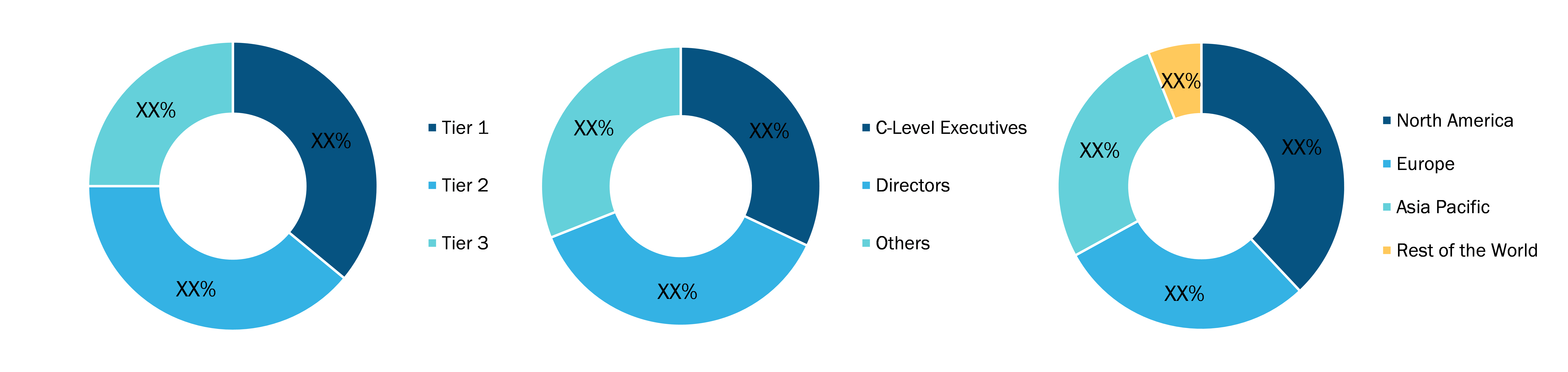
Below is the breakup of our primary respondents by company, designation, and region:
Research Methodology

Once we receive the confirmation from primary research sources or primary respondents, we finalize the base year market estimation and forecast the data as per the macroeconomic and microeconomic factors assessed during data collection.

  1. Data Analysis:

Once data is validated through both secondary as well as primary respondents, we finalize the market estimations by hypothesis formulation and factor analysis at regional and country level.

  • 3.1 Macro-Economic Factor Analysis:

We analyse macroeconomic indicators such the gross domestic product (GDP), increase in the demand for goods and services across industries, technological advancement, regional economic growth, governmental policies, the influence of COVID-19, PEST analysis, and other aspects. This analysis aids in setting benchmarks for various nations/regions and approximating market splits. Additionally, the general trend of the aforementioned components aid in determining the market's development possibilities.

  • 3.2 Country Level Data:

Various factors that are especially aligned to the country are taken into account to determine the market size for a certain area and country, including the presence of vendors, such as headquarters and offices, the country's GDP, demand patterns, and industry growth. To comprehend the market dynamics for the nation, a number of growth variables, inhibitors, application areas, and current market trends are researched. The aforementioned elements aid in determining the country's overall market's growth potential.

  • 3.3 Company Profile:

The “Table of Contents” is formulated by listing and analyzing more than 25 - 30 companies operating in the market ecosystem across geographies. However, we profile only 10 companies as a standard practice in our syndicate reports. These 10 companies comprise leading, emerging, and regional players. Nonetheless, our analysis is not restricted to the 10 listed companies, we also analyze other companies present in the market to develop a holistic view and understand the prevailing trends. The “Company Profiles” section in the report covers key facts, business description, products & services, financial information, SWOT analysis, and key developments. The financial information presented is extracted from the annual reports and official documents of the publicly listed companies. Upon collecting the information for the sections of respective companies, we verify them via various primary sources and then compile the data in respective company profiles. The company level information helps us in deriving the base number as well as in forecasting the market size.

  • 3.4 Developing Base Number:

Aggregation of sales statistics (2020-2022) and macro-economic factor, and other secondary and primary research insights are utilized to arrive at base number and related market shares for 2022. The data gaps are identified in this step and relevant market data is analyzed, collected from paid primary interviews or databases. On finalizing the base year market size, forecasts are developed on the basis of macro-economic, industry and market growth factors and company level analysis.

  1. Data Triangulation and Final Review:

The market findings and base year market size calculations are validated from supply as well as demand side. Demand side validations are based on macro-economic factor analysis and benchmarks for respective regions and countries. In case of supply side validations, revenues of major companies are estimated (in case not available) based on industry benchmark, approximate number of employees, product portfolio, and primary interviews revenues are gathered. Further revenue from target product/service segment is assessed to avoid overshooting of market statistics. In case of heavy deviations between supply and demand side values, all thes steps are repeated to achieve synchronization.

We follow an iterative model, wherein we share our research findings with Subject Matter Experts (SME’s) and Key Opinion Leaders (KOLs) until consensus view of the market is not formulated – this model negates any drastic deviation in the opinions of experts. Only validated and universally acceptable research findings are quoted in our reports.

We have important check points that we use to validate our research findings – which we call – data triangulation, where we validate the information, we generate from secondary sources with primary interviews and then we re-validate with our internal data bases and Subject matter experts. This comprehensive model enables us to deliver high quality, reliable data in shortest possible time.

Your data will never be shared with third parties, however, we may send you information from time to time about our products that may be of interest to you. By submitting your details, you agree to be contacted by us. You may contact us at any time to opt-out.