The global nutritional bars market size is projected to reach US$ 13.50 billion by 2034 from US$ 8.34 billion in 2025. The market is anticipated to register a CAGR of 5.5% during the forecast period 2026–2034. Key market dynamics include a heightening global focus on protein fortification and functional snacking, rising consumer awareness regarding the metabolic benefits of high-fiber diets, and a significant shift toward clean-label, plant-based formulations. Additionally, the market is expected to benefit from the growing popularity of keto and paleo diets, expansion in organized fitness and wellness retail channels across emerging economies, and the increasing inclusion of nutritional bars in high-value health segments like clinical nutrition and sports performance.
Nutritional Bars Market AnalysisThe nutritional bars market analysis shows a shift toward high-value functional snacking as consumers prioritize macro-nutrient balance and ingredient transparency. Procurement trends indicate the market is splitting into mass-market conventional protein bars and high-growth, allergen-friendly, and gluten-free niche segments. Strategic opportunities are emerging in specialty meal-replacement and keto-compliant bars, where low glycemic indexes and high-quality fat sources offer a clear competitive advantage over traditional high-sugar snack alternatives. The analysis also notes that market expansion depends on flavoring innovation to mask botanical protein notes and the logistical efficiency of temperature-controlled supply chains for "fresh-bar" formats. Competitive differentiation now stands out depending on branding that tells a story and highlights non-GMO sourcing, sustainable packaging, and transparent supply chains. This approach helps manufacturers command premium prices in a crowded landscape of health-conscious consumers.
Nutritional Bars Market OverviewNutritional bars have evolved from niche athletic supplements to mainstream lifestyle products. Nutritional bars now include functional fiber bars, brain-health bars with nootropics, and pediatric nutrition bars. Both global food companies and D2C startups compete in this market, using protein sources such as whey, pea, and cricket. Growing demand for convenient meal-replacement options among health-conscious consumers in North America and Europe has increased the popularity of nutritional bars as a portable wellness solution. North America leads in revenue due to its established fitness culture, while Asia-Pacific is advancing in ingredient innovation and retail adoption. The US market is the most developed, driven by health-focused millennials and the broad availability of functional snacks. Competition among brands is fueling greater flavor variety and the inclusion of superfoods like collagen, MCT oil, and ancient grains.
Customize Research To Suit Your Requirement
We can optimize and tailor the analysis and scope which is unmet through our standard offerings. This flexibility will help you gain the exact information needed for your business planning and decision making.
Nutritional Bars Market: Strategic Insights
Market Size Value in US$ 7,100.96 Million in 2022 Market Size Value by US$ 9,838.38 Million by 2028 Growth rate CAGR of 5.6% from 2022 to 2028 Forecast Period 2022-2028 Base Year 2022
Shejal
Have a question?
Shejal will walk you through a 15-minute call to present the report’s content and answer all queries if you have any.
Speak to Analyst
Nutritional Bars Market Drivers and OpportunitiesCustomize Research To Suit Your Requirement
We can optimize and tailor the analysis and scope which is unmet through our standard offerings. This flexibility will help you gain the exact information needed for your business planning and decision making.
Nutritional Bars Market: Strategic Insights
| Market Size Value in | US$ 7,100.96 Million in 2022 |
| Market Size Value by | US$ 9,838.38 Million by 2028 |
| Growth rate | CAGR of 5.6% from 2022 to 2028 |
| Forecast Period | 2022-2028 |
| Base Year | 2022 |
Shejal
Have a question?
Shejal will walk you through a 15-minute call to present the report’s content and answer all queries if you have any.
Speak to Analyst
Market Drivers:
- Rising Demand for On-the-Go Functional Nutrition: The fast-paced lifestyle of urban populations has made portable, nutrient-dense bars a preferred replacement for traditional sit-down meals, driving volume across all demographics.
- Mainstreaming of Fitness and Bodybuilding: The expansion of gym memberships and home-fitness trends has sustained high demand for protein-heavy inputs, with consumers trading up to high-performance formulations.
- Rapid Expansion of E-commerce and Subscription Models: Online retail has removed shelf-space barriers for niche brands. This is particularly evident in the rapid adoption of specialized bars (e.g., vegan, soy-free) in North America and Europe.
Market Opportunities:
- Expansion into Clinical and Geriatric Nutrition: Beyond the gym, nutritional bars offer significant opportunities as delivery vehicles for vitamins and minerals specifically formulated for the elderly and those recovery from illness.
- Growth in Emerging APAC and MEA Corridors: Forming strategic partnerships between Western-based brands and local distributors in China, India, and the UAE may facilitate access to high-margin segments where premium snacking is a status symbol.
- Diversification into Sustainable and Upcycled Ingredients: There is a growing opportunity for producers to target eco-conscious Gen Z consumers through the use of upcycled ingredients and plastic-free, compostable packaging.
The Nutritional Bars Market share is analyzed across various segments to provide a clearer understanding of its structure, growth potential, and emerging trends. Below is the standard segmentation approach used in most industry reports:
By Type:
- Protein Bars: The dominant segment, driven by athletes and consumers seeking satiety and muscle recovery solutions.
- High-Fiber Bars: A fast-growing niche focused on digestive health, weight management, and steady energy release.
By Category:
- Gluten-Free: A rapidly expanding segment that aligns with global allergen-free trends, increasingly preferred by consumers with celiac disease or gluten sensitivities.
- Conventional: The primary volume driver, benefiting from established supply chains and cost efficiencies in the mass-market snacking sector.
By Distribution Channel:
- Supermarkets & Hypermarkets: Remains the primary channel for household purchases, benefiting from the expansion of "health and wellness" aisles.
- Online Retail: The fastest-rising channel, enabling D2C brands to reach global audiences and offer subscription-based bulk purchasing.
- Convenience Stores: Offers a vital touchpoint for impulse, grab-and-go purchases in urban and transit hubs.
By Geography:
- North America
- Europe
- Asia Pacific
- South & Central America
- Middle East & Africa
Market Report Scope
Nutritional Bars Market Share Analysis by GeographyNorth America currently leads the market, and Asia-Pacific is expected to grow fastest in the coming years. Emerging markets in the Middle East and Africa also have many untapped opportunities for premium functional snack manufacturers to expand their reach.
1. North America
- Market Share: Holds the largest share globally driven by a deeply ingrained snack culture and a high focus on preventative health.
- Key Drivers:
- Rising consumer preference for high-protein, low-sugar profiles in daily diets to manage weight and metabolic health.
- Strong presence of market leaders like General Mills and Simply Good Foods, providing robust distribution and marketing reach.
- Early adoption of innovative ingredients like plant-based collagen and adaptogens to target "wellness" beyond simple satiety.
- Trends: Scaling of keto-certified products and the successful adoption of refrigerated "fresh" bars to appeal to the "whole food" consumer who shops the grocery store perimeter.
2. Europe
- Market Share: A significant segment anchored by strict labeling regulations and a high demand for organic and non-GMO nutritional snacks.
- Key Drivers:
- High awareness of vegan and vegetarian lifestyles, particularly in the UK and Germany, driving a surge in plant-based protein bars.
- Robust fitness infrastructure and a long-standing tradition of outdoor endurance sports like cycling and hiking.
- Emphasis on food safety and transparency, which builds high consumer trust in locally manufactured, "clean-label" brands.
- Trends: A strategic shift toward sugar-reduction technologies and the use of sustainable European-grown protein sources like fava beans and lupin to meet environmental targets.
3. Asia-Pacific
- Market Share: The fastest-growing region, with China and Japan leading the adoption of "beauty-from-within" and functional snacks.
- Key Drivers:
- Massive urbanization and a rising middle class seeking westernized lifestyle products that offer convenience and health.
- Government-supported health initiatives (especially in China and India) to combat rising lifestyle-related diseases like diabetes and obesity.
- Rapidly growing fitness culture, with gym and yoga studio memberships driving the demand for portable, post-workout protein.
- Trends: Heavy reliance on e-commerce platforms like Tmall and JD.com, and the infusion of traditional regional ingredients (e.g., matcha, ginseng, and goji berries) into westernized bar formats.
4. South and Central America
- Market Share: An emerging market with Brazil accounting for a significant regional market.
- Key Drivers:
- Increasing urbanization and a fast-paced lifestyle making on-the-go snacking a necessity for working professionals in major metros.
- Rising participation in sports and national-level athletic events, boosting the demand for energy and protein-focused bars.
- Growing preference for Mediterranean-style diets among high-income segments, favoring bars made with tropical fruits and natural sweeteners.
- Trends: Growth of "farm-to-table" boutique brands and the adoption of localized flavor profiles like Açaí and Dulce de Leche to compete with international imports.
5. Middle East and Africa
- Market Share: A developing market with significant growth in GCC countries (Saudi Arabia, UAE).
- Key Drivers:
- Strategic alignment with national health goals like Saudi Vision 2030, which aims to improve the quality of life and encourage active lifestyles.
- High demand for nutrient-dense snacks among a young, tech-savvy population and large expatriate communities.
- Expansion of modern retail channels and specialized "health zones" within hypermarkets across the Gulf region.
- Trends: Implementation of modern logistics to handle heat-sensitive products, and a focus on high-protein, "shelf-stable" variants that cater to both the athletic and pediatric segments.
Competition is intensifying due to the presence of established leaders such as Mars Inc (Kind LLC), General Mills, and Kellogg Co. Regional innovators like Simply Good Foods and Clif Bar & Co, alongside niche North American players like Perfect Bar LLC and Rise Bar, also contribute to a diverse and rapidly expanding market landscape. This competitive environment pushes vendors to differentiate through:
- Premiumization and Functional Branding: Positioning bars as superior nutritional tools by emphasizing clean-label ingredients and high-quality protein sources.
- Product Diversification: Moving beyond "chocolate-peanut" to include savory flavors, seasonal limited editions, and bars tailored to specific dietary needs like low-FODMAP.
- Supply Chain Transparency: Managing the entire process from farm-sourced ingredients to sustainable manufacturing to meet ethical standards.
- Healthy Aging and Sarcopenia Prevention: Capitalize on the demographic shift by marketing high-protein, fiber-enriched bars specifically for the 60+ population to support muscle maintenance and digestive health.
- E-commerce and DTC Expansion: Leverage direct-to-consumer (DTC) models and subscription services to bypass traditional retail barriers, allowing smaller brands to offer customized "pick-and-mix" boxes that cater to individualized flavor and nutrient preferences.
- The Simply Good Foods Co
- Clif Bar & Co
- General Mills Inc
- The Kellogg Co
- Rise Bar Inc
- The Quaker Oats Co
- Perfect Bar LLC
- Mars Inc
- Kind LLC
Disclaimer: The companies listed above are not ranked in any particular order.
Nutritional Bars Market News and Recent Developments- In January 2026, Zydus Wellness’ RiteBite Max Protein launched a new range of millet-based wafer protein bars, combining a familiar wafer format with 10 g of protein and traditional grains. The launch reflects evolving consumer demand for everyday, lighter protein snacks and supports innovation within the nutritional bars segment.
- In October 2025, Ready® announced a nationwide retail partnership with The Vitamin Shoppe®, launching its best-selling protein bars across more than 640 U.S. stores and online. The rollout includes an exclusive new Iced Oatmeal Cookie flavor, strengthening Ready®’s presence in the fast-growing functional and protein bars segment.
The "Nutritional Bars Market Size and Forecast (2021–2034)" report provides a detailed analysis of the market covering below areas:
- Nutritional Bars Market size and forecast at global, regional, and country levels for all the key market segments covered under the scope
- Nutritional Bars Market trends, as well as market dynamics such as drivers, restraints, and key opportunities
- Detailed PEST and SWOT analysis
- Nutritional Bars Market analysis covering key market trends, global and regional framework, major players, regulations, and recent market developments
- Industry landscape and competition analysis covering market concentration, heat map analysis, prominent players, and recent developments in the Nutritional Bars Market.
- Detailed company profiles
Report Coverage
Revenue forecast, Company Analysis, Industry landscape, Growth factors, and Trends

Segment Covered
Type, Category, and Distribution Channel

Regional Scope
North America, Europe, Asia Pacific, Middle East & Africa, South & Central America

Country Scope
Argentina, Australia, Brazil, Canada, China, France, Germany, India, Italy, Japan, Mexico, Russian Federation, Saudi Arabia, South Africa, South Korea, United Arab Emirates, United Kingdom, United States
Frequently Asked Questions
Key players include Kind LLC (Mars), Clif Bar, Simply Good Foods, Kellogg, and General Mills.
Challenges include the rising cost of high-quality protein isolates, the struggle to balance taste with low-sugar profiles, and the high competition from other functional snack formats like protein cookies and chips.
Asia-Pacific is the fastest-growing region, fueled by rising disposable incomes and a surge in fitness awareness in urban centers.
Trends include the shift toward "fresh" refrigerated bars in North America, organic and fiber-rich formulations in Europe, and the rise of traditional functional ingredients in Asia-Pacific.
The market is expected to reach approximately US$ 13.50 billion, growing from a 2025 valuation of US$ 8.34 billion.
Yes! We provide a free sample of the report, which includes Report Scope (Table of Contents), report structure, and selected insights to help you assess the value of the full report. Please click on the "Download Sample" button or contact us to receive your copy.
Absolutely - analyst assistance is part of the package. You can connect with our analyst post-purchase to clarify report insights, methodology or discuss how the findings apply to your business needs.
Once your order is successfully placed, you will receive a confirmation email along with your invoice.
• For published reports: You'll receive access to the report within 4-6 working hours via a secured email sent to your email.
• For upcoming reports: Your order will be recorded as a pre-booking. Our team will share the estimated release date and keep you informed of any updates. As soon as the report is published, it will be delivered to your registered email.
We offer customization options to align the report with your specific objectives. Whether you need deeper insights into a particular region, industry segment, competitor analysis, or data cut, our research team can tailor the report accordingly. Please share your requirements with us, and we'll be happy to provide a customized proposal or scope.
The report is available in either PDF format or as an Excel dataset, depending on the license you choose.
The PDF version provides the full analysis and visuals in a ready-to-read format. The Excel dataset includes all underlying data tables for easy manipulation and further analysis.
Please review the license options at checkout or contact us to confirm which formats are included with your purchase.
Our payment process is fully secure and PCI-DSS compliant.
We use trusted and encrypted payment gateways to ensure that all transactions are protected with industry-standard SSL encryption. Your payment details are never stored on our servers and are handled securely by certified third-party processors.
You can make your purchase with confidence, knowing your personal and financial information is safe with us.
Yes, we do offer special pricing for bulk purchases.
If you're interested in purchasing multiple reports, we're happy to provide a customized bundle offer or volume-based discount tailored to your needs. Please contact our sales team with the list of reports you're considering, and we'll share a personalized quote.
Yes, absolutely.
Our team is available to help you make an informed decision. Whether you have questions about the report's scope, methodology, customization options, or which license suits you best, we're here to assist. Please reach out to us at sales@theinsightpartners.com, and one of our representatives will get in touch promptly.
Yes, a billing invoice will be automatically generated and sent to your registered email upon successful completion of your purchase.
If you need the invoice in a specific format or require additional details (such as company name, GST, or VAT information), feel free to contact us, and we'll be happy to assist.
Yes, certainly.
If you encounter any difficulties accessing or receiving your report, our support team is ready to assist you. Simply reach out to us via email or live chat with your order information, and we'll ensure the issue is resolved quickly so you can access your report without interruption.
The Insight Partners performs research in 4 major stages: Data Collection & Secondary Research, Primary Research, Data Analysis and Data Triangulation & Final Review.
- Data Collection and Secondary Research:
As a market research and consulting firm operating from a decade, we have published many reports and advised several clients across the globe. First step for any study will start with an assessment of currently available data and insights from existing reports. Further, historical and current market information is collected from Investor Presentations, Annual Reports, SEC Filings, etc., and other information related to company’s performance and market positioning are gathered from Paid Databases (Factiva, Hoovers, and Reuters) and various other publications available in public domain.
Several associations trade associates, technical forums, institutes, societies and organizations are accessed to gain technical as well as market related insights through their publications such as research papers, blogs and press releases related to the studies are referred to get cues about the market. Further, white papers, journals, magazines, and other news articles published in the last 3 years are scrutinized and analyzed to understand the current market trends.
- Primary Research:
The primarily interview analysis comprise of data obtained from industry participants interview and answers to survey questions gathered by in-house primary team.
For primary research, interviews are conducted with industry experts/CEOs/Marketing Managers/Sales Managers/VPs/Subject Matter Experts from both demand and supply side to get a 360-degree view of the market. The primary team conducts several interviews based on the complexity of the markets to understand the various market trends and dynamics which makes research more credible and precise.
A typical research interview fulfils the following functions:
- Provides first-hand information on the market size, market trends, growth trends, competitive landscape, and outlook
- Validates and strengthens in-house secondary research findings
- Develops the analysis team’s expertise and market understanding
Primary research involves email interactions and telephone interviews for each market, category, segment, and sub-segment across geographies. The participants who typically take part in such a process include, but are not limited to:
- Industry participants: VPs, business development managers, market intelligence managers and national sales managers
- Outside experts: Valuation experts, research analysts and key opinion leaders specializing in the electronics and semiconductor industry.
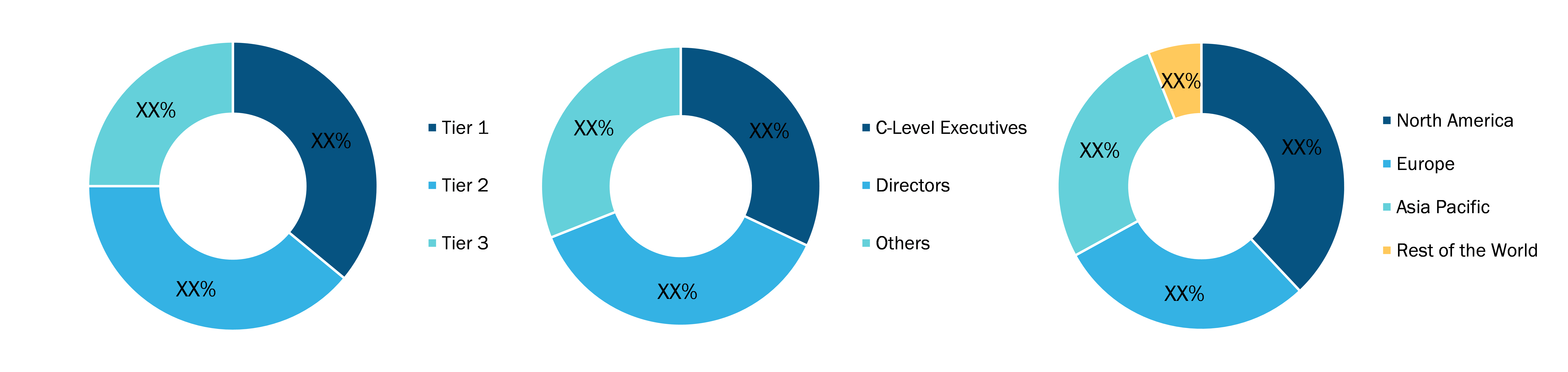
Below is the breakup of our primary respondents by company, designation, and region:
Once we receive the confirmation from primary research sources or primary respondents, we finalize the base year market estimation and forecast the data as per the macroeconomic and microeconomic factors assessed during data collection.
- Data Analysis:
Once data is validated through both secondary as well as primary respondents, we finalize the market estimations by hypothesis formulation and factor analysis at regional and country level.
- 3.1 Macro-Economic Factor Analysis:
We analyse macroeconomic indicators such the gross domestic product (GDP), increase in the demand for goods and services across industries, technological advancement, regional economic growth, governmental policies, the influence of COVID-19, PEST analysis, and other aspects. This analysis aids in setting benchmarks for various nations/regions and approximating market splits. Additionally, the general trend of the aforementioned components aid in determining the market's development possibilities.
- 3.2 Country Level Data:
Various factors that are especially aligned to the country are taken into account to determine the market size for a certain area and country, including the presence of vendors, such as headquarters and offices, the country's GDP, demand patterns, and industry growth. To comprehend the market dynamics for the nation, a number of growth variables, inhibitors, application areas, and current market trends are researched. The aforementioned elements aid in determining the country's overall market's growth potential.
- 3.3 Company Profile:
The “Table of Contents” is formulated by listing and analyzing more than 25 - 30 companies operating in the market ecosystem across geographies. However, we profile only 10 companies as a standard practice in our syndicate reports. These 10 companies comprise leading, emerging, and regional players. Nonetheless, our analysis is not restricted to the 10 listed companies, we also analyze other companies present in the market to develop a holistic view and understand the prevailing trends. The “Company Profiles” section in the report covers key facts, business description, products & services, financial information, SWOT analysis, and key developments. The financial information presented is extracted from the annual reports and official documents of the publicly listed companies. Upon collecting the information for the sections of respective companies, we verify them via various primary sources and then compile the data in respective company profiles. The company level information helps us in deriving the base number as well as in forecasting the market size.
- 3.4 Developing Base Number:
Aggregation of sales statistics (2020-2022) and macro-economic factor, and other secondary and primary research insights are utilized to arrive at base number and related market shares for 2022. The data gaps are identified in this step and relevant market data is analyzed, collected from paid primary interviews or databases. On finalizing the base year market size, forecasts are developed on the basis of macro-economic, industry and market growth factors and company level analysis.
- Data Triangulation and Final Review:
The market findings and base year market size calculations are validated from supply as well as demand side. Demand side validations are based on macro-economic factor analysis and benchmarks for respective regions and countries. In case of supply side validations, revenues of major companies are estimated (in case not available) based on industry benchmark, approximate number of employees, product portfolio, and primary interviews revenues are gathered. Further revenue from target product/service segment is assessed to avoid overshooting of market statistics. In case of heavy deviations between supply and demand side values, all thes steps are repeated to achieve synchronization.
We follow an iterative model, wherein we share our research findings with Subject Matter Experts (SME’s) and Key Opinion Leaders (KOLs) until consensus view of the market is not formulated – this model negates any drastic deviation in the opinions of experts. Only validated and universally acceptable research findings are quoted in our reports.
We have important check points that we use to validate our research findings – which we call – data triangulation, where we validate the information, we generate from secondary sources with primary interviews and then we re-validate with our internal data bases and Subject matter experts. This comprehensive model enables us to deliver high quality, reliable data in shortest possible time.

Get Free Sample For