The global plant-based ham market size is projected to reach US$ 1,420.85 million by 2034 from US$ 643.49 million in 2025. The market is anticipated to register a CAGR of 9.2% during the forecast period 2026–2034.
Key market dynamics include an accelerating global shift toward veganism and vegetarianism, rising consumer awareness regarding the health risks associated with processed red meats, and significant advancements in food texturization technologies. Additionally, the market is expected to benefit from the expansion of plant-based deli sections in mainstream supermarkets, the growing popularity of meat-free cold cut alternatives for convenience meals, and the increasing inclusion of plant-based ham in quick-service restaurant menus and breakfast sandwich formats.
Plant-Based Ham Market AnalysisThe plant-based ham market analysis indicates a transition from niche health-store products to mainstream grocery staples as manufacturers achieve better parity in taste and texture with traditional pork. Procurement trends show a diversification of protein sources beyond soy, with pea, wheat, and even mycoprotein gaining traction to satisfy clean-label and allergen-free demands. Strategic opportunities are emerging in the premium charcuterie segment, where smoked, cured, and artisanal plant-based hams are positioned for high-margin gourmet experiences. The analysis also notes that market expansion is heavily influenced by the flexitarian demographic, consumers who do not strictly follow a vegan diet but seek to reduce their meat intake for health and environmental reasons. Competitive differentiation now hinges on clean-label formulations that minimize artificial additives and sodium while maximizing high-protein claims.
Plant-Based Ham Market OverviewPlant-based ham has evolved from simple soy-based loaves to sophisticated, multi-textured products, including slices, rolls, and whole roasts. Plant-based ham features bioengineered options that mimic the fat marbling and smoky flavor profiles of traditional ham using advanced emulsification and fermentation techniques. Both global food companies and specialized vegan startups compete in this market, leveraging various distribution channels from traditional retail to direct-to-consumer platforms. Growing demand for convenient, ready-to-eat protein sources among busy urban populations in Europe and North America has solidified plant-based ham's role as a portable wellness solution. Europe currently leads in revenue due to its deep-rooted deli culture, while North America and Asia-Pacific are advancing in ingredient innovation and retail adoption. The US market is the most developed, driven by health-focused millennials and the broad availability of functional snacks. Both global food companies and D2C startups compete in this sector, using advanced protein sources to replicate traditional textures. Innovation is fueling greater flavor variety and the inclusion of clean-label ingredients.
Customize Research To Suit Your Requirement
We can optimize and tailor the analysis and scope which is unmet through our standard offerings. This flexibility will help you gain the exact information needed for your business planning and decision making.
Plant-Based Ham Market: Strategic Insights
| Market Size Value in | US$ 494.17 Million in 2022 |
| Market Size Value by | US$ 1,010.45 Million by 2028 |
| Growth rate | CAGR of 12.7% from 2022 to 2028 |
| Forecast Period | 2022-2028 |
| Base Year | 2022 |
Shejal
Have a question?
Shejal will walk you through a 15-minute call to present the report’s content and answer all queries if you have any.
Speak to Analyst
Market Drivers:
- Superior Nutritional Profile and Health Consciousness: Plant-based ham is typically cholesterol-free and lower in saturated fats compared to animal-based counterparts. This nutritional benefit, along with growing interest in heart-healthy diets, is driving its popularity.
- Premiumization of the Global Deli Category: The expansion of gourmet plant-based retail and specialty deli counters has sustained high demand for high-quality ham substitutes. As consumers trade up to artisanal experiences, plant-based charcuterie continues to see stable volume gains.
- Rapid Expansion of Digital and E-commerce Channels: Online retail has removed traditional geographic barriers for niche plant-based meats. This is particularly evident in the rapid adoption of shelf-stable and frozen plant-based ham products in regions like Asia-Pacific and North America.
Market Opportunities:
- Expansion into Foodservice and Breakfast Menus: Beyond retail slices, plant-based ham offers significant opportunities in high-protein breakfast sandwiches and pizza toppings for major restaurant chains.
- Growth in Emerging APAC Corridors: Forming strategic partnerships between Western plant-based suppliers and Asian distributors may facilitate access to high-margin market segments in China and Singapore, where demand for premium, clean-label meat alternatives is increasing.
- Diversification into Specialty Certifications: There is a growing opportunity for producers to target specific demographics through certifications such as Organic, Non-GMO, and Halal, as seen in recent successful retail expansions in the North American and European markets.
The Plant-Based Ham Market share is analyzed across various segments to provide a clearer understanding of its structure, growth potential, and emerging trends. Below is the standard segmentation approach used in industry reports:
By Product Type:
- Slices and Strips: Remains the primary segment for daily consumption, benefiting from high demand in the sandwich and cold-cut category. It is the dominant volume driver due to its convenience and versatility.
- Rolls: A versatile format often preferred by foodservice providers and deli counters for custom slicing. This segment allows for varied culinary applications in both commercial and home kitchens.
- Roasts: A high-value seasonal segment that aligns with holiday traditions and festive meals. It is increasingly preferred by consumers who prioritize a centerpiece for meat-free celebrations.
By Distribution Channel:
- Supermarkets & Hypermarkets: Remains the primary channel for plant-based deli meats, benefiting from the expansion of dedicated vegan and vegetarian refrigerated sections in mainstream grocery stores.
- Convenience Stores: Offers a select but growing range of grab-and-go plant-based snacks and individual sandwich servings in urban markets and transit hubs.
- Online Retail: The fastest-rising channel, especially for bulk purchases and artisanal D2C brands, enabling wider access to specialized plant-based products that may not be available in local stores.
By Geography:
- North America
- Europe
- Asia Pacific
- South & Central America
- Middle East & Africa
Market Report Scope
Plant-Based Ham Market Share Analysis by GeographyAsia-Pacific is expected to grow fastest in the coming years. Emerging markets in South & Central America, the Middle East, and Africa also have many untapped opportunities for premium meat alternative producers and food innovators to expand.
The plant-based ham market is undergoing a significant transformation, moving from a niche vegan specialty to a mainstream deli staple. Growth is driven by the rising prevalence of health issues related to processed meats, a surge in flexitarian demand, and the expansion of the high-end meatless charcuterie sector. Below is a summary of market share and trends by region:
1. North America
- Market Share: A robust and high-value segment driven by a mature fitness culture and significant venture capital investment.
- Key Drivers:
- Strong consumer preference for high-protein, cholesterol-free meat substitutes in the US and Canada.
- Rapid mainstreaming of plant-based deli slices in high-end grocery chains and warehouse clubs.
- Increased presence of domestic startups focusing on bioengineered texture and authentic smoky flavor.
- Trends: Scaling of refrigerated deli distribution and the successful adoption of specialty certifications like Non-GMO and Organic to appeal to health-conscious millennials.
2. Europe
- Market Share: Holds the largest share globally, anchored by a deep-rooted culture of cold cuts and deli consumption in Germany, the UK, and France.
- Key Drivers:
- High domestic consumption of plant-based alternatives is supported by favorable government attitudes toward sustainable proteins.
- Established processing infrastructure and strict regulatory frameworks favoring clean-label food production.
- Robust retail presence where plant-based ham is integrated into standard deli counters alongside traditional pork.
- Trends: A strategic shift toward using high-moisture extrusion technology to create whole-muscle texture. There is also an increasing focus on allergen-free formulations to meet the demands of eco-conscious European consumers.
3. Asia-Pacific
- Market Share: The fastest-growing region, with China and Singapore acting as the key markets for innovation and consumption.
- Key Drivers:
- Massive consumer base seeking premium, sustainable nutrition amid rising concerns over zoonotic diseases and food safety.
- Government-supported agricultural initiatives focused on developing local plant-protein supply chains.
- Rapid urbanization and rising disposable incomes are leading to a preference for Western-style breakfast meats and snacks.
- Trends: Heavy reliance on e-commerce platforms and B2B contracts for plant-based ham used in the bakery and quick-service restaurant industries.
4. South and Central America
- Market Share: Emerging market with a growing sector for meat analogs in countries like Brazil and Argentina.
- Key Drivers:
- Increasing awareness of the environmental impact of traditional livestock farming in the Amazon region.
- Modernization of food processing facilities to supply high-quality plant-based meats to urban centers.
- Rising interest in health-focused diets among middle-to-high income segments in major cities.
- Trends: Growth of boutique plant-forward brands and the introduction of regional flavors in plant-based ham rolls to differentiate from imported brands.
5. Middle East and Africa
- Market Share: Developing market with potential in high-income urban hubs, transitioning toward formalized retail for meat alternatives.
- Key Drivers:
- Traditional presence of plant-forward Mediterranean diets in the Levant region.
- High demand for Halal-certified plant-based protein options in modern retail channels.
- Strategic investments in food security and smart manufacturing to reduce reliance on imported animal products.
- Trends: Implementation of advanced cold-chain and packaging technologies to maintain product integrity in hot climates, coupled with a focus on nutrient-dense slices for the school-lunch segment.
High Market Density and Competition
Competition is intensifying due to the presence of established leaders such as Tofurky Co., Inc., Lightlife Foods, Inc., and VBites Foods, Ltd. Regional experts and niche players like The Vegetarian Butcher (Netherlands) and Green Monday (Hong Kong), alongside North American innovators such as Field Roast and Quorn Foods, also contribute to a diverse and rapidly expanding market landscape.
This competitive environment pushes vendors to differentiate through:
- Premiumization and functional branding: Positioning plant-based ham as a superior nutritional alternative by emphasizing high fiber, zero cholesterol, and low sodium content.
- Diversified Product Portfolios: Companies offer more than just basic slices, including honey-glazed roasts, smoked deli rolls, and spicy ham-style strips.
- Supply Chain Integrity: Producers manage the entire process from sourcing non-GMO peas and soy to local processing, ensuring transparency and meeting ethical standards.
Opportunities and Strategic Moves
- Partner with High-End Retail and Foodservice: Tapping into the surging demand for meat-free breakfast sandwiches and pizza toppings by securing contracts with national cafe chains and QSRs.
- Incorporate Sustainable and Regenerative Sourcing: Using ingredients from regenerative agriculture to appeal to environmentally conscious Gen Z consumers who prioritize the carbon footprint of their food.
- Hain Celestial Canada ULC
- Tofurky Co Inc
- Lightlife Foods Inc
- VBites Foods Ltd
- Nestle SA
- Quorn Foods Ltd
- Meliora Foods Pty Ltd
- Gourmet Evoution LLC
- Worthington Food Inc
- Mantra Food Thailand Co Ltd
Disclaimer: The companies listed above are not ranked in any particular order.
Plant-Based Ham Market News and Recent Developments- In January 2026, DADDY FOOD, a South Korean food tech innovator, is set to disrupt the global plant-based meat market with its flagship product, CONGPAM. Positioned as a clean-label alternative to traditional processed canned ham, CONGPAM offers the nostalgic taste and texture of Spam while being entirely vegan and significantly healthier.
- In May 2024, Tofurky announced a new product line for food-service customers at the National Restaurant Association Show in Chicago. Tofurky is ushering in all-new plant-based cold cuts with a meaty recipe that delivers upgraded taste, texture, and visual appeal that emulates whole muscle cuts of animal-based meats. Tofurky's savory Plant-Based Deli Slices will be available in Turk’y and Ham varieties, with 13g of protein per serving, enabling food-service operators to provide a delicious protein-rich option for any sandwich, wrap, panini, or melt.
The Plant-Based Ham Market Size and Forecast (2021–2034) report provides a detailed analysis of the market covering below areas:
- Plant-Based Ham Market size and forecast at global, regional, and country levels for all the key market segments covered under the scope
- Plant-Based Ham Market trends, as well as market dynamics such as drivers, restraints, and key opportunities
- Detailed PEST and SWOT analysis
- Plant-Based Ham Market analysis covering key market trends, global and regional framework, major players, regulations, and recent market developments
- Industry landscape and competition analysis covering market concentration, heat map analysis, prominent players, and recent developments in the Plant-Based Ham Market.
- Detailed company profiles
Report Coverage
Revenue forecast, Company Analysis, Industry landscape, Growth factors, and Trends

Segment Covered
Product Type, and Distribution Channel

Regional Scope
North America, Europe, Asia Pacific, Middle East & Africa, South & Central America

Country Scope
Argentina, Australia, Brazil, Canada, China, France, Germany, Italy, Japan, Mexico, Russian Federation, South Africa, South Korea, United Kingdom, United States
Frequently Asked Questions
The major players operating in the global plant-based ham market are Hain Celestial Canada ULC; Tofurky Co., Inc.; Lightlife Foods, Inc.; Vbites Foods, Ltd.; Nestle SA; Quorn Foods Ltd.; Meliora Foods Pty Ltd.; Zebra Food Ltd.; Gourmet Evoution, LLC; and Worthington Food Inc.
Some main challenges include the high cost of raw materials compared to conventional pork, the technical difficulty of mimicking the exact fat-to-lean ratio of ham, and the need for rigorous cold-chain integrity.
Asia-Pacific is expected to have a higher growth rate due to increasing inclination toward vegetarian diets and urban middle-class demand for sustainable protein.
The market is expected to reach approximately US$ 1,420.85 million, growing from a 2025 valuation of US$ 643.49 million.
Trends include the shift toward clean-label reformulations in the United States, the rise of artisanal deli-counter experiences in Europe, and the expansion of plant-based ham into the breakfast bakery segment in Asia-Pacific.
Yes! We provide a free sample of the report, which includes Report Scope (Table of Contents), report structure, and selected insights to help you assess the value of the full report. Please click on the "Download Sample" button or contact us to receive your copy.
Absolutely - analyst assistance is part of the package. You can connect with our analyst post-purchase to clarify report insights, methodology or discuss how the findings apply to your business needs.
Once your order is successfully placed, you will receive a confirmation email along with your invoice.
• For published reports: You'll receive access to the report within 4-6 working hours via a secured email sent to your email.
• For upcoming reports: Your order will be recorded as a pre-booking. Our team will share the estimated release date and keep you informed of any updates. As soon as the report is published, it will be delivered to your registered email.
We offer customization options to align the report with your specific objectives. Whether you need deeper insights into a particular region, industry segment, competitor analysis, or data cut, our research team can tailor the report accordingly. Please share your requirements with us, and we'll be happy to provide a customized proposal or scope.
The report is available in either PDF format or as an Excel dataset, depending on the license you choose.
The PDF version provides the full analysis and visuals in a ready-to-read format. The Excel dataset includes all underlying data tables for easy manipulation and further analysis.
Please review the license options at checkout or contact us to confirm which formats are included with your purchase.
Our payment process is fully secure and PCI-DSS compliant.
We use trusted and encrypted payment gateways to ensure that all transactions are protected with industry-standard SSL encryption. Your payment details are never stored on our servers and are handled securely by certified third-party processors.
You can make your purchase with confidence, knowing your personal and financial information is safe with us.
Yes, we do offer special pricing for bulk purchases.
If you're interested in purchasing multiple reports, we're happy to provide a customized bundle offer or volume-based discount tailored to your needs. Please contact our sales team with the list of reports you're considering, and we'll share a personalized quote.
Yes, absolutely.
Our team is available to help you make an informed decision. Whether you have questions about the report's scope, methodology, customization options, or which license suits you best, we're here to assist. Please reach out to us at sales@theinsightpartners.com, and one of our representatives will get in touch promptly.
Yes, a billing invoice will be automatically generated and sent to your registered email upon successful completion of your purchase.
If you need the invoice in a specific format or require additional details (such as company name, GST, or VAT information), feel free to contact us, and we'll be happy to assist.
Yes, certainly.
If you encounter any difficulties accessing or receiving your report, our support team is ready to assist you. Simply reach out to us via email or live chat with your order information, and we'll ensure the issue is resolved quickly so you can access your report without interruption.
The Insight Partners performs research in 4 major stages: Data Collection & Secondary Research, Primary Research, Data Analysis and Data Triangulation & Final Review.
- Data Collection and Secondary Research:
As a market research and consulting firm operating from a decade, we have published many reports and advised several clients across the globe. First step for any study will start with an assessment of currently available data and insights from existing reports. Further, historical and current market information is collected from Investor Presentations, Annual Reports, SEC Filings, etc., and other information related to company’s performance and market positioning are gathered from Paid Databases (Factiva, Hoovers, and Reuters) and various other publications available in public domain.
Several associations trade associates, technical forums, institutes, societies and organizations are accessed to gain technical as well as market related insights through their publications such as research papers, blogs and press releases related to the studies are referred to get cues about the market. Further, white papers, journals, magazines, and other news articles published in the last 3 years are scrutinized and analyzed to understand the current market trends.
- Primary Research:
The primarily interview analysis comprise of data obtained from industry participants interview and answers to survey questions gathered by in-house primary team.
For primary research, interviews are conducted with industry experts/CEOs/Marketing Managers/Sales Managers/VPs/Subject Matter Experts from both demand and supply side to get a 360-degree view of the market. The primary team conducts several interviews based on the complexity of the markets to understand the various market trends and dynamics which makes research more credible and precise.
A typical research interview fulfils the following functions:
- Provides first-hand information on the market size, market trends, growth trends, competitive landscape, and outlook
- Validates and strengthens in-house secondary research findings
- Develops the analysis team’s expertise and market understanding
Primary research involves email interactions and telephone interviews for each market, category, segment, and sub-segment across geographies. The participants who typically take part in such a process include, but are not limited to:
- Industry participants: VPs, business development managers, market intelligence managers and national sales managers
- Outside experts: Valuation experts, research analysts and key opinion leaders specializing in the electronics and semiconductor industry.
Below is the breakup of our primary respondents by company, designation, and region:
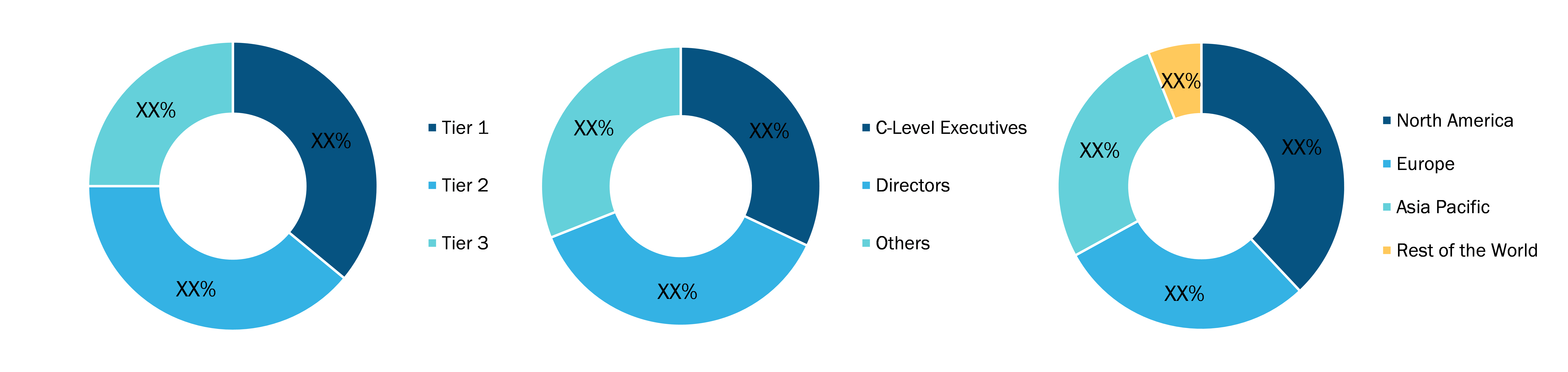
Once we receive the confirmation from primary research sources or primary respondents, we finalize the base year market estimation and forecast the data as per the macroeconomic and microeconomic factors assessed during data collection.
- Data Analysis:
Once data is validated through both secondary as well as primary respondents, we finalize the market estimations by hypothesis formulation and factor analysis at regional and country level.
- 3.1 Macro-Economic Factor Analysis:
We analyse macroeconomic indicators such the gross domestic product (GDP), increase in the demand for goods and services across industries, technological advancement, regional economic growth, governmental policies, the influence of COVID-19, PEST analysis, and other aspects. This analysis aids in setting benchmarks for various nations/regions and approximating market splits. Additionally, the general trend of the aforementioned components aid in determining the market's development possibilities.
- 3.2 Country Level Data:
Various factors that are especially aligned to the country are taken into account to determine the market size for a certain area and country, including the presence of vendors, such as headquarters and offices, the country's GDP, demand patterns, and industry growth. To comprehend the market dynamics for the nation, a number of growth variables, inhibitors, application areas, and current market trends are researched. The aforementioned elements aid in determining the country's overall market's growth potential.
- 3.3 Company Profile:
The “Table of Contents” is formulated by listing and analyzing more than 25 - 30 companies operating in the market ecosystem across geographies. However, we profile only 10 companies as a standard practice in our syndicate reports. These 10 companies comprise leading, emerging, and regional players. Nonetheless, our analysis is not restricted to the 10 listed companies, we also analyze other companies present in the market to develop a holistic view and understand the prevailing trends. The “Company Profiles” section in the report covers key facts, business description, products & services, financial information, SWOT analysis, and key developments. The financial information presented is extracted from the annual reports and official documents of the publicly listed companies. Upon collecting the information for the sections of respective companies, we verify them via various primary sources and then compile the data in respective company profiles. The company level information helps us in deriving the base number as well as in forecasting the market size.
- 3.4 Developing Base Number:
Aggregation of sales statistics (2020-2022) and macro-economic factor, and other secondary and primary research insights are utilized to arrive at base number and related market shares for 2022. The data gaps are identified in this step and relevant market data is analyzed, collected from paid primary interviews or databases. On finalizing the base year market size, forecasts are developed on the basis of macro-economic, industry and market growth factors and company level analysis.
- Data Triangulation and Final Review:
The market findings and base year market size calculations are validated from supply as well as demand side. Demand side validations are based on macro-economic factor analysis and benchmarks for respective regions and countries. In case of supply side validations, revenues of major companies are estimated (in case not available) based on industry benchmark, approximate number of employees, product portfolio, and primary interviews revenues are gathered. Further revenue from target product/service segment is assessed to avoid overshooting of market statistics. In case of heavy deviations between supply and demand side values, all thes steps are repeated to achieve synchronization.
We follow an iterative model, wherein we share our research findings with Subject Matter Experts (SME’s) and Key Opinion Leaders (KOLs) until consensus view of the market is not formulated – this model negates any drastic deviation in the opinions of experts. Only validated and universally acceptable research findings are quoted in our reports.
We have important check points that we use to validate our research findings – which we call – data triangulation, where we validate the information, we generate from secondary sources with primary interviews and then we re-validate with our internal data bases and Subject matter experts. This comprehensive model enables us to deliver high quality, reliable data in shortest possible time.

Get Free Sample For