The global Sex Toys market size is projected to reach US$ 89.79 billion by 2034 from US$ 45.29 billion in 2025. The market is anticipated to register a CAGR of 7.9% during the forecast period 2026–2034. Key market dynamics include a heightening global focus on sexual wellness as a core component of mental and physical health, rising consumer openness toward self-pleasure, and a significant shift toward high-tech, aesthetically pleasing designs. Additionally, the market is expected to benefit from the normalization of adult products in mainstream media, the expansion of discreet e-commerce logistics, and the increasing inclusion of gender-neutral and body-safe materials in product development.
Sex Toys Market AnalysisThe sex toys market analysis reveals a strategic pivot toward medicalization and high-tech personalization. As the industry moves away from generic novelty items, businesses are finding success by positioning products as clinical-grade wellness tools. This shift is driven by a deep understanding of evolving consumer needs, particularly the demand for body-safe materials like platinum-cured silicone and ergonomic designs that cater to diverse physical abilities and post-surgical needs. Competitive differentiation is now defined by "SexTech" integration, featuring AI-driven responsiveness, haptic feedback, and long-distance connectivity. Strategic opportunities abound for brands that leverage direct-to-consumer (D2C) data to offer personalized recommendations and subscription models. Furthermore, navigating the fragmented global regulatory landscape remains a critical hurdle; however, companies that proactively secure safety certifications and adopt sustainable manufacturing are capturing the loyalty of eco-conscious Gen Z and Millennial demographics, effectively securing a higher-margin market entry.
Sex Toys Market OverviewSex toys are shifting from a stigmatized, "under-the-counter" niche to a global wellness commodity. While historically focused on basic vibrators and dildos, sex toys are expanding into specialized segments like teledildonics, BDSM gear, and smart wearable devices. Both independent boutique brands and large consumer conglomerates are part of this market, leveraging the destigmatization of female and LGBTQ+ pleasure. Health-conscious consumers in North America and Europe are increasingly viewing sex toys as therapeutic tools for stress relief and sexual dysfunction, helping the market gain popularity as a "self-care" choice. North America remains the main revenue generator, but the Asia-Pacific region has become the engine for manufacturing and rapid digital growth, especially through mobile-first retail in China and India. For instance, in the US market, growth is fueled by the normalization of pleasure as "self-care," particularly among Gen Z and Millennials. High e-commerce penetration and the entry of mainstream retailers like Sephora have successfully transitioned these products from adult shops to lifestyle staples.
Customize Research To Suit Your Requirement
We can optimize and tailor the analysis and scope which is unmet through our standard offerings. This flexibility will help you gain the exact information needed for your business planning and decision making.
Sex Toys Market: Strategic Insights
| Market Size Value in | US$ 30,974.79 Million in 2020 |
| Market Size Value by | US$ 55,648.88 Million by 2028 |
| Growth rate | CAGR of 7.6% from 2021 to 2028 |
| Forecast Period | 2021-2028 |
| Base Year | 2021 |
Shejal
Have a question?
Shejal will walk you through a 15-minute call to present the report’s content and answer all queries if you have any.
Speak to Analyst
Market Drivers:
- Normalization via the Wellness Framing: The rebranding of sex toys as "wellness devices" has allowed them to enter mainstream retail and be recommended by healthcare professionals for stress relief.
- Technological Integration (SexTech): The rise of teledildonics, AI-driven vibration patterns, and VR-syncing has attracted a tech-savvy demographic seeking modern, interactive intimacy.
- Expansion of E-commerce Logistics: Secure, anonymous, and ultra-fast delivery options have removed the "shame barrier" for millions of potential buyers in conservative regions.
Market Opportunities:
- Sustainable and Biodegradable Innovation: A massive opportunity exists for brands to lead in "Green Sex" by developing recyclable electronics and plant-based, body-safe materials.
- Therapeutic and Geriatric Focus: Developing products for post-menopausal health, pelvic floor therapy, and senior intimacy allows brands to tap into a high-margin, medically aligned demographic.
- Inclusivity and Customization: Creating gender-neutral products and devices tailored for individuals with disabilities remains a significant, underserved growth area.
The Sex Toys Market share is analyzed across various segments to provide a clearer understanding of its structure, growth potential, and emerging trends. Below is the standard segmentation approach used in most industry reports:
By Material:
- Silicone: The dominant segment due to its non-porous, hypoallergenic, and "body-safe" nature. It is the gold standard for premium and medical-grade vibrators.
- Plastic: Often used in entry-level products (ABS plastic); valued for durability and cost-effectiveness.
- Metal & Glass: Niche categories favored for temperature play (retaining heat or cold) and aesthetic luxury.
- Others: Includes TPE/TPR and rubber, often used for realistic textures in masturbation sleeves.
By Gender:
- Female: The largest revenue generator, fueled by "pleasure-positive" branding and products targeting clitoral and G-spot stimulation.
- Male: The fastest-growing segment, focusing on high-tech masturbators, prostate massagers, and performance-enhancing rings.
By Product:
- Vibrators & Dildos: The core volume drivers, ranging from discreet "bullet" styles to app-controlled wearable devices.
- Anal Toys & Penis Rings: Growing segments as consumers move toward more varied experimentation and partner play.
- BDSM Toys & Masturbation Sleeves: High-growth niches influenced by pop culture and advancements in realistic material science.
- Sex Dolls, Clothing, and Others: Includes high-end robotic dolls and lingerie that complement the intimate hardware market.
By Distribution Channel:
- E-Commerce: The primary channel, providing the critical anonymity, discreet packaging, and vast selection required by consumers.
- Specialty Stores: Vital for the "boutique" experience, offering expert consultation and high-end retail environments.
- Others: Includes pharmacies and mass merchandisers that are increasingly stocking sexual wellness items.
By Geography:
- North America
- Europe
- Asia Pacific
- South & Central America
- Middle East & Africa
The geographic segmentation of the sex toys market highlights a landscape shaped by varying levels of social acceptance, regulatory frameworks, and technological adoption. While mature markets in the West focus on premium "SexTech" and wellness integration, emerging economies are witnessing a rapid transformation driven by urbanization and digital retail expansion. This regional diversity allows for a broad spectrum of growth strategies, from luxury branding in developed hubs to high-volume e-commerce penetration in developing territories.
1. North America
- Market Share: This region holds the largest share of the global market, serving as the primary hub for innovation and major brand headquarters.
- Key Drivers:
- Integration into Mainstream Retail
- High Disposable Income
- Cultural Normalization
- Trends: Growing Integration of intimate products into mainstream beauty and lifestyle retail environments.
2. Europe
- Market Share: Europe represents the second-largest market, characterized by mature retail ecosystems and progressive social attitudes.
- Key Drivers:
- Strict Material Safety Regulations
- Strong Presence of Premium Brands
- Progressive Sexual Education
- Trends: A significant shift toward sustainable "Green Sex" products, including carbon-neutral manufacturing.
3. Asia Pacific
- Market Share: This is the fastest-growing regional market, propelled by a massive youth population and rapid digital transformation.
- Key Drivers:
- Rapid Urbanization
- Growth of Mobile E-commerce
- Massive Manufacturing Infrastructure
- Trends: Heavy emphasis on teledildonics and AI-driven toys that sync with local social media platforms.
4. South & Central America
- Market Share: An emerging growth territory with significant potential in major economies like Brazil and Chile.
- Key Drivers:
- Increasing Internet Penetration
- Shifting Social Norms
- Growth of Local Artisanal Brands
- Trends: Popularity of subscription-based intimacy boxes offering a curated consumer experience.
5. Middle East & Africa
- Market Share: A developing niche market that faces distinct cultural and regulatory constraints but shows high growth in private digital channels.
- Key Drivers:
- Rising Urban Youth Demographics
- Expansion of Discreet Logistics
- Increasing Focus on Clinical Health
- Trends: Preference for discreet, aesthetic designs that resemble non-intimate household objects.
High Market Density and Competition
Competition is intensifying due to the presence of established leaders such as Crave, Lovehoney Group Ltd., BMS Factory, Tenga Co. Ltd., Fun Factory GmbH, WOW Tech International GmbH, LELO, Lifestyles Healthcare PTE LTD, and Unbound, which also contribute to a diverse and rapidly expanding market landscape.
This competitive environment pushes vendors to differentiate through:
- Premiumization and lifestyle branding position sexual wellness products as high-end self-care essentials rather than taboo novelties, utilizing medical-grade silicone, elegant aesthetics, and sophisticated packaging to appeal to the "pleasure positive" consumer.
- Product Diversification has expanded the market beyond basic vibrators to include app-controlled devices, teledildonics for long-distance intimacy, AI-powered haptic feedback tools, and specialized ergonomics for gender-inclusive and disability-friendly use.
- Vertical Integration and Safety Standards allow leading brands to control the manufacturing process from hypoallergenic material sourcing to final assembly. This ensures "body-safe" certifications, such as phthalate-free and non-porous guarantees, which are critical for building consumer trust.
- Technological Integration, specifically the use of IoT, Bluetooth connectivity, and sonic wave technology, enables brands to offer customizable pleasure patterns and "silent" motors, catering to a tech-savvy demographic that prioritizes both performance and discretion.
Opportunities and Strategic Moves
- Mainstream Retail Integration: Partner with mass-market pharmacies, beauty retailers, and global e-commerce giants to transition products from adult-only specialty stores into the broader health and wellness aisles, tapping into the multi-billion dollar "self-care" trend.
- Sustainability and Circularity: Implement eco-friendly initiatives, such as rechargeable battery systems, biodegradable packaging, and "buy-back" recycling programs for silicone devices to attract environmentally conscious Gen Z and Millennial shoppers who reject disposable "e-waste" culture.
- Crave
- Lovehoney Group Ltd.
- BMS Factory
- Tenga Co. Ltd.
- Fun Factory GmbH
- WOW Tech International GmbH
- LELO
- Lifestyles Healthcare PTE LTD
- Unbound
Disclaimer: The companies listed above are not ranked in any particular order.
Sex Toys Market News and Recent Developments- In February 2024, the sexual wellness brand Dame acquired sex toy maker Emojibator for an undisclosed sum. This strategic move expanded Dame's portfolio by integrating Emojibator's playful, emoji-inspired designs into its established lineup of high-end wellness products. Alexandra Fine, co-founder and CEO of Dame, stepped in to oversee both brands, while Emojibator founder Joe Vela transitioned into the role of director of sales at Dame. Following the acquisition, Emojibator continued to operate under its original brand name and remained available through its dedicated e-commerce website. The brand's popular sex toys also maintained their presence across existing retail partners, including adult novelty concepts like Lovers Stores and The Pleasure Parlor, lifestyle chain Urban Outfitters, and e-tailer Verishop. Dame's distribution already overlapped with Emojibator's at several of these select retailers, allowing for a streamlined supply chain and broader market reach.
- In January 2025, Lovense debuted its latest AI-driven sex toys at the Consumer Electronics Show (CES) in Las Vegas. The brand also introduced the Solace, a wearable vibrator.
The "Sex Toys Market Size and Forecast (2021–2034)" report provides a detailed analysis of the market covering below areas:
- Sex Toys Market size and forecast at global, regional, and country levels for all the key market segments covered under the scope
- Sex Toys Market trends, as well as market dynamics such as drivers, restraints, and key opportunities
- Detailed PEST and SWOT analysis
- Sex Toys Market analysis covering key market trends, global and regional framework, major players, regulations, and recent market developments
- Industry landscape and competition analysis covering market concentration, heat map analysis, prominent players, and recent developments in the Sex Toys Market.
- Detailed company profiles
Report Coverage
Revenue forecast, Company Analysis, Industry landscape, Growth factors, and Trends

Segment Covered
Material, Gender, Product and Distribution Channel

Regional Scope
North America, Europe, Asia Pacific, Middle East & Africa, South & Central America

Country Scope
Argentina, Australia, Brazil, Canada, China, France, Germany, India, Italy, Japan, Mexico, Saudi Arabia, South Africa, South Korea, Spain, United Arab Emirates, United Kingdom, United States
Frequently Asked Questions
The market is expected to reach approximately US$ 89.79 billion by 2034 from US$ 45.29 billion in 2025. The market is anticipated to register a CAGR of 7.9% during the forecast period.
Key trends include the mainstreaming of products in North American beauty stores, the shift toward sustainable "Green Sex" materials in Europe, and the rise of AI-integrated teledildonics in the Asia-Pacific region.
Asia-Pacific is the fastest-growing region, driven by its massive Gen Z demographic and the rapid expansion of mobile-led retail.
Challenges include navigating fragmented global legal frameworks, the high cost of R&D for medical-grade materials, and persistent social stigma in several conservative regions.
Key players include Crave, Lovehoney Group Ltd., BMS Factory, Tenga Co. Ltd., Fun Factory GmbH, WOW Tech International GmbH, LELO, Lifestyles Healthcare PTE LTD, and Unbound.
Yes! We provide a free sample of the report, which includes Report Scope (Table of Contents), report structure, and selected insights to help you assess the value of the full report. Please click on the "Download Sample" button or contact us to receive your copy.
Absolutely - analyst assistance is part of the package. You can connect with our analyst post-purchase to clarify report insights, methodology or discuss how the findings apply to your business needs.
Once your order is successfully placed, you will receive a confirmation email along with your invoice.
• For published reports: You'll receive access to the report within 4-6 working hours via a secured email sent to your email.
• For upcoming reports: Your order will be recorded as a pre-booking. Our team will share the estimated release date and keep you informed of any updates. As soon as the report is published, it will be delivered to your registered email.
We offer customization options to align the report with your specific objectives. Whether you need deeper insights into a particular region, industry segment, competitor analysis, or data cut, our research team can tailor the report accordingly. Please share your requirements with us, and we'll be happy to provide a customized proposal or scope.
The report is available in either PDF format or as an Excel dataset, depending on the license you choose.
The PDF version provides the full analysis and visuals in a ready-to-read format. The Excel dataset includes all underlying data tables for easy manipulation and further analysis.
Please review the license options at checkout or contact us to confirm which formats are included with your purchase.
Our payment process is fully secure and PCI-DSS compliant.
We use trusted and encrypted payment gateways to ensure that all transactions are protected with industry-standard SSL encryption. Your payment details are never stored on our servers and are handled securely by certified third-party processors.
You can make your purchase with confidence, knowing your personal and financial information is safe with us.
Yes, we do offer special pricing for bulk purchases.
If you're interested in purchasing multiple reports, we're happy to provide a customized bundle offer or volume-based discount tailored to your needs. Please contact our sales team with the list of reports you're considering, and we'll share a personalized quote.
Yes, absolutely.
Our team is available to help you make an informed decision. Whether you have questions about the report's scope, methodology, customization options, or which license suits you best, we're here to assist. Please reach out to us at sales@theinsightpartners.com, and one of our representatives will get in touch promptly.
Yes, a billing invoice will be automatically generated and sent to your registered email upon successful completion of your purchase.
If you need the invoice in a specific format or require additional details (such as company name, GST, or VAT information), feel free to contact us, and we'll be happy to assist.
Yes, certainly.
If you encounter any difficulties accessing or receiving your report, our support team is ready to assist you. Simply reach out to us via email or live chat with your order information, and we'll ensure the issue is resolved quickly so you can access your report without interruption.
The Insight Partners performs research in 4 major stages: Data Collection & Secondary Research, Primary Research, Data Analysis and Data Triangulation & Final Review.
- Data Collection and Secondary Research:
As a market research and consulting firm operating from a decade, we have published many reports and advised several clients across the globe. First step for any study will start with an assessment of currently available data and insights from existing reports. Further, historical and current market information is collected from Investor Presentations, Annual Reports, SEC Filings, etc., and other information related to company’s performance and market positioning are gathered from Paid Databases (Factiva, Hoovers, and Reuters) and various other publications available in public domain.
Several associations trade associates, technical forums, institutes, societies and organizations are accessed to gain technical as well as market related insights through their publications such as research papers, blogs and press releases related to the studies are referred to get cues about the market. Further, white papers, journals, magazines, and other news articles published in the last 3 years are scrutinized and analyzed to understand the current market trends.
- Primary Research:
The primarily interview analysis comprise of data obtained from industry participants interview and answers to survey questions gathered by in-house primary team.
For primary research, interviews are conducted with industry experts/CEOs/Marketing Managers/Sales Managers/VPs/Subject Matter Experts from both demand and supply side to get a 360-degree view of the market. The primary team conducts several interviews based on the complexity of the markets to understand the various market trends and dynamics which makes research more credible and precise.
A typical research interview fulfils the following functions:
- Provides first-hand information on the market size, market trends, growth trends, competitive landscape, and outlook
- Validates and strengthens in-house secondary research findings
- Develops the analysis team’s expertise and market understanding
Primary research involves email interactions and telephone interviews for each market, category, segment, and sub-segment across geographies. The participants who typically take part in such a process include, but are not limited to:
- Industry participants: VPs, business development managers, market intelligence managers and national sales managers
- Outside experts: Valuation experts, research analysts and key opinion leaders specializing in the electronics and semiconductor industry.
Below is the breakup of our primary respondents by company, designation, and region:
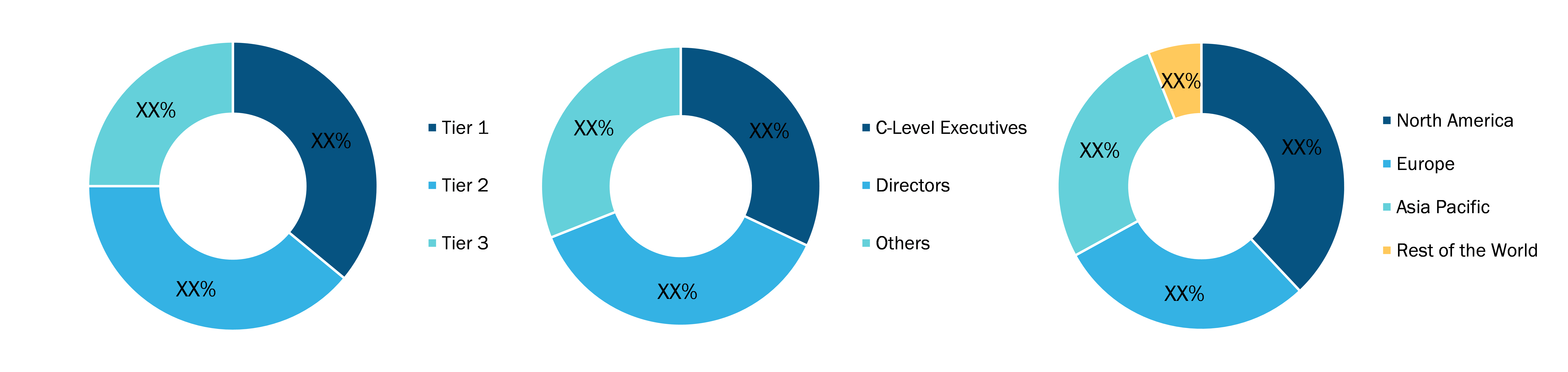
Once we receive the confirmation from primary research sources or primary respondents, we finalize the base year market estimation and forecast the data as per the macroeconomic and microeconomic factors assessed during data collection.
- Data Analysis:
Once data is validated through both secondary as well as primary respondents, we finalize the market estimations by hypothesis formulation and factor analysis at regional and country level.
- 3.1 Macro-Economic Factor Analysis:
We analyse macroeconomic indicators such the gross domestic product (GDP), increase in the demand for goods and services across industries, technological advancement, regional economic growth, governmental policies, the influence of COVID-19, PEST analysis, and other aspects. This analysis aids in setting benchmarks for various nations/regions and approximating market splits. Additionally, the general trend of the aforementioned components aid in determining the market's development possibilities.
- 3.2 Country Level Data:
Various factors that are especially aligned to the country are taken into account to determine the market size for a certain area and country, including the presence of vendors, such as headquarters and offices, the country's GDP, demand patterns, and industry growth. To comprehend the market dynamics for the nation, a number of growth variables, inhibitors, application areas, and current market trends are researched. The aforementioned elements aid in determining the country's overall market's growth potential.
- 3.3 Company Profile:
The “Table of Contents” is formulated by listing and analyzing more than 25 - 30 companies operating in the market ecosystem across geographies. However, we profile only 10 companies as a standard practice in our syndicate reports. These 10 companies comprise leading, emerging, and regional players. Nonetheless, our analysis is not restricted to the 10 listed companies, we also analyze other companies present in the market to develop a holistic view and understand the prevailing trends. The “Company Profiles” section in the report covers key facts, business description, products & services, financial information, SWOT analysis, and key developments. The financial information presented is extracted from the annual reports and official documents of the publicly listed companies. Upon collecting the information for the sections of respective companies, we verify them via various primary sources and then compile the data in respective company profiles. The company level information helps us in deriving the base number as well as in forecasting the market size.
- 3.4 Developing Base Number:
Aggregation of sales statistics (2020-2022) and macro-economic factor, and other secondary and primary research insights are utilized to arrive at base number and related market shares for 2022. The data gaps are identified in this step and relevant market data is analyzed, collected from paid primary interviews or databases. On finalizing the base year market size, forecasts are developed on the basis of macro-economic, industry and market growth factors and company level analysis.
- Data Triangulation and Final Review:
The market findings and base year market size calculations are validated from supply as well as demand side. Demand side validations are based on macro-economic factor analysis and benchmarks for respective regions and countries. In case of supply side validations, revenues of major companies are estimated (in case not available) based on industry benchmark, approximate number of employees, product portfolio, and primary interviews revenues are gathered. Further revenue from target product/service segment is assessed to avoid overshooting of market statistics. In case of heavy deviations between supply and demand side values, all thes steps are repeated to achieve synchronization.
We follow an iterative model, wherein we share our research findings with Subject Matter Experts (SME’s) and Key Opinion Leaders (KOLs) until consensus view of the market is not formulated – this model negates any drastic deviation in the opinions of experts. Only validated and universally acceptable research findings are quoted in our reports.
We have important check points that we use to validate our research findings – which we call – data triangulation, where we validate the information, we generate from secondary sources with primary interviews and then we re-validate with our internal data bases and Subject matter experts. This comprehensive model enables us to deliver high quality, reliable data in shortest possible time.

Get Free Sample For