
Road Roller Market Size, Share & Forecast by 2034
Coverage: By Type (Static Road Roller, Tire Road Roller, Drum Roller, Others); Application (Roads, Sites Development, Industrial Yards Construction) , and Geography (North America, Europe, Asia Pacific, and South and Central America)
- Status : Data Released
- Report Code : TIPRE00008024
- Category : Manufacturing and Construction
- No. of Pages : 150
- Available Report Formats :


- Last update date : September 07, 2026


2025 Market Size
US$ 6.76 Bn
Base year value
2034 Forecast
US$ 9.44 Bn
Projected by 2034
CAGR 2026-2034
3.78 %
Growth rate
Addressable Market
US$ 73.58 Bn
(2026-2034)
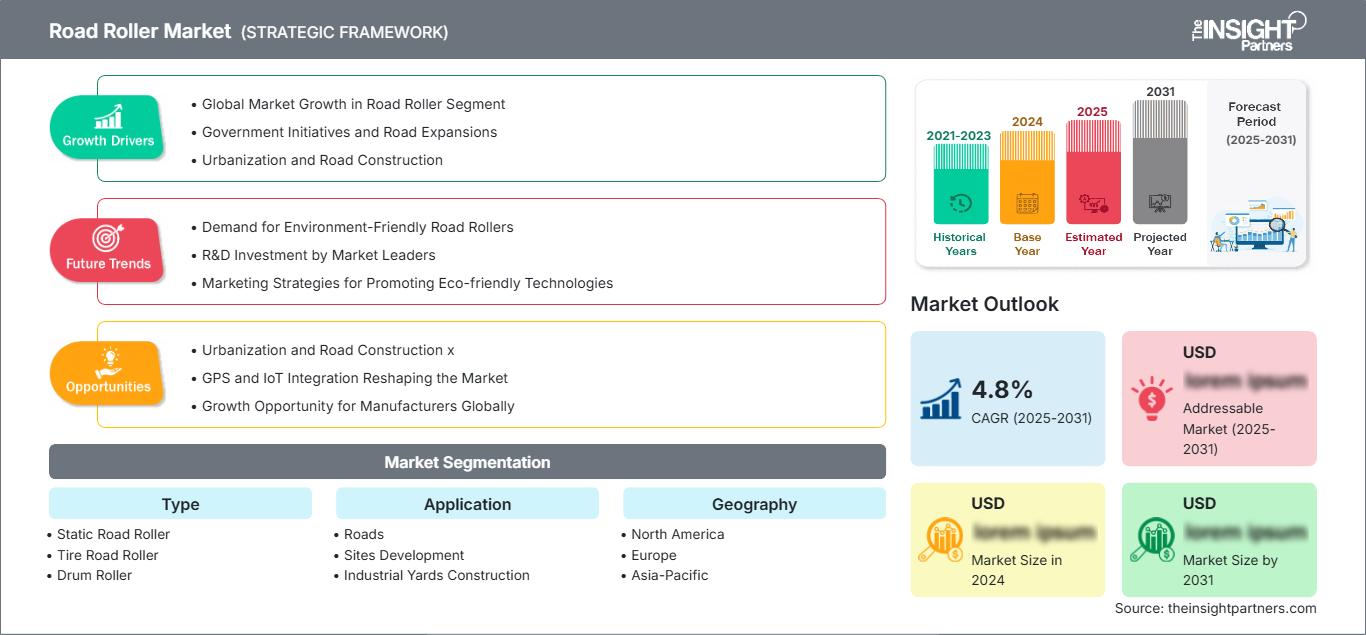
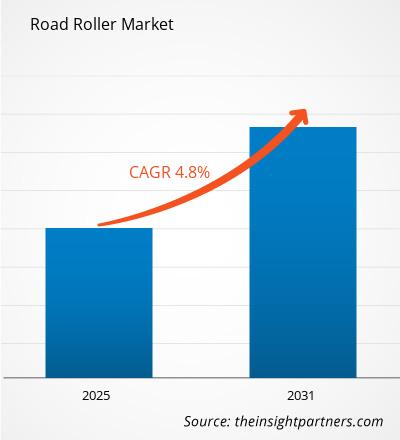
The road roller market is positioned as a steady-growth construction equipment category, supported by road rehabilitation, new transport corridors, urban development, and industrial site preparation. The market is valued at US$ 6.76 Billion in 2025 and is projected to reach US$ 9.44 Billion by 2034, expanding at a CAGR of 3.78% during 2026–2034. Demand remains closely linked to public infrastructure expenditure, contractor fleet replacement, and productivity requirements across asphalt and soil compaction activities.
In North America, the road roller market size is supported by highway rehabilitation, bridge approaches, municipal resurfacing, and continued investment in transportation infrastructure. The region is estimated to register a CAGR of 3.1–3.8% during 2026–2034. Demand is reinforced by aging pavement networks and increasing contractor preference for machines offering automated compaction monitoring, lower fuel consumption, operator assistance, and improved fleet utilization.
Road Roller Market Assessment and Insights
- North America: North America is estimated to hold a 18–22% share in 2025 and grow at a CAGR of 3.1–3.8% between 2026–2034, supported by highway rehabilitation, municipal paving, rental fleets, and equipment modernization.
- US: The US represents 70–75% of North America in 2025, with a CAGR of 3.2–3.9% during 2026–2034, led by pavement rehabilitation and contractor fleet renewal.
- Europe: Europe accounts for a 19–23% share in 2025 and is expected to grow at 2.7–3.5% CAGR between 2026–2034, with Germany, the UK, France, Italy, and Spain supporting demand through maintenance and sustainability-led equipment replacement.
- Asia Pacific: Asia Pacific represents 43–47% share in 2025 and is projected to expand at a CAGR of 4.3–5.2% during 2026–2034, led by China and India, followed by Japan, South Korea, and Southeast Asian infrastructure markets.
- Largest Segment: Static Road Roller holds an estimated 31–35% market share in 2025 and is projected to expand at a 3.3–4.0% CAGR during 2026–2034, supported by established applications.
- High Growth Segment: Sites Development accounts for an estimated 22–26% market share in 2025 and is expected to grow at 4.2–5.0% CAGR during 2026–2034, supported by urban expansion.
- Key companies analyzed in detail: Action Construction Equipment Ltd., BOMAG GmbH, Caterpillar Inc., J C Bamford Excavators Ltd., Liugong Machinery Co., Ltd., SANY Group, SINOMACH Company Limited, WIRTGEN GROUP, XCMG Group, and Xiamen XGMA Machinery Co., Ltd.
Source: The Insight Partners' analysis based on proprietary research, government publications, company annual reports, investor presentations, industry databases, and expert interviews.
The road roller market has evolved from mechanically controlled compaction equipment toward machines incorporating hydrostatic drives, vibration management, operator-assistance functions, telematics, and intelligent compaction. The incorporation of sensors that track passes, operating parameters, and machine reaction is getting more prevalent amongst manufacturers. Furthermore, the production strategy is also shifting towards regionalization, whereby global manufacturers tailor certain machinery models or parts to cater to emission laws, terrain, budgetary considerations, and service network needs of established and developing construction markets.
In the future, developments would be focused on low-emissions engines, fleet management systems, automatic density control, and small-sized machinery suitable for urban applications. Construction activities in developing Asian and Middle Eastern countries would increase machinery demand, along with increased emission regulations impacting engine choice and machinery design. Moreover, rental services would also start gaining importance owing to the need for predictable costs and high utilization rates by contractors.
Road Roller Market Report Scope
| Report Attribute | Details |
|---|---|
| Market size in 2025 | US$ 6.76 Billion |
| Market Size by 2034 | US$ 9.44 Billion |
| Global CAGR (2026 - 2034) | 3.78% |
| Historical Data | 2021-2024 |
| Forecast period | 2026-2034 |
Road Roller Market Analysis
Road construction remains the principal demand ecosystem because effective compaction determines pavement density, load distribution, surface durability, and resistance to premature deformation. The road roller market growth is therefore influenced by highway construction, resurfacing cycles, airport approaches, industrial yards, and municipal maintenance. The value chain includes steel and component suppliers, engine manufacturers, equipment OEMs, dealers, rental companies, contractors, and after-sales service providers. Supply conditions are shaped by hydraulic component availability, engine compliance, steel costs, and regional manufacturing capacity.
Contractors now tend to analyze machinery based on the total cost of ownership and not only the purchase price of the machinery. Factors such as fuel economy, efficiency of drums, maintenance intervals, ergonomic design, parts availability, and machine availability can significantly affect purchasing decisions. Those manufacturers that have existing dealer networks have an advantage if fast servicing is required in projects. Financing and locally assembled machinery become more important in developing countries, whereas productivity, emissions performance, and automatic compaction abilities are critical factors in developed economies.
The competition level is rising due to the fact that major global manufacturers integrate a wide range of products along with IT solutions and local production. Caterpillar Inc. competes with its construction equipment ecosystem, whereas BOMAG GmbH and WIRTGEN GROUP specialize in compaction technology. XCMG Group, SANY Group, Liugong Machinery Co., Ltd., and SINOMACH Company Limited create competitive pressure with the help of extensive Asian manufacturing facilities.
Action Construction Equipment Ltd., J C Bamford Excavators Ltd., and Xiamen XGMA Machinery Co., Ltd. provide additional competitive depth across selected markets and equipment categories. Strategic positioning increasingly depends on localized product configurations, dealer coverage, financing, telematics, and lifecycle support. Investment is moving toward intelligent compaction, electric prototypes, emission-compliant engines, and connected construction workflows rather than simple increases in machine capacity.
● REPORT CUSTOMIZATION
Tailor This Report To Align With Your Specific Business Requirements
This report can be customized to align precisely with your business objectives, scope, and target markets. Customization options include tailored segmentation, geography, competitive analysis, and strategic insights to support informed decision-making.
Customize This Report →WHAT YOU CAN ADJUST
- ● Segmentations
- ● Geography
- ● Competitive Analysis
- ● Language Preferences
Road Roller Market: Strategic Insights
Regional Insights
North America road roller market
North America is estimated at 18–22% OF THE road roller market share in 2025, with a CAGR of 3.1–3.8% through 2034. The United States controls regional demand, while Canada helps with highway maintenance, access roads for the resource industry, and municipal infrastructure. Aging pavement, bridge rehabilitation, and federal transportation funding programs continue to support replacement needs. Contractors are now focusing on equipment that offers consistency of compaction and telematics, along with cost efficiency.
Rental remains a significant route due to the fact that smaller contractors can gain access to state-of-the-art equipment without having to make any capital investments. Urban resurfacing jobs need compact rollers that are easy to maneuver, have high visibility, and generate low noise. The Canadian market demonstrates a relationship between seasonal opportunities and infrastructure renewal. Local manufacturers and global OEMS are competing based on service, financing, and parts availability.
U.S. road roller Market
The US represents 70–75% of the North America road roller market in 2025 and is expected to grow at a CAGR of 3.2–3.9% through 2034. The demand comes from road repairs, airport infrastructure, city roads, commercial construction, and land preparation for large sites. More often than not, the purchasing of these machines takes into account the performance and the cost of maintenance, rather than simply the purchasing price.
Companies such as Caterpillar Inc. and J C Bamford Excavators Ltd. keep their brands visible throughout the US construction equipment market, while specialist manufacturers of rollers compete via innovative technologies and expertise in their applications. The road maintenance market is dominated by tandem and compact versions, while heavy machines are used in larger earthworks projects. The rental industry also plays a role in influencing the choice of machines due to their ability to serve different contractors and projects.
Europe road roller Market
Europe holds an estimated 19–23% share of the road roller market in 2025 and is projected to grow at a CAGR of 2.7–3.5%. Germany leads regional manufacturing and technology development, while the UK, France, Italy, and Spain contribute substantial replacement and infrastructure demand. Emissions requirements, energy efficiency, and advanced construction practices strongly influence procurement. Germany benefits from specialized compaction expertise and a strong domestic industrial base.
The UK market is shaped by road maintenance, local authority resurfacing, and contractor fleet renewal. Germany emphasizes precision compaction, digital site documentation, and low-emission equipment. France and Italy support demand through transport infrastructure and urban rehabilitation, while Spain benefits from road modernization and construction activity. European contractors increasingly assess equipment against lifecycle emissions, operator safety, productivity, and regulatory compliance, making connected and efficient rollers strategically relevant.
APAC road roller market
APAC holds an estimated 43–47% share of the road roller market in 2025 and is expected to grow at a CAGR of 4.3–5.2%, making it the leading regional market. China and India account for substantial demand, while Japan, South Korea, and Australia contribute through mature construction fleets and specialized projects. Infrastructure spending, urbanization, industrial corridors, and road expansion support equipment utilization.
China remains the leading country, supported by extensive road and industrial construction. India combines highway investment with expanding domestic equipment manufacturing. Japan emphasizes precision and fleet efficiency, while South Korea supports infrastructure modernization. Australia generates demand from highways, mining-related infrastructure, and regional connectivity projects. Policy emphasis on domestic manufacturing, emissions compliance, and transport connectivity should sustain equipment modernization across the region.
Middle East & Africa road roller Market
The Middle East and Africa road roller market demand is projected to expand at a CAGR of 3.2–4.2%. Saudi Arabia leads regional activity through large infrastructure and urban development programs, while the UAE supports construction through transport, logistics, and real-estate projects. South Africa remains an important African market for road rehabilitation and industrial development, with the rest of MEA driven by selective infrastructure investment.
Equipment demand is closely tied to government-funded roads, ports, airports, industrial zones, and energy-related infrastructure. High temperatures and demanding operating conditions favor robust machines with accessible service support. Contractors often prioritize reliability, parts availability, and simplified maintenance. The regional opportunity is therefore strongest for manufacturers capable of combining durable configurations with dealer networks, financing options, and equipment suited to intensive project environments.
Segmentation Analysis
Type
The Type segment is projected to grow at a CAGR of 3.6–4.3% during 2026–2034. Product selection varies according to soil characteristics, asphalt specifications, project scale, required density, and operating environment. Static and drum configurations retain broad utilization, while contractors increasingly consider vibration control, machine versatility, operator assistance, and fuel efficiency. Product differentiation is therefore shifting toward productivity and application-specific performance.
- Static Road Roller: Static machines retain relevance for applications where controlled surface pressure, simple operation, and predictable compaction are preferred. Their established technology supports replacement demand among contractors requiring straightforward equipment.
- Tire Road Roller: Tire rollers provide kneading action and are important for asphalt finishing and surface treatment. Their flexibility supports applications requiring uniform material distribution and controlled surface texture.
- Drum Roller: Drum rollers remain central to soil and asphalt compaction because they provide adaptable operating configurations and strong productivity. Demand is supported by highway, industrial, and large-site projects.
- Others: Specialized configurations serve niche requirements involving constrained sites, combined drum-tire arrangements, or application-specific compaction conditions where conventional machines may be less efficient.
Application
The Application segment is expected to register a CAGR of 3.9–4.7% through 2034. Road construction remains fundamental, but site development and industrial yards broaden the addressable equipment base. Procurement increasingly depends on material type, project duration, surface specifications, working width, maneuverability, and required compaction uniformity. Contractors favor adaptable equipment where project portfolios span several applications.
- Roads: Road projects represent the core application because asphalt and base-layer compaction directly influence pavement strength and longevity. Highway construction, resurfacing, municipal maintenance, and regional connectivity programs sustain recurring demand.
- Sites Development: Site development requires soil and aggregate compaction for commercial, residential, logistics, and mixed-use projects. Equipment demand benefits from urban expansion and the preparation of large construction footprints.
- Industrial Yards Construction: Industrial yards require stable foundations for heavy vehicles, storage areas, manufacturing facilities, and logistics operations. Durable rollers are important where repeated loading creates stringent surface performance requirements.
Geography
The Geography segment is modeled at a CAGR of 4.0–4.8% during 2026–2034, reflecting differences in infrastructure pipelines, construction cycles, equipment replacement, and industrialization. Asia Pacific provides the strongest expansion potential, while North America and Europe remain significant replacement markets. South and Central America, together with the Middle East and Africa, offer selective opportunities tied to transport and industrial infrastructure.
- North America: Mature infrastructure networks create recurring rehabilitation and replacement demand, with rental penetration and digital equipment management influencing purchasing decisions.
- Europe: Regulatory requirements, sustainability objectives, and technologically advanced contractors support demand for efficient, connected, and low-emission compaction equipment.
- Asia-Pacific: Large infrastructure pipelines and industrial expansion make the region the principal volume market, with China and India providing substantial demand.
- South and Central America: Road connectivity, logistics infrastructure, agriculture-linked development, and urbanization create project-based demand for durable and cost-efficient equipment.
- Middle East and Africa: Infrastructure diversification, urban development, energy projects, and transport investment support selective demand for heavy-duty and serviceable equipment.
Opportunity Snapshot
| Application | Revenue Contribution (High/Medium/Low) | Trend Tag | Adoption Stage |
| Roads | High | Highway Renewal | Mature |
| Sites Development | Medium | Urban Expansion | Scaling |
| Industrial Yards Construction | Medium | Logistics Foundations | Scaling |
Road Roller Market Growth Drivers and Impact Analysis
Accelerating Road Rehabilitation and Pavement Renewal
The need for roller equipment from road rehabilitation becomes a continuous need since road pavement degradation is not a problem that is solved by constructing new roads. Old highway pavements, municipal roads, airports, and freight need to be milled, resurfaced, prepared for a new base and compacted. These contribute to the growing demand for roller equipment in both government and private road construction. Road maintenance contractors have a preference for machines that switch from one job site to another without major changes in the setup. The effect is not only on the purchase of equipment but also on the demand for rental services, maintenance, replacement drums, vibration units and service contracts. Government spending on transportation is important in the equipment market since it decides when and where to deploy the equipment.
Connected Compaction Improves Productivity and Quality Control
With the advent of digital compaction solutions, the methods used by contractors to track machine passes, temperatures, vibrations, and density have been affected. Through the use of connected platforms, structured information can be acquired in order to determine poorly compacted regions and evaluate the progress of the project. In terms of the practical application, this technology is especially important in big road construction and airport construction projects, where any mistakes may result in a high cost due to rework. Manufacturers can now distinguish their products based on such criteria as sensors, telematics, automated controls, and integrated software instead of purely mechanical properties. These technologies allow fleet managers to evaluate the usage of equipment and spot underutilized machines. With the growing digitalization of the process of construction, the compatibility of equipment with site management systems becomes more important.
Emission Standards Reshape Machine Replacement Decisions
Emission regulations have become a factor shaping the design of construction machinery through increased demands for compliance with engines, better after-treatment systems, efficiency of hydraulics, and reduction of fuel use. The process involves manufacturers and contractors because it increases upfront cost for compliant machinery, but decreases risks and costs of operation. The example of India’s CEV Stage V system proves that stricter requirements lead to both increased demands on manufacturing and greater compatibility with exports. Similar regulatory pressure in Europe and North America encourages the purchase of new machinery instead of using inefficient old machinery. Compliance is becoming an integral element of the competitiveness of products for manufacturers. The influence can be seen in the development of electric and alternative power compaction machinery for urban works.
Road Roller Market Future Trends
Autonomous Compaction and Real-Time Density Optimization
The road roller market trends are moving toward automated compaction based on real-time measurement of density, temperature, passes, vibration, and machine position. Future systems are likely to combine onboard sensors with cloud-based analytics, enabling operators to identify incomplete coverage while projects remain active. Automated target-setting could reduce variability between operators and improve consistency across large work zones. Integration with paving equipment may also allow rollers to respond dynamically to material temperature and placement conditions. As contractors seek measurable productivity gains, compaction systems that convert operational data into actionable instructions should gain greater relevance. Over time, machine manufacturers may compete increasingly on software architecture, sensor accuracy, data interoperability, and workflow integration rather than solely on horsepower, drum dimensions, or static operating weight.
Electrification Expands in Urban and Restricted Construction Zones
Electrification is more probable to progress through small and medium-sized rollers that would be employed for urban construction, landscape work, municipal maintenance, and construction, subject to noise and local emission regulations. Batteries would eliminate tailpipe emissions and may make operation simpler, provided there is suitable charging equipment available. Nevertheless, the decision on using batteries depends on their energy density, the time necessary to charge, duty cycles, temperature, and cost efficiency. Manufacturers should therefore maintain product lines including both standard and electric powertrains without attempting a complete shift to electrified machinery at once. Procurement policies by municipalities and low-emission construction sites can increase the use of battery-driven machines when operating limits create economic repercussions.
Road Roller Market Opportunities
Localized Manufacturing for Emerging Infrastructure Markets
The road roller market scope provides opportunities for manufacturers to establish localized production, component sourcing, and service partnerships in countries with sustained infrastructure pipelines. Local manufacturing can reduce logistics costs, shorten delivery periods, and allow equipment to be adapted to regional emission standards, climate conditions, road specifications, and contractor preferences. India and Southeast Asia offer particularly relevant opportunities because infrastructure development is accompanied by increasing construction equipment manufacturing capability. Partnerships with local dealers, rental companies, and financing institutions can further reduce adoption barriers. Manufacturers should prioritize modular product platforms that permit regional configuration without excessive engineering costs. Export-oriented production can also improve factory utilization by serving neighboring markets with similar requirements. The strongest investment cases are likely to combine manufacturing localization with parts availability and technical training.
Digital Fleet Services and Lifecycle Revenue Models
The Road roller market forecasts indicate an expanding opportunity for manufacturers to develop recurring revenue around connected fleet services, predictive maintenance, operator training, and productivity analytics. Telematics systems for equipment can offer data about machine utilization, service notifications, location information, and operation-condition information, which can lead to better asset management. Such an approach will allow the manufacturers to build their subscription business models and will help dealers in creating more opportunities to interact with their customers along the life cycle of the machine. It can be especially interesting for rental fleets, where machine utilization data is directly related to fleet management and maintenance planning. Contractors can also be potential buyers of such service solutions, which include machine health tracking, preventive maintenance, and planning of machine parts ordering.
Frequently Asked Questions

- Comprehensive Market Sizing and Forecast Analysis
- Detailed Segmentation Analysis
- In-Depth Market Dynamics Assessment
- Regional and Country-Level Insights
- Competitive Landscape and Company Benchmarking
- Strategic Business Intelligence
Recent Reports
Testimonials

The Insight Partners' SCADA System Market report is comprehensive, with valuable insights on current trends and future forecasts. The team was highly professional, responsive, and supportive throughout. We are very satisfied and highly recommend their services.
RAN KEDEM Partner, Reali Technologies LTDs
I requested a report on a very specific software market and the team produced the report in a few days. The information was very relevant and well presented. I then requested some changes and additions to the report. The team was again very responsive and I got the final report in less than a week.
JEAN-HERVE JENN Chairman, Future Analytica
We worked with The Insight Partners for an important market study and forecast. They gave us clear insights into opportunities and risks, which helped shape our plans. Their research was easy to use and based on solid data. It helped us make smart, confident decisions. We highly recommend them.
PIYUSH NAGPAL Sr. Vice President, High Beam Global
The Insight Partners delivered insightful, well-structured market research with strong domain expertise. Their team was professional and responsive throughout. The user-friendly website made accessing industry reports seamless. We highly recommend them for reliable, high-quality research services
YUKIHIKO ADACHI CEO, Deep Blue, LLC.
This is the first time I have purchased a market report from The Insight Partners.While I was unsure at first, I visited their web site and felt more comfortable to take the risk and purchase a market report.I am completely satisfied with the quality of the report and customer service. I had several questions and comments with the initial report, but after a couple of dialogs over email with their analyst I believe I have a report that I can use as input to our strategic planning process.Thank you so much for taking the extra time and making this a positive experience.I will definitely recommend your service to others and you will be my first call when we need further market data.
JOHN SUZUKI President and Chief Executive Officer, Board Director, BK Technologies
I wish to appreciate your support and the professionalism you displayed in the course of attending to my request for information regarding to infectious disease IVD market in Nigeria. I appreciate your patience, your guidance, and the fact that you were willing to offer a discount, which eventually made it possible for us to close a deal. I look forward to engaging The Insight Partners in the future, all thanks to the impression you have created in me as a result of this first encounter.
DR CHIJIOKE ONYIA MANAGING DIRECTOR, PineCrest Healthcare Ltd.Reason to Buy
- Informed Decision-Making
- Understanding Market Dynamics
- Competitive Analysis
- Identifying Emerging Markets
- Customer Insights
- Market Forecasts
- Risk Mitigation
- Boosting Operational Efficiency
- Strategic Planning
- Investment Justification
- Tracking Industry Innovations
- Aligning with Regulatory Trends





 Get Free Sample for