
Rock Duster Market Size, Demand & Growth by 2034
Coverage: By Type (High pressure bulk, Bantam, Slinger, Trickle Wet / Slurry, Mine-wide automated dusting systems); Technology (Hydraulic, Electric, Diesel); End-user (Mining, Agriculture, Construction, Others) , and Geography (North America, Europe, Asia Pacific, and South and Central America)
- Status : Data Released
- Report Code : TIPRE00017206
- Category : Manufacturing and Construction
- No. of Pages : 150
- Available Report Formats :


- Last update date : September 07, 2026


2025 Market Size
US$ 372.59 Mn
Base year value
2034 Forecast
US$ 586.42 Mn
Projected by 2034
CAGR 2026-2034
5.17 %
Growth rate
Addressable Market
US$ 4,351.16 Mn
(2026-2034)
The rock duster market is positioned for steady expansion as underground safety requirements, coal-mine dust control practices, and equipment modernization support demand. The market is valued at US$ 372.59 Million in 2025 and is projected to reach US$ 586.42 Million by 2034, registering a CAGR of 5.17% during 2026–2034. Demand remains concentrated in underground mining, while automated distribution systems and mobile dusters broaden operational applications.
North America remains a structurally important market, supported by established underground coal operations, stringent mine-safety requirements, and replacement demand for permissible equipment. The rock duster market size is expected to expand at an estimated 5.3–5.8% CAGR between 2026 and 2034, with regulatory compliance and modernization of aging mining fleets providing sustained equipment demand.
Rock Duster Market Assessment and Insights
- North America: North America is expected to account for a 31–35% share in 2025 and expand at a 5.3–5.8% CAGR between 2026–2034, supported by underground coal mining, equipment replacement, and regulatory emphasis on combustible dust control.
- US: The US is projected to represent 72–76% of North America's 2025 market, with growth of 5.1–5.6% CAGR between 2026–2034, supported by MSHA compliance and replacement of aging dusting equipment.
- Europe: Europe is estimated at a 24–28% share in 2025 and a 4.6–5.1% CAGR between 2026–2034, with Germany, Poland, the UK, and Czechia supporting specialized underground mining equipment demand.
- Asia Pacific: Asia Pacific is estimated to hold a 28–32% share in 2025 and grow at 5.8–6.4% CAGR between 2026–2034, led by China, Australia, India, and Indonesia, where mine modernization and safety investment support adoption.
- Largest Segment: High pressure bulk systems are estimated to hold a 34–38% market share in 2025 and grow at a 4.8–5.3% CAGR during 2026–2034.
- High Growth Segment: Electric technology is estimated to represent a 28–32% market share in 2025 and expand at a 6.1–6.7% CAGR during 2026–2034.
- Key companies analyzed in detail: A.L. Lee Corporation, Brain Industries (International) Pty Ltd, Damascus Corporation, DSI Underground, HafcoVac, Hager Equipment Company, Irwin Car and Equipment, Johnson Industries, Saminco Solutions LLC, and STRATA WORLDWIDE.
Source: The Insight Partners' analysis based on proprietary research, government publications, company annual reports, investor presentations, industry databases, and expert interviews.
Mine dust control equipment has evolved from manual mechanical devices to high-capacity systems with enhanced metering, mobility, and control. Bulk dusters that operate on high-pressure technology will be significant due to their efficiency in achieving wide coverage in extensive underground areas, and trickle and slurry dusters take care of application needs. Battery-powered and electrical equipment are also becoming significant in view of the need for less emissions and lower maintenance problems.
The future use of this equipment will be largely influenced by compatibility with the mine ventilation system, electrical requirements, remote operation, and properties of dusting materials. New mining jurisdictions in the Asia Pacific and certain parts of Africa will increase the purchases of the equipment as deep mining becomes more mechanized. The investment in mine-wide systems should go to those who can integrate storage, transfer, metering, and distribution of the equipment.
Rock Duster Market Report Scope
| Report Attribute | Details |
|---|---|
| Market size in 2025 | US$ 372.59 Million |
| Market Size by 2034 | US$ 586.42 Million |
| Global CAGR (2026 - 2034) | 5.17% |
| Historical Data | 2021-2024 |
| Forecast period | 2026-2034 |
Rock Duster Market Analysis
Demand in the rock duster market growth is primarily linked to underground coal production, statutory dust-control obligations, and the need to maintain adequate inert material distribution across active workings. The value chain comprises limestone and inert dust suppliers, machinery makers, hydraulic and electric component providers, mine contractors, distributors, and after-sales service providers. The procurement of machines is now based on factors such as reliability, permissible certification, capability, hose reach, and maintenance needs.
The supply chain dynamics vary depending on the type of equipment. High-pressure and hydraulic machines need powerful pumps, blowers, tanks, and metering mechanisms, while electric machines are made up of motors, controls, batteries, and mining-permitted electrical parts. Engineering expertise enables suppliers to tailor-make machinery in accordance with the seam structure, mine ventilation, dust storage facilities, and electricity sources in the mines. Local service provision still differentiates companies since any delay underground has serious implications.
The rock duster market analysis indicates a fragmented competitive environment in which specialist manufacturers compete through equipment durability, permissible designs, customization, and service responsiveness. A.L. Lee Corporation, Damascus Corporation, Johnson Industries, and Irwin Car and Equipment maintain strong relevance across underground mining equipment applications. STRATA WORLDWIDE differentiates through integrated stone-dusting systems, while Saminco Solutions LLC contributes electrical expertise relevant to mine equipment modernization.
Positioning is becoming more focused on lifecycle support than simply selling equipment. This is evident from the fact that companies are making investments in electric drives, automated material handling, modular storage systems, better dust metering, and equipment that reduces operator exposure. DSI Underground has experience in mining systems, Brain Industries and HafcoVac work in pneumatic systems and dust management applications, and Hager Equipment Company, currently affiliated with American Manufacturing and Components, specializes in underground equipment for coal and potash applications.
● REPORT CUSTOMIZATION
Tailor This Report To Align With Your Specific Business Requirements
This report can be customized to align precisely with your business objectives, scope, and target markets. Customization options include tailored segmentation, geography, competitive analysis, and strategic insights to support informed decision-making.
Customize This Report →WHAT YOU CAN ADJUST
- ● Segmentations
- ● Geography
- ● Competitive Analysis
- ● Language Preferences
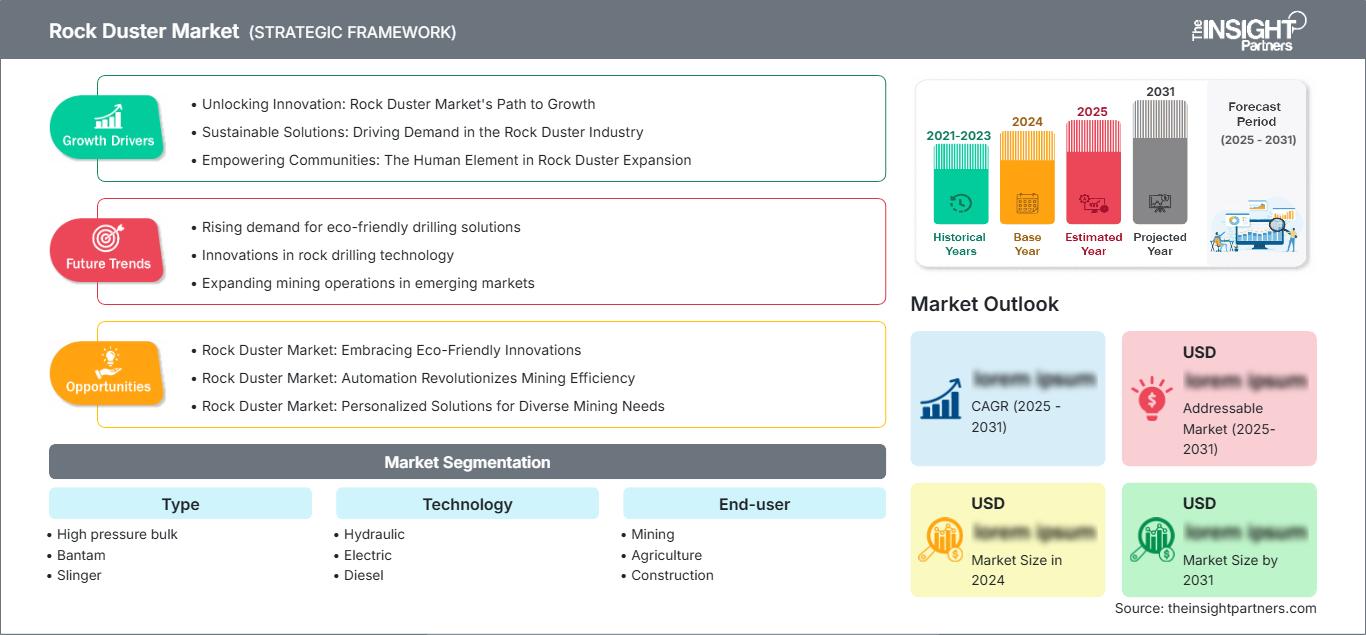
Rock Duster Market: Strategic Insights
Regional Insights
North America Rock Duster Market
North America is estimated to represent 31–35% of the global Rock Duster Market in 2025 and is projected to expand at a 5.3–5.8% CAGR through 2034. The US accounts for 72–76% of regional demand, reflecting its large installed base of underground coal operations and established mine-safety framework. Canada contributes through potash and other underground resource projects.
Regulations continue to be one of the main structural drivers. The MSHA’s requirement to conduct rock dusting has helped to mitigate the risk of explosions because of coal dust, and the MSHA’s regulation on respirable crystalline silica is a strong motivator for managing air dust. The replacement of older permitted machinery, mechanization, and higher capacity need fuel purchases.
U.S. Rock Duster Market
The U.S. represents an estimated 72–76% of North America's 2025 Rock Duster Market demand and is projected to grow at a 5.1–5.6% CAGR through 2034. Coal mining is still the major base for applications, but potash, salt, limestone mining, and other underground mines also have their own specific needs. A.L. Lee Corporation, Damascus Corporation, Johnson Industries, and Irwin Car and Equipment have staying power within the market.
Current trends in applications are moving towards bigger capacities, permissible electric machines, and automation to minimize handling needs. According to MSHA's guidelines, control of explosive coal dust must be done without increasing exposure to respirable dust due to rock-dusting procedures. Johnson Industries provides battery-operated permissible machinery, but hydraulics and mechanics have established themselves in mines where such machinery is feasible.
Europe Rock Duster Market
Europe is estimated to hold a 24–28% of the Rock Duster Market share in 2025 and expand at a 4.6–5.1% CAGR through 2034. Poland and Germany provide important underground mining demand, while the UK, Czechia, and selected Eastern European markets support specialized equipment requirements. Regional procurement increasingly emphasizes worker protection, equipment efficiency, and compliance.
Despite the fact that the British market has a smaller scale for coal mining, there still exists a special underground mining equipment industry there. The German market has the capability of industrial and mining engineering, while the Polish market is still important because of its underground coal production industry. There is comparatively less need for coal mining in France, Italy, and Spain, but they are important due to industrial minerals and quarries.
APAC Rock Duster Market
APAC is estimated to account for 28–32% of the Rock Duster Market in 2025 and grow at a 5.8–6.4% CAGR through 2034, making it the leading high-growth region. China represents the largest demand center, followed by Australia, India, Japan, and South Korea.
China's extensive underground mining activity supports equipment demand, while Australia emphasizes mine safety, automation, and high-capacity stone-dusting systems. India is developing underground coal and mineral capacity, creating replacement and modernization opportunities. Japan and South Korea contribute through specialized industrial and mining applications. Policy emphasis on occupational safety, mine productivity, and mechanization should support the adoption of electric and automated systems.
Middle East & Africa Rock Duster Market
The Middle East and Africa Rock Duster Market demand is comparatively specialized, with Saudi Arabia, the UAE, South Africa, and the rest of MEA contributing through mining, mineral extraction, tunneling, and infrastructure projects. The region is expected to grow at a 4.2–4.8% CAGR through 2034.
South Africa represents the leading regional market because of its established underground coal and hard-rock mining base. Saudi Arabia and the UAE provide opportunities through mining diversification and infrastructure development, while other African markets are linked to expanding mineral extraction. Equipment requiring limited electrical infrastructure, rugged construction, and straightforward servicing can gain preference in remote operating environments.
Segmentation Analysis
Type
According to the Rock Duster Market, type segmentation is led by high-pressure bulk equipment because large underground operations require rapid distribution and consistent coverage. The segment is projected to expand at a 4.8–5.3% CAGR during 2026–2034. Mine operators balance capacity, hose reach, dust-storage requirements, maneuverability, and labor availability when selecting equipment. Automated and mine-wide configurations should gain relevance where extensive workings justify centralized transfer infrastructure.
- High pressure bulk: These systems address large-volume dusting requirements and remain strategically important for extensive underground workings where rapid coverage, high throughput, and reduced repositioning frequency influence equipment selection.
- Bantam: Compact Bantam systems serve operations requiring maneuverability in constrained headings and localized application, offering a practical option where larger equipment cannot efficiently navigate underground working areas.
- Slinger: Slinger configurations support controlled mechanical distribution and are suited to applications requiring straightforward deployment, adjustable discharge, and compatibility with mobile underground equipment.
- Trickle Wet/Slurry: Wet and slurry systems support targeted dust application where adhesion and controlled placement are priorities, particularly around ribs, roofs, and areas requiring specialized treatment.
- Mine-wide automated dusting systems: These integrated systems connect storage, transfer, and distribution functions, reducing manual handling and supporting consistent dusting across longwall and development areas.
Technology
According to the Rock Duster Market, technology segmentation reflects differences in mine infrastructure, energy availability, certification requirements, and maintenance preferences. Electric technology is projected to record a 6.1–6.7% CAGR during 2026–2034, exceeding the overall market pace as battery and mine-approved electrical systems become more practical. Hydraulic and diesel technologies remain relevant where established mine fleets and power arrangements favor their use.
- Hydraulic: Hydraulic systems provide strong torque and robust performance in demanding underground environments, particularly where hydraulic power is already available on mobile mining machinery and service infrastructure.
- Electric: Electric systems benefit from lower local emissions, increasingly capable battery technologies, and compatibility with mine electrification initiatives, supporting their adoption for permissible and mobile dusting applications.
- Diesel: Diesel configurations remain useful in operations requiring high mobility and extended duty cycles where electrical infrastructure is constrained or equipment must operate independently across remote workings.
End-user
End-user segmentation is dominated by mining applications because statutory dust control and underground explosion prevention directly support equipment procurement. Mining demand is expected to grow at a 5.2–5.7% CAGR through 2034. Agriculture and construction remain smaller applications, but specialized dust-management requirements create niche opportunities for portable equipment and non-permissible systems.
- Mining: Mining is the core application base, driven by underground coal and mineral operations requiring systematic distribution of inert dust and equipment capable of functioning under demanding environmental conditions.
- Agriculture: Agricultural applications are niche and generally involve material handling or dust-control requirements where portable distribution equipment can be adapted to specific operational environments.
- Construction: Construction applications include tunneling, excavation, boring, and other confined environments where controlled particulate management and rugged portable equipment can improve workplace conditions.
Opportunity Snapshot
| End-User | Revenue Contribution (High/Medium/Low) | Trend Tag | Adoption Stage |
| Mining | High | Mine Safety | Mature |
| Agriculture | Low | Bulk Handling | Emerging |
| Construction | Medium | Tunnel Dusting | Scaling |
Rock Duster Market Growth Drivers and Impact Analysis
Stricter control of combustible and respirable mine dust
Enforcement activities still represent an immediate procurement trigger due to the need for proper management of explosive coal dust and protection from hazardous particles in the atmosphere for miners. In the United States, MSHA's rock-dusting approach makes the use of adequate inert material in underground coal mines mandatory, with the latest requirements concerning silica exposure drawing more attention to dust control measures in mines. From the perspective of market implications, the increased focus is on the equipment capable of ensuring proper dosing, low exposure risk for operators, and documentation capabilities. Suppliers, who would be able to provide permissible design along with metering and mobility, will benefit from replacements even in the case of low growth of output in mines.
Expansion and modernization of underground mining operations
The growing intricacy of mining operations underground makes it necessary to have equipment able to function over a longer distance range and amid a more mechanized production system. Deep operations, longer hauling routes, development of longwall operations, and a larger production footprint make it harder to distribute inert dust using manual systems. With the modernization of fleets, dusters are increasingly assessed not in isolation but in comparison to other equipment lines. It offers the chance to develop electric and hydraulic models that could be powered by existing facilities. Modernization adds the importance of the availability of equipment since downtime in production would bring disproportionate costs. Companies offering spare parts, field service, remanufacturing, and configuring could thus benefit from increased customer loyalty.
Automation and electrification of underground equipment
Automation and electrification have influenced the process of selecting underground mining equipment. Battery- and electrical-driven dusters help to lower reliance on diesel engines and could be simpler to use in confined spaces, where ventilation standards are high. Automation of stone-dusting systems would further lower the amount of labor through the movement of bulk materials from above-ground stockpiles into underground sites. The commercial benefits go beyond the sale of equipment due to the fact that a complete system requires controls, storage units, transportation equipment, sensors, and maintenance. It will not be widespread due to the differences in mine configuration, budgets, certification, and power availability. Nonetheless, manufacturers that develop modular systems, which can be used manually, semi-automated, or automated, would cater to more mines.
Rock Duster Market Future Trends
Integrated dusting infrastructure with remote monitoring
The rock duster market trends are expected to move toward integrated systems that connect surface storage, underground transfer, dust distribution, and operating controls. Rather than treating dusting as an isolated maintenance activity, mine operators will increasingly integrate it with broader mine-management systems. Remote status monitoring could provide visibility into hopper levels, transfer pressure, operating intervals, and equipment availability, allowing maintenance teams to intervene before interruptions occur. Modular architecture will become important because mines expand in stages and require equipment that can be extended without replacing the entire system. Digital interfaces may also support operating records and maintenance planning. The strongest adoption is likely in large underground coal operations with centralized infrastructure, while smaller mines will continue relying on mobile or manually controlled equipment.
Low-emission equipment and adaptable power architectures
Future procurement is expected to give priority to those equipment designs that can be designed using battery, electric, hydraulic, and hybrid power systems, depending on the nature of operations at the mines. In this case, electrification becomes pertinent to the areas where the operators are looking into ways of reducing underground emissions and improving ventilation efficiency. Battery-powered dusters will allow mobility without the need for cables. Electric drives also enable predictable maintenance scheduling. Hydraulics will also play an important role since they fit very well into the existing mobile equipment. Future equipment designs will also be characterized by interchangeable power modules, ease of servicing, and control systems rather than any one system that will apply to all.
Rock Duster Market Opportunities
Mine-wide automated systems for large underground operations
The strongest investment opportunity lies in mine-wide dusting infrastructure, where production scale, long underground distances, and labor constraints justify centralized systems. Suppliers can target operations by combining surface silos, pneumatic transfer, underground storage pods, automated controls, and adjustable discharge points into modular packages. Such systems can be configured progressively, allowing mines to begin with high-priority zones and extend coverage as production areas develop. The rock duster market forecasts indicate that capital-intensive solutions should gain traction where operators can quantify labor savings, improved coverage consistency, and reduced equipment repositioning. Vendors should prioritize engineering partnerships with mine operators because geological conditions, ventilation arrangements, access restrictions, and existing material-handling systems determine system architecture. Service contracts can further improve the commercial case.
Specialized electric dusters for fleet modernization
There is an excellent opportunity for manufacturers who can adapt their dusting equipment to work with acceptable battery-powered technologies in addition to current underground mine vehicle platforms. More and more buyers consider how equipment emits, charges, operates, needs maintenance, and fits current mine electrical specifications. A modular electric duster is able to solve problems of replacements without the need for changing the entire fleet. This is especially true in the case of using standard batteries, controls and maintenance modules. Suppliers must pay attention to such applications where the costs of ventilation and usage of diesel fuel make electrification economically viable. Cooperation with mining equipment OEMs and electrical system experts will speed up the process of adaptation and certification. The potential also lies in retrofits when older mobile equipment is able to get improved dusting equipment without full replacements.
Frequently Asked Questions

- Comprehensive Market Sizing and Forecast Analysis
- Detailed Segmentation Analysis
- In-Depth Market Dynamics Assessment
- Regional and Country-Level Insights
- Competitive Landscape and Company Benchmarking
- Strategic Business Intelligence
Recent Reports
Testimonials

The Insight Partners provided valuable market intelligence that supported our global go-to-market strategy. Their team was professional, responsive, and attentive to our feedback, providing thoughtful analysis and helpful methodological clarifications throughout the project.
Junmo Kim Chief Financial Officer (CFO), Enertech Co., Ltd.
The Insight Partners' SCADA System Market report is comprehensive, with valuable insights on current trends and future forecasts. The team was highly professional, responsive, and supportive throughout. We are very satisfied and highly recommend their services.
RAN KEDEM Partner, Reali Technologies LTDs
I requested a report on a very specific software market and the team produced the report in a few days. The information was very relevant and well presented. I then requested some changes and additions to the report. The team was again very responsive and I got the final report in less than a week.
JEAN-HERVE JENN Chairman, Future Analytica
We worked with The Insight Partners for an important market study and forecast. They gave us clear insights into opportunities and risks, which helped shape our plans. Their research was easy to use and based on solid data. It helped us make smart, confident decisions. We highly recommend them.
PIYUSH NAGPAL Sr. Vice President, High Beam Global
The Insight Partners delivered insightful, well-structured market research with strong domain expertise. Their team was professional and responsive throughout. The user-friendly website made accessing industry reports seamless. We highly recommend them for reliable, high-quality research services
YUKIHIKO ADACHI CEO, Deep Blue, LLC.
This is the first time I have purchased a market report from The Insight Partners.While I was unsure at first, I visited their web site and felt more comfortable to take the risk and purchase a market report.I am completely satisfied with the quality of the report and customer service. I had several questions and comments with the initial report, but after a couple of dialogs over email with their analyst I believe I have a report that I can use as input to our strategic planning process.Thank you so much for taking the extra time and making this a positive experience.I will definitely recommend your service to others and you will be my first call when we need further market data.
JOHN SUZUKI President and Chief Executive Officer, Board Director, BK Technologies
I wish to appreciate your support and the professionalism you displayed in the course of attending to my request for information regarding to infectious disease IVD market in Nigeria. I appreciate your patience, your guidance, and the fact that you were willing to offer a discount, which eventually made it possible for us to close a deal. I look forward to engaging The Insight Partners in the future, all thanks to the impression you have created in me as a result of this first encounter.
DR CHIJIOKE ONYIA MANAGING DIRECTOR, PineCrest Healthcare Ltd.Reason to Buy
- Informed Decision-Making
- Understanding Market Dynamics
- Competitive Analysis
- Identifying Emerging Markets
- Customer Insights
- Market Forecasts
- Risk Mitigation
- Boosting Operational Efficiency
- Strategic Planning
- Investment Justification
- Tracking Industry Innovations
- Aligning with Regulatory Trends





 Get Free Sample for