
Roll Forming Machine Market Size, Trends & Growth by 2034
Coverage: By Type (Dry Wall Roll Forming Machines, T-Bar Roll Forming Machine, Roller Shutter Roll Forming Machine, Sheet Metal Roll Forming Machines, Others); Operation (Manual, Automatic); Portability (Non-Portable, Portable); Applications (Open-Loop Stopping, Open-Loop Flying Die, Closed-Loop Stopping, Closed-Loop Flying Die), and Geography (North America, Europe, Asia Pacific, and South and Central America)
- Status : Data Released
- Report Code : TIPRE00010630
- Category : Manufacturing and Construction
- No. of Pages : 150
- Available Report Formats :


- Last update date : September 07, 2026


2025 Market Size
US$ 9.61 Bn
Base year value
2034 Forecast
US$ 12.35 Bn
Projected by 2034
CAGR 2026-2034
2.83 %
Growth rate
Addressable Market
US$ 99.70 Bn
(2026-2034)
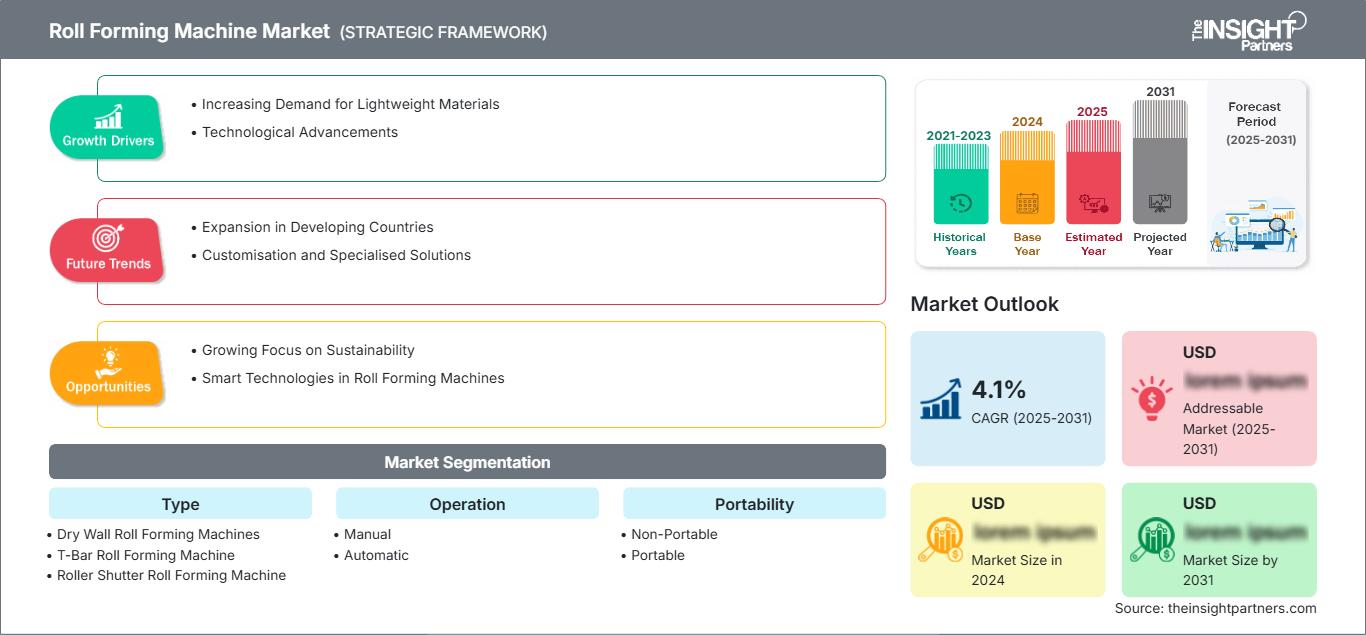
The roll forming machine market is valued at US$ 9.61 Billion in 2025 and is projected to reach US$ 12.35 Billion in 2034, registering a CAGR of 2.83% from 2026 to 2034. Expansion is supported by demand for continuously formed steel profiles, automated fabrication, construction components, roofing systems, and precision metal sections. The market remains closely linked to investment in manufacturing capacity, construction activity, lightweight structures, and increasingly integrated coil-processing lines.
North America is positioned for measured expansion as manufacturers modernize metal-forming capacity and respond to reshoring, labor constraints, and demand for locally fabricated building components. The roll forming machine market size is expected to benefit from an estimated 3.0–3.6% CAGR between 2026 and 2034, supported by automated material handling, replacement of aging equipment, and adoption of flexible production lines for roofing, framing, transportation, and industrial applications.
Roll Forming Machine Market Assessment and Insights
- North America: North America is expected to account for a 24–28% share in 2025 and grow at a 3.0–3.6% CAGR between 2026–2034, supported by reshoring, construction demand, equipment modernization, and increasing automation across metal fabrication operations.
- US: The US is estimated to represent 72–76% of North America in 2025 and expand at a 3.1–3.7% CAGR between 2026–2034, led by construction, roofing, automotive, and replacement investment.
- Europe: Europe is projected to hold a 27–31% share in 2025 and record a 2.7–3.3% CAGR between 2026–2034, with Germany, Italy, France, and the UK benefiting from advanced manufacturing, energy-efficient equipment, and specialized profile production.
- Asia Pacific: Asia Pacific is estimated at a 34–38% share in 2025 and is forecast to grow at a 3.1–3.8% CAGR between 2026–2034, with China, Japan, India, South Korea, and Australia supported by industrialization and infrastructure investment.
- Largest Segment: Sheet Metal Roll Forming Machines are estimated to command a 31–35% market share in 2025, with a 2.9–3.5% CAGR from 2026–2034, reflecting broad profile requirements across construction and industrial fabrication.
- High Growth Segment: Automatic systems are estimated to hold a 43–47% market share in 2025 and expand at a 3.5–4.1% CAGR from 2026–2034, driven by labor savings and integrated production control.
- Key companies analyzed in detail: Bradbury Co., Inc.; CHERNG JI Industrial Co., Ltd.; Dallan S.p.A.; Englert Inc.; Formtek, Inc.; GASPARINI S.p.A.; IL KWANG Metal Forming Co., Ltd.; Metform International Ltd.; Samco Machinery Ltd.; ZHONGYUAN Forming Machine.
Source: The Insight Partners' analysis based on proprietary research, government publications, company annual reports, investor presentations, industry databases, and expert interviews.
Metal forming production has moved away from individual forming machines and into integrated lines, which include decoiling, punching, roll forming, cutting, conveying, stacking, and packaging operations. Digital control systems and servos are used more often now to ensure repeatable profiles and shorter changeover times. An example is that company Dallan produced a full-electric system aiming to reduce energy consumption by 34%, compared to hydraulic systems.
For the forecast period, equipment investments are expected to focus on modular automation, compact equipment, and production systems that can operate several different profiles while minimizing manual intervention. Manufacturing hubs established in Asia and the reshoring trend in North America and Europe can also increase equipment demand. Workplace safety, energy efficiency, and resource productivity considerations in regulations should also encourage the replacement of old hydraulic and manual systems.
Roll Forming Machine Market Report Scope
| Report Attribute | Details |
|---|---|
| Market size in 2025 | US$ 9.61 Billion |
| Market Size by 2034 | US$ 12.35 Billion |
| Global CAGR (2026 - 2034) | 2.83% |
| Historical Data | 2021-2024 |
| Forecast period | 2026-2034 |
Roll Forming Machine Market Analysis
Demand for the roll forming machine market growth is anchored in applications requiring repeatable profiles at sustained production volumes. The construction firms and the metal fabricators make use of formed profiles in roofing, wall systems, framing, shutters, decking, and structural applications, while the automotive manufacturers need lightweight and uniform dimensional sections. The value chain includes suppliers of steel and aluminum coils, designers of tooling and machine building, system integration and fabricators, as well as end users. The equipment suppliers have started competing in terms of throughputs, changeover, tool life, controls and post-sale services besides the machines.
The supply chain is influenced by the engineering customizations as the geometry of profile, material thickness, line speed, punching and cut-off are very different. The manufacturers, thus, maintain an engineering-intensive manufacturing process along with standardization in modules. The automatic material handling has become very important as downstream operations like stacking, bundling and packaging can otherwise become bottlenecks to the high-speed forming machines.
The roll forming machine market analysis indicates a competitive structure combining established engineering companies with specialized regional manufacturers. Bradbury Co., Inc. and Formtek, Inc. emphasize engineered forming solutions, while Dallan S.p.A. focuses strongly on lean coil-processing and electric technologies. Englert Inc. has a differentiated position in portable roofing equipment, whereas Samco Machinery Ltd. serves diverse sectors, including automotive, construction, racking, transportation, and solar.
Positioning has become more and more associated with automation, engineering, and lifecycle support. The fact that Dallan has invested in an energy-efficient form with its 2025 fully electric high-speed platform shows the association between positioning and automation. The involvement of Formtek in the major events in the industry clearly shows the focus on technical training and process optimization. The appointment of a vice president of engineering by Samco in 2025 also confirms this.
● REPORT CUSTOMIZATION
Tailor This Report To Align With Your Specific Business Requirements
This report can be customized to align precisely with your business objectives, scope, and target markets. Customization options include tailored segmentation, geography, competitive analysis, and strategic insights to support informed decision-making.
Customize This Report →WHAT YOU CAN ADJUST
- ● Segmentations
- ● Geography
- ● Competitive Analysis
- ● Language Preferences
Roll Forming Machine Market: Strategic Insights
Regional Insights
North America roll forming machine market
North America is estimated to represent 24–28% of the 2025 roll forming machine market and is projected to expand at a 3.0–3.6% CAGR through 2034. The United States dominates regional demand, supported by construction, metal roofing, transportation equipment, and the replacement of aging forming assets. Reshoring is also encouraging manufacturers to improve domestic production flexibility and shorten supply chains.
Equipment buyers increasingly prioritize automation, portable systems, and integrated material handling. Englert's portfolio demonstrates the importance of mobile roofing production, where on-site forming can reduce freight, storage, and sizing-related losses. Formtek and Bradbury serve more engineered industrial requirements, while Samco provides customized solutions across construction, automotive, transportation, and solar applications. The regional market therefore, combines standardized roofing equipment with high-value engineered systems.
U.S. roll forming machine Market
The US accounts for an estimated 72–76% of North America's 2025 roll forming machine market and is expected to grow at a 3.1–3.7% CAGR through 2034. Demand is distributed across construction, roofing, automotive, industrial fabrication, and infrastructure-related manufacturing. Portable equipment is particularly relevant where contractors need customized panels produced close to installation sites.
Bradbury Co., Inc., Formtek, Inc., Englert Inc., and Samco Machinery Ltd. provide differentiated capabilities spanning engineered systems, construction roll forming, portable roofing equipment, and customized production lines. Open-loop systems remain suitable for standardized applications, while closed-loop configurations are increasingly relevant where dimensional accuracy and automated cutoff are priorities. Formtek's 2025 participation in the Construction Rollforming Show and FABTECH illustrates the continuing emphasis on production optimization and technical engagement.
Europe roll forming machine Market
Europe is estimated to hold 27–31% of the 2025 roll forming machine market, with a 2.7–3.3% CAGR through 2034. Germany is a leading market because of its industrial machinery base, while Italy remains important for specialized sheet-metal technologies. The UK, France, Spain, and Italy contribute through construction, roofing, industrial fabrication, and machinery replacement.
The UK market is influenced by construction refurbishment and demand for efficient building-envelope components. Germany benefits from advanced manufacturing and engineering expertise, supporting demand for high-precision automated lines. France, Italy, and Spain provide opportunities in roofing, building products, industrial profiles, and specialized machinery. Dallan's European development activity around full-electric forming and lean production demonstrates factors that are strengthening its position in the Roll Forming Machine Market Share landscape through a focus on energy efficiency, productivity, and reduced labor intensity.
APAC roll forming machine Market
APAC is estimated to account for 34–38% of the 2025 roll forming machine market and is projected to grow at a 3.1–3.8% CAGR. China leads regional demand, followed by Japan, South Korea, India, and Australia. Industrial expansion, construction activity, manufacturing localization, and infrastructure investment support equipment adoption across both standardized and customized applications.
Middle East & Africa roll forming machine Market
MEA represents a smaller but developing market, with Saudi Arabia, the UAE, and South Africa serving as important demand centers. Regional growth is expected at a 3.1–3.7% CAGR through 2034, supported by construction, industrial diversification, logistics infrastructure, and energy-related facilities.
Saudi Arabia and the UAE benefit from large infrastructure and industrial projects, while South Africa supports demand from construction and fabrication. The Rest of MEA presents selective opportunities where local production of roofing, structural profiles, and building components can reduce dependence on imported finished products and improve project responsiveness.
Segmentation Analysis
Type
Type segmentation is shaped by profile complexity, material specifications, production volumes, and end-use requirements. Sheet Metal Roll Forming Machines remain the largest category, while specialized equipment addresses drywall, T-bar, shutter, and other profile requirements. The segment is expected to expand at a 2.8–3.5% CAGR from 2026–2034 as manufacturers seek flexible forming capabilities. The roll forming machine market scope increasingly includes integrated punching, cutting, and handling rather than standalone forming units.
- Dry Wall Roll Forming Machines: Demand is linked to metal framing and drywall construction. Automated systems are strategically important where high-volume stud and track production requires consistent dimensions, rapid forming, and integrated packaging.
- T-Bar Roll Forming Machine: T-bar systems serve suspended-ceiling applications and benefit from repeatable profile geometry. Demand is concentrated where commercial construction requires standardized ceiling-grid components with efficient continuous production.
- Roller Shutter Roll Forming Machine: Roller shutter equipment addresses residential, commercial, and industrial openings. Modular designs allow manufacturers to produce multiple profiles while supporting incremental automation and reduced setup requirements.
- Sheet Metal Roll Forming Machines: These machines serve broad construction and industrial applications and constitute the largest type category because manufacturers require adaptable equipment for roofing, panels, framing, channels, and structural sections.
- Others: Specialized configurations address niche profiles and customer-specific production requirements. Their strategic importance lies in customization, enabling equipment suppliers to serve applications that cannot be efficiently handled by standardized machines.
Operation
According to the Roll Forming Machine Market Report, operation is divided between Manual and Automatic systems. Automatic equipment is expected to grow at a 3.5–4.1% CAGR from 2026–2034, exceeding manual systems as manufacturers address labor availability, throughput requirements, and process consistency. Manual systems retain relevance among smaller fabricators and applications where profile variety, low production volumes, or lower initial capital expenditure outweigh automation benefits.
- Manual: Manual machines remain relevant for small-scale fabrication and contractors requiring relatively simple operation. Lower complexity can support adoption where production volumes do not justify extensive automation.
- Automatic: Automatic systems integrate controls, servo drives, cutoff, punching, and material handling. Their strategic value increases as manufacturers seek higher utilization, consistent quality, reduced operator dependence, and connected production workflows.
Portability
Portability reflects the location and operating model of profile production. Non-Portable systems are expected to record a 2.7–3.3% CAGR from 2026–2034, supported by permanent manufacturing plants and high-volume operations. Portable equipment remains strategically relevant for contractors and roofing companies that benefit from producing material at or near project locations.
- Non-Portable: Fixed installations support higher production volumes, extensive automation, multiple forming stations, and integration with downstream manufacturing equipment. They remain central to factories producing standardized profiles continuously.
- Portable: Portable systems reduce transportation requirements and support job-site fabrication. Their value is strongest in roofing and construction applications where project-specific dimensions and reduced logistics costs influence equipment selection.
Applications
Applications differentiate forming lines according to cutoff architecture and control configuration. Closed-Loop Flying Die systems are expected to post a 3.6–4.2% CAGR from 2026–2034 because manufacturers increasingly prioritize continuous production and precise cutting without frequent line stoppages. The roll forming machine market Forecasts indicate increasing interest in integrated controls and synchronized forming operations.
- Open-Loop Stopping: Open-loop stopping provides a straightforward configuration for applications where production speed and cutoff precision requirements are moderate. It remains suitable for standardized profiles and cost-sensitive production environments.
- Open-Loop Flying Die: Flying-die systems permit cutting during continuous movement, improving throughput where long production runs justify greater equipment complexity and synchronized cutoff control.
- Closed-Loop Stopping: Closed-loop stopping combines feedback control with stationary cutoff operations. It supports tighter dimensional management where repeatability is important, but continuous cutting is not essential.
- Closed-Loop Flying Die: This configuration combines feedback control and continuous cutting, making it suitable for automated high-throughput lines requiring accurate lengths, reduced interruptions, and coordinated downstream handling.
Opportunity Snapshot
| Applications | Revenue Contribution | Trend Tag | Adoption Stage |
| Open-Loop Stopping | Medium | Profile Control | Mature |
| Open-Loop Flying Die | Medium | Continuous Cut | Scaling |
| Closed-Loop Stopping | Medium | Feedback Cutoff | Scaling |
| Closed-Loop Flying Die | High | Servo Cutting | Scaling |
Roll Forming Machine Market Growth Drivers and Impact Analysis
Reshoring and Manufacturing Localization
The trend toward reshoring has elevated the importance of flexible equipment for metal forming due to the need for shortening supply chains, controlling production schedules, and reducing vulnerabilities from transport interruptions. Dallan has recognized that there is a comeback of the manufacturing industry in Europe and America, attributing this trend to the increased demand for automated manufacturing systems. In terms of equipment manufacturers, the trend implies a greater need for compact lines, quick installations, remote support, and modularity. To counter the trend, manufacturers can replace imported ready-made profiles with locally fabricated sections, adjusted for individual projects. The second important aspect of the trend includes the demand for mobile roofs, which will make manufacturing closer to construction sites.
Labor Productivity and Automated Material Handling
The limitations on labor are driving companies toward automating operations associated with the forming operation itself rather than concentrating exclusively on the forming station. Loading materials, unloading parts, stacking and bundling and packaging can become bottlenecks despite the speed at which the forming machine runs. The engineering capabilities of Samco show that the use of automation can also be included in roll forming lines, which enables their customers to avoid labor-intensive manual processes and make their manufacturing flow smoother. It means a lot from the business perspective, because it is possible to increase not only the machine speed but also the efficiency of the entire production line. This gives manufacturers a chance to sell more complete packages, including services.
Energy Efficiency in Metal Processing
Increasingly, energy efficiency has emerged as one of the selection criteria for equipment since manufacturers evaluate the operating cost, besides the cost of acquisition. The full-electric forming machines provide an example of how machine design is capable of lowering energy use without compromising on accuracy and speed. Dallan indicated that there was a 34% drop in energy usage in their full-electric punching, roll forming, and cutting machines compared to hydraulic ones. Such savings can influence equipment choice when the machines have to be used in long production runs. The suppliers may distinguish themselves by means of electric drive, regeneration systems, efficient motors, good tooling and software that prevents wastage through idling. The benefits go beyond just energy savings since the low energy usage, less maintenance of hydraulics and quietness create a better working environment.
Roll Forming Machine Market Future Trends
Connected Coil-to-Pack Production
The roll forming machine market trends are moving toward connected coil-to-pack systems that combine forming, punching, cutting, inspection, conveying, bundling, and packaging within coordinated production architectures. Rather than treating each individual machine as a discrete piece of equipment, manufacturers will increasingly be linking recipes for manufacturing, tooling parameters, quality data, and commands for material handling within the context of a common control infrastructure. The Dallan automated drywall profile line is an example of this trend in that it combines roll forming and automated packaging into a production system capable of producing 33,000 meters of product in eight hours, utilizing just one operator. Future production systems will probably follow suit using predictive maintenance, digital scheduling, vision inspection, and automated changeover management.
Electric and Modular Forming Platforms
The architecture of future machines is likely to be more focused on electric actuation, modular forming stations, and scalability in terms of automation. In fact, electric platforms will help save energy and integrate easily with digital control systems, whereas modular platforms will give customers an opportunity to increase punching, cutting, material handling, and packaging capability depending on their future needs. The implementation of such solutions minimizes the risks involved in making a big investment and makes it possible for smaller companies to join the market with a simpler version of a machine and then scale up. An example of such a combination could be Dallan’s 2025 Full Electric 120 platform. With time, machine manufacturers may start selling configurable platforms rather than machines built for specific purposes.
Roll Forming Machine Market Opportunities
Localized Portable Production for Construction
The roll forming machine market forecasts indicate an opportunity for suppliers to expand portable and semi-automated systems serving contractors, roofing specialists, and regional building-product manufacturers. Producing panels closer to construction sites can reduce freight requirements, storage needs, handling losses, and dimensional errors. The opportunity is strongest where project specifications vary and transportation of long profiles is costly. Suppliers can differentiate through trailer-mounted systems, rapid setup, interchangeable tooling, remote diagnostics, and financing models suited to smaller contractors. Portable equipment can also act as an entry point into broader automation, allowing customers to begin with manual or semi-automatic production and later add computerized controls, automated cutting, and material handling. This creates a scalable investment pathway while addressing decentralized construction activity and demand for faster project execution.
High-Precision Profiles for Lightweight Structures
Another opportunity in terms of investment is the creation of machines which will produce components from lightweight steel and aluminum profiles, for use in the automotive industry, building, energy industry and manufacturing structures. In such cases, the need for precision in controlling the behavior of material, its geometry, springback and tolerance becomes more relevant, making it necessary to invest in innovative technology and feedback. Machine providers may focus on special applications, where the significance of tolerance is higher than the sensitivity to cost, which is usually the case with standard machines. Collaboration between machine manufacturers, tool manufacturers, material manufacturers and final users will enable faster development of new profiles. Machines able to work with different gauges and materials, without having to make major changes to the mechanical structure, are also beneficial.
Frequently Asked Questions

- Comprehensive Market Sizing and Forecast Analysis
- Detailed Segmentation Analysis
- In-Depth Market Dynamics Assessment
- Regional and Country-Level Insights
- Competitive Landscape and Company Benchmarking
- Strategic Business Intelligence
Recent Reports
Testimonials

The Insight Partners' SCADA System Market report is comprehensive, with valuable insights on current trends and future forecasts. The team was highly professional, responsive, and supportive throughout. We are very satisfied and highly recommend their services.
RAN KEDEM Partner, Reali Technologies LTDs
I requested a report on a very specific software market and the team produced the report in a few days. The information was very relevant and well presented. I then requested some changes and additions to the report. The team was again very responsive and I got the final report in less than a week.
JEAN-HERVE JENN Chairman, Future Analytica
We worked with The Insight Partners for an important market study and forecast. They gave us clear insights into opportunities and risks, which helped shape our plans. Their research was easy to use and based on solid data. It helped us make smart, confident decisions. We highly recommend them.
PIYUSH NAGPAL Sr. Vice President, High Beam Global
The Insight Partners delivered insightful, well-structured market research with strong domain expertise. Their team was professional and responsive throughout. The user-friendly website made accessing industry reports seamless. We highly recommend them for reliable, high-quality research services
YUKIHIKO ADACHI CEO, Deep Blue, LLC.
This is the first time I have purchased a market report from The Insight Partners.While I was unsure at first, I visited their web site and felt more comfortable to take the risk and purchase a market report.I am completely satisfied with the quality of the report and customer service. I had several questions and comments with the initial report, but after a couple of dialogs over email with their analyst I believe I have a report that I can use as input to our strategic planning process.Thank you so much for taking the extra time and making this a positive experience.I will definitely recommend your service to others and you will be my first call when we need further market data.
JOHN SUZUKI President and Chief Executive Officer, Board Director, BK Technologies
I wish to appreciate your support and the professionalism you displayed in the course of attending to my request for information regarding to infectious disease IVD market in Nigeria. I appreciate your patience, your guidance, and the fact that you were willing to offer a discount, which eventually made it possible for us to close a deal. I look forward to engaging The Insight Partners in the future, all thanks to the impression you have created in me as a result of this first encounter.
DR CHIJIOKE ONYIA MANAGING DIRECTOR, PineCrest Healthcare Ltd.Reason to Buy
- Informed Decision-Making
- Understanding Market Dynamics
- Competitive Analysis
- Identifying Emerging Markets
- Customer Insights
- Market Forecasts
- Risk Mitigation
- Boosting Operational Efficiency
- Strategic Planning
- Investment Justification
- Tracking Industry Innovations
- Aligning with Regulatory Trends





 Get Free Sample for