
Rooftop Units Market Share, Demand & Growth by 2034
Coverage: By Capacity (Below 25 Tons, 25-50 Tons, Above 50 Tons); Application (Shopping Malls, Supermarkets and Hypermarkets, Restaurants, Workspaces, Retail Stores, Industrial, Others) , and Geography (North America, Europe, Asia Pacific, and South and Central America)
- Status : Data Released
- Report Code : TIPRE00013562
- Category : Manufacturing and Construction
- No. of Pages : 150
- Available Report Formats :


- Last update date : September 07, 2026


2025 Market Size
US$ 48.86 Bn
Base year value
2034 Forecast
US$ 81.9 Bn
Projected by 2034
CAGR 2026-2034
5.91 %
Growth rate
Addressable Market
US$ 592.44 Bn
(2026-2034)
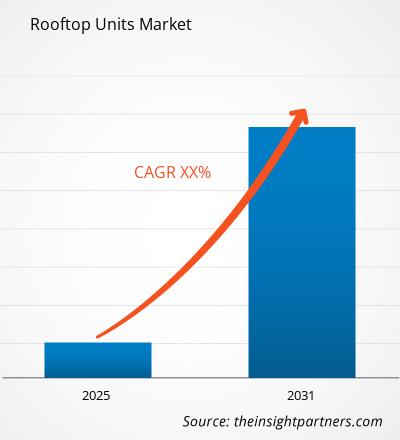
The rooftop units market is positioned at the intersection of packaged HVAC demand, commercial building expansion, and equipment replacement cycles. The market was valued at US$ 48.86 Billion in 2025 and is projected to reach US$ 81.9 Billion by 2034, registering a CAGR of 5.91% from 2026 to 2034. Demand is increasingly influenced by energy efficiency, refrigerant transition, digital controls, and requirements for reliable packaged climate management.
North America remains structurally important, supported by its extensive installed base of packaged HVAC equipment, mature commercial construction ecosystem, and recurring replacement requirements. The regional rooftop units market size is expected to expand at approximately 4.8–5.4% CAGR between 2026 and 2034, with the replacement of aging equipment and increasingly stringent efficiency requirements providing a durable demand foundation.
Rooftop Units Market Assessment and Insights
- North America: North America represented a 23–25% share in 2025 and is expected to grow at a 4.8–5.4% CAGR between 2026–2034, supported by replacement demand, commercial construction, energy-efficiency standards, and widespread packaged HVAC adoption.
- US: The US accounted for 79–82% of North America's 2025 share and is projected to grow at a 4.9–5.3% CAGR between 2026–2034, led by commercial replacement activity.
- Europe: Europe held a 21–24% share in 2025 and is forecast to expand at a 4.4–5.0% CAGR between 2026–2034, with Germany, the UK, France, Italy, and Spain supporting efficiency-led modernization.
- Asia Pacific: Asia Pacific captured a 31–34% share in 2025 and is projected to advance at a 6.3–7.0% CAGR between 2026–2034, led by China, India, Japan, and South Korea through construction and industrial expansion.
- Largest Segment: Capacity below 25 tons held a 54–58% market share in 2025, with a 5.4–5.9% CAGR between 2026–2034, reflecting broad applicability across commercial properties.
- High Growth Segment: Capacity above 50 tons represented a 12–16% market share in 2025, with a 6.6–7.2% CAGR between 2026–2034, supported by large facilities and logistics assets.
- Key companies analyzed in detail: AAON, Inc.; Accurex, LLC; CAREL Industries S.p.A.; Carrier Global Corporation; DAIKIN APPLIED; Danfoss A/S; Nortek Air Solutions; Trane Technologies plc; Johnson Controls International plc; Lennox International Inc.
Source: The Insight Partners' analysis based on proprietary research, government publications, company annual reports, investor presentations, industry databases, and expert interviews.
The rooftop units market has evolved from conventional packaged cooling equipment toward higher-efficiency platforms incorporating variable-speed fans, advanced economizers, heat-pump configurations, electronic controls, and lower-global-warming-potential refrigerants. Modern manufacturers design their machines with greater emphasis on service modularity and compatibility with currently installed roof curbs. Such innovations decrease the level of disturbance during installation and increase part-load efficiency, especially in commercial buildings such as shopping centers, restaurants, warehouses, etc.
Future developments will include equipment replacement schemes, electrification, building management systems, and more strict regulations concerning refrigerants. The growth of construction activities in such countries as India, Southeast Asia, and the Middle East will increase the size of demand, while traditional markets will focus on retrofit efficiency. Investments will go to controls, heat-pump systems, sensors, and equipment that can communicate with the building automation system.
Rooftop Units Market Report Scope
| Report Attribute | Details |
|---|---|
| Market size in 2025 | US$ 48.86 Billion |
| Market Size by 2034 | US$ 81.9 Billion |
| Global CAGR (2026 - 2034) | 5.91% |
| Historical Data | 2021-2024 |
| Forecast period | 2026-2034 |
Rooftop Units Market Analysis
Demand for the rooftop units market is closely tied to commercial floor-space growth, equipment replacement, and the operational need to condition large single-story buildings economically. The value chain spans compressors, heat exchangers, fans, controls, refrigerant circuits, sheet-metal fabrication, system integration, distributors, mechanical contractors, and maintenance providers. Rising electricity costs make part-load efficiency increasingly relevant to owners.
Manufacturing dynamics are shaped by steel, copper, aluminum, semiconductor, motor, and refrigerant availability. Packaged configurations can reduce field labor because major components arrive factory assembled, while standardized footprints simplify replacement planning. Suppliers therefore compete on lead times, curb compatibility, controls, serviceability, and lifecycle economics as much as on nominal cooling capacity.
Competitive positioning in the rooftop units market combines broad product portfolios with application specialization. Carrier Global Corporation, Trane Technologies plc, Johnson Controls International plc, and Lennox International Inc. compete across major commercial applications, while AAON, Inc., emphasizes configurable packaged equipment. DAIKIN APPLIED, Nortek Air Solutions, Danfoss A/S, and CAREL Industries S.p.A. strengthen the ecosystem through applied systems, airflow, controls, and component technologies.
According to the Rooftop Units Market Report, investment is increasingly directed toward refrigerant-transition readiness, electrified heating, connected controls, and manufacturing flexibility. Johnson Controls International plc offers rooftop platforms spanning approximately 3–150 tons, while Carrier Global Corporation has expanded its products using R-454B refrigerant. Such developments indicate that competitive differentiation is shifting toward efficiency, regulatory compatibility, controls integration, and replacement convenience rather than basic packaged-air-conditioning functionality alone.
● REPORT CUSTOMIZATION
Tailor This Report To Align With Your Specific Business Requirements
This report can be customized to align precisely with your business objectives, scope, and target markets. Customization options include tailored segmentation, geography, competitive analysis, and strategic insights to support informed decision-making.
Customize This Report →WHAT YOU CAN ADJUST
- ● Segmentations
- ● Geography
- ● Competitive Analysis
- ● Language Preferences
Rooftop Units Market: Strategic Insights

Regional Insights
North America rooftop units market
North America accounted for a 23–25% of the rooftop units market share in 2025 and is projected to grow at a 4.8–5.4% CAGR through 2034. The market is favored by an already installed high volume of packaged HVAC equipment, robust retail and warehouse network, as well as contractor networks. Replacement remains important since old equipment provides room for more efficient systems to be put in place without the need to remodel buildings completely.
The United States makes up the key regional demand driver, whereas Canada contributes with its commercial constructions, institutions, and replacement programs. More and more often, energy-efficiency regulations, phase-out of certain refrigerants, utility incentives, and decarbonization programs impact procurement specifications. The rooftop HVAC equipment remains appealing to those who value quick installations and limited utilization of mechanical rooms in buildings.
U.S. rooftop units Market
The US represented 79–82% of North America's 2025 rooftop units market share and is expected to grow at a 4.9–5.3% CAGR through 2034. Commercial buildings, retail space, restaurants, warehouses, and offices are the main application types. Replacement demand is of special importance since rooftop units may often be replaced through the utilization of the already installed roof curbs and distribution network.
Carrier Global Corporation, Trane Technologies plc, Johnson Controls International plc, Lennox International Inc., and AAON, Inc. are leading companies in the industry with their presence on both capacity and application markets. Presently, equipment innovations include lower GWP refrigerants, variable-speed technology, advanced controls, and heat pumps. This results in the existence of recurrent demand for replacements in the US along with the technology shift.
Europe rooftop units market
Europe held a 21–24% share of the rooftop units market in 2025 and is projected to expand at a 4.4–5.0% CAGR through 2034. Germany is the leading demand center, followed by the UK, France, Italy, and Spain. Efficiency requirements, building renovation, electrification, and refrigerant policies are progressively influencing equipment specifications and lifecycle decisions.
The UK market emphasizes commercial retrofit, energy performance, and controls integration across offices, retail properties, and public buildings. Germany combines industrial modernization with stringent building-efficiency objectives, creating demand for equipment capable of reducing energy consumption while maintaining reliable ventilation and temperature control. France, Italy, and Spain add opportunities through retail modernization, hospitality facilities, logistics construction, and climate-driven cooling requirements, supporting Germany's leading regional position.
APAC rooftop units market
APAC represented a 31–34% share in 2025 and is expected to grow at a 6.3–7.0% CAGR through 2034. China leads the region, while India, Japan, South Korea, and Australia provide significant opportunities. Urbanization, manufacturing investment, retail expansion, and commercial construction support equipment demand.
China's scale in construction and industrial facilities sustains regional leadership, while India's organized commercial real estate expansion provides strong incremental demand. Japan and South Korea emphasize efficiency and advanced controls, whereas Australia combines replacement requirements with energy-performance priorities. Policy support for efficient buildings and expanding HVAC penetration should keep APAC among the fastest-growing regional markets.
Middle East & Africa rooftop units Market
The Middle East and Africa market is expected to grow at approximately 5.2–6.0% CAGR through 2034, with Saudi Arabia leading regional demand. UAE construction, Saudi infrastructure programs, and South African commercial facilities support adoption, while the Rest of MEA remains comparatively fragmented.
Extreme cooling requirements, expanding commercial developments, logistics facilities, and industrial projects create a strong need for dependable packaged systems. In the Gulf, energy efficiency increasingly complements capacity requirements as building owners manage substantial cooling loads. Saudi Arabia and the UAE are likely to remain the principal investment centers, while South Africa provides a diversified base across retail, industrial, and institutional applications.
Segmentation Analysis
Capacity
Capacity remains a fundamental purchasing criterion because thermal load, building footprint, operating profile, and available roof space determine equipment configuration. The segment is projected to record a 5.0–6.5% CAGR from 2026–2034. Smaller packaged systems address broad commercial applications, while larger units increasingly serve logistics, industrial, and large-format retail facilities.
- Below 25 Tons: This range serves restaurants, retail stores, supermarkets, workspaces, and smaller commercial properties. Its broad application base supports replacement volume, standardized installation, and strong contractor familiarity.
- 25-50 Tons: Mid-capacity systems address larger commercial buildings and multi-zone facilities requiring greater airflow and cooling output. Demand is supported by shopping centers, supermarkets, warehouses, and institutional properties.
- Above 50 Tons: Large systems are strategically important for industrial facilities, distribution centers, major retail complexes, and high-load applications where fewer high-capacity units can simplify equipment management.
Application
Application represents a strategically diverse portion of the rooftop units market scope because occupancy, operating schedules, internal heat gains, ventilation requirements, and building geometry determine equipment selection. The segment is estimated to expand at a 5.4–6.4% CAGR from 2026–2034, with commercial applications providing the broadest installed opportunity.
- Shopping Malls: Large enclosed spaces require dependable cooling, ventilation, and zoning. Rooftop configurations can support distributed conditioning while preserving valuable interior floor area for commercial activities.
- Supermarkets and Hypermarkets: These facilities require continuous temperature management across sales areas, storage zones, and customer spaces, creating demand for reliable packaged systems with efficient part-load operation.
- Restaurants: Variable occupancy, kitchen heat, ventilation requirements, and extended operating hours create a strong need for flexible rooftop equipment and dependable controls.
- Workspaces: Offices increasingly prioritize indoor environmental quality, energy performance, and controllability, supporting replacement of older packaged systems with connected and higher-efficiency equipment.
- Retail Stores: Distributed stores favor standardized equipment and straightforward replacement procedures, particularly where operators manage multiple locations and seek consistent maintenance requirements.
- Industrial: Industrial buildings require robust airflow, temperature control, and high-capacity equipment. Rooftop systems are relevant where manufacturing, warehousing, and logistics activities create substantial thermal loads.
Opportunity Snapshot
| Application | Revenue Contribution (High/Medium/Low) | Trend Tag | Adoption Stage |
| Shopping Malls | High | Centralized Cooling | Mature |
| Supermarkets and Hypermarkets | High | Refrigeration Integration | Mature |
| Restaurants | Medium | Kitchen Ventilation | Scaling |
| Workspaces | High | Smart Controls | Scaling |
| Retail Stores | High | Retrofit Efficiency | Mature |
| Industrial | High | High-Capacity Cooling | Scaling |
Rooftop Units Market Growth Drivers and Impact Analysis
Commercial Replacement Cycles and Aging Equipment
Equipment replacement due to the aging of HVAC systems is one of the structural drivers since most buildings are running systems that are past the intended target lifespan. Decisions on whether to do replacement or repair on the HVAC system are based on factors such as repair costs, energy usage, downtime risks, and compliance considerations. This has made packaged rooftop units more attractive since the replacement could be done using the same distribution networks and roof curbs already in place. The effect is not limited to the equipment manufacturers alone but also affects contractors, distribution companies, controls providers, and maintenance companies. Replacement presents an opportunity for upgrading the system through the inclusion of VSDs, better economizers, heat pumps, and digital monitoring without having to redesign the HVAC system completely.
Energy Efficiency and Refrigerant Transition
Changes in efficiency requirements and refrigerant transition are driving changes in equipment specifications in developed regions. New equipment is increasingly being required to meet seasonal efficiency requirements as well as refrigerant properties, safety requirements, compressor requirements, and servicing requirements. In the US, equipment makers are releasing platforms that are compatible with low-GWP refrigerants like R-454B, while the EU has pressure towards decarbonization and fluorinated gases policy. These developments will hasten the replacement of old equipment that fails to meet the new requirements. Suppliers of equipment will be affected because they will need to supply compressors, valves, sensors, controls, and servicing equipment that are suited for the new refrigerant systems. The effect on building owners will be the greater importance of the total cost of ownership and compatibility with future regulations.
Expansion of Logistics, Retail, and Commercial Infrastructure
The increase in warehouses, distribution centers, organized retail, food service, and mixed commercial sites increases the install base. Logistics sites need a consistent environment inside the facility for employees, equipment, and goods stored. The same holds true for retail sites as well as food service sites, where there is variable occupation and hours of operation. The rooftop configuration can meet these demands while minimizing the need for competition for space inside for the mechanical system. The effect on the market would be greatest when developers prefer standard equipment for multiple facilities, thereby making it easier for procurement departments to specify, inventory parts, and maintain the equipment. Large projects will also allow for larger equipment.
Rooftop Units Market Future Trends
Lower-GWP Refrigerants and Electrified Rooftop Platforms
The rooftop units market trends are moving toward equipment architectures designed around lower-GWP refrigerants and greater electrification. The heat pump rooftop units are gaining significance in those regions where there is a preference for alternatives to fossil fuel heating systems, especially in areas working towards building decarbonization. The future development of these units is expected to incorporate variable speed compressors, fan controls, better defrost techniques, and refrigerants, along with more advanced safety monitoring. Manufacturers will have to retain their performance capabilities across varied ambient temperatures and ensure easy maintenance as well. With evolving refrigerant laws at various paces in different regions, suppliers that have a modular platform will be able to customize their products for the specific region.
Connected Controls and Predictive Equipment Management
Connected controllers are anticipated to become increasingly integrated into packaged rooftop solutions that allow operators to control temperatures, air flow, alarms, energy usage, and equipment status from afar. In the future, the units will not just work independently as HVAC units but will be part of building automation and load management. The use of sensors, cloud technology, analysis, and machine learning may be able to detect abnormal compressor performance, fan degradation, filter loading, and controller faults before any breakdowns happen. This will result in moving toward maintenance models that focus on preventive actions. It is an area that makes particular sense for retail, restaurant, and commercial facilities with multiple sites who have to maintain many units scattered across several locations.
Rooftop Units Market Opportunities
Standardized Multi-Site Retrofit Programs
The presence of large retail, foodservice, supermarket, and office space organizations represents a significant investment opportunity since their facilities may be distributed and have standard HVAC systems. Manufacturers can offer a retrofit solution that combines the selection of equipment, roof curb compatibility, controls, installation process coordination, commissioning, and maintenance. Retrofit solutions can help to streamline procurement processes and create consistent specifications among dispersed locations. This solution will be especially useful for companies looking to cut down on energy consumption without affecting their activities. Recurring service income can also be generated by remote monitoring, preventive maintenance, spare-parts contracts, and performance testing. Thus, a strategic investment in retrofitting solutions can meet needs related both to new equipment and aftermarket services. Companies with a developed network of distributors and digital servicing capabilities are in a favorable position to carry out such solutions.
High-Capacity Systems for Logistics and Industrial Buildings
Expansion of logistics networks, manufacturing facilities, and large-format commercial buildings creates opportunities for high-capacity packaged equipment and application-specific engineering. Developers increasingly require systems capable of handling substantial thermal loads while minimizing installation complexity and preserving usable building space. Suppliers can differentiate through modular high-capacity platforms, advanced airflow management, heat recovery, efficient compressors, and integrated controls. Investment opportunities extend to engineering services that optimize unit selection according to building geometry, operating schedules, ventilation loads, and local climate. The rooftop units market forecasts indicate that larger facilities can support stronger demand for equipment consolidation, especially where operators prefer fewer units with higher individual capacity. Manufacturers that combine robust equipment with commissioning and lifecycle support can capture value beyond the initial hardware sale.
Frequently Asked Questions

- Comprehensive Market Sizing and Forecast Analysis
- Detailed Segmentation Analysis
- In-Depth Market Dynamics Assessment
- Regional and Country-Level Insights
- Competitive Landscape and Company Benchmarking
- Strategic Business Intelligence
Recent Reports
Testimonials

The Insight Partners' SCADA System Market report is comprehensive, with valuable insights on current trends and future forecasts. The team was highly professional, responsive, and supportive throughout. We are very satisfied and highly recommend their services.
RAN KEDEM Partner, Reali Technologies LTDs
I requested a report on a very specific software market and the team produced the report in a few days. The information was very relevant and well presented. I then requested some changes and additions to the report. The team was again very responsive and I got the final report in less than a week.
JEAN-HERVE JENN Chairman, Future Analytica
We worked with The Insight Partners for an important market study and forecast. They gave us clear insights into opportunities and risks, which helped shape our plans. Their research was easy to use and based on solid data. It helped us make smart, confident decisions. We highly recommend them.
PIYUSH NAGPAL Sr. Vice President, High Beam Global
The Insight Partners delivered insightful, well-structured market research with strong domain expertise. Their team was professional and responsive throughout. The user-friendly website made accessing industry reports seamless. We highly recommend them for reliable, high-quality research services
YUKIHIKO ADACHI CEO, Deep Blue, LLC.
This is the first time I have purchased a market report from The Insight Partners.While I was unsure at first, I visited their web site and felt more comfortable to take the risk and purchase a market report.I am completely satisfied with the quality of the report and customer service. I had several questions and comments with the initial report, but after a couple of dialogs over email with their analyst I believe I have a report that I can use as input to our strategic planning process.Thank you so much for taking the extra time and making this a positive experience.I will definitely recommend your service to others and you will be my first call when we need further market data.
JOHN SUZUKI President and Chief Executive Officer, Board Director, BK Technologies
I wish to appreciate your support and the professionalism you displayed in the course of attending to my request for information regarding to infectious disease IVD market in Nigeria. I appreciate your patience, your guidance, and the fact that you were willing to offer a discount, which eventually made it possible for us to close a deal. I look forward to engaging The Insight Partners in the future, all thanks to the impression you have created in me as a result of this first encounter.
DR CHIJIOKE ONYIA MANAGING DIRECTOR, PineCrest Healthcare Ltd.Reason to Buy
- Informed Decision-Making
- Understanding Market Dynamics
- Competitive Analysis
- Identifying Emerging Markets
- Customer Insights
- Market Forecasts
- Risk Mitigation
- Boosting Operational Efficiency
- Strategic Planning
- Investment Justification
- Tracking Industry Innovations
- Aligning with Regulatory Trends





 Get Free Sample for