
Rotary Blasthole Drilling Rig Market Size, Share & Forecast by 2034
Coverage: by Type (Mid-Range Drilling Rig, Large-Range Drilling Rig, Others); Application (Quarries, Open-Pit Mining, Others) , and Geography (North America, Europe, Asia Pacific, and South and Central America)
- Status : Data Released
- Report Code : TIPRE00007805
- Category : Manufacturing and Construction
- No. of Pages : 150
- Available Report Formats :


- Last update date : September 18, 2026


2025 Market Size
US$ 3.57 Bn
Base year value
2034 Forecast
US$ 5.66 Bn
Projected by 2034
CAGR 2026-2034
5.24 %
Growth rate
Addressable Market
US$ 41.84 Bn
(2026-2034)
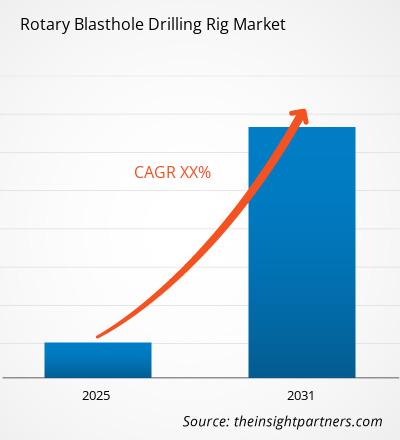
The rotary blasthole drilling rig market is projected to grow from US$ 3.57 Billion in 2025 to US$ 5.66 Billion by 2034, registering a CAGR of 5.24% during 2026–2034. Demand is supported by open-pit mine expansion, quarry productivity requirements, fleet automation, and the replacement of aging diesel-powered drilling equipment with digitally connected and lower-emission alternatives.
North America remains a mature but technology-intensive region, with the rotary blasthole drilling rig market size supported by large copper, iron ore, aggregate, and critical mineral projects. Regional demand is expected to expand at a CAGR of 4.8–5.3% during 2026–2034 as operators prioritize machine utilization, operator safety, autonomous drilling readiness, and high-precision blast outcomes.
Rotary Blasthole Drilling Rig Market Assessment and Insights
- North America accounted for 29–32% share in 2025 and is expected to grow at a CAGR of 4.8–5.3% during 2026–2034, supported by mine modernization, productivity improvement programs, and equipment replacement across mature surface mining fleets.
- US represented 73–77% of North America demand in 2025 and is projected to expand at 4.7–5.2% CAGR, led by copper, aggregates, and industrial minerals activity.
- Europe held 17–20% share in 2025 and is expected to grow at 4.2–4.8% CAGR, with Sweden, Germany, the UK, and Finland contributing through quarrying, industrial minerals, and electrification-led mining equipment adoption.
- Asia Pacific represented 35–38% share in 2025 and is forecast to grow at 5.7–6.3% CAGR, supported by China, India, Australia, and Indonesia, where open-pit mine output and infrastructure-linked aggregates consumption are increasing.
- Largest Segment: Large-Range Drilling Rig held 56–60% share in 2025 and is expected to grow at 5.0–5.5% CAGR due to its suitability for deep benches, high-volume mines, and demanding blasthole diameter requirements.
- High Growth Segment: Open-Pit Mining accounted for 68–72% share in 2025 and is expected to expand at 5.5–6.0% CAGR as operators mechanize drilling plans and automate repetitive bench operations.
- Key companies analyzed in detail: BAUER Maschinen GmbH, Caterpillar Inc., Epiroc AB, Furukawa Co., Ltd., Komatsu Ltd., Nanchang Kama Co., Ltd., Sandvik AB, Schramm, Inc., Sinosteel Hengyang Heavy Machinery Co., Ltd., and Sunward Intelligent Equipment Group.
Source: The Insight Partners' analysis based on proprietary research, government publications, company annual reports, investor presentations, industry databases, and expert interviews.
Equipment evolution has moved the rotary blasthole drilling rig market from mechanically intensive rigs toward electronically controlled platforms that improve accuracy, repetition, and lifecycle economics. Mine operators now evaluate drills based on penetration consistency, automation compatibility, fuel efficiency, and the ability to integrate guidance, fleet monitoring, and maintenance analytics. This shift is redefining purchasing decisions across both mid-range and large-range rigs.
Future demand will be shaped by deeper surface mines, harder ore bodies, higher stripping ratios, and stricter safety expectations. Emerging geographies are investing in open-pit mining capacity, while mature regions are replacing conventional rigs with electric, autonomous-ready, and remotely monitored platforms. The resulting rotary blasthole drilling rig market growth is steady rather than cyclical, with upgrade-led demand complementing greenfield mining investments.
Rotary Blasthole Drilling Rig Market Report Scope
| Report Attribute | Details |
|---|---|
| Market size in 2025 | US$ 3.57 Billion |
| Market Size by 2034 | US$ 5.66 Billion |
| Global CAGR (2026 - 2034) | 5.24% |
| Historical Data | 2021-2024 |
| Forecast period | 2026-2034 |
Rotary Blasthole Drilling Rig Market Analysis
The rotary blasthole drilling rig market growth is closely tied to the need for predictable blast quality. The correct positioning of holes and their depths is responsible for fragmentation, shoveling, crushing, and hauling. Hence, mining companies are considering drilling to be a production control point rather than an independent process, thus requiring rigs with GPS guidance systems, automated leveling, execution of drill plans, and machine diagnostics.
Market dynamics have also been altered due to differentiation on the part of equipment manufacturers in terms of digital control, electric drives, and aftersales services. Equipment is supplied by global mining machinery suppliers and drilling equipment manufacturers, resulting in competition in the areas of availability, machine automation, and energy consumption. There is a preference for platforms capable of scaling from assisted drilling to teleremote or autonomous drilling without re-equipping the entire fleet.
Competitive positioning will be undertaken by firms that have a wide range of surface mining equipment. Epiroc AB and Sandvik AB are placing emphasis on automation and electrification, whereas Komatsu Ltd. provides its customers with rotary and down-the-hole blasthole drills meant for tough mine environments. Caterpillar Inc., Furukawa Co., Ltd., BAUER Maschinen GmbH, Nanchang Kama Co., Ltd., Sinosteel Hengyang Heavy Machinery Co., Ltd., Schramm, Inc., and Sunward Intelligent Equipment Group cater to the needs specific to regions and applications.
The rotary blasthole drilling rig market analysis indicates that product strategy is shifting from horsepower-led differentiation to performance assurance. Buyers want drills that reduce rework, protect operators, lower fuel or power costs, and link directly with mine planning systems. This favors suppliers that combine robust mechanical design with sensors, automation software, operator training, and field support.
● REPORT CUSTOMIZATION
Tailor This Report To Align With Your Specific Business Requirements
This report can be customized to align precisely with your business objectives, scope, and target markets. Customization options include tailored segmentation, geography, competitive analysis, and strategic insights to support informed decision-making.
Customize This Report →WHAT YOU CAN ADJUST
- ● Segmentations
- ● Geography
- ● Competitive Analysis
- ● Language Preferences
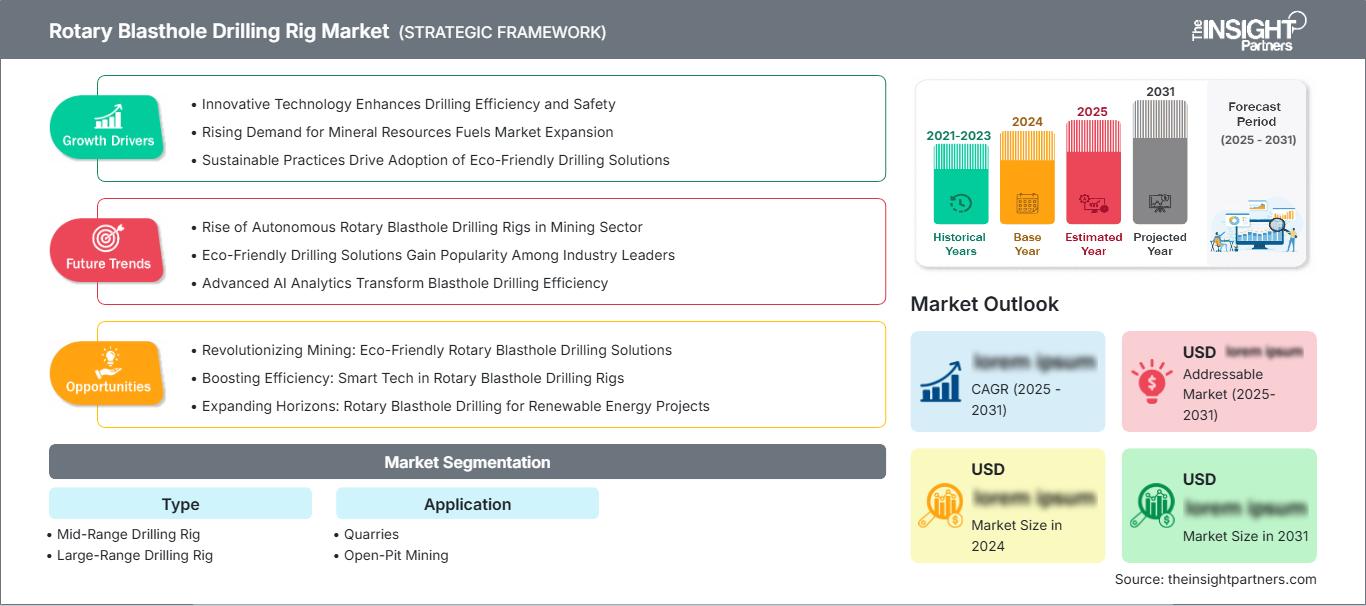
Rotary Blasthole Drilling Rig Market: Strategic Insights
Regional Insights
North America Rotary Blasthole Drilling Rig Market
North America accounted for 29–32% of global demand in 2025, with a projected CAGR of 4.8–5.3% during 2026–2034. The region benefits from large-scale copper, coal, aggregates, and industrial mineral operations that require high equipment availability and precision drilling. Operators are replacing older rigs with systems that improve blast control and reduce workforce exposure.
The rotary blasthole drilling rig market share in the region is reinforced by technology adoption. U.S. and Canadian mines are evaluating teleremote drilling, autonomous pattern execution, and electrified platforms to reduce variability. Strong dealer support, strict safety culture, and demand for lower emissions are expected to sustain replacement-led equipment sales.
U.S. Rotary Blasthole Drilling Rig Market
The U.S. represented 73–77% of North America demand in 2025 and is expected to grow at a CAGR of 4.7–5.2% through 2034. The demand for drilling equipment is mainly seen in copper, aggregates, coal, phosphate, and industrial minerals, where the timing of production is determined by drilling repeatability, reliability, and accurate blast hole positioning.
Presence of the company favors the use of advanced equipment, where such companies include Komatsu Ltd., Epiroc AB, Sandvik AB, and Caterpillar Inc., among others that manufacture equipment for surface mining fleets. The aggregate demand driven by infrastructure and investments in critical minerals also drives the adoption of mid-range and large-range rigs.
Europe Rotary Blasthole Drilling Rig Market
Europe held 17–20% share in 2025 and is forecast to grow at a 4.2–4.8% CAGR. The United Kingdom, Germany, Sweden, Finland, France, Italy, and Spain utilize quarrying, aggregates, industrial minerals, and selective metal mining to support of demand. Issues related to energy efficiency, emissions regulations, and worker safety are key purchase considerations.
Sweden and Finland are especially pertinent due to the presence of advanced mining equipment technologies and innovations and the development of electric mining technologies in the Nordic region. The United Kingdom and Germany add value in the form of aggregates and industrial minerals production. Southern European countries continue supporting the demand for cement, limestone, and construction material quarries.
APAC Rotary Blasthole Drilling Rig Market
APAC represented 35–38% share in 2025 and is projected to expand at 5.7–6.3% CAGR. The regions involved include China, Australia, India, Indonesia, Japan, and South Korea via coal, copper, iron ore, limestone, and construction aggregates. Australia is a technology-based adopter, but India and Indonesia are moving into surface mining and quarry production.
Policy support in the region regarding mineral extraction, infrastructure development, and domestic resource security is leading to more demand for machinery. The productivity of drilling machines is valued highly in the APAC region because of the tough conditions and diverse geological formations. Large open-pit mines are expected to form the core of demand, while quarries will provide volume potential for mid-size drills.
Middle East & Africa Rotary Blasthole Drilling Rig Market
The Middle East & Africa market is expected to grow at 5.0–5.6% CAGR, driven by limestone, phosphate, gold, copper, iron ore, and quarrying activity. MEA countries such as Saudi Arabia, UAE, South Africa, and the Rest of MEA are allocating resources to mining diversification, construction materials, and resource development.
South Africa is still dominating due to its already existing mining portfolio and the demand for surface drilling equipment. Saudi Arabia and the UAE are growing in terms of quarrying and minerals projects due to the diversification of infrastructure and industry. Fleet durability, spares availability, and safety are among the major buying criteria.
Segmentation Analysis
Type
Type is segmented into Mid-Range Drilling Rig and Large-Range Drilling Rig. The rotary blasthole drilling rig market scope under this segment reflects the contrast between flexible quarry and smaller mine equipment and heavy-duty rigs used for deep, large-diameter blastholes. Type-level demand is expected to expand at 5.0–5.6% CAGR during 2026–2034.
- Mid-Range Drilling Rig: Mid-range rigs serve quarries, smaller open-pit mines, and contractors requiring mobility, manageable operating costs, and reliable drilling in varied rock conditions without over-investing in oversized machine capacity.
- Large-Range Drilling Rig: Large-range rigs dominate high-volume surface mines where deeper holes, larger diameters, strong pulldown capacity, and automation readiness directly influence blast quality and production continuity.
Application
Application includes Quarries and Open-Pit Mining. Application-level demand is projected to grow at 5.2–5.8% CAGR during 2026–2034 as both sectors improve drilling precision and operating safety. The Rotary Blasthole Drilling Rig market report indicates higher utilization intensity and equipment scale while quarries support demand.
- Quarries: Quarry operators use blasthole rigs to improve bench control, fragmentation consistency, and aggregates output, especially where construction materials demand requires predictable drilling cycles and reduced downtime.
- Open-Pit Mining: Open-pit mining remains the primary application as copper, iron ore, coal, gold, phosphate, and critical mineral producers rely on productive drilling to optimize blasting, loading, hauling, and crushing performance.
Opportunity Snapshot
| Application | Revenue Contribution | Trend Tag | Adoption Stage |
|---|---|---|---|
| Quarries | Medium | Aggregates Automation | Scaling |
| Open-Pit Mining | High | Autonomous Benches | Scaling |
Rotary Blasthole Drilling Rig Market Growth Drivers and Impact Analysis
Automation-Led Productivity in Open-Pit Mines
Automated plan execution on mining drill rigs helps minimize hole deviation, enhance the accuracy of depth, and equalize operator performance. The rotary blasthole drills affect the outcome of the blasts directly, which means automation generates some downstream benefits for the loading, hauling, and crushing activities. Besides, automated ready rigs reduce the risk associated with bench hazards and increase utilization when changing shifts or working under adverse conditions. With the drive for low unit costs in mining, rigs incorporating GPS, auto-drilling, machine monitoring, and remote control are becoming increasingly attractive.
Electrification and Emissions Reduction Requirements
Electrification is starting to be a viable purchasing consideration for large mines with existing power structures and sustainability objectives. Electric drills will decrease the amount of diesel used, reduce emissions at the bench level, and make energy management easier when linked to power sources on-site. Modular electric drills have become available, along with ways to convert to electric drills without rethinking drilling processes. The most critical driver for electrified drills is for companies operating in locations where there are high expectations for their environmental performance.
Rising Demand for Critical Minerals and Construction Materials
Demand for copper, iron ore, phosphate, aggregates, limestone, and other mined materials supports recurring equipment investment. Critical mineral projects require efficient surface drilling to improve ore recovery and maintain production schedules, while construction-linked quarry demand supports mid-range rig replacement. The Rotary Blasthole Drilling Rig market forecast reinforces the business case for newer rigs. Producers facing harder rock, deeper benches, and higher stripping ratios are prioritizing equipment that sustains penetration performance and reduces rework.
Rotary Blasthole Drilling Rig Market Future Trends
Connected Drill Fleets and Predictive Maintenance
The rotary blasthole drilling rig market trends increasingly point toward connected fleets that transmit utilization, component health, drill performance, and maintenance data into centralized mine systems. Predictive maintenance will help reduce unplanned stoppages by identifying compressor, rotary head, feed system, and hydraulic issues before failure. This will shift value from equipment purchase price toward uptime assurance, software capability, service contracts, and analytics support. Suppliers able to convert machine data into actionable maintenance recommendations will gain stronger aftermarket positioning.
Scalable Autonomy from Assisted Drilling to Full Remote Operation
The future rig platforms will increasingly feature a design based on scalable autonomy. Rather than selecting a choice between manual equipment and completely autonomous equipment, the mine owners will implement the capabilities on a step-by-step basis, including auto-leveling, auto-drilling, GPS-based patterns, remote control, and multiple rig management. This approach reduces the risks of automation implementation and enables operators to bring automation capability level in line with the existing skill set of personnel, communication system, and facility infrastructure.
Rotary Blasthole Drilling Rig Market Opportunities
Aftermarket Modernization and Retrofit Programs
There is an excellent chance here for retrofit packages offering digital monitoring, guidance, safety improvements, and the choice of electric drive conversions. While most mine owners cannot afford to change their whole fleet at once, they can certainly upgrade specific machinery, which will help them increase efficiency and comply with regulations. Retrofitting will also increase the relationship with suppliers due to service, software, training, and parts sales. This opportunity is especially valuable in mature mining zones with old but mechanically viable rigs that just lack control systems.
High-Growth Mining Corridors in APAC and MEA
Rotary Blasthole Drilling Rig Forecasts indicate that APAC and MEA offer strong opportunities as mining and quarrying capacity expands. India, Indonesia, Australia, Saudi Arabia, and parts of Africa require rigs suited to high temperatures, variable geology, and limited service windows. Suppliers that combine durable platforms with local parts availability, operator training, and financing support can capture demand from both state-backed projects and private mining contractors. Regional customization will be important for sustained growth.
Frequently Asked Questions

- Comprehensive Market Sizing and Forecast Analysis
- Detailed Segmentation Analysis
- In-Depth Market Dynamics Assessment
- Regional and Country-Level Insights
- Competitive Landscape and Company Benchmarking
- Strategic Business Intelligence
Recent Reports
Testimonials

The Insight Partners provided valuable market intelligence that supported our global go-to-market strategy. Their team was professional, responsive, and attentive to our feedback, providing thoughtful analysis and helpful methodological clarifications throughout the project.
Junmo Kim Chief Financial Officer (CFO), Enertech Co., Ltd.
The Insight Partners' SCADA System Market report is comprehensive, with valuable insights on current trends and future forecasts. The team was highly professional, responsive, and supportive throughout. We are very satisfied and highly recommend their services.
RAN KEDEM Partner, Reali Technologies LTDs
I requested a report on a very specific software market and the team produced the report in a few days. The information was very relevant and well presented. I then requested some changes and additions to the report. The team was again very responsive and I got the final report in less than a week.
JEAN-HERVE JENN Chairman, Future Analytica
We worked with The Insight Partners for an important market study and forecast. They gave us clear insights into opportunities and risks, which helped shape our plans. Their research was easy to use and based on solid data. It helped us make smart, confident decisions. We highly recommend them.
PIYUSH NAGPAL Sr. Vice President, High Beam Global
The Insight Partners delivered insightful, well-structured market research with strong domain expertise. Their team was professional and responsive throughout. The user-friendly website made accessing industry reports seamless. We highly recommend them for reliable, high-quality research services
YUKIHIKO ADACHI CEO, Deep Blue, LLC.
This is the first time I have purchased a market report from The Insight Partners.While I was unsure at first, I visited their web site and felt more comfortable to take the risk and purchase a market report.I am completely satisfied with the quality of the report and customer service. I had several questions and comments with the initial report, but after a couple of dialogs over email with their analyst I believe I have a report that I can use as input to our strategic planning process.Thank you so much for taking the extra time and making this a positive experience.I will definitely recommend your service to others and you will be my first call when we need further market data.
JOHN SUZUKI President and Chief Executive Officer, Board Director, BK Technologies
I wish to appreciate your support and the professionalism you displayed in the course of attending to my request for information regarding to infectious disease IVD market in Nigeria. I appreciate your patience, your guidance, and the fact that you were willing to offer a discount, which eventually made it possible for us to close a deal. I look forward to engaging The Insight Partners in the future, all thanks to the impression you have created in me as a result of this first encounter.
DR CHIJIOKE ONYIA MANAGING DIRECTOR, PineCrest Healthcare Ltd.Reason to Buy
- Informed Decision-Making
- Understanding Market Dynamics
- Competitive Analysis
- Identifying Emerging Markets
- Customer Insights
- Market Forecasts
- Risk Mitigation
- Boosting Operational Efficiency
- Strategic Planning
- Investment Justification
- Tracking Industry Innovations
- Aligning with Regulatory Trends





 Get Free Sample for