
Rotary Tray Sealer Market Growth, Trends & Forecast by 2034
Coverage: by Type (Semi-Automatic, Automatic); End-user (Food and Beverages, Pharmaceuticals, Chemicals, Others) , and Geography (North America, Europe, Asia Pacific, and South and Central America)
- Status : Data Released
- Report Code : TIPRE00010148
- Category : Manufacturing and Construction
- No. of Pages : 150
- Available Report Formats :


- Last update date : September 18, 2026


2025 Market Size
US$ 258.79 Mn
Base year value
2034 Forecast
US$ 393.91 Mn
Projected by 2034
CAGR 2026-2034
4.78 %
Growth rate
Addressable Market
US$ 2,963.01 Mn
(2026-2034)
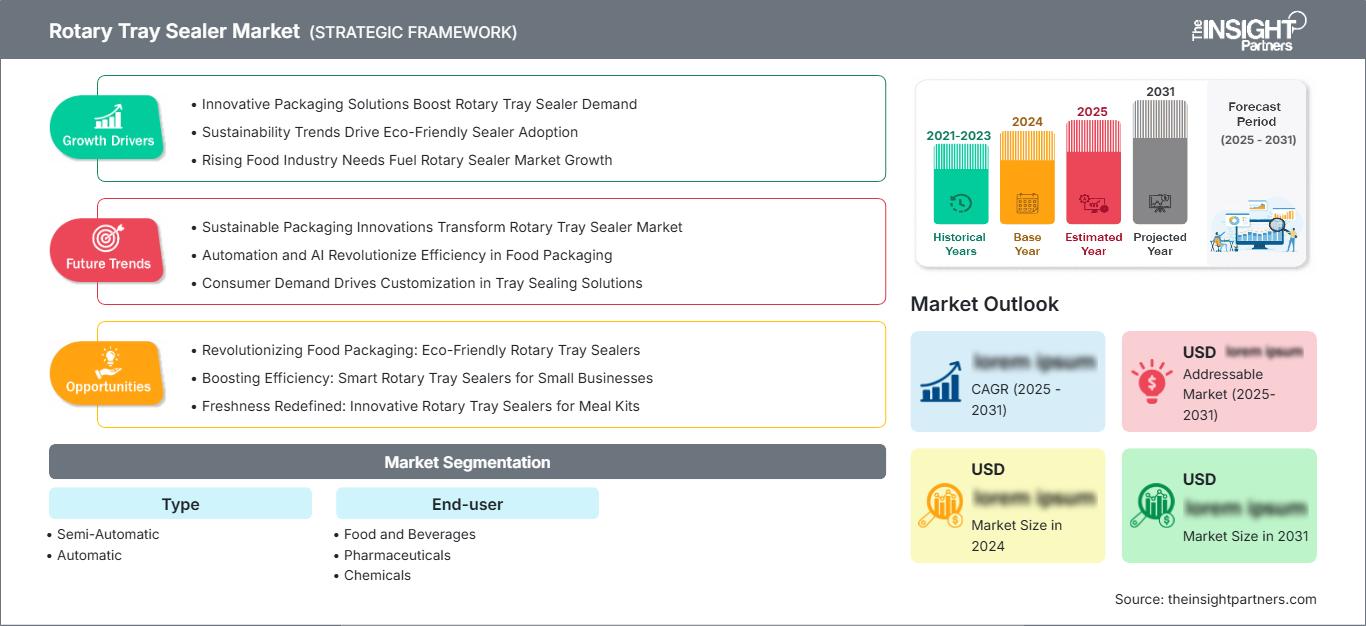
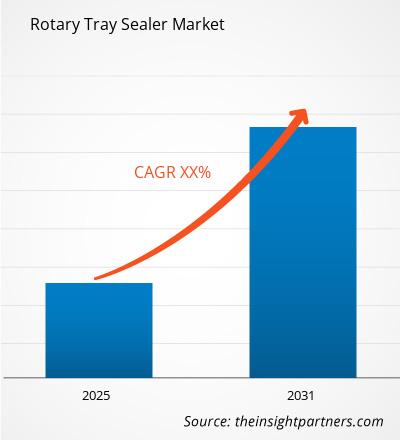
The rotary tray sealer market was valued at US$ 258.79 Million in 2025 and is projected to reach US$ 393.91 Million by 2034, expanding at a CAGR of 4.78% during 2026–2034. Demand is supported by automated packaging, increasing requirements for consistent seal integrity, and the use of tray formats across food and beverage, pharmaceutical, and chemical applications. Equipment modernization is increasingly focused on throughput, hygiene, flexible changeovers, and efficient integration with upstream and downstream packaging operations.
North America is expected to maintain a mature demand base, with an estimated 3.8–4.6% CAGR during 2026–2034. Food processors increasingly require automated sealing to manage labor availability and maintain consistent packaging quality, while pharmaceutical manufacturers prioritize controlled and repeatable sealing environments. The Rotary Tray Sealer Market size is supported by established packaging machinery distribution, replacement demand, and investments in automated production lines across medium- and high-volume facilities.
Rotary Tray Sealer Market Assessment and Insights
- North America: North America is estimated to account for 22–26% share in 2025 and expand at a 3.8–4.6% CAGR between 2026–2034, supported by automated food processing, pharmaceutical packaging, replacement cycles, and demand for efficient tray-handling systems.
- US: The US represents approximately 78–83% of North American demand in 2025 and is projected to grow at a 3.7–4.5% CAGR between 2026–2034, supported by food processing and healthcare packaging.
- Europe: Europe is estimated at a 25–29% share in 2025, with a 4.1–4.9% CAGR between 2026–2034. Germany, the UK, Italy, France, and Spain remain important markets because of established food processing and packaging machinery ecosystems.
- Asia Pacific: Asia Pacific is estimated to hold a 30–35% share in 2025 and grow at a 5.0–5.9% CAGR between 2026–2034, led by China, Japan, India, South Korea, and Australia amid manufacturing expansion and packaging automation.
- Largest Segment: Automatic systems are expected to hold a 54.2% market share in 2025 and expand at a 5.0–5.6% CAGR between 2026–2034, reflecting high-throughput packaging requirements.
- High Growth Segment: Food and beverages are estimated to account for a 47.9% market share in 2025 and grow at a 4.7–5.3% CAGR between 2026–2034, supported by convenience and fresh-food packaging.
- Key companies analyzed in detail: Contour International, DFC Packaging Pty Ltd, Everlong Enterprise Co., Ltd, Lockwood Packaging Ltd, Nelipak Corporation, ORICS, Pack Line Ltd, Proseal UK Ltd., Vortech Food Machinery, and Y-FANG SEALING MACHINE LTD.
Source: The Insight Partners' analysis based on proprietary research, government publications, company annual reports, investor presentations, industry databases, and expert interviews.
Packaging operations have shifted toward equipment capable of combining sealing consistency with higher throughput, reduced operator intervention, and faster format changes. Rotary configurations remain relevant where manufacturers require compact equipment with repeatable sealing cycles. Electric sealing systems, programmable controls, recipe management, automatic film handling, and improved diagnostics are increasingly shaping equipment differentiation. These developments reflect broader production priorities around hygiene, labor productivity, packaging integrity, and equipment utilization.
Looking ahead, adoption should broaden across emerging food-processing and pharmaceutical manufacturing centers. Investment in automated packaging lines is likely to remain strongest where labor costs, production volumes, and quality-control requirements justify capital expenditure. The Rotary Tray Sealer Market report highlights suppliers' focus on modular configurations and simplified maintenance. Regulatory attention to food safety, pharmaceutical packaging integrity, traceability, and packaging waste should encourage processors to modernize sealing systems where existing machinery cannot meet evolving production requirements.
Rotary Tray Sealer Market Report Scope
| Report Attribute | Details |
|---|---|
| Market size in 2025 | US$ 258.79 Million |
| Market Size by 2034 | US$ 393.91 Million |
| Global CAGR (2026 - 2034) | 4.78% |
| Historical Data | 2021-2024 |
| Forecast period | 2026-2034 |
Rotary Tray Sealer Market Analysis
Demand across the packaging ecosystem is increasingly influenced by the rotary tray sealer market growth requirements of ready-to-eat food, fresh produce, prepared meals, meat, seafood, pharmaceutical products, and selected chemical applications. Value chains are represented by tray/lidding-film suppliers, machine manufacturers, sealing-tool producers, automation companies, filling/weighing equipment suppliers, distributors, system integrators, and end users. Machine market demand will be affected by packaging quantity as well as upgrades.
Companies will compete in the aspects of consistent sealing, sealing cycle capacity, flexibility of tooling, hygiene, maintainability, and integration ability. The supply situation will be affected by such factors as motors, sensors, PLCs, heaters, sealing dies, film handling modules, and stainless-steel manufacturing. Automation systems will be more expensive to implement, but they will be better in terms of more predictable machine operation.
Competitive Environment
The competitive environment has other competitors, each with its own positioning approaches. Proseal UK Ltd is part of a bigger picture of packaging technology. The company Nelipak Corporation has significance in the area of healthcare packaging and cleanroom sealable products. Some of the competitors that specialize in special packaging needs include Pack Line Ltd, ORICS, Vortech Food Machinery, and DFC Packaging Pty Ltd.
Strategic investment is increasingly directed toward automation, energy-efficient sealing, rapid tool changes, machine diagnostics, and integrated packaging lines. The rotary tray sealer market analysis indicates that suppliers able to combine mechanical reliability with digital controls can improve their relevance to processors seeking measurable productivity gains. Competitive differentiation is also shifting toward lifecycle value, including servicing, spare parts, tooling support, installation, operator training, and remote diagnostics.
● REPORT CUSTOMIZATION
Tailor This Report To Align With Your Specific Business Requirements
This report can be customized to align precisely with your business objectives, scope, and target markets. Customization options include tailored segmentation, geography, competitive analysis, and strategic insights to support informed decision-making.
Customize This Report →WHAT YOU CAN ADJUST
- ● Segmentations
- ● Geography
- ● Competitive Analysis
- ● Language Preferences
Rotary Tray Sealer Market: Strategic Insights
Regional Insights
North America Rotary Tray Sealer Market
North America is estimated to represent a 22–26% of the Rotary Tray Sealer Market share in 2025, with regional demand projected to expand at a 3.8–4.6% CAGR through 2034. The USA leads in regional consumption, with existing facilities for food processing, pharmaceutical manufacturing, packaging services, and automated processing. The contribution from Canada includes food processing, meat processing, packaged foods, and pharmaceutical packaging applications. Consumers place importance on seals, sanitation, safety for operators, and compatibility with automated processing lines.
There is also an extensive inventory of packaging machinery in the region, which creates repeat sales potential. Processors now consider labor, changeovers, accessibility, and total cost of ownership during equipment selection. The demand for trays in fresh and convenient foods creates further demand for equipment, and pharmaceutical packaging is another application area where sealing is critical.
U.S. Rotary Tray Sealer Market
The U.S. represents approximately 78–83% of North American Rotary Tray Sealer Market demand in 2025 and is expected to grow at a 3.7–4.5% CAGR through 2034. Large food processors, contract packagers, pharmaceutical firms, and prepared-food makers constitute the primary customer group. Packaging automation is becoming more appealing in situations when labor shortages and scheduling considerations dictate a need for increased efficiency without sacrificing sealing performance.
The choice of equipment depends on line speeds, sizes of the trays used, type of film, washing, changeover, and interface with fillers, checkweighers, labelers, and inspection machinery. Companies such as Proseal UK Ltd. and Nelipak Corporation are good illustrations of how different applications can coexist in the general industry context. Food, medical, and special packaging applications present a niche for both high-speed automated machines and flexible equipment for small production lines.
Europe Rotary Tray Sealer Market
Europe is estimated to hold a 25–29% share in 2025 and is projected to expand at a 4.1–4.9% CAGR through 2034. Germany is a leading market because of its advanced machinery manufacturing base and extensive food-processing sector. The UK, Italy, France, and Spain also provide significant demand through prepared foods, meat, seafood, pharmaceutical packaging, horticulture, and industrial production. European customers increasingly evaluate machinery through productivity, hygiene, energy use, and packaging material efficiency.
The UK has an established food-processing and packaging machinery ecosystem, supporting demand for both automated and flexible sealing systems. Germany benefits from high levels of manufacturing automation and engineering expertise, creating opportunities for sophisticated packaging lines. Italy remains important for packaging machinery and food manufacturing, while France and Spain provide demand from prepared foods, fresh products, and pharmaceutical applications. Regulatory emphasis on food safety and packaging sustainability also encourages equipment modernization.
APAC Rotary Tray Sealer Market
Asia Pacific is estimated to account for a 30–35% share in 2025 and is projected to grow at a 5.0–5.9% CAGR through 2034. China represents the leading market, supported by food processing, manufacturing scale, and automation investment. Japan and South Korea emphasize precision and labor-saving machinery, while India and Australia provide expanding opportunities across food, pharmaceuticals, and industrial packaging.
Middle East & Africa Rotary Tray Sealer Market
The Middle East and Africa region is expected to expand at a 4.0–4.8% CAGR through 2034. Saudi Arabia and the UAE provide demand through food processing, prepared foods, imported-product repacking, and industrial modernization, while South Africa has a comparatively diversified food and pharmaceutical manufacturing base. Rest-of-region demand remains more fragmented and price-sensitive.
Investment in food-processing infrastructure, cold-chain development, pharmaceutical production, and industrial diversification can increase requirements for reliable packaging equipment. The UAE and Saudi Arabia are particularly relevant because food-security initiatives and manufacturing investments encourage local processing capacity. South Africa provides a broader base of established processors. Equipment suppliers able to provide service coverage, straightforward maintenance, and scalable automation can address adoption barriers across the region.
Segmentation Analysis
Type
The rotary tray sealer market scope by type is primarily determined by production volume, labor availability, capital expenditure, and required flexibility. Automatic systems are favored by medium and large processors requiring consistent throughput, while semi-automatic machinery remains appropriate for lower-volume operations, frequent product changes, trials, and customers transitioning from manual packaging.
- Semi-Automatic: Semi-automatic machines offer a practical balance between operator involvement and sealing consistency. They suit smaller processors, specialist packaging operations, product development environments, and facilities where production volumes do not justify complete automation.
- Automatic: Automatic systems support continuous production with reduced manual intervention and consistent sealing parameters. Their strategic importance is strongest in high-volume food and pharmaceutical operations requiring repeatable quality, throughput, and integration with broader packaging lines.
End-user
The end-user rotary tray sealer market is shaped by packaging volumes, product characteristics, regulatory requirements, and the economic value of sealing consistency. Food and beverages represent the principal demand base, while pharmaceuticals require controlled packaging environments and chemicals demand application-specific compatibility, safety, and sealing reliability.
- Food and Beverages: Food and beverage processors use tray sealers for prepared meals, fresh foods, meat, seafood, produce, and convenience products. Reliable seals support product protection, presentation, hygiene, and distribution requirements.
- Pharmaceuticals: Pharmaceutical users prioritize repeatability, contamination control, packaging integrity, and validation requirements. Equipment suitable for controlled production environments can command stronger strategic importance where product protection and compliance are critical.
- Chemicals: Chemical applications require careful consideration of material compatibility, containment, operator safety, and seal integrity. Demand is more specialized, with equipment selection influenced by product characteristics and packaging format.
Opportunity Snapshot
| End-user | Revenue Contribution | Trend Tag | Adoption Stage |
| Food and Beverages | High | Convenience Meals | Mature |
| Pharmaceuticals | Medium | Sterile Packaging | Scaling |
| Chemicals | Low | Secure Containment | Emerging |
Rotary Tray Sealer Market Growth Drivers and Impact Analysis
Automation to Address Packaging Labor Constraints
Labor availability is becoming an increasingly important factor in packaging-line investment decisions. Automated tray sealing can reduce repetitive manual activities while improving consistency across sealing cycles, making automation attractive to processors operating multiple shifts. The Rotary Tray Sealer Market forecast indicates the strongest impact in high-volume environments where product formats remain sufficiently standardized to justify automated tooling. Automatic equipment can also connect with tray denesters, fillers, weighing systems, inspection equipment, coding systems, and conveyors, creating a broader productivity proposition. For equipment suppliers, this driver increases demand for modular systems that can be configured according to line requirements. It also creates opportunities for aftermarket automation upgrades, controls modernization, and replacement of labor-intensive equipment. Processors increasingly assess automation through throughput, labor requirements, downtime, changeover efficiency, and quality performance rather than machinery speed alone.
Growing Consumption of Convenience and Prepared Foods
There is a growing demand for convenience packaged foods, which creates new applications for tray sealing equipment. Meals, fresh foods, meat, fish, vegetables, and ready-to-cook foods need packaging that is capable of providing good closure but at the same time allowing presentation and transportation. There are many options for tray sealing in terms of sealing formats, such as atmospheric or modified atmospheric format, and this allows food processors to choose appropriate equipment for their products. Diverse application possibilities allow investing in both traditional and developing food processing market segments. Flexibility in using tooling and compatibility with various types of trays and films create possibilities of working with different kinds of products. However, the impact goes beyond the purchase of new equipment, since there might be a need to change existing equipment when the type of packaging changes or the volume of production increases.
Demand for Higher Packaging Integrity and Process Control
Package integrity is now critical for processors because they wish to reduce the possibility of any leaks, contamination, spoilage, and product damage. In the case of foods, good seal integrity provides packaging for the products and their life management, whereas the pharmaceutical industry needs more precise and repeatable processes. Automation of machines is better at maintaining a definite temperature, pressure, time, and tooling conditions compared to highly manual operations. The digital control systems help in recipe management, diagnostics, audit tracking, and operator assistance. Such a driver prefers those equipment providers who can show repeatable machine operation rather than higher mechanical productivity. Hygienic design of machines, easy access to cleaning locations, controlled sealing environment, and preventive maintenance features will be more valuable now.
Rotary Tray Sealer Market Future Trends
Intelligent Changeover and Recipe-Based Operation
The rotary tray sealer market trends are likely to increasingly center on intelligent changeover systems that reduce operator dependency and improve repeatability between production runs. Recipe-controlled systems are able to save sealing information, tooling setup details, temperatures, and instructions for each specific item. The next-generation machinery might include automated tooling recognition, guided tooling setup process, and diagnostics to help prevent setup mistakes and lower changeover times. This feature will be particularly useful for manufacturers that have different sizes of trays and small-volume productions. Manufacturers of packaging machinery can offer their customers a software interface that enables the use of complex features without any special programming skills. Eventually, an automatic setup check might become a useful productivity feature since manufacturers want to spend as little time as possible on setup while ensuring the same quality of sealing.
Energy-Efficient Electric Sealing Architectures
It is anticipated that energy efficiency will become an increasingly important factor for equipment selection, as manufacturers take into account operational costs along with production capability. Electrical sealers could offer precise seal pressure application and would also lessen reliance on compressed air systems when properly configured. Future equipment will also have more efficient actuators, better heating management, more efficient idle states, and energy monitoring capability. These elements could help lower operational costs and promote overall business sustainability goals. This development will allow for greater retrofitting potential, especially in instances when current machinery is still mechanically viable but relies on less efficient pneumatic or heating systems. Equipment manufacturers will be able to differentiate themselves by establishing energy consumption under specified operational parameters and relating energy efficiency to the total cost of ownership.
Rotary Tray Sealer Market Opportunities
Expansion of Flexible Packaging Automation in Emerging Economies
The rotary tray sealer market forecasts indicate opportunities in emerging manufacturing economies where food processing and pharmaceutical production are expanding but packaging automation remains uneven. China, India, Southeast Asia, and selected Middle Eastern markets offer potential for scalable equipment that can be introduced at semi-automatic levels and subsequently upgraded. Suppliers can build market presence through local distributors, service partnerships, demonstration centers, financing arrangements, and standardized machine platforms. Offering compact systems with straightforward operation can reduce capital and training barriers for smaller processors. As production volumes increase, these customers can migrate toward automatic systems, creating a natural equipment-upgrade pathway. Local availability of tooling, spare parts, and technical service will remain critical because downtime and maintenance uncertainty can discourage investment even when the productivity case is attractive.
Healthcare Packaging and Cleanroom-Compatible Sealing
Pharmaceutical and medical packaging offers a strategically attractive opportunity because sealing integrity, traceability, contamination control, and validation can support higher-value equipment applications. Suppliers with cleanroom-compatible machinery, stainless-steel construction, controlled sealing parameters, automated tooling identification, and documentation capabilities can target specialized healthcare customers. Demand can also arise from contract manufacturers and medical-device producers seeking flexible packaging capacity without building fully dedicated systems for every product. Nelipak Corporation illustrates the importance of combining tray-sealing equipment with broader healthcare packaging capabilities. Suppliers can pursue partnerships with packaging-material producers, contract manufacturers, and medical-device companies to develop application-specific solutions. The opportunity is distinct from high-volume food packaging because purchasing decisions may prioritize validation, cleanliness, process documentation, and reliability over maximum cycle throughput.
Frequently Asked Questions

- Comprehensive Market Sizing and Forecast Analysis
- Detailed Segmentation Analysis
- In-Depth Market Dynamics Assessment
- Regional and Country-Level Insights
- Competitive Landscape and Company Benchmarking
- Strategic Business Intelligence
Recent Reports
Testimonials

The Insight Partners provided valuable market intelligence that supported our global go-to-market strategy. Their team was professional, responsive, and attentive to our feedback, providing thoughtful analysis and helpful methodological clarifications throughout the project.
Junmo Kim Chief Financial Officer (CFO), Enertech Co., Ltd.
The Insight Partners' SCADA System Market report is comprehensive, with valuable insights on current trends and future forecasts. The team was highly professional, responsive, and supportive throughout. We are very satisfied and highly recommend their services.
RAN KEDEM Partner, Reali Technologies LTDs
I requested a report on a very specific software market and the team produced the report in a few days. The information was very relevant and well presented. I then requested some changes and additions to the report. The team was again very responsive and I got the final report in less than a week.
JEAN-HERVE JENN Chairman, Future Analytica
We worked with The Insight Partners for an important market study and forecast. They gave us clear insights into opportunities and risks, which helped shape our plans. Their research was easy to use and based on solid data. It helped us make smart, confident decisions. We highly recommend them.
PIYUSH NAGPAL Sr. Vice President, High Beam Global
The Insight Partners delivered insightful, well-structured market research with strong domain expertise. Their team was professional and responsive throughout. The user-friendly website made accessing industry reports seamless. We highly recommend them for reliable, high-quality research services
YUKIHIKO ADACHI CEO, Deep Blue, LLC.
This is the first time I have purchased a market report from The Insight Partners.While I was unsure at first, I visited their web site and felt more comfortable to take the risk and purchase a market report.I am completely satisfied with the quality of the report and customer service. I had several questions and comments with the initial report, but after a couple of dialogs over email with their analyst I believe I have a report that I can use as input to our strategic planning process.Thank you so much for taking the extra time and making this a positive experience.I will definitely recommend your service to others and you will be my first call when we need further market data.
JOHN SUZUKI President and Chief Executive Officer, Board Director, BK Technologies
I wish to appreciate your support and the professionalism you displayed in the course of attending to my request for information regarding to infectious disease IVD market in Nigeria. I appreciate your patience, your guidance, and the fact that you were willing to offer a discount, which eventually made it possible for us to close a deal. I look forward to engaging The Insight Partners in the future, all thanks to the impression you have created in me as a result of this first encounter.
DR CHIJIOKE ONYIA MANAGING DIRECTOR, PineCrest Healthcare Ltd.Reason to Buy
- Informed Decision-Making
- Understanding Market Dynamics
- Competitive Analysis
- Identifying Emerging Markets
- Customer Insights
- Market Forecasts
- Risk Mitigation
- Boosting Operational Efficiency
- Strategic Planning
- Investment Justification
- Tracking Industry Innovations
- Aligning with Regulatory Trends





 Get Free Sample for