
Safety Cabinets and Cans Market Size, Share & Forecast by 2034
Coverage: By Type (Metal material, Non-Metallic material); End-user (Oil, Chemical, Others), and Geography (North America, Europe, Asia Pacific, and South and Central America)
- Status : Data Released
- Report Code : TIPRE00027666
- Category : Manufacturing and Construction
- No. of Pages : 150
- Available Report Formats :


- Last update date : September 21, 2026


2025 Market Size
US$ 2.19 Bn
Base year value
2034 Forecast
US$ 3.8 Bn
Projected by 2034
CAGR 2026-2034
6.31 %
Growth rate
Addressable Market
US$ 27.10 Bn
(2026-2034)
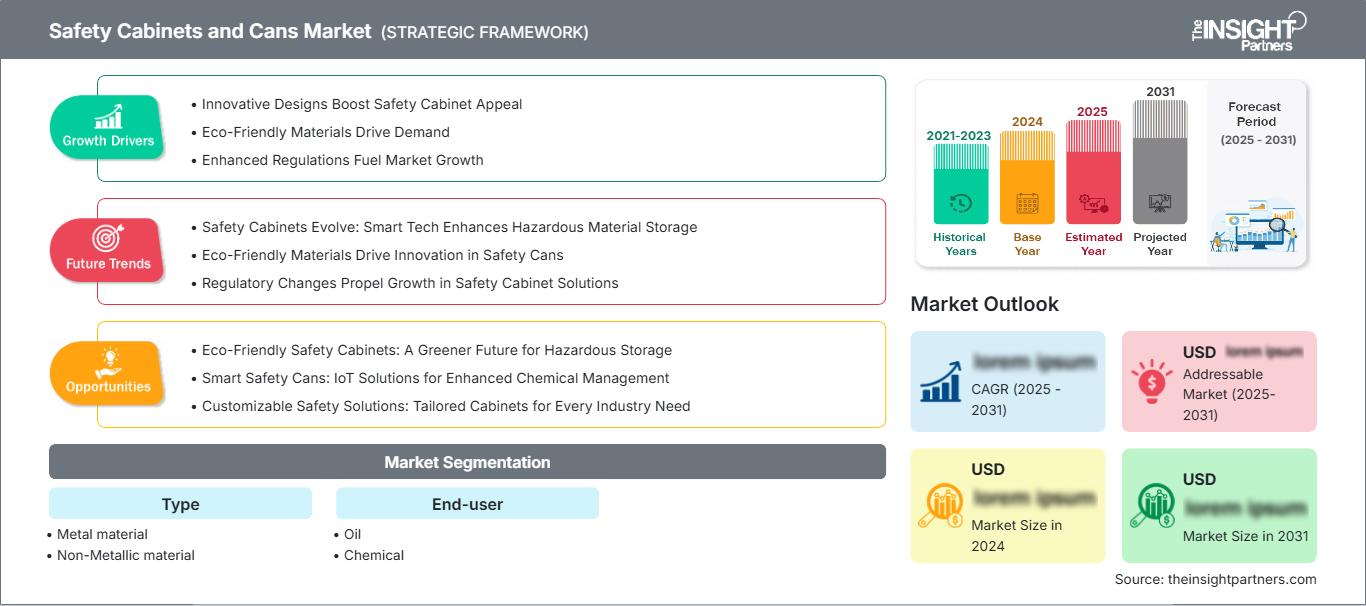
The safety cabinets and cans market combines fire-resistant storage cabinets, hazardous-liquid safety cans, and associated containment formats used where flammable or chemically reactive materials require controlled handling. The market is valued at US$ 2.19 Billion in 2025 and is projected to reach US$ 3.80 Billion by 2034, registering a CAGR of 6.31% during 2026–2034. Demand is supported by industrial safety requirements, chemical handling controls, and the replacement of aging storage infrastructure.
Across North America, the Safety Cabinets and Cans Market size benefits from established workplace-safety enforcement, mature chemical-processing facilities, and recurring replacement of storage equipment. Regional growth is estimated at 6.4–6.8% CAGR between 2026–2034. Strong adoption is associated with compliance-driven procurement, facility modernization, and demand from oil, chemical processing, laboratories, and industrial maintenance operations.
Safety Cabinets and Cans Market Assessment and Insights
- North America: North America is expected to account for a 31–35% share in 2025 and expand at a 6.4–6.8% CAGR between 2026–2034. Mature industrial infrastructure, chemical safety enforcement, and replacement demand support sustained procurement.
- US: The US is estimated to represent 72–76% of North America's 2025 demand and grow at a 6.3–6.7% CAGR between 2026–2034, supported by stringent workplace storage requirements.
- Europe: Europe is projected to hold a 25–29% share in 2025 and advance at a 5.8–6.2% CAGR between 2026–2034. Germany, the UK, France, Italy, and Spain provide substantial demand through chemical handling and occupational safety requirements.
- Asia Pacific: Asia Pacific is estimated at a 27–31% share in 2025 and is expected to grow at a 7.0–7.5% CAGR between 2026–2034. China, Japan, India, South Korea, and Australia drive demand through industrial expansion and safety modernization.
- Largest Segment: Metal material is expected to hold a 68–72% market share in 2025, with a 5.8–6.2% CAGR through 2034, reflecting established fire-resistance and durability requirements.
- High Growth Segment: Non-Metallic material represents a 28–32% share in 2025 and is projected to grow at a 7.0–7.5% CAGR, supported by corrosion resistance and specialized chemical applications.
- Key companies analyzed in detail: DENIOS SE, Eagle Manufacturing Company, ECOSAFE SA, Justrite Manufacturing Company, L.L.C., Complete Environmental Products, Jamco Products, Inc., Rötzmeier Sicherheitsbehälter, Safeway Products, SciMatCo, and Strong Hold Products.
Source: The Insight Partners' analysis based on proprietary research, government publications, company annual reports, investor presentations, industry databases, and expert interviews.
There is a growing focus on double-wall construction, self-closure, spill containment, grounding, corrosion resistance, and suitability for use with hazardous material handling. Steel is key for fire-proof cabinets, whereas engineered plastics and stainless steel are used for applications exposed to corrosive conditions. Improvements in terms of shelf design, cabinet capacity, access methods, and labeling can also be expected.
Future growth will depend on both the replacement of existing cabinets in mature markets and new industrial capacity additions in the Asia-Pacific and some Middle Eastern countries. The development of specialty chemicals, refinery operations, labs, and pharmaceutical manufacturing will expand the number of end users. Regulations on the storage of hazardous materials will continue to drive the replacement of improvised solutions with proper cabinets and cans.
Safety Cabinets and Cans Market Report Scope
| Report Attribute | Details |
|---|---|
| Market size in 2025 | US$ 2.19 Billion |
| Market Size by 2034 | US$ 3.8 Billion |
| Global CAGR (2026 - 2034) | 6.31% |
| Historical Data | 2021-2024 |
| Forecast period | 2026-2034 |
Safety Cabinets and Cans Market Analysis
Industrial demand is closely linked to the handling of flammable liquids, solvents, oils, and corrosive substances. The safety cabinets and cans market growth, therefore, follows plant expansion, maintenance activity, laboratory utilization, and stricter internal safety audits. The typical players in procurement include the manufacturer, industrial distributors, safety consultants, facility managers, and the compliance department, whose needs will be defined by compatibility, capacity, fire resistance, ventilation, and accessibility needs.
Supply chain consists of steel processing, polymer processing, hardware, coating, shelving, hinges, locking mechanism, grounding, and safety certifications. Metal cabinets would need to have controlled welding and coating processes, whereas non-metallic products need to focus on polymer processing and chemical compatibility. Regional vendors compete on lead time and customization, while manufacturers take advantage of the experience with certification process, larger catalogs, and distributor connections.
The competitive dynamics are fragmented among the cabinet, can, and containment lines. Justrite Manufacturing Company, L.L.C. and Eagle Manufacturing Company have an excellent strategic position by having a vast range of hazardous-material storage products. DENIOS SE offers engineered solutions for workplace safety and for the handling of hazardous substances. ECOSAFE SA, Rötzmeier Sicherheitsbehälter, Jamco Products, Inc. and Complete Environmental Products offer solutions according to their specific needs.
The strategic positioning is becoming more and more based upon the product line, familiarity with certifications, manufacturing stability, and application engineering, rather than just price competition. Strong Hold Products specializes in heavy-duty industrial storage products. SciMatCo and Safeway Products are competing in the specialized safety equipment market segments. The investments are made in solid construction, customizable storage, faster delivery, and product documentation for inspection purposes.
● REPORT CUSTOMIZATION
Tailor This Report To Align With Your Specific Business Requirements
This report can be customized to align precisely with your business objectives, scope, and target markets. Customization options include tailored segmentation, geography, competitive analysis, and strategic insights to support informed decision-making.
Customize This Report →WHAT YOU CAN ADJUST
- ● Segmentations
- ● Geography
- ● Competitive Analysis
- ● Language Preferences
Safety Cabinets and Cans Market: Strategic Insights
Regional Insights
North America safety cabinets and cans market
North America is estimated to represent 31–35% of global Safety cabinets and cans market demand in 2025 and expand at a 6.4–6.8% CAGR through 2034. The US accounts for most regional consumption, supported by extensive chemical, petroleum, manufacturing, laboratory, and maintenance operations. The OSHA regulation for flammable-liquid storage creates an ever-repeating cycle of replacement based on the need for compliance. The facility managers will also have to take into account the cabinet capacity, labeling, fire-resistance and segregation, thus creating more incentive for purchasing based on specification than cost saving.
The regional demand will be driven by the modernization of industries and the replacement of cabinets that have become vulnerable to corrosion, mechanical damage, or obsolete designs. Canada provides its contribution from its energy sector, mining activities, chemical process industry and labs, whereas the US has the advantage of having a wider reach and larger installed base. The product differentiation is now based on the features such as self-closing doors, leakage prevention sills, flame arrestors, grounding and durable finishes.
U.S. safety cabinets and cans Market
The US represents an estimated 72–76% of the Safety cabinets and cans market share of North American demand in 2025 and is expected to grow at a 6.3–6.7% CAGR through 2034. Demand spans chemical plants, oil operations, laboratories, automotive facilities, maintenance workshops, and industrial distribution centers. Federal workplace rules establish detailed requirements for flammable-liquid storage, including cabinet construction and maximum quantities. Procurement decisions consequently involve safety officers, environmental teams, facility engineers, and purchasing departments.
The application mix is shifting toward higher-specification cabinets as facilities replace damaged or obsolete equipment and strengthen hazardous-material segregation. Manufacturers, including Justrite Manufacturing Company, L.L.C., Eagle Manufacturing Company, Jamco Products, Inc., and Strong Hold Products, have established market visibility through industrial storage portfolios. Growth is also supported by the expansion of specialty chemical and pharmaceutical facilities, where controlled storage, clear labeling, material compatibility, and inspection readiness are important purchasing criteria.
Europe safety cabinets and cans Market
Europe is estimated to account for 25–29% of the global Safety cabinets and cans market demand in 2025 and grow at a 5.8–6.2% CAGR through 2034, with Germany representing a leading national market. UK demand is supported by established occupational-safety systems and chemical-handling controls across laboratories, manufacturing, and industrial maintenance. Germany has particularly strong demand because of its chemical and manufacturing base, engineering capabilities, and rigorous workplace-safety culture. France, Italy, and Spain contribute through chemical processing, energy, automotive, food manufacturing, and laboratory infrastructure, creating a broad replacement and new-installation opportunity.
European buyers place substantial emphasis on documented conformity, chemical compatibility, fire protection, ergonomics, and environmental performance. DENIOS SE and Rötzmeier Sicherheitsbehälter have strong regional relevance, while broader suppliers compete through distribution reach and application-specific configurations. The region's mature industrial base limits volume acceleration compared with Asia Pacific, but recurring compliance inspections, modernization of production sites, and replacement of legacy storage systems provide resilient demand. Germany remains the leading country within the regional opportunity.
APAC safety cabinets and cans Market
Asia Pacific is estimated at 27–31% of the global Safety cabinets and cans market demand in 2025 and is projected to grow at a 7.0–7.5% CAGR through 2034. China leads regional consumption, followed by Japan, South Korea, India, and Australia. Expanding chemical, pharmaceutical, electronics, energy, and manufacturing facilities are increasing the requirements for controlled storage. Industrial safety modernization is also encouraging operators to adopt internationally recognized storage practices.
China combines manufacturing scale with expanding safety controls, while India benefits from pharmaceutical and specialty-chemical investment. Japan and South Korea provide demand from advanced manufacturing and chemical industries, whereas Australia contributes through mining and energy. Regional policy initiatives, plant modernization, and increasing attention to hazardous-material management should support sustained adoption, making APAC the fastest-growing major region.
Middle East & Africa safety cabinets and cans Market
The Middle East and Africa Safety cabinets and cans market demand is developing from a smaller installed base, with growth estimated at a 5.4–5.9% CAGR through 2034. Saudi Arabia is a leading market, supported by oil and gas, petrochemicals, and industrial diversification. The UAE benefits from logistics, energy, chemicals, and manufacturing investment, while South Africa contributes through mining, chemicals, and industrial processing.
Energy infrastructure remains a major demand anchor, particularly where flammable liquids, lubricants, solvents, and maintenance chemicals require controlled storage. The rest of MEA demand is more project-oriented and sensitive to industrial investment cycles. Increasing adoption of formal safety-management systems and international operating practices should gradually expand the addressable customer base, particularly around refineries, chemical facilities, industrial parks, laboratories, and large maintenance operations.
Segmentation Analysis
Type
Safety Cabinets and Cans Market trends indicate that type selection is increasingly influenced by liquid characteristics, operating environment, cabinet capacity, regulatory requirements, and lifecycle expectations. Metal material remains the dominant configuration because of fire resistance, mechanical strength, standardized fabrication, and established compliance practices support broad deployment. Non-Metallic material is gaining relevance where corrosion resistance and chemical compatibility outweigh the advantages of conventional steel.
- Metal material: Metal cabinets and cans remain the core specification for flammable-liquid storage because steel supports robust construction, fire-resistant designs, durable hinges, lock systems, and standardized safety features. Industrial buyers commonly select these products for manufacturing, chemical processing, maintenance, and laboratory environments.
- Non-Metallic material: Non-metallic solutions address applications where corrosion resistance, reduced material interaction, and chemical compatibility are priorities. Demand is particularly relevant for corrosive environments and specialized storage applications where conventional metal construction could degrade or require additional protective treatment.
End-user
End-user comprises Oil and Chemical. The segment is strongly influenced by the volume and hazard characteristics of liquids handled at operating sites. Oil facilities require reliable containment for fuels, lubricants, and maintenance chemicals, while chemical operations require greater attention to segregation, compatibility, spill prevention, and inspection procedures. The combined segment is expected to expand at a 6.2–6.7% CAGR through 2034 as industrial facilities upgrade storage infrastructure and formalize hazardous-material controls. This supports the safety cabinets and cans market scope across both established and expanding processing environments.
- Oil: Oil facilities require durable storage for flammable liquids, lubricants, solvents, and maintenance chemicals. Procurement priorities include fire resistance, secure access, spill containment, and compatibility with facility-level hazardous-material procedures.
- Chemical: Chemical users demand application-specific storage based on substance compatibility, corrosivity, flammability, segregation, and exposure risk. Specialized cabinets and can configurations support safer handling across production, laboratories, maintenance areas, and chemical distribution facilities.
Opportunity Snapshot
| End-user | Revenue Contribution (High/Medium/Low) | Trend Tag (MAX 2 words) | Adoption Stage |
| Oil | High | Fuel Containment | Mature |
| Chemical | High | Chemical Segregation | Scaling |
Safety Cabinets and Cans Market Growth Drivers and Impact Analysis
Stricter hazardous-liquid storage compliance
Regulatory enforcement is one of the key drivers of demand because such facilities are not supposed to store hazardous liquid materials like any other material handling facility. In the United States, for example, regulations by OSHA dictate how flammable liquids should be stored in terms of construction and maximum capacities. Similarly, expectations of safety compliance in other parts of Europe and elsewhere in the industrialized world will make manufacturers formalize their process of storing the material. The effects are not limited to newly erected storage facilities since inspections can lead to the identification of old, damaged and modified cabinets which must be replaced. Therefore, compliance personnel will also affect purchases along with the production manager and the procurement department.
Expansion of chemical and energy processing capacity
Chemical processing, refining, specialty chemical, and industrial maintenance investments result in even more sites where flammable or corrosive material needs to be housed near points of usage. New sites will typically integrate safety devices during engineering and commissioning rather than depending only on retrofits. This leads to higher sales of cabinets, cans, and other containment systems through project integrators, distributors, and purchasing managers in manufacturing plants. Storage system requirements also arise in existing sites as production lines switch raw materials or increase their capacity. The effect is most pronounced when industrial growth is accompanied by high safety standards. Thus, the Asia Pacific region is well-positioned for fast-paced demand growth, whereas North America and Europe will experience demand due to modernization and replacement cycles.
Replacement of aging and non-compliant storage infrastructure
One of the major sources of demand stems from the installation of equipment that has reached the end of its usable life. Equipment that has been subjected to chemicals, moisture, physical shocks, and handling could suffer from corrosion, broken hinges, locks, or containment issues. Replacement is now more likely to occur based on inspections and maintenance efforts rather than failures alone. The market value lies in the continual need for replacements in manufacturing plants, laboratories, refineries, and chemical facilities. Purchasers could opt to make simultaneous upgrades from the standard manual-close cabinets to high-end systems that incorporate self-closing doors, superior shelves, construction quality, and improved spill containment features.
Safety Cabinets and Cans Market Future Trends
Integrated compliance-oriented product design
Future product development will increasingly treat compliance documentation, usability, and physical safety as a combined design requirement. Manufacturers are likely to standardize clearer labeling, modular shelves, improved locking mechanisms, concealed self-closing systems, grounding provisions, and easier inspection access. Digital product documentation may also become more important, allowing facility teams to retrieve specifications, certifications, installation guidance, and maintenance records without relying on paper manuals. Rather than introducing complex electronics into every cabinet, suppliers are likely to prioritize traceability and serviceability. The resulting designs should reduce inspection uncertainty and simplify procurement across multi-site industrial organizations. This trend will favor manufacturers that combine engineering discipline with strong technical documentation and standardized product platforms.
Material engineering for specialized chemical environments
Material selection is expected to become more application-specific as industrial users handle broader combinations of fuels, solvents, acids, and reactive chemicals. Steel will remain central for many fire-resistant applications, but non-metallic materials and corrosion-resistant metals can gain share where chemical exposure presents a greater lifecycle concern. Manufacturers may expand liner options, coatings, polymer components, and stainless-steel configurations to address demanding environments. Such development can reduce premature degradation and lower replacement frequency when the selected material is matched correctly to the stored substance. The trend also creates a stronger role for application engineering because buyers will increasingly evaluate chemical compatibility, temperature, cleaning requirements, and expected service conditions rather than selecting cabinets solely by capacity or purchase price.
Safety Cabinets and Cans Market Opportunities
Localized manufacturing and distribution in emerging markets
Emerging industrial economies provide an opportunity for suppliers to combine localized manufacturing, regional distribution, and technical support. India, Southeast Asia, the Middle East, and selected Latin American markets are expanding chemical, energy, pharmaceutical, and manufacturing capabilities, creating new storage requirements. Suppliers can reduce adoption barriers by offering locally available standard configurations, application guidance, replacement parts, and compliance documentation. Regional warehousing can also shorten delivery cycles for project-based procurement. The opportunity is strongest where customers are transitioning from informal storage toward structured hazardous-material management. Strategic partnerships with industrial distributors, engineering contractors, and safety consultants can improve market access without requiring manufacturers to establish complete direct-sales organizations in every country.
Specialized storage for high-risk industrial applications
Specialized applications offer attractive opportunities for suppliers able to move beyond standardized cabinet configurations. Refineries, specialty chemical plants, laboratories, and advanced manufacturing sites may require combinations of corrosion resistance, fire protection, segregation, mobility, spill containment, or unusual capacity. Product platforms can be adapted to these requirements through modular shelving, specialized liners, stainless-steel construction, customized dimensions, and application-specific accessories. The safety cabinets and cans market forecasts, therefore, depend partly on suppliers' ability to convert engineering requirements into repeatable product families. Investment in application engineering and configurable manufacturing can create higher-value opportunities than undifferentiated commodity products. Such positioning also strengthens relationships with engineering, procurement and construction firms responsible for specifying safety equipment during new facility development.
Frequently Asked Questions

- Comprehensive Market Sizing and Forecast Analysis
- Detailed Segmentation Analysis
- In-Depth Market Dynamics Assessment
- Regional and Country-Level Insights
- Competitive Landscape and Company Benchmarking
- Strategic Business Intelligence
Recent Reports
Testimonials

The Insight Partners provided valuable market intelligence that supported our global go-to-market strategy. Their team was professional, responsive, and attentive to our feedback, providing thoughtful analysis and helpful methodological clarifications throughout the project.
Junmo Kim Chief Financial Officer (CFO), Enertech Co., Ltd.
The Insight Partners' SCADA System Market report is comprehensive, with valuable insights on current trends and future forecasts. The team was highly professional, responsive, and supportive throughout. We are very satisfied and highly recommend their services.
RAN KEDEM Partner, Reali Technologies LTDs
I requested a report on a very specific software market and the team produced the report in a few days. The information was very relevant and well presented. I then requested some changes and additions to the report. The team was again very responsive and I got the final report in less than a week.
JEAN-HERVE JENN Chairman, Future Analytica
We worked with The Insight Partners for an important market study and forecast. They gave us clear insights into opportunities and risks, which helped shape our plans. Their research was easy to use and based on solid data. It helped us make smart, confident decisions. We highly recommend them.
PIYUSH NAGPAL Sr. Vice President, High Beam Global
The Insight Partners delivered insightful, well-structured market research with strong domain expertise. Their team was professional and responsive throughout. The user-friendly website made accessing industry reports seamless. We highly recommend them for reliable, high-quality research services
YUKIHIKO ADACHI CEO, Deep Blue, LLC.
This is the first time I have purchased a market report from The Insight Partners.While I was unsure at first, I visited their web site and felt more comfortable to take the risk and purchase a market report.I am completely satisfied with the quality of the report and customer service. I had several questions and comments with the initial report, but after a couple of dialogs over email with their analyst I believe I have a report that I can use as input to our strategic planning process.Thank you so much for taking the extra time and making this a positive experience.I will definitely recommend your service to others and you will be my first call when we need further market data.
JOHN SUZUKI President and Chief Executive Officer, Board Director, BK Technologies
I wish to appreciate your support and the professionalism you displayed in the course of attending to my request for information regarding to infectious disease IVD market in Nigeria. I appreciate your patience, your guidance, and the fact that you were willing to offer a discount, which eventually made it possible for us to close a deal. I look forward to engaging The Insight Partners in the future, all thanks to the impression you have created in me as a result of this first encounter.
DR CHIJIOKE ONYIA MANAGING DIRECTOR, PineCrest Healthcare Ltd.Reason to Buy
- Informed Decision-Making
- Understanding Market Dynamics
- Competitive Analysis
- Identifying Emerging Markets
- Customer Insights
- Market Forecasts
- Risk Mitigation
- Boosting Operational Efficiency
- Strategic Planning
- Investment Justification
- Tracking Industry Innovations
- Aligning with Regulatory Trends





 Get Free Sample for