
Sanitary Valves Market Demand, Share & Growth by 2034
Coverage: by Type (Ball Valves, Check Valves, Butterfly Valves, Control Valves, Others); End-user (Food and Beverage, Chemical, Pharmaceuticals, Oil and Gas, Energy and Power, Others) , and Geography (North America, Europe, Asia Pacific, and South and Central America)
- Status : Data Released
- Report Code : TIPRE00010632
- Category : Manufacturing and Construction
- No. of Pages : 150
- Available Report Formats :


- Last update date : September 18, 2026


2025 Market Size
US$ 587.57 Mn
Base year value
2034 Forecast
US$ 759.71 Mn
Projected by 2034
CAGR 2026-2034
2.90 %
Growth rate
Addressable Market
US$ 6,117.32 Mn
(2026-2034)
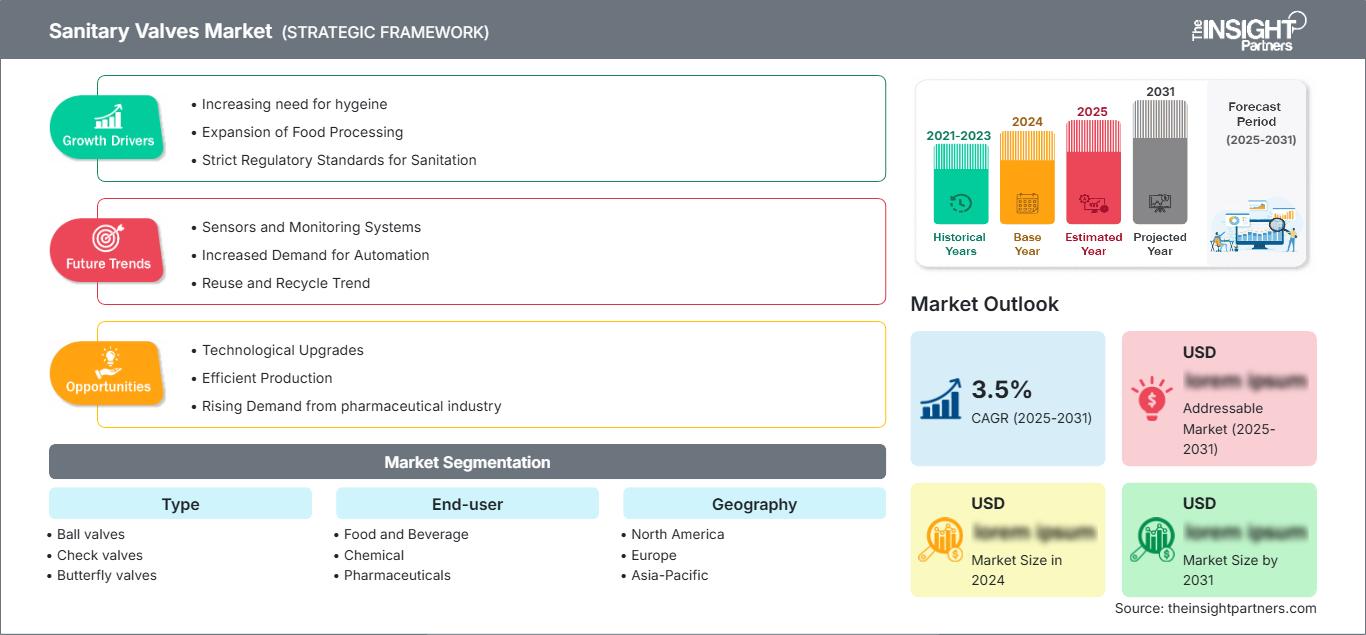
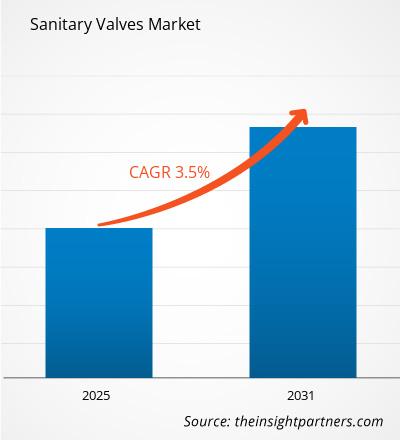
The sanitary valves market was valued at US$ 587.57 million in 2025 and is projected to reach US$ 759.71 million by 2034, growing at a CAGR of 2.90% during 2026–2034. Demand is tied to hygienic fluid control in food, beverage, pharmaceuticals, chemicals, oil and gas, and energy facilities where contamination prevention, cleanability, and operational reliability influence procurement decisions.
North America remains a structurally important region for sanitary valves market size expansion, supported by dairy modernization, beverage processing automation, and pharmaceutical capacity upgrades. The region is estimated to account for 31–34% share in 2025 and grow at a 2.6–3.1% CAGR during 2026–2034, with the U.S. driving most replacement and specification-led demand.
Sanitary Valves Market Assessment and Insights
- North America holds an estimated 31–34% share in 2025 and is expected to register a 2.6–3.1% CAGR between 2026–2034, supported by regulated food processing and biopharma utilities.
- US accounts for 72–76% of North America in 2025 and is projected to grow at a 2.7–3.2% CAGR amid automation-led plant upgrades.
- Europe captures 28–31% share in 2025 and grows at a 2.4–2.9% CAGR, led by Germany, France, Italy, Spain, and the UK.
- Asia Pacific represents 24–27% share in 2025 and is expected to grow at a 3.4–4.0% CAGR as China, India, Japan, South Korea, and Australia expand hygienic processing.
- Largest Segment: food and beverage holds 42–46% market share in 2025 and grows at a 2.7–3.2% CAGR due to dairy, brewing, bottled beverages, and processed foods.
- High Growth Segment: pharmaceuticals holds 18–21% share in 2025 and grows at a 3.5–4.1% CAGR due to sterile manufacturing and validation needs.
- Key companies analyzed in detail: Alfa Laval AB, Emerson Electric Co., Flowserve Corporation, GEA Group Aktiengesellschaft, ITT Inc., Krones AG, Max Seal, Inc., MISUMI Group Inc., SPX FLOW, Inc., and Valtorc International.
Source: The Insight Partners' analysis based on proprietary research, government publications, company annual reports, investor presentations, industry databases, and expert interviews.
The sanitary valves market has evolved from mechanically selected components into application-specific hygienic control systems. Product evaluation criteria include minimization of dead legs, surface finish, actuator responsiveness, sealing ability, and compatibility with clean-in-place systems. The use of stainless steel casing, modular valves, pneumatic top, and leak detection is gaining significance due to the requirement for a reliable cleaning cycle, reduced footprint, and minimal unforeseen plant shutdowns in multi-product manufacturing plants.
Factors such as stringent food safety programs, increased demand from the biopharmaceutical industry, and energy-efficient plant design will influence future procurement decisions. Growth in the region will be driven by new facilities in the Asia-Pacific region and investment in capital expenditure in North America. European buyers will focus on life-cycle cost savings, water savings, and validated hygienic designs.
Sanitary Valves Market Report Scope
| Report Attribute | Details |
|---|---|
| Market size in 2025 | US$ 587.57 Million |
| Market Size by 2034 | US$ 759.71 Million |
| Global CAGR (2026 - 2034) | 2.90% |
| Historical Data | 2021-2024 |
| Forecast period | 2026-2034 |
Sanitary Valves Market Analysis
Market growth is underpinned by increasing production of dairy, beverages, injectables, specialty chemicals, and process fluids used in clean energy production. Such uses call for valves that avoid cross-contamination and enable precise flow isolation, diverting and throttling. High demand is driven by instances where clean-up time affects facility usage rate and where automation of ball, butterfly, check, and control valves is crucial to the efficiency of production facilities. Additional drivers are increased regulatory requirements in regard to quality, hygiene and traceability of products.
Stainless-steel suppliers, actuator providers, seal materials producers, control systems suppliers, distributors, and engineering firms make up the supply chain. Market supply is affected by the availability of 316L stainless steel, certification procedures and delivery terms of customized valve matrices. Increasingly, buyers favor suppliers capable of providing documentation, servicing, and validating valve systems for several plants. Additionally, market demand will be positively affected by manufacturing digitization efforts and demand for flow control devices capable of working with automation systems.
The market analysis indicates a competitive field where Alfa Laval AB and GEA Group Aktiengesellschaft emphasize hygienic processing portfolios, while Emerson Electric Co. and Flowserve Corporation leverage wider automation and control capabilities. ITT Inc., Krones AG, SPX FLOW, Inc., MISUMI Group Inc., Max Seal, Inc., and Valtorc International address specialized valve, component, and distribution requirements. Competitive differentiation increasingly centers on hygienic design expertise, automation compatibility, service responsiveness, validation support, and the ability to deliver application-specific solutions for regulated industries.
The focus of investment lies on small valve manifolds, digital feedback, leak detectors, and cleanability. Large providers have been enhancing their services since avoiding downtime has become as important as the cost of purchase. Small companies have managed to differentiate themselves using engineered products, quick customization, and applications that help customers, such as those in the food, pharmaceutical, chemical, oil and gas, and energy industries. The future growth will come from the modernization of facilities, expansion of hygienic production capabilities, and the intelligence of the valves.
● REPORT CUSTOMIZATION
Tailor This Report To Align With Your Specific Business Requirements
This report can be customized to align precisely with your business objectives, scope, and target markets. Customization options include tailored segmentation, geography, competitive analysis, and strategic insights to support informed decision-making.
Customize This Report →WHAT YOU CAN ADJUST
- ● Segmentations
- ● Geography
- ● Competitive Analysis
- ● Language Preferences
Sanitary Valves Market: Strategic Insights
Regional Insights
North America sanitary valves market
North America accounts for 31–34% sanitary valves market share in 2025 and is expected to grow at a 2.6–3.1% CAGR during 2026–2034. Demand is driven by pasteurized dairy, craft and industrial beverages, nutraceuticals, and pharmaceutical clean utilities that require validated fluid control.
Replacement cycles are closely tied to automation upgrades and hygiene audits. Processors are choosing valves with leakage detection, clean-in-place capability, and digital feedback to lower batch loss risk. The region benefits from advanced engineering contractors and established aftermarket support, which shortens adoption cycles.
U.S. sanitary valves Market
The U.S. represents 72–76% of North America in 2025 and grows at a 2.7–3.2% CAGR. Its leadership is linked to high installed processing capacity, biopharmaceutical investments, ready-to-drink beverage lines, and dairy plant modernization across major production states.
Company presence is broad, with global and domestic suppliers supporting OEMs, system integrators, and end users. Application trends favor automated butterfly valves for high-volume lines, control valves for dosing precision, and check valves where backflow prevention protects product integrity.
Europe sanitary valves Market
Europe holds 28–31% share in 2025 and grows at a 2.4–2.9% CAGR. Germany leads through equipment manufacturing, pharmaceutical production, and dairy processing, while France, Italy, Spain, and the UK contribute through beverage, food, and life sciences activity.
European buyers emphasize hygienic certification, water-efficient cleaning, and low-maintenance designs. Germany and Italy are important for process equipment supply, France and Spain support food and beverage demand, and the UK remains active in pharmaceuticals and specialty processing, sustaining steady replacement demand.
APAC sanitary valves Market
APAC represents 24–27% share in 2025 and is projected to grow at a 3.4–4.0% CAGR, the strongest regional pace. China leads volume demand, while India, Japan, South Korea, and Australia add growth through packaged food, beverages, pharmaceuticals, and dairy processing.
Industrial policy, rising quality expectations, and export-oriented manufacturing are encouraging processors to adopt hygienic valves with documented materials and repeatable cleaning performance. Local fabricators compete on cost, but multinational suppliers retain advantages in sterile, automated, and high-specification applications.
Middle East & Africa sanitary valves Market
The Middle East and Africa is expected to grow at a 2.5–3.0% CAGR during 2026–2034. Saudi Arabia and the UAE are expanding food, beverage, water, and pharmaceutical infrastructure, while South Africa supports regional demand through food processing and industrial maintenance.
Energy and infrastructure projects create selective requirements for hygienic and corrosion-resistant flow control in utilities, specialty chemicals, and packaged consumables. Demand is project-driven, so suppliers with distributor coverage, local inventory, and engineering support are better placed to capture recurring replacement opportunities.
Segmentation Analysis
Type
Type demand is expected to grow at a 2.7–3.3% CAGR during 2026–2034. The market scope across ball, check, butterfly, and control valves reflects distinct use cases, from isolation and backflow protection to high-cycle flow control and dosing precision in hygienic production environments.
- Ball valves remain preferred for reliable shutoff, chemical compatibility, and low pressure drop in transfer lines where processors need durable isolation across cleanable piping systems.
- Check valves protect process streams from backflow, helping facilities maintain product integrity, pump protection, and compliance in food, beverage, chemical, and pharmaceutical operations.
- Butterfly valves are widely adopted on high-volume lines because they offer compact design, cost efficiency, and quick actuation for dairy, beverage, and CIP circuits.
- Control valves support precision dosing, pressure regulation, and process stability, especially where automation investments require repeatable flow modulation and feedback integration.
End-user
End-user demand is projected to grow at a 2.9–3.5% CAGR. Food and beverage provides the largest revenue base, while pharmaceuticals deliver faster specification-driven growth. Chemical, oil and gas, and energy users contribute through specialty fluids, clean utilities, and controlled process environments, according to the Sanitary Valves Market report.
- Food and Beverage accounts for the greatest demand because dairy, brewing, soft drinks, sauces, and processed foods require frequent cleaning, contamination control, and dependable line uptime.
- Chemical applications use sanitary-grade valves where purity, corrosion resistance, and controlled transfer are needed for specialty ingredients, additives, and sensitive formulations.
- Pharmaceuticals require validated materials, sterile operation, and documentation, making hygienic valves important for injectable drugs, biologics, clean steam, and purified water loops.
- Oil and Gas demand is selective but relevant for specialty chemicals, sampling, and clean utility systems that require reliable isolation and corrosion-resistant construction.
- Energy and Power applications include clean fluids, water treatment, and auxiliary systems where dependable flow control supports process reliability and maintenance efficiency.
Opportunity Snapshot
| End-user | Revenue Contribution | Trend Tag | Adoption Stage |
| Food and Beverage | High | CIP Automation | Mature |
| Chemical | Medium | Specialty Purity | Scaling |
| Pharmaceuticals | Medium | Sterile Utilities | Scaling |
| Oil and Gas | Low | Clean Sampling | Emerging |
| Energy and Power | Low | Water Quality | Emerging |
Sanitary Valves Market Growth Drivers and Impact Analysis
Rising Hygiene Compliance in Food and Beverage Processing
Food and beverage manufacturers are also stepping up their spending on cleanable equipment as recalls, incidents of contamination, and failed audits can disrupt their income and reputation among customers. Cleanable valves are beneficial for lessening residue buildup, providing quick cleaning-in-place processes and controlled product transfer. This trend is also contributing to the need for replacement among dairy producers, brewers, juice companies, sauces producers, and drinks in RTD packages since they experience numerous changes in their production lines and need valves that can guarantee easy cleaning and fast availability of the processing lines. At the same time, regulations related to food safety, traceability, and sanitation are becoming stricter, which forces the manufacturers to renew their old valve equipment. Modern valve designs can also help in reducing the usage of water and cleaning products and minimizing downtime during production.
Expansion of Pharmaceutical and Bioprocessing Capacity
Valves are needed by pharmaceutical and bioprocess companies to meet sterile transfer, purified water, clean steam, and process control validation. The demand for biologics, injectable medicines, vaccines, and higher purity drug forms means that requirements have increased for material, seal, surface finish, and documentation. Suppliers who can offer traceability, automated capability, and application engineering benefit from their qualifications being difficult and from users favoring qualified components in repeated engagements. Increasing capital investment in contract manufacturing facilities, cell and gene therapy, and specialized pharma plants is generating new market opportunities in sophisticated sanitary valves. Manufacturers need valves that can facilitate validation protocols, consistent operation, and regulatory compliance.
Automation of Hygienic Production Lines
Production processes have become increasingly automated through the transition from manually operated valves to either pneumatically controlled or digitally monitored valves in order to increase accuracy and minimize operator involvement. The automation of valves provides feedback possibilities and rapid changeovers, as well as more integration with supervisory control. The effect can be seen on valve manifolds, dosing systems, CIP skids, and package-related processing because the precise positioning and leak detection contribute to decreasing wastage, downtime, and contamination risks. The automation efforts are increasingly associated with the Industry 4.0 approach that concentrates on process visibility and predictive maintenance. The intelligent valves produce data about their performance that allows determining potential problems before breakdowns occur and therefore prevent unplanned downtime and maintenance expenses. As manufacturing industries face labor shortages, automated hygienic valves become an attractive solution to increasing efficiency.
Sanitary Valves Market Future Trends
Smart Valve Monitoring
The sanitary valves market trends will increasingly center on sensors, control tops, and diagnostic feedback that convert valves into monitored process assets. Facilities want early warning of seal wear, actuator failure, leakage, and misalignment before quality or downtime events occur. This shift will favor suppliers that combine mechanical reliability with digital interfaces, as food, beverage, and pharmaceutical plants seek predictive maintenance and stronger quality records.
Compact Hygienic Valve Matrices
The need for space-saving, flexibility in handling multiple products, and quick changeover is driving manufacturers towards adopting smaller valve layouts to simplify piping requirements and minimize cleaning effort. This includes using mix-proof principles, modular body designs, and smaller valves so that multiple products can be handled without increasing the floor space requirement. This is more applicable to beverage, dairy, and personal care manufacturing facilities.
Sanitary Valves Market Opportunities
Pharmaceutical Clean Utility Upgrades
The sanitary valves market forecasts show a strong opportunity in clean utility systems because purified water, water-for-injection, and clean steam loops demand reliable, validated valve assemblies. Suppliers can target pharmaceutical expansions and retrofits with documentation packages, corrosion-resistant materials, and automation-ready configurations. The most attractive accounts will be facilities standardizing components across multiple sites to simplify maintenance, validation, spare parts, and lifecycle support.
Aftermarket Service and Retrofit Programs
Installed processing plants create recurring opportunities through seal kits, actuator conversions, leakage upgrades, and valve replacement programs. Many producers prefer incremental retrofits over full line rebuilds, especially when capital budgets are staged. Vendors that offer site audits, fast delivery, interchangeable parts, and maintenance training can capture long-term revenue while improving customer retention in mature regions and supporting gradual modernization in emerging markets.
Frequently Asked Questions

- Comprehensive Market Sizing and Forecast Analysis
- Detailed Segmentation Analysis
- In-Depth Market Dynamics Assessment
- Regional and Country-Level Insights
- Competitive Landscape and Company Benchmarking
- Strategic Business Intelligence
Recent Reports
Testimonials

The Insight Partners' SCADA System Market report is comprehensive, with valuable insights on current trends and future forecasts. The team was highly professional, responsive, and supportive throughout. We are very satisfied and highly recommend their services.
RAN KEDEM Partner, Reali Technologies LTDs
I requested a report on a very specific software market and the team produced the report in a few days. The information was very relevant and well presented. I then requested some changes and additions to the report. The team was again very responsive and I got the final report in less than a week.
JEAN-HERVE JENN Chairman, Future Analytica
We worked with The Insight Partners for an important market study and forecast. They gave us clear insights into opportunities and risks, which helped shape our plans. Their research was easy to use and based on solid data. It helped us make smart, confident decisions. We highly recommend them.
PIYUSH NAGPAL Sr. Vice President, High Beam Global
The Insight Partners delivered insightful, well-structured market research with strong domain expertise. Their team was professional and responsive throughout. The user-friendly website made accessing industry reports seamless. We highly recommend them for reliable, high-quality research services
YUKIHIKO ADACHI CEO, Deep Blue, LLC.
This is the first time I have purchased a market report from The Insight Partners.While I was unsure at first, I visited their web site and felt more comfortable to take the risk and purchase a market report.I am completely satisfied with the quality of the report and customer service. I had several questions and comments with the initial report, but after a couple of dialogs over email with their analyst I believe I have a report that I can use as input to our strategic planning process.Thank you so much for taking the extra time and making this a positive experience.I will definitely recommend your service to others and you will be my first call when we need further market data.
JOHN SUZUKI President and Chief Executive Officer, Board Director, BK Technologies
I wish to appreciate your support and the professionalism you displayed in the course of attending to my request for information regarding to infectious disease IVD market in Nigeria. I appreciate your patience, your guidance, and the fact that you were willing to offer a discount, which eventually made it possible for us to close a deal. I look forward to engaging The Insight Partners in the future, all thanks to the impression you have created in me as a result of this first encounter.
DR CHIJIOKE ONYIA MANAGING DIRECTOR, PineCrest Healthcare Ltd.Reason to Buy
- Informed Decision-Making
- Understanding Market Dynamics
- Competitive Analysis
- Identifying Emerging Markets
- Customer Insights
- Market Forecasts
- Risk Mitigation
- Boosting Operational Efficiency
- Strategic Planning
- Investment Justification
- Tracking Industry Innovations
- Aligning with Regulatory Trends





 Get Free Sample for