
Scissor Lift Tables Market Share, Growth & Demand by 2034
Coverage: By Type (Double Scissor Lift Tables, Triple Scissor Lift Tables, Quadruple Scissor Lift Tables); Application (Aerospace, Mining, Construction and Manufacturing, Others) , and Geography (North America, Europe, Asia Pacific, and South and Central America)
- Status : Data Released
- Report Code : TIPRE00022050
- Category : Manufacturing and Construction
- No. of Pages : 150
- Available Report Formats :


- Last update date : September 21, 2026


2025 Market Size
US$ 968.26 Mn
Base year value
2034 Forecast
US$ 1,536.24 Mn
Projected by 2034
CAGR 2026-2034
5.26 %
Growth rate
Addressable Market
US$ 11,359.23 Mn
(2026-2034)
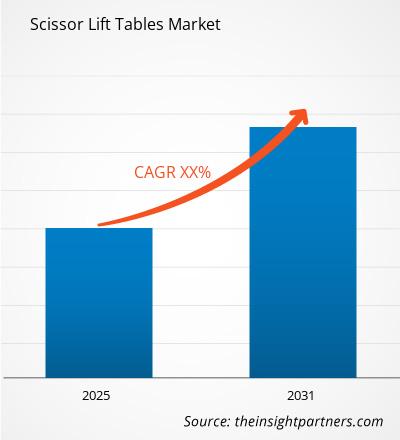
The Scissor Lift Tables market was valued at US$ 968.26 million in 2025 and is expected to reach US$ 1536.24 million by 2034; it is estimated to record a CAGR of 5.26% during 2026-2034.
Scissor Lift Tables Market Assessment and Insights
- North America held 30–33% share in 2025 and is expected to grow at a CAGR of 5.4–5.9% during 2026–2034, supported by warehouse automation, industrial ergonomics, and factory modernization.
- US represented 78–82% of North America share in 2025 and is projected to grow at a CAGR of 5.3–5.8% through 2034, led by manufacturing and logistics upgrades.
- Europe accounted for 24–27% share in 2025 and is expected to grow at a CAGR of 5.0–5.5%, led by Germany, the UK, France, Italy, and Spain through safety-led industrial equipment replacement.
- Asia Pacific captured 34–37% share in 2025 and is projected to grow at a CAGR of 6.4–7.0%, led by China, Japan, South Korea, India, and Australia through manufacturing and warehouse expansion.
- Largest Segment: Double Scissor Lift Tables held 52–56% market share in 2025 and is expected to grow at a CAGR of 5.5–6.0%, reflecting broad use in manufacturing workstations and loading processes.
- High Growth Segment: Aerospace held 18–21% share in 2025 and is projected to grow at a CAGR of 6.2–6.8%, supported by aircraft maintenance, tooling, and precision component handling.
- Key companies analyzed in detail: Autoquip Corporation, BOLZONI S.p.A., Bishamon Industries Corporation, EdmoLift AB, Gidrolast Corporation, Hydro Fabs, Inkema Sistemas S.L., KRAUS Betriebsausstattung und Fördertechnik GmbH, Lange Lift Company, and PALFINGER AG.
Source: The Insight Partners' analysis based on proprietary research, government publications, company annual reports, investor presentations, industry databases, and expert interviews.
The industrial lift equipment has evolved from simple hydraulic lifts to advanced positioning systems that are safe, offer better control and interfaces, and can be designed according to specific applications. Factors that affect the scissor lift table industry include production facilities where there is repetitive load positioning, less chances of musculoskeletal injuries, and integration with conveyors, forklifts, guided vehicles, and packaging cells.
Future investments will be focused in Asia Pacific manufacturing areas, North America warehousing improvements, and European machinery replacement programs. Future growth will be supported by safety requirements, high labor costs, and ergonomics at the plant level. Customized tables for aerospace tools, mining maintenance, and construction material handling are expected to widen the addressable market.
Scissor Lift Tables Market Report Scope
| Report Attribute | Details |
|---|---|
| Market size in 2025 | US$ 968.26 Million |
| Market Size by 2034 | US$ 1,536.24 Million |
| Global CAGR (2026 - 2034) | 5.26% |
| Historical Data | 2021-2024 |
| Forecast period | 2026-2034 |
Scissor Lift Tables Market Analysis
The growth in the market is attributed to the need for efficient and safe manipulation of loads in workplaces where lifting manually becomes unproductive and risky. Customers implement the systems in areas such as pallet handling, assembly, welding assistance, servicing of aircraft parts, maintenance of mining machinery, and preparation of construction materials.
The supply chain comprises the manufacturers of steel, hydraulic components, electrical controls, lift tables, distributors, system integrators, and service providers. The market analysis indicates that customers are becoming more concerned with rating capacity, platform dimensions, lift height, duty cycle, safety interlocks, and customization when purchasing.
Competition is still moderately fragmented, featuring global and regional experts catering to varying loads and usages. Autoquip Corporation, EdmoLift AB, Bishamon Industries Corporation, BOLZONI S.p.A., and PALFINGER AG focus on engineered lifting systems, whereas Gidrolast Corporation, Hydro Fabs, Inkema Sistemas S.L., KRAUS Betriebsausstattung und Fördertechnik GmbH, and Lange Lift Company provide for niche and regional requirements.
Emerging investment trends include modular electric controls, compact heavy-duty frames, safety guards, and low-profile structures requiring less civil work. Manufacturers are also providing better documentation and service offerings, as industrial clients seek lifting solutions that help them be compliant, reliable, and easily integrated in automated handling operations.
● REPORT CUSTOMIZATION
Tailor This Report To Align With Your Specific Business Requirements
This report can be customized to align precisely with your business objectives, scope, and target markets. Customization options include tailored segmentation, geography, competitive analysis, and strategic insights to support informed decision-making.
Customize This Report →WHAT YOU CAN ADJUST
- ● Segmentations
- ● Geography
- ● Competitive Analysis
- ● Language Preferences
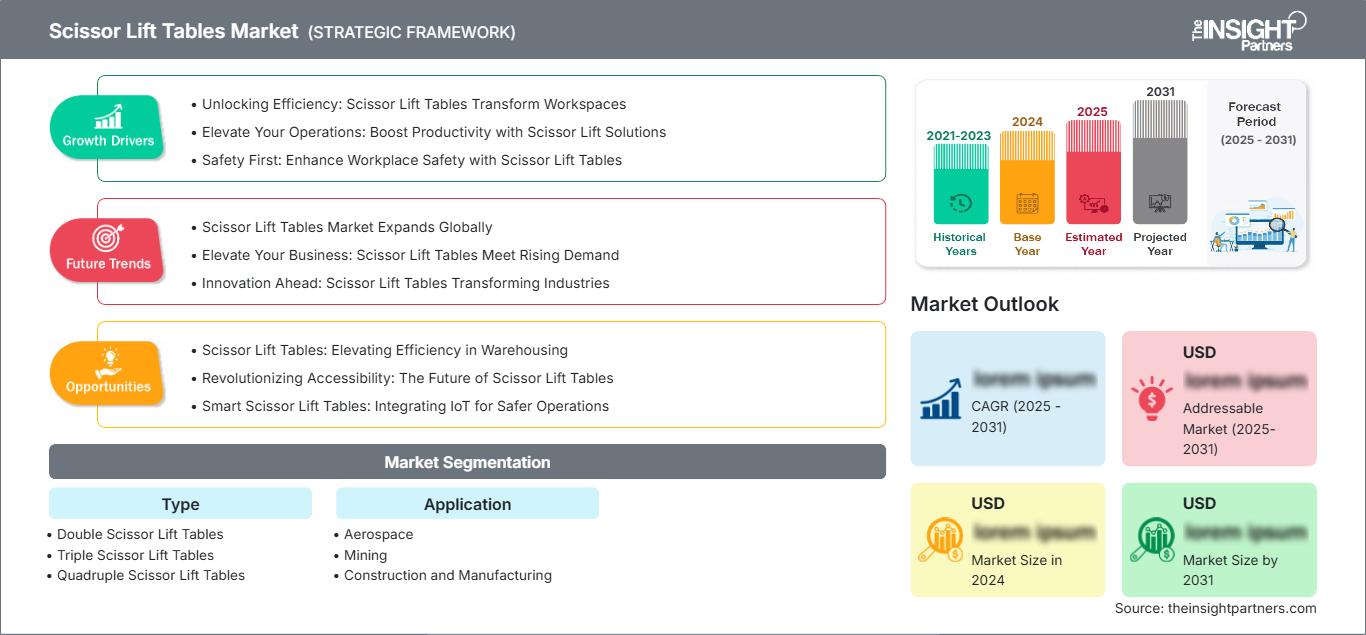
Scissor Lift Tables Market: Strategic Insights
Regional Insights
North America scissor lift tables market
North America accounted for 30–33% scissor lift tables market share in 2025, supported by manufacturing, logistics, aerospace maintenance, and warehouse operations. The US and Canada use lift tables in ergonomic workstations, loading docks, pallet handling, and machinery service. Demand is reinforced by safety programs that reduce manual material handling and improve workstation productivity.
The region is expected to grow at a CAGR of 5.4–5.9% from 2026–2034. Replacement demand is strong because older hydraulic tables are being upgraded with better controls, guarding, and higher duty cycles. Distribution centers and reshored production lines will sustain order flow.
U.S. scissor lift tables Market
The US represented 78–82% of North America share in 2025 and remains the leading country. Large manufacturing clusters, aerospace facilities, automotive suppliers, and logistics networks drive demand for customized tables that improve workstation ergonomics and heavy-load handling.
The country is projected to expand at a CAGR of 5.3–5.8% during 2026–2034. Autoquip Corporation, Bishamon Industries Corporation, Lange Lift Company, and PALFINGER AG maintain market relevance through industrial lifting portfolios, dealer networks, and project-specific engineering support.
Europe scissor lift tables Market
Europe held 24–27% share in 2025 and is forecast to grow at a CAGR of 5.0–5.5% through 2034. Germany leads through machinery, automotive, and manufacturing applications, while the UK supports demand from warehouses, aerospace maintenance, and industrial safety programs.
France, Italy, and Spain add demand through construction equipment services, packaging lines, and mechanical manufacturing. European buyers emphasize CE compliance, low-noise operation, ergonomic design, and long lifecycle support. EdmoLift AB, BOLZONI S.p.A., Inkema Sistemas S.L., and KRAUS Betriebsausstattung und Fördertechnik GmbH strengthen regional supply.
APAC scissor lift tables Market
APAC captured 34–37% share in 2025 and is expected to grow at a CAGR of 6.4–7.0% during 2026–2034. China is the leading country because manufacturing expansion, warehouse mechanization, and export-oriented production increase demand for practical lifting equipment.
Japan and South Korea support demand through advanced factories, while India benefits from logistics and manufacturing investment. Australia contributes through mining maintenance and industrial facilities. Regional users prioritize durability, capacity, price competitiveness, and availability of service support.
Middle East & Africa scissor lift tables Market
The Middle East & Africa market is expected to grow at a CAGR of 4.8–5.4% during 2026–2034. Saudi Arabia leads demand through construction, logistics, mining support, and industrial diversification projects that require safer material lifting.
The UAE contributes through warehousing, airports, and industrial zones, while South Africa adds mining and manufacturing use cases. The rest of MEA remains project-led, but adoption is improving as safety and productivity expectations rise in industrial operations.
Segmentation Analysis
Type
Type is expected to grow at a CAGR of 5.7–6.3% during 2026–2034 as buyers select lift-table configurations based on height, stroke, floor space, load profile, and workstation integration. This market scope reflects demand for compact vertical range, multi-stage height reach, and heavy-load positioning across industrial environments.
- Double Scissor Lift Tables dominate usage because they provide higher travel than single-stage tables while maintaining practical platform dimensions, making them suitable for assembly, loading, and ergonomic positioning.
- Triple Scissor Lift Tables serve applications requiring extended vertical reach in compact floor areas, including maintenance access, high-level loading, aerospace tooling, and specialized production workstations.
- Quadruple Scissor Lift Tables address niche high-lift requirements where substantial elevation is needed without permanent elevators, supporting heavy industrial, construction, and specialty material handling tasks.
Application
Application is expected to grow at a CAGR of 5.8–6.4% during 2026–2034 as users deploy lift tables to improve safety, cycle time, and heavy-load positioning. Construction and manufacturing remain the leading application group because repeated material staging and workstation lifting are common across factories and project sites.
- Aerospace requires precise and stable lifting for tooling, aircraft components, maintenance access, and inspection workflows where controlled elevation improves safety and protects high-value parts.
- Mining uses heavy-duty tables for equipment servicing, component handling, workshop maintenance, and safer access to large mechanical assemblies in harsh operating conditions.
- Construction and Manufacturing leads demand through assembly lines, pallet handling, loading docks, welding stations, equipment servicing, and material preparation where ergonomics and throughput directly affect productivity.
Opportunity Snapshot
| Application | Revenue Contribution | Trend Tag | Adoption Stage |
| Aerospace | Medium | Tooling Access | Scaling |
| Mining | Medium | Heavy Service | Scaling |
| Construction and Manufacturing | High | Ergonomic Flow | Mature |
Scissor Lift Tables Market Growth Drivers and Impact Analysis
Workplace Ergonomics and Injury Reduction
Improvements in ergonomics are one of the main sources of growth since manual lifting and improper heights of the work station lead to fatigue, injuries, and loss of productivity. Scissor lift tables make it possible to adjust the load height to a level that is safe for handling during the processes of assembling, packing, welding, and inspecting. This allows to avoid bending, stretching, and frequent use of forklifts to adjust the position of the load. Safety programs in North America and Europe reinforce this argument by making a link between lifting machines and injury prevention.
Warehouse Automation and Material Flow Modernization
New concepts of material handling have been developed for distribution centers and manufacturing plants to incorporate conveyor systems, pallet workstations, robotic cells, and automated equipment handling. The purpose of lift tables in this new concept of material handling is to change the height of the load between operations and avoid any bottleneck in the packaging, receiving, or assembly process points. This is due to the increasing functional requirement rather than an occasional one of the lift tables, because of the automation in the workflow.
Heavy-Duty Customization for Specialized Industries
Aerospace, mining, construction, and heavy manufacturing call for hoisting devices that need to operate under odd loads, odd sizes, and tough maintenance environments. Customization involves alteration of standard tables by adding extra-large platforms, sturdier construction, bellows, turntables, rails, or even control systems. The benefit here is that it helps make good profits for the manufacturers as they come up with custom designs for projects. This is critical since specialized customers consider safety more than the cost of purchasing equipment.
Scissor Lift Tables Market Future Trends
Smarter Electrical Controls and Diagnostics
The scissor lift tables market trends show growing use of modular control systems, digital diagnostics, and simplified configuration tools. Operators want faster troubleshooting, easier commissioning, and improved maintenance visibility. Electrical controls that support limit switches, safety logic, and service diagnostics can reduce downtime in production environments. Future systems will likely include clearer operator interfaces, remote fault interpretation, and integration points for automated handling equipment. This trend will raise expectations for documentation and service support, especially among global manufacturers managing many lift tables across plants.
Low-Profile and Pit-Free Installations
This type of system will see increased use in the future since there is a need for many facilities to take advantage of lift table characteristics without having to install floor pits and perform major modifications to the facility structure. This kind of equipment can simply be installed onto the existing floors and loaded using pallet trucks. Future product developments will include lowering of closed heights and better stability and safety for the operators.
Scissor Lift Tables Market Opportunities
Retrofitting Workstations in Aging Factories
The scissor lift tables market forecasts indicate strong potential in retrofitting older factories where manual material movement still dominates. Many facilities cannot redesign entire production lines, but they can add lift tables at welding stations, palletizing points, inspection areas, and assembly benches. This creates an actionable sales path for modular, low-profile, and customized systems. Manufacturers that offer site assessment, ergonomic justification, and fast installation can win from plants seeking measurable productivity gains without major capital disruption.
Aerospace and Mining Maintenance Platforms
The specialty platforms present a target-rich environment due to the fact that aerospace and mining customers both have requirements for fixed-positioning of expensive parts and large assemblies. Aerospace maintenance requires careful handling of tools and parts, while mining workshops work with bulky equipment in tough environments. Specialization differentiates suppliers through their ability to provide stronger constructions, specialty platforms, protective guards, and accurate control. The project looks appealing since buyers are more interested in reliability and certification than in cost.
Frequently Asked Questions

- Comprehensive Market Sizing and Forecast Analysis
- Detailed Segmentation Analysis
- In-Depth Market Dynamics Assessment
- Regional and Country-Level Insights
- Competitive Landscape and Company Benchmarking
- Strategic Business Intelligence
Recent Reports
Testimonials

The Insight Partners provided valuable market intelligence that supported our global go-to-market strategy. Their team was professional, responsive, and attentive to our feedback, providing thoughtful analysis and helpful methodological clarifications throughout the project.
Junmo Kim Chief Financial Officer (CFO), Enertech Co., Ltd.
The Insight Partners' SCADA System Market report is comprehensive, with valuable insights on current trends and future forecasts. The team was highly professional, responsive, and supportive throughout. We are very satisfied and highly recommend their services.
RAN KEDEM Partner, Reali Technologies LTDs
I requested a report on a very specific software market and the team produced the report in a few days. The information was very relevant and well presented. I then requested some changes and additions to the report. The team was again very responsive and I got the final report in less than a week.
JEAN-HERVE JENN Chairman, Future Analytica
We worked with The Insight Partners for an important market study and forecast. They gave us clear insights into opportunities and risks, which helped shape our plans. Their research was easy to use and based on solid data. It helped us make smart, confident decisions. We highly recommend them.
PIYUSH NAGPAL Sr. Vice President, High Beam Global
The Insight Partners delivered insightful, well-structured market research with strong domain expertise. Their team was professional and responsive throughout. The user-friendly website made accessing industry reports seamless. We highly recommend them for reliable, high-quality research services
YUKIHIKO ADACHI CEO, Deep Blue, LLC.
This is the first time I have purchased a market report from The Insight Partners.While I was unsure at first, I visited their web site and felt more comfortable to take the risk and purchase a market report.I am completely satisfied with the quality of the report and customer service. I had several questions and comments with the initial report, but after a couple of dialogs over email with their analyst I believe I have a report that I can use as input to our strategic planning process.Thank you so much for taking the extra time and making this a positive experience.I will definitely recommend your service to others and you will be my first call when we need further market data.
JOHN SUZUKI President and Chief Executive Officer, Board Director, BK Technologies
I wish to appreciate your support and the professionalism you displayed in the course of attending to my request for information regarding to infectious disease IVD market in Nigeria. I appreciate your patience, your guidance, and the fact that you were willing to offer a discount, which eventually made it possible for us to close a deal. I look forward to engaging The Insight Partners in the future, all thanks to the impression you have created in me as a result of this first encounter.
DR CHIJIOKE ONYIA MANAGING DIRECTOR, PineCrest Healthcare Ltd.Reason to Buy
- Informed Decision-Making
- Understanding Market Dynamics
- Competitive Analysis
- Identifying Emerging Markets
- Customer Insights
- Market Forecasts
- Risk Mitigation
- Boosting Operational Efficiency
- Strategic Planning
- Investment Justification
- Tracking Industry Innovations
- Aligning with Regulatory Trends





 Get Free Sample for