
Sewage Submersible Pump Market Size, Growth & Trends by 2034
Coverage: By Power Rating (Below 5HP, 6-50 HP, Above 50 HP); End-user (Mining and Construction, Municipal, Industrial, Others) , and Geography (North America, Europe, Asia Pacific, and South and Central America)
- Status : Data Released
- Report Code : TIPRE00019807
- Category : Manufacturing and Construction
- No. of Pages : 150
- Available Report Formats :


- Last update date : July 13, 2026


2025 Market Size
US$ 3.49 Bn
Base year value
2034 Forecast
US$ 5.81 Bn
Projected by 2034
CAGR 2026-2034
5.84 %
Growth rate
Addressable Market
US$ 42.17 Bn
(2026-2034)
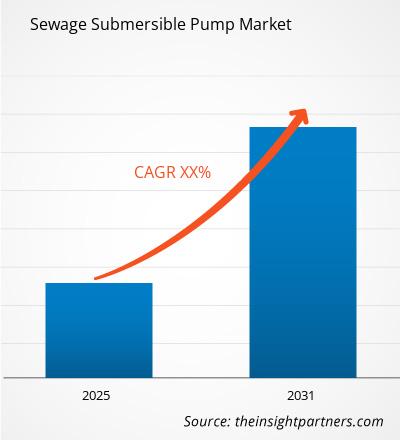
Sewage submersible pump market size is projected to grow from US$ 3.49 Billion in 2025 to US$ 5.81 Billion by 2034, registering a CAGR of 5.84% during 2026–2034. Growth is supported by sustained replacement of aging wastewater assets, higher municipal sewerage coverage, and industrial effluent handling requirements across mining, construction, and process industries.
Across North America, utilities are prioritizing resilient lift stations, flood-prone drainage corridors, and energy-efficient pumping upgrades. The Sewage Submersible Pump Market size outlook in the region is supported by a modelled CAGR range of 4.8–5.3% through 2034, driven by federal water infrastructure funding in the U.S. and deferred asset rehabilitation in Canada.
Sewage Submersible Pump Market Assessment and Insights
- North America accounted for 28–32% share in 2025 and is expected to grow at a CAGR of 4.8–5.3% during 2026–2034, supported by pump station rehabilitation and wastewater resilience programs.
- US represented 82–86% of North America sewage submersible pump market in 2025 and is forecast to grow at a CAGR of 4.9–5.4% during 2026–2034.
- Europe held 24–28% share in 2025 and is projected to grow at a CAGR of 4.5–5.0% during 2026–2034, led by Germany, the UK, France, Italy, and Spain.
- Asia Pacific captured 30–34% share in 2025 and is expected to grow at a CAGR of 6.8–7.4% during 2026–2034, with China, India, Japan, South Korea, and Australia as key demand centers.
- Largest Segment Municipal held 52–56% sewage submersible pump market share in 2025 and is forecast to grow at a CAGR of 5.4–5.9% during 2026–2034.
- High Growth Segment Mining and Construction held 17–21% market share in 2025 and is forecast to grow at a CAGR of 6.6–7.2% during 2026–2034.
- Key companies analyzed in detail: ANDRITZ AG, EBARA Corporation, The Gorman-Rupp Company, Grundfos Holding A/S, KSB SE & Co. KGaA, Ruhrpumpen Group, Sulzer Ltd, Tsurumi Manufacturing Co., Ltd., Wilo SE, Xylem Inc.
Source: The Insight Partners' analysis based on proprietary research, government publications, company annual reports, investor presentations, industry databases, and expert interviews.
Product evolution has moved the sewage submersible pump market from basic solids-handling equipment toward digitally supervised, clog-resistant, high-efficiency systems. The design of impellers, motor insulation, seals, and cooling systems is being modified to withstand ragging, gritting, and varying wet well conditions. The dynamics of production are also changing to incorporate modular manufacturing, common motor platforms, and locally available service inventory to minimize maintenance time for utilities and construction firms.
Future demand will depend on urban sewage projects in developing countries, industrial wastewater projects, and climate adaption works in vulnerable urban centers. Governments are tying their sewerage infrastructure development projects with public health, water resource conservation, and reuse of wastewater, which improves procurement visibility. As such, manufacturers with service offerings, monitoring technologies, and optimal hydraulics stand to benefit.
Sewage Submersible Pump Market Report Scope
| Report Attribute | Details |
|---|---|
| Market size in 2025 | US$ 3.49 Billion |
| Market Size by 2034 | US$ 5.81 Billion |
| Global CAGR (2026 - 2034) | 5.84% |
| Historical Data | 2021-2024 |
| Forecast period | 2026-2034 |
Sewage Submersible Pump Market Analysis
The sewage submersible pump market growth profile is anchored in rising wastewater volumes, urban sewer network expansion, and stricter discharge management. Pump buyers in municipalities have placed importance on buying pumps that have low clogging occurrences, are capable of sustaining flow when solids load varies, and consume low energy levels in lift stations.
The pump value chain consists of motor producers, casters, seal producers, control panel producers, distributors, and service contractors. Stainless steel, cast iron, copper, and electronics continue to be crucial in supply, although the larger producers of pumps are managing risks in sourcing by assembling in regional factories.
Sewage submersible pump market analysis indicates a competitive field where scale, application engineering, and service depth matter more than unit pricing alone. Efficient motor drives, digital control systems, and worldwide urban references by Xylem Inc., Sulzer Ltd, KSB SE & Co. KGaA, Grundfos Holding A/S, and Wilo SE drive competition.
Specialized companies like Tsurumi Manufacturing Co., Ltd., The Gorman-Rupp Company, EBARA Corporation, Ruhrpumpen Group, and ANDRITZ AG build up the market with their experience in dewatering, engineered wastewater solutions, and regional distributors. Money is flowing to better hydraulic performance, predictive maintenance, and construction/mining tough pumps.
● REPORT CUSTOMIZATION
Tailor This Report To Align With Your Specific Business Requirements
This report can be customized to align precisely with your business objectives, scope, and target markets. Customization options include tailored segmentation, geography, competitive analysis, and strategic insights to support informed decision-making.
Customize This Report →WHAT YOU CAN ADJUST
- ● Segmentations
- ● Geography
- ● Competitive Analysis
- ● Language Preferences
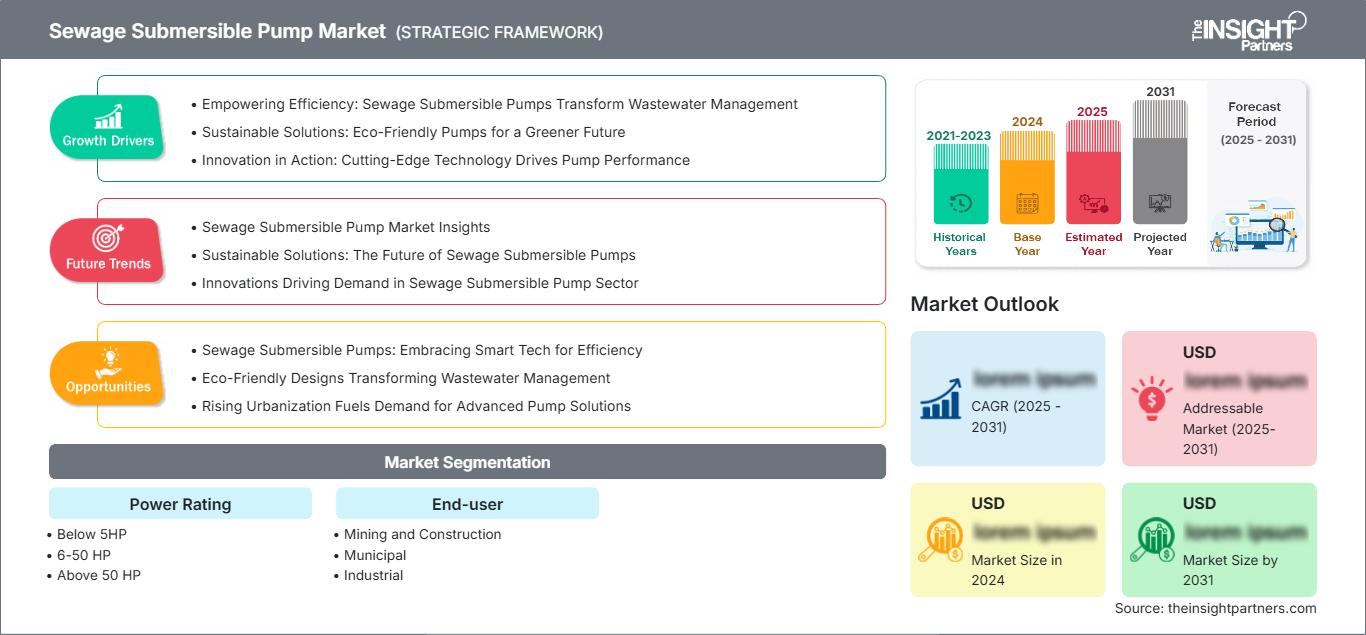
Sewage Submersible Pump Market: Strategic Insights
Regional Insights
North America Sewage Submersible Pump Market
North America held 28–32% sewage submersible pump market share in 2025 and is projected to grow at a CAGR of 4.8–5.3% through 2034. Demand in the region is driven by spending on sewage plant upgrades, lift station upgrades, and flood-proofing projects. Municipalities are looking to replace existing dry pit or less efficient pumps with submersible models in order to minimize space requirements and minimize maintenance exposure.
Demand is currently impacted by the U.S. Infrastructure Investment and Jobs Act, as well as improvements to sewer networks in Canada due to infiltration, inflow, and heavy rain conditions. The strongest demand will be in 6-50 HP models for use in municipal wet wells, commercial complexes, and industrial drainage.
U.S. Sewage Submersible Pump Market
The U.S. represented 82–86% of North America sewage submersible pump market in 2025 and is expected to expand at a CAGR of 4.9–5.4% during 2026–2034. Demand is concentrated in municipal wastewater districts, commercial building basements, stormwater pumping stations, and industrial wastewater pits. Replacement cycles are accelerated by aging sewer infrastructure and rising service costs linked to ragging and pump failures.
Product availability is high for Xylem Inc., The Gorman-Rupp Company, Grundfos Holding A/S, Sulzer Ltd., and EBARA Corporation through direct sales, distribution channels, and municipal partner companies. There is a trend in applications that requires controls, telemetry, and grinders or cutters because of wipes and fibrous solids creating operational risks.
Europe Sewage Submersible Pump Market
Europe accounted for 24–28% sewage submersible pump market share in 2025 and is forecast to grow at a CAGR of 4.5–5.0% during 2026–2034. Germany leads regional demand because of advanced municipal wastewater coverage, industrial processing clusters, and strict effluent standards. The UK market is shaped by sewer overflow reduction programs and utility investment in pumping station reliability.
The countries include France, Italy, and Spain, which offer contributions through network rehabilitation, coastal cleaning regulations as a result of tourism, and improved industrial effluent processing facilities. The companies include KSB SE & Co. KGaA, Wilo SE, Sulzer Ltd, Grundfos Holding A/S, and ANDRITZ AG, which benefit from their geographical location near engineering clients and workshops.
APAC Sewage Submersible Pump Market
APAC’s market share was recorded at 30-34% in 2025 and is estimated to have a CAGR of 6.8-7.4% over 2026-2034, which will make it the fastest-growing region. China has dominance in terms of installed municipal capacity, whereas India has good demand increment in terms of sewerage infrastructure and industrial zones.
Both Japan and South Korea favor highly reliable pumps owing to high population densities, whereas Australia prefers wastewater assets that can withstand natural calamities owing to its location near the coastlines. The factors behind the widespread use are sanitation spending, manufacturing, and mine dewatering requirements.
Middle East & Africa Sewage Submersible Pump Market
Middle East & Africa is projected to grow at a CAGR of 5.7–6.3% during 2026–2034, supported by urban development, desalination-linked wastewater reuse, and industrial infrastructure. Saudi Arabia drives up the demand with its urban and infrastructure developments, while the United Arab Emirates demands highly specified municipal and commercial pumps.
South Africa’s contribution includes its mining, municipal rehabilitation, and wastewater treatment requirements. The demand for Rest of MEA is still driven by projects, with energy complexes, construction sites, and sanitation programs needing submersible pumps that can work in abrasive environments.
Segmentation Analysis
Power Rating
Power Rating is projected to grow at a CAGR of 5.6–6.1% during 2026–2034. The sewage submersible pump market scope across power classes reflects sharply different duty cycles, from small building sumps to municipal wet wells and heavy industrial drainage. Selection depends on flow, head, solids size, installation depth, and service accessibility.
- Below 5HP serves residential, commercial basement, and light-duty wastewater applications where compact design, easy replacement, and low operating noise are important for facility managers and contractors.
- 6-50 HP is the core municipal and commercial duty range, balancing solids handling, energy efficiency, and maintainability for lift stations, industrial pits, and construction drainage.
- Above 50 HP supports high-flow municipal stations, mining sumps, and large industrial effluent systems where robust motors, cooling, and abrasion resistance determine lifecycle economics.
End-user
End-user demand is expected to grow at a CAGR of 5.8–6.3% during 2026–2034. Municipal buyers remain the volume anchor, while mining, construction, and industrial users create higher-specification opportunities. Purchasing decisions increasingly factor in uptime, service response, energy cost, and the ability to manage solids without frequent intervention.
- Mining and Construction requires abrasion-resistant, portable, and high-head pumps for dewatering shafts, tunnels, foundations, and temporary wastewater flows where equipment reliability directly affects site productivity.
- Municipal remains the largest end-user as utilities replace aging lift station pumps, expand sewer coverage, and add monitoring to reduce emergency maintenance and overflow incidents.
- Industrial demand comes from food processing, chemicals, pulp and paper, and manufacturing facilities that need compliant wastewater transfer with corrosion resistance and stable solids handling.
Opportunity Snapshot
| Segment Name | Revenue Contribution | Trend Tag | Adoption Stage |
| Mining and Construction | Medium | Site Dewatering | Scaling |
| Municipal | High | Lift Stations | Mature |
| Industrial | Medium | Effluent Control | Scaling |
Sewage Submersible Pump Market Growth Drivers and Impact Analysis
Wastewater Infrastructure Renewal
Increasing age of existing sewer networks and lift stations leads to replacement of pumps prior to any failure that could cause overflow, odor problems, or noncompliance. This is favorable for the Sewage Submersible Pump as it may be installed in wet well installations without need for dry pits. Programs for building infrastructures pay increasing attention to resilience in respect of intense precipitation, water infiltration and urban floods; this stimulates the need for robust solids-handling machinery. The effect will be especially strong in developed countries with known replacement market, and developing cities with installation of their first sewerage systems.
Industrial Wastewater Compliance
Discharge restrictions become more stringent, while wastewater management processes become subject to closer monitoring. Submersible sewage pumps are becoming more common in pretreatment pits, equalization tanks, and stormwater drainage systems where solid material and corrosive liquids may be encountered. It provides additional growth potential for pumps that are built from durable materials and offer thermal protection as well as self-clearing capabilities. Another advantage for the industry is a decreased number of downtimes because any interruption of the wastewater system could stop production or incur environmental fines.
Shift Toward Energy-Efficient Pumping
Energy usage is one of the largest costs in the lifetime of wastewater pump stations, particularly those that operate all the time with varying inflows. Consequently, efficient motors, optimized impellers, variable speed capability, and controls capable of matching output to hydraulics are now being demanded by buyers. This has two consequences on the market: First, the value proposition of more expensive equipment will be reinforced in public procurement processes, and second, retrofits will become more interesting to utilities that have high electricity costs. Energy efficiency is also important for reducing emissions from water utilities' operations, which include pumping.
Sewage Submersible Pump Market Future Trends
Condition-Monitored Wet Wells
Sewage submersible pump market trends are moving toward continuous condition monitoring that connects pumps, level sensors, vibration signals, seal leakage alerts, and energy data into utility dashboards. Future procurement will favor systems that predict clogging, identify abnormal starts, and schedule maintenance before emergency callouts occur. This trend is especially relevant for distributed lift stations, where manual inspections are costly and failures can quickly cause overflows. Over time, data-rich pump fleets will allow utilities to benchmark performance, optimize replacement intervals, and justify capital spending based on measured operating risk rather than fixed maintenance schedules.
Solids-Resilient Hydraulic Designs
Wastewater composition is changing as low-flow fixtures, wipes, fibers, and grit increase clogging risk in many sewer networks. Future pump designs will emphasize hydraulics that pass fibrous material while maintaining efficiency across partial-load conditions. Cutter, vortex, channel, and anti-rag impeller formats will be selected more carefully by application rather than treated as interchangeable options. Manufacturers are also expected to use computational fluid dynamics, wear-resistant materials, and modular wet-end designs to improve reliability. This creates room for differentiated engineering and service-based selling.
Sewage Submersible Pump Market Opportunities
Packaged Lift Station Modernization
Utilities and developers increasingly prefer packaged lift station solutions that combine pumps, guide rails, controls, telemetry, valves, and prefabricated chambers. This creates an opportunity for suppliers to move beyond component sales and capture higher project value through engineered systems. Sewage submersible pump market forecasts indicate stronger demand where municipalities need faster installation, standardized maintenance, and lower civil construction risk. Vendors can differentiate by offering configurable packages for residential growth corridors, industrial parks, and flood-prone drainage basins. Partnerships with civil contractors and control integrators will be important for converting this opportunity into recurring project pipelines.
Aftermarket Services and Retrofit Programs
Large installed bases create attractive aftermarket opportunities in inspection, repair, seal replacement, motor rewinding, impeller upgrades, and control retrofits. Many utilities and industrial operators lack internal capacity to maintain submerged equipment, making service contracts valuable. Suppliers can use condition data to recommend replacements, energy upgrades, or hydraulic conversions that reduce clogging and downtime. This opportunity is commercially important because aftermarket margins are often more stable than project sales and improve customer retention. Regional service centers, rental fleets, and rapid-response technicians will influence supplier selection.
Recent Developments
- June 2026: Xylem (NYSE: XYL), a leading global water technology company, today announced a landmark agreement with Dow (NYSE: DOW) to design, build and operate advanced water systems at its large-scale industrial complex in Fort Saskatchewan, Alberta, Canada. The agreement expands Xylem’s long-standing collaboration with Dow, supporting the increased operations tied to Dow’s Path2Zero project.
- February 2026: EKKI Water Technologies and Germany’s HOMA Pumpenfabrik GmbH, announced a step forward in their Indo-German collaboration with the launch of the LINUS Clog-Defense Sewage Pump Range, and the next phase of expansion of EKKI HOMA, their joint venture focused on sewage pumping solutions for India and emerging markets. The LINUS Clog-Defense system is specifically engineered to eliminate and prevent clogging before it occurs, addressing one of the most critical challenges in sewage pumping systems.
- September 2025: EBARA CORPORATION (hereafter “EBARA”) has launched the new model DKE anti-clog submersible wastewater pump (hereafter “the Pump”) for global markets outside Japan (50 Hz power supply regions), with sales starting in August 2025. The Pump features an anti-clog design that prevents foreign matter from blocking the impeller and helps realize high operating efficiency. Following initial release in the United States in 2023, the sales are now being expanded to Europe, China, Southeast Asia, the Middle East and other regions.
Frequently Asked Questions

- Comprehensive Market Sizing and Forecast Analysis
- Detailed Segmentation Analysis
- In-Depth Market Dynamics Assessment
- Regional and Country-Level Insights
- Competitive Landscape and Company Benchmarking
- Strategic Business Intelligence
Recent Reports
Testimonials

The Insight Partners' SCADA System Market report is comprehensive, with valuable insights on current trends and future forecasts. The team was highly professional, responsive, and supportive throughout. We are very satisfied and highly recommend their services.
RAN KEDEM Partner, Reali Technologies LTDs
I requested a report on a very specific software market and the team produced the report in a few days. The information was very relevant and well presented. I then requested some changes and additions to the report. The team was again very responsive and I got the final report in less than a week.
JEAN-HERVE JENN Chairman, Future Analytica
We worked with The Insight Partners for an important market study and forecast. They gave us clear insights into opportunities and risks, which helped shape our plans. Their research was easy to use and based on solid data. It helped us make smart, confident decisions. We highly recommend them.
PIYUSH NAGPAL Sr. Vice President, High Beam Global
The Insight Partners delivered insightful, well-structured market research with strong domain expertise. Their team was professional and responsive throughout. The user-friendly website made accessing industry reports seamless. We highly recommend them for reliable, high-quality research services
YUKIHIKO ADACHI CEO, Deep Blue, LLC.
This is the first time I have purchased a market report from The Insight Partners.While I was unsure at first, I visited their web site and felt more comfortable to take the risk and purchase a market report.I am completely satisfied with the quality of the report and customer service. I had several questions and comments with the initial report, but after a couple of dialogs over email with their analyst I believe I have a report that I can use as input to our strategic planning process.Thank you so much for taking the extra time and making this a positive experience.I will definitely recommend your service to others and you will be my first call when we need further market data.
JOHN SUZUKI President and Chief Executive Officer, Board Director, BK Technologies
I wish to appreciate your support and the professionalism you displayed in the course of attending to my request for information regarding to infectious disease IVD market in Nigeria. I appreciate your patience, your guidance, and the fact that you were willing to offer a discount, which eventually made it possible for us to close a deal. I look forward to engaging The Insight Partners in the future, all thanks to the impression you have created in me as a result of this first encounter.
DR CHIJIOKE ONYIA MANAGING DIRECTOR, PineCrest Healthcare Ltd.Reason to Buy
- Informed Decision-Making
- Understanding Market Dynamics
- Competitive Analysis
- Identifying Emerging Markets
- Customer Insights
- Market Forecasts
- Risk Mitigation
- Boosting Operational Efficiency
- Strategic Planning
- Investment Justification
- Tracking Industry Innovations
- Aligning with Regulatory Trends





 Get Free Sample for