
Sewing Machines Market Size, Growth & Demand by 2034
Coverage: by Type (Automatic Lock Stitch Sewing Machines, High-Speed Stretch Sewing Machines, Automatic High-Speed Overlock Sewing Machines, Others); Application (Domestic, Industrial) , and Geography (North America, Europe, Asia Pacific, and South and Central America)
- Status : Data Released
- Report Code : TIPRE00007357
- Category : Manufacturing and Construction
- No. of Pages : 150
- Available Report Formats :


- Last update date : July 13, 2026


2025 Market Size
US$ 4.64 Bn
Base year value
2034 Forecast
US$ 6.51 Bn
Projected by 2034
CAGR 2026-2034
3.83 %
Growth rate
Addressable Market
US$ 50.63 Bn
(2026-2034)
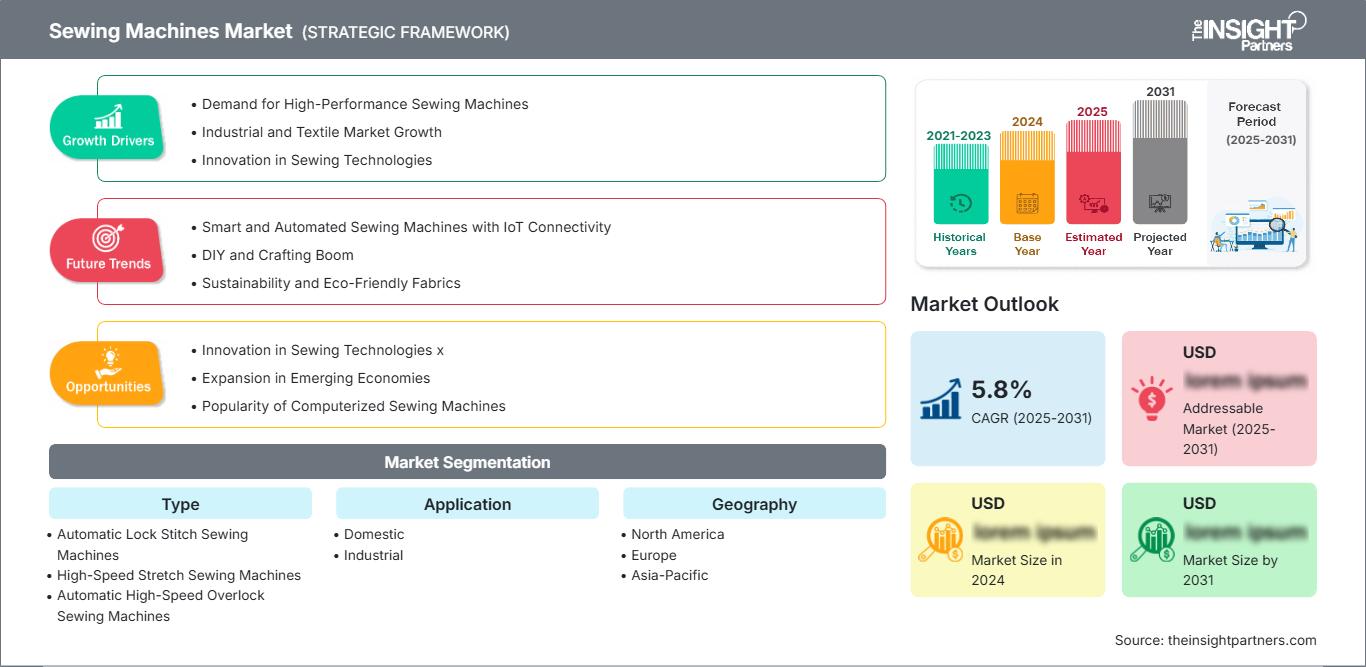
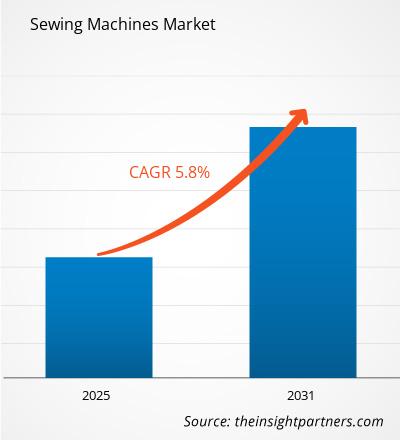
The sewing machines market size is projected to grow from US$ 4.64 Billion in 2025 to US$ 6.51 Billion by 2034, registering a CAGR of 3.83% during 2026–2034. Demand continues to be firmly based on factory-produced clothes, home sewing, craft-oriented demand, and equipment replacement. This is a market characterized by the continued use of automatic lock stitching, rapid stretch, and overlock machines.
Within North America, the sewing machines market forecast is supported by mature household ownership, home-based microbusinesses, quilting communities, and apparel reshoring pilots. The region is estimated to expand at a 2.6–3.0% CAGR during 2026–2034, led by replacement of mechanical units with computerized models and demand for precision stitching in upholstery, repair services, and small-batch garment production.
Sewing Machines Market Assessment and Insights
- North America accounted for 23–25% share in 2025 and is growing at a 2.6–3.0% CAGR between 2026–2034, supported by repair culture, quilting demand, and industrial reshoring.
- US represented 88–91% of North America in 2025 and is growing at a 2.5–2.9% CAGR between 2026–2034 as home studios and apparel workshops upgrade equipment.
- Europe held 18–20% share in 2025 and is growing at a 2.7–3.1% CAGR between 2026–2034, led by Germany, the UK, France, Italy, and Spain.
- Asia Pacific captured 48–51% share in 2025 and is growing at a 4.3–4.8% CAGR between 2026–2034, with China, Japan, South Korea, India, and Australia driving industrial demand.
- Largest Segment Industrial application held 68–71% sewing machines market share in 2025 and is expanding at a 3.9–4.3% CAGR between 2026–2034.
- High Growth Segment Automatic high-speed overlock sewing machines held 21–24% market share in 2025 and is growing at a 5.4–5.9% CAGR between 2026–2034.
- Key companies analyzed in detail: Bernina International AG, Brother Industries, Ltd., China Feiyue USA Inc., JACK Sewing Machine Co., Ltd., Jaguar International Corporation, Janome Sewing Machine Co., Ltd., JUKI Corporation, Merrow Manufacturing LLC, SVP Worldwide LLC, Tacony Corporation.
Source: The Insight Partners' analysis based on proprietary research, government publications, company annual reports, investor presentations, industry databases, and expert interviews.
Changes in technology migration are influencing buying considerations because factories are going away from simple mechanical models into those with programmed lock stitch, direct drive, auto-trimming of threads and feed control through sensors. Another factor that has an impact on Sewing Machine demand is the fact that apparel production is becoming more flexible with style changes and smaller quality allowances. In response, manufacturers have developed machines that require less operator skills, generate less rework and downtime for knitting, jeans, upholstery, home textiles and technical fabrics.
The future demand for Sewing Machines will grow in the Asia Pacific and certain Middle Eastern manufacturing zones due to the need for flexible lines in apparel exporters. Energy-saving motors, safer operator interface and digital diagnostic features will help facilitate equipment upgrades. Regulatory requirements relating to workplace safety and export readiness are likely to influence the choice of branded Sewing Machines manufacturers.
Sewing Machines Market Report Scope
| Report Attribute | Details |
|---|---|
| Market size in 2025 | US$ 4.64 Billion |
| Market Size by 2034 | US$ 6.51 Billion |
| Global CAGR (2026 - 2034) | 3.83% |
| Historical Data | 2021-2024 |
| Forecast period | 2026-2034 |
Sewing Machines Market Analysis
The sewing machines market growth is driven by industrial productivity targets, rising garment customization, and the need for consistent seam quality across apparel and non-apparel textiles. The industrial users require higher efficiency, better thread management, and minimal down time while the residential consumers look for computerized libraries of stitches and ease of maintenance. The supply chain consists of motors, electronic controllers, needle and thread systems, sales organizations, trainers, and after-sales services.
The supplier landscape stays highly focused on the manufacturing centers of Asia, but the engineering and brand ownership is spread out across Japan, Switzerland, USA, and China. The Sewing Machine industry enjoys the economies of scale through standardized components, but the differentiation factor lies in feed accuracy, interface software, operator comfort, and service response speed.
The sewing machines market analysis indicates a competitive structure in which JUKI Corporation, Brother Industries, Ltd., Janome Sewing Machine Co., Ltd., and Bernina International AG compete on precision, automation, and reliability, while JACK Sewing Machine Co., Ltd. and China Feiyue USA Inc. strengthen value-tier access. SVP Worldwide LLC, Tacony Corporation, Jaguar International Corporation, and Merrow Manufacturing LLC retain relevance through brand portfolios, specialty stitching, and channel depth.
The emphasis in investments is now on digitized control, service platform and local distribution. Traditional brands protect their margins with premium home country machinery and industrialization, while competitive brands strive for economies of scale in emerging clothing industries. The key to strategic positioning lies in achieving a balance between automation and cost-effectiveness, especially when smaller factories need to become productive without automation.
● REPORT CUSTOMIZATION
Tailor This Report To Align With Your Specific Business Requirements
This report can be customized to align precisely with your business objectives, scope, and target markets. Customization options include tailored segmentation, geography, competitive analysis, and strategic insights to support informed decision-making.
Customize This Report →WHAT YOU CAN ADJUST
- ● Segmentations
- ● Geography
- ● Competitive Analysis
- ● Language Preferences
Sewing Machines Market: Strategic Insights
Regional Insights
North America Sewing Machines Market
North America accounted for 23–25% share in 2025 and is expected to grow at a 2.6–3.0% CAGR during 2026–2034. Sewing machines market share in the region is supported by household replacement, quilting, garment repair, small fashion labels, and demand for durable upholstery stitching. Higher labor costs encourage semi-automated features that improve productivity without requiring large factory-scale investments.
Local customers have preferences for computerized machines, domestic embroidery-capable machines, and industrial lockstitch machines used by alteration businesses, furniture manufacturers, and textile converters. The importance of dealer channels is due to the influence of training and maintenance on purchasing decisions. Demand for replacement products is more stable than demand for greenfield products.
U.S. Sewing Machines Market
US comprised 88% to 91% of the total demand from North America in 2025, and is expected to register growth at a 2.5% to 2.9% CAGR during 2026 to 2034. The demand was driven by household sewing, quilting, apparel modification, upholstery mending, and custom workshops. Key companies with prominent distribution channels in the US were Brother Industries, Ltd., Janome Sewing Machine Co., Ltd., SVP Worldwide LLC, and Tacony Corporation.
Some of the application trends in the US include preference of the end-users towards ease of threading, embroidery, and stitch digitalization among domestic customers and locking stitching and overlock among industrial end-users for limited batch production. Serviceability will continue to play an important role as the training, accessories, and servicing determine the equipment life cycle.
Europe Sewing Machines Market
Europe held 18–20% sewing machines market share in 2025 and is forecast to grow at a 2.7–3.1% CAGR during 2026–2034. Germany remains the leading country because of technical textile production, repair workshops, and premium household demand. The UK benefits from sewing education, craft retailing, and alteration services, while France supports niche fashion and home décor use cases.
The Italian and Spanish markets contribute by way of fashion production, leather products, and smaller factories where industrial sewing machines with greater reliability are required compared to large assembly lines. Efficiency in energy usage, safety, precision, and lifecycle support is often important for European customers. The demand increases gradually, yet high-end consumption and repair drive replacements.
APAC Sewing Machines Market
Share of APAC stood at 48–51% in 2025 and will further grow by a CAGR of 4.3–4.8% in the period 2026–2034. China dominates due to significant manufacturing capability, whereas Japan and South Korea offer superior equipment design. India and Southeast Asia offer additional demand due to export of apparel, uniforms, and home textile production.
Industrially oriented policies and workforce training help in equipment replacement in APAC. Australia is still smaller and meets domestic, artisanal, and specialized textile demand. Usage of Sewing Machines in APAC has become more inclined towards increased efficiency and reduction of defects along with flexibility in production line for brands globally.
Middle East & Africa Sewing Machines Market
Middle East & Africa is expected to grow at a 3.4–3.9% CAGR during 2026–2034, led by the UAE, Saudi Arabia, South Africa, and Rest of MEA. Demand is linked to tailoring services, uniforms, hospitality textiles, and localized garment workshops supported by infrastructure and retail expansion.
The indirect impact of investments in energy and infrastructure is on textile care, protective gear, and service uniforms. UAE is the distribution base; there is increased demand in Saudi Arabia for vocational services and small businesses, while South Africa is the anchor for the service region.
Segmentation Analysis
Type
Type is forecast to expand at a 3.7–4.2% CAGR during 2026–2034 as buyers differentiate machines by seam formation, fabric handling, speed, and automation. Sewing machines market scope across type categories reflects both basic replacement and higher-value purchases by factories seeking lower operator dependency, consistent output, and tighter finishing quality across knitted, woven, and technical fabrics.
- Automatic Lock Stitch Sewing Machines remain essential for straight seams, apparel assembly, and durable stitching. Demand is stable because factories value repeatability, low training burden, and compatibility with broad fabric categories.
- High-Speed Stretch Sewing Machines serve knitwear, sportswear, innerwear, and elastic fabrics where seam flexibility is critical. Their strategic importance rises as apparel brands expand comfort-oriented and performancewear collections.
- Automatic High-Speed Overlock Sewing Machines are vital for edge finishing, seam reinforcement, and high-throughput garment lines. Adoption is strongest where manufacturers need faster finishing with lower defect rates.
Application
Application is projected to grow at a 3.6–4.1% CAGR during 2026–2034 as industrial fleets and domestic users follow different purchasing cycles. Industrial buyers focus on uptime, speed, and serviceability, while domestic customers emphasize ease of use, creativity, and compact designs. The segment mix supports recurring demand through accessories, training, maintenance, and upgrades.
- Domestic demand is shaped by quilting, craft learning, clothing repair, and home-based microbusinesses. Buyers increasingly select computerized models that simplify stitch selection and expand creative use cases.
- Industrial demand dominates due to garment assembly, uniforms, upholstery, and technical textiles. Purchasers prioritize machine durability, speed, spare parts availability, and integration into standardized production workflows.
Opportunity Snapshot
| Application | Revenue Contribution | Trend Tag | Adoption Stage |
| Domestic | Medium | Home Craft | Scaling |
| Industrial | High | Factory Automation | Mature |
Sewing Machines Market Growth Drivers and Impact Analysis
Automation in Apparel Production Lines
Apparel makers have automated thread trimming, feeding controls and stitch parameters programming to enhance product uniformity while minimizing fatigue on operators. This factor has direct implications for the procurement of Sewing Machines as factories will be able to increase their productivity without reengineering their entire assembly lines. Automatic lock stitch and automatic overlock machines minimize rework, ensure quality seams and decrease the training time for new hires. This aspect is most relevant for the export centers that make apparel where the brand demands quality, fast replenishment, and production control.
Growth in Repair, Alteration, and Home-Based Sewing
Repair-based consumption behavior and micropreneurship drive constant domestic and light commercial equipment demand. There is an increase in longevity of garments, customization of clothing, and earnings from sewing through local businesses and web-based sales. The effect of these trends on the market is reflected in the mature markets, where there are no garment production facilities anymore, but people keep sewing in homes due to creativity, quilting, and upholstering services.
Expansion of Technical Textiles and Non-Apparel Uses
The non-apparel applications are increasing the addressable market for heavy duty and special Sewing Machines. In the upholstery, automobile interiors, filter mediums, protective apparel, and industrial textiles, there is a need for strong feeding systems, seam strength, and machine durability. Companies who will provide customized attachments, parts, and knowledge of applications will be able to command more value. This is strategically important since it decreases reliance on the cyclic nature of the fashion industry.
Sewing Machines Market Future Trends
Connected Maintenance and Operator Guidance
Sewing machines market trends will increasingly center on connected maintenance, QR-based tutorials, digital stitch libraries, and service diagnostics that reduce downtime for both households and factories. Manufacturers are expected to embed more guidance into machine interfaces, helping users solve threading, tension, and accessory selection issues faster. For industrial fleets, predictive maintenance indicators and digital parts information can improve uptime planning. This trend should raise brand loyalty because software support, training content, and service ecosystems become as important as mechanical durability.
Precision Feed Systems for Complex Fabrics
Equipment development in the future will be focused on controlling the feeding system in the sewing of stretch materials, multi-layered material, curved seams, and industrial textiles. With increased variety in fashion trends and specialization in industrial textiles, users will require machines that ensure uniformity of stitching through different substrates. The feeding system will help minimize the occurrence of puckers, missing stitches, and dependency on the operator to get the right output.
Sewing Machines Market Opportunities
Localized Service Networks in Emerging Apparel Hubs
Manufacturers can unlock incremental demand by strengthening dealer training, spare-parts availability, and technician networks in India, Southeast Asia, the Middle East, and Africa. Many small and midsize factories delay upgrades when maintenance access is uncertain. A localized service model reduces perceived ownership risk and supports multi-machine purchases. The opportunity is investment-oriented because distributors that combine financing, demonstrations, operator training, and rapid repair can convert replacement intent into confirmed orders across growing apparel and tailoring clusters.
Affordable Computerized Machines for Skill Development
Vocational institutes, home creators, and entry-level entrepreneurs represent a scalable opportunity for simplified computerized machines. Products that combine guided setup, durable construction, and accessible pricing can support skill development while building long-term brand preference. Sewing Machines suppliers can pair machines with online lessons, accessory bundles, and certification partnerships. This approach creates a pipeline from domestic learning to microbusiness use, particularly in markets where apparel repair, tailoring, and craft-based income are expanding.
Recent Developments
- January 2026: Hikari, a leading global sewing machine manufacturer, officially launched its new generation of intelligent sewing solutions in Bangladesh, unveiling a range of advanced machines designed to significantly enhance productivity, efficiency, and quality in the garment industry.
- August 2025: SVP Worldwide, the parent company of PFAFF®, SINGER®, and HUSQVARNA® VIKING® sewing brands, announced the highly anticipated global launch of three new PFAFF sewing machines: the creative expression 750, quilt expression 725, and expression 715. These machines combine precision engineering, cutting-edge technology, and the timeless craftsmanship PFAFF is known for.
- August 2024: JUKI CORPORATION launched the phased sales of the LK-1900C high-speed electronic bartacking sewing system. This versatile sewing machine can be used for various processes such as bartacking (the reinforcement of sewing sections) and the attachment of belt loops or buttons.
Frequently Asked Questions

- Comprehensive Market Sizing and Forecast Analysis
- Detailed Segmentation Analysis
- In-Depth Market Dynamics Assessment
- Regional and Country-Level Insights
- Competitive Landscape and Company Benchmarking
- Strategic Business Intelligence
Recent Reports
Testimonials

The Insight Partners' SCADA System Market report is comprehensive, with valuable insights on current trends and future forecasts. The team was highly professional, responsive, and supportive throughout. We are very satisfied and highly recommend their services.
RAN KEDEM Partner, Reali Technologies LTDs
I requested a report on a very specific software market and the team produced the report in a few days. The information was very relevant and well presented. I then requested some changes and additions to the report. The team was again very responsive and I got the final report in less than a week.
JEAN-HERVE JENN Chairman, Future Analytica
We worked with The Insight Partners for an important market study and forecast. They gave us clear insights into opportunities and risks, which helped shape our plans. Their research was easy to use and based on solid data. It helped us make smart, confident decisions. We highly recommend them.
PIYUSH NAGPAL Sr. Vice President, High Beam Global
The Insight Partners delivered insightful, well-structured market research with strong domain expertise. Their team was professional and responsive throughout. The user-friendly website made accessing industry reports seamless. We highly recommend them for reliable, high-quality research services
YUKIHIKO ADACHI CEO, Deep Blue, LLC.
This is the first time I have purchased a market report from The Insight Partners.While I was unsure at first, I visited their web site and felt more comfortable to take the risk and purchase a market report.I am completely satisfied with the quality of the report and customer service. I had several questions and comments with the initial report, but after a couple of dialogs over email with their analyst I believe I have a report that I can use as input to our strategic planning process.Thank you so much for taking the extra time and making this a positive experience.I will definitely recommend your service to others and you will be my first call when we need further market data.
JOHN SUZUKI President and Chief Executive Officer, Board Director, BK Technologies
I wish to appreciate your support and the professionalism you displayed in the course of attending to my request for information regarding to infectious disease IVD market in Nigeria. I appreciate your patience, your guidance, and the fact that you were willing to offer a discount, which eventually made it possible for us to close a deal. I look forward to engaging The Insight Partners in the future, all thanks to the impression you have created in me as a result of this first encounter.
DR CHIJIOKE ONYIA MANAGING DIRECTOR, PineCrest Healthcare Ltd.Reason to Buy
- Informed Decision-Making
- Understanding Market Dynamics
- Competitive Analysis
- Identifying Emerging Markets
- Customer Insights
- Market Forecasts
- Risk Mitigation
- Boosting Operational Efficiency
- Strategic Planning
- Investment Justification
- Tracking Industry Innovations
- Aligning with Regulatory Trends





 Get Free Sample for