
Shipping Containers Market Share, Demand & Growth by 2034
Coverage: by Container Size (Small Container (20 feet), Large Container (40 feet), High Cube Container (40 feet)); Product Type (Dry Storage Container, Flat Rack Container, Refrigerated Container, Special Purpose Container) , and Geography (North America, Europe, Asia Pacific, and South and Central America)
- Status : Data Released
- Report Code : TIPRE00006760
- Category : Manufacturing and Construction
- No. of Pages : 150
- Available Report Formats :


- Last update date : July 15, 2026


2025 Market Size
US$ 12.22 Bn
Base year value
2034 Forecast
US$ 15.45 Bn
Projected by 2034
CAGR 2026-2034
2.97 %
Growth rate
Addressable Market
US$ 127.68 Bn
(2026-2034)
The Shipping Containers Market size will grow to US$ 12.22 billion by 2025, compared to US$ 15.45 billion in 2034, at a CAGR of 2.97% over the period 2026-2034. The factors responsible for the market are containerized trade, intermodal transport, cold chain logistic and new fleet orders for carriers, lessees and shippers. These are some sustainable factors for the market since there is continuous need for durable goods for transportation.
North American CAGR will be around 2.7-3.1%, supported by investments in port infrastructure, management of inventory by retailers and increasing intermodal shipments by domestic container transports. The market size in North America will be boosted by steady import, nearshoring warehouse activities and refrigeration logistics of foods & pharma products. This may result in balanced growth due to durability and dependency on trade of container assets.
Shipping Containers Market Assessment and Insights
- North America accounted for 24–27% share in 2025 and is projected to grow at a CAGR of 2.7–3.1% during 2026–2034, driven by port automation, rail-linked inland depots, and resilient import flows.
- US represented 78–82% of North America in 2025 and is expected to grow at a CAGR of 2.8–3.2% during 2026–2034, led by retail and cold-chain demand.
- Europe held 20–23% share in 2025 and is forecast to grow at a CAGR of 2.4–2.8% during 2026–2034, with Germany, the UK, France, Italy, and Spain leading multimodal deployment.
- Asia Pacific captured 38–42% share in 2025 and is likely to grow at a CAGR of 3.1–3.5% during 2026–2034, supported by China, Japan, South Korea, India, and Australia.
- Largest Segment Dry Storage Container held 54–58% market share in 2025 and is projected to grow at a CAGR of 2.5–2.9% during 2026–2034.
- High Growth Segment Refrigerated Container held 14–17% market share in 2025 and is expected to grow at a CAGR of 4.2–4.8% during 2026–2034.
- Key companies analyzed in detail: A.P. Møller – Mærsk A/S, China International Marine Containers (Group) Co., Ltd., China Shipping Container Lines Co., Ltd., CXIC Group Containers Company Limited, Dong Fang International Asset Management Ltd., Jindo Co., Ltd., Singamas Container Holdings Limited, TLS Offshore Containers International Pvt. Ltd., WK Containers, Inc., YMC Container Solutions.
Source: The Insight Partners' analysis based on proprietary research, government publications, company annual reports, investor presentations, industry databases, and expert interviews.
The production of containers is no longer only based on a uniform steel box design. Now the focus of container manufacturing is mainly on optimizing fleets, preventing container corrosion, ensuring traceability through technology, and designing containers suitable for carrying special goods. Chinese producers are still dominating the market of containers because of their ability to procure raw materials and negotiate favorable contracts in addition to being near the ports of export. However, shippers and leasing companies are now focused not only on how many containers they have but also on how available and easily refurbished those containers are, and on whether refrigerated containers can be connected.
Due to the growing logistics routes forming in India, South-East Asia, Gulf, and Latin America in the future, more freight will be transported via containerized means and there will be more inland container facilities. Regulatory pressure with regard to food safety, pharmaceutical product reliability, and traceability will create more need for reliable dry, refrigerated, flat rack, and specialized containers.
Shipping Containers Market Report Scope
| Report Attribute | Details |
|---|---|
| Market size in 2025 | US$ 12.22 Billion |
| Market Size by 2034 | US$ 15.45 Billion |
| Global CAGR (2026 - 2034) | 2.97% |
| Historical Data | 2021-2024 |
| Forecast period | 2026-2034 |
Shipping Containers Market Analysis
The growth of the Shipping Containers Market depends on trends in global merchandise trade, the expansion of intermodal rail options, and the increasing need to protect high-value cargo from a variety of factors during transportation. The highest demand is in the markets where the exporters require reliable equipment and the importers are looking for faster turnaround. In addition, there are food processes, retail, industrial machinery, and chemical transport which create a constant need for dry, freezing, and special containers.
Regarding the supply side and its dynamics, such aspects as steel prices, factory utilization, leasing demand, and no problems with repositioning manufacturing facilities are still important. The modern trends in manufacturing focus on creating containers that can last longer and provide tracking and operational efficiency. The supply chain regarding containers consists of steelmakers, etc.
The analysis of the Shipping Containers Market highlights the industry's competitive environment. The highest-ranking companies in this area are China International Marine Containers (Group) Co., Ltd., Singamas Container Holdings Limited, CXIC Group Containers Company Limited and Dong Fang International Asset Management. A.P. Møller – Mærsk A/S creates demand with the fleet approach, refrigerated containers application, and logistics strategies.
Companies such as TLS Offshore Containers International Pvt. Ltd., WK Containers, Inc., and YMC Container Solutions concentrate on specific needs of customers. Investments are being directed towards insulated containers and offshore-certified units. Importantly, strategic positioning depends on the after-sales support, existing depots, and the ability to deliver containers suitable for cargo routes.
● REPORT CUSTOMIZATION
Tailor This Report To Align With Your Specific Business Requirements
This report can be customized to align precisely with your business objectives, scope, and target markets. Customization options include tailored segmentation, geography, competitive analysis, and strategic insights to support informed decision-making.
Customize This Report →WHAT YOU CAN ADJUST
- ● Segmentations
- ● Geography
- ● Competitive Analysis
- ● Language Preferences
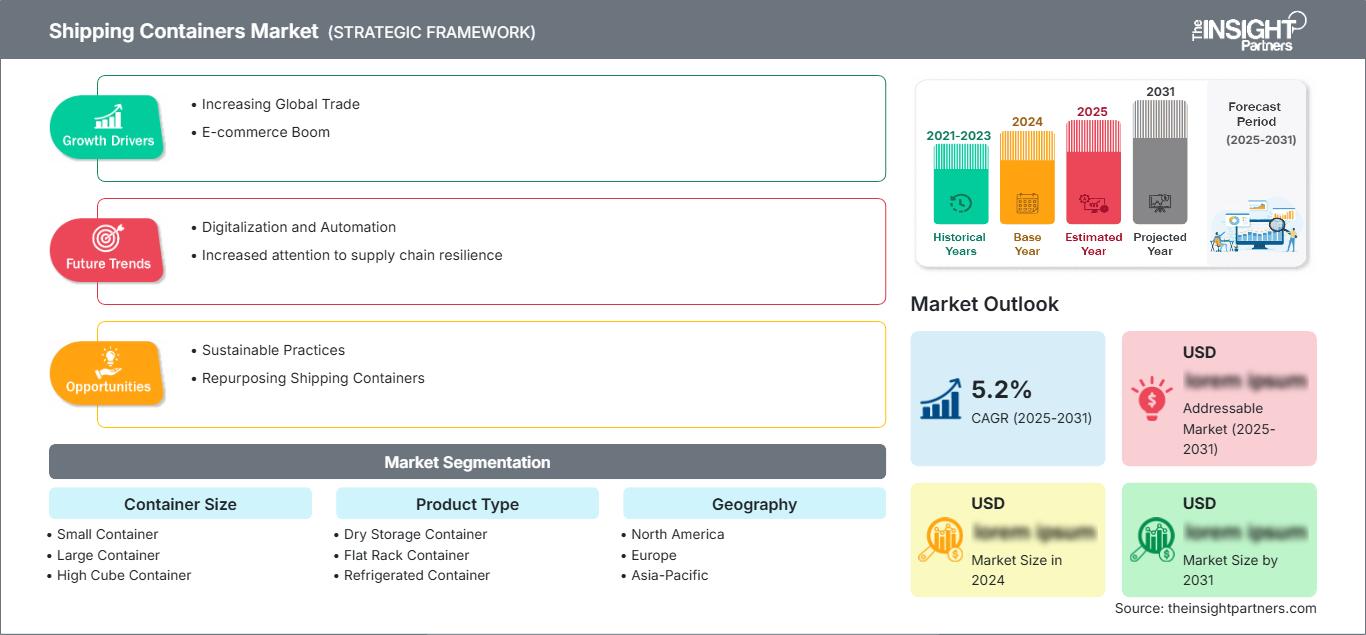
Shipping Containers Market: Strategic Insights
Regional Insights
North America Shipping Containers Market
In 2025, North America accounted for 24-27% of global revenue and is expected to grow at 2.7-3.1% CAGR till the year 2034. Shipping containers market share is sharply propelled by strong corridors of imports, intra-land rail transport, port automation, and the demand for equipment related to consumer goods, automotive components, food supply logistics, and pharmaceutical operations in the US, Canada, and Mexico.
The structural growth comes from nearshoring, expansion of intermodal terminals, and spending on cold chains that demands for availability of refrigerated containers. Replacement demand remains stable since fleet owners craft a balance between new acquisitions with repairs, refurbishing, and leasing of containers. Higher domestic freight costs lead to the popularity of standard containers which speed up logistics and effectively increase the utilization of assets in the ports, warehouses, and rail terminals.
U.S. Shipping Containers Market
The US market contributed 78-82% of the demand in North America in 2025 and is projected to undergo growth of 2.8-3.2% CAGR from the year 2025 to 2034. Demand stems from retail replenishments, e-commerce fulfillment, agricultural exports, refrigerated food deliveries, and pharmaceuticals provided to the domestic market.
Company presence can be witnessed in carrier procurement, fleet leasing, and depot services as opposed to large-scale domestic manufacturing. A.P. Møller-Mærsk A/S is able to affect reefer as well as inland logistics demand while WK Containers, Inc. and YMC Container Solutions meet the demand for customized storage, sale, and modification.
Europe Shipping Containers Market
Europe represented 20–23% share in 2025 and is projected to grow at a 2.4–2.8% CAGR during 2026–2034. Germany is the leading country, supported by export manufacturing, inland waterways, rail freight corridors, and high utilization of dry and high cube containers for machinery, chemicals, automotive components, and consumer goods.
UK makes use of port-connected warehousing as well as retail import operations, whereas France, Italy, and Spain generate additional demand due to food exports, automobile transportation and Mediterranean shipping routes. Compliance, repairability, and intermodal capability are important for European buyers. The importance of refrigerated units becomes evident given the need for better temperature control and product traceability.
APAC Shipping Containers Market
In 2025, APAC accounted for 38-42%, and the region is expected to grow at a CAGR of 3.1-3.5%. China will remain the leading nation because of its manufacturing prowess, export intensity, and steel production. Japan and South Korea facilitate specialized as well as high-grade logistics demand, whereas India and Australia add bulk because of their diversifying infrastructure and trade.
Industrial policy, port capacity expansion, and intermodal projects within the region drive demand in the region. The close proximity to port facilities and suppliers is important for container manufacturers, and easy availability and quick delivery are important considerations for logistics users. Refrigerated and high cube containers find growing applications owing to higher cargo-conditioning needs.
Middle East & Africa Shipping Containers Market
MEA is forecasted to experience growth rates of 2.9–3.3% through 2034, with the UAE leading in transshipment, logistics parks, and re-export operations within the region. Demand in Saudi Arabia comes from industrial areas and development projects, whereas South Africa acts as the center of containerized traffic in southern Africa.
Industrial equipment, construction needs, food imports, and project cargo drive equipment demand. Flat racks and specialized containers play an essential role in carrying oversized industrial equipment, whereas dry containers serve for consumer and retail movements. The rest of the MEA still faces uneven demand, but investments in ports and corridors are increasing equipment efficiency.
Segmentation Analysis
Container Size
Container Size is projected to grow at a 2.8–3.2% CAGR during 2026–2034, with the Shipping Containers Market scope shaped by route economics, cargo density, warehouse compatibility, and inland handling constraints. Large and high cube units attract demand where shippers need space efficiency, while small containers remain useful in storage, regional distribution, and constrained urban sites.
- Small Container serves urban storage, construction sites, short-haul cargo, and smaller exporters requiring flexible capacity without committing to standard high-volume units.
- Large Container remains the workhorse for international freight, offering broad compatibility across ships, railcars, trucks, depots, and automated port handling systems.
- High Cube Container gains strategic importance for lightweight, bulky goods, e-commerce inventories, automotive components, and warehouse-to-port movements requiring additional vertical capacity.
Product Type
Product Type is expected to grow at a 2.9–3.4% CAGR during 2026–2034 as cargo profiles diversify. Dry storage containers dominate general freight, while refrigerated containers expand with food and pharmaceutical logistics. Flat rack and special-purpose designs address project cargo, offshore use, hazardous goods, and non-standard payloads requiring stronger engineering and certification.
- Dry Storage Container leads demand because it handles consumer goods, textiles, machinery parts, packaged food, and industrial cargo across most international and domestic routes.
- Flat Rack Container supports heavy machinery, vehicles, pipes, and oversized equipment where open sides, reinforced floors, and loading flexibility are essential.
- Refrigerated Container is strategically important for perishable food, seafood, meat, dairy, chemicals, and medicines requiring controlled temperature throughout long-distance transport.
- Special Purpose Container addresses customized logistics for offshore, military, hazardous, energy, and modular storage applications where standard units cannot meet operational requirements.
Opportunity Snapshot
| Segment Name | Revenue Contribution | Trend Tag | Adoption Stage |
| Dry Storage Container | High | General Freight | Mature |
| Flat Rack Container | Medium | Project Cargo | Scaling |
| Refrigerated Container | Medium | Cold Chain | Scaling |
| Special Purpose Container | Low | Custom Logistics | Emerging |
Shipping Containers Market Growth Drivers and Impact Analysis
Intermodal freight networks require standardized durable assets
Standardized containers are still favored by rail, road, and maritime companies since their use makes the handling of cargo easier, protects the goods from damage, and ensures reduced time required for transferring the cargo from one transport mode to another. With automation of operations at port and inland terminal facilities, consistency of equipment becomes increasingly important. This results in consistent demand for replacement of dry and high cube containers, especially those used on long distance corridors, where increased utilization enhances cost economics.
Cold-chain trade increases reefer fleet requirements</h3>
The increasing use of perishables, seafood, meats, dairy products, specialized chemicals, and medicines that require refrigeration is enhancing the utility of refrigerated containers. There is a need for temperature controls, compatibility with power supplies, monitoring, and maintenance of refrigerated containers across all modes of transportation, such as ports, vessels, trucks, and rail terminals. This factor is creating a greater need for high-quality containers and better after-sales services. The effect goes beyond just the sale of container due to the need for coordination of storage facilities, sensors, spares, and cleaning.
Trade-route uncertainty supports buffer inventory of containers
Route interruptions, port congestion, peak seasons, and trade imbalance make it worthwhile for carriers and lessors to build flexible equipment reserves. Though overcapacity may influence lease costs, a lack of containers means lost business opportunities and higher repositioning costs. The end effect is better equipment purchasing practices with preference for versatile container equipment capable of operating on various routes and carrying various cargo types. This factor helps ensure consistent demand for standard dry storage containers as well as select use of flat racks and specialized container units for project cargoes.
Shipping Containers Market Future Trends
Digitally monitored container fleets
According to the Trends of the Shipping Containers Market, there is an increased trend of sensors, connectivity, and data platforms for monitoring location, temperature, shock, door activity, and dwell time. Digital visibility is crucial in monitoring refrigerated, pharmaceuticals, and valuable freight because of the need for prevention of claims and documentation as a factor influencing customer decision-making. In the long run, data-enabled shipping containers could contribute to maintenance management, efficient positioning, and reduction of cargo loss.
Lower-carbon materials and lifecycle management
Buyers of containers will have to analyze lifecycle emissions, ease of repairs, and the efficiency of using materials when customers demand green transportation logistics. Companies can incorporate better coating systems, efficient steel construction, use of recyclable materials, and modularity to increase lifecycle without sacrificing the strength of the product. Leasing companies will also focus on recycling and reuse instead of premature disposal of products. It will not change the reliance on steel but will influence the purchasing process through linking of sustainability and residual value.
Shipping Containers Market Opportunities
Reefer deployment in emerging food corridors
Fruit and vegetable producers, seafood and meat producers, dairy companies, and food processors require dependable reefer units for shipping their products into premium markets, which will result in minimum product damage. Producers of these products could invest in developing reefer fleets close to production centers, inland cold storage centers, and ports of entry. This is an interesting venture since cargo owners are willing to pay for dependability and temperature assurance.
Customized containers for industrial and energy projects
For industrial construction, oil rigs, battery energy, mining, and defense transportation applications, container sizes with non-standard dimensions, loads with special weight or other features such as ventilation, insulation, or lifting certificates may be required. Design, certification, and quick modification skills of specialists will allow capturing the value. Unlike general-purpose containers for commodities, these types are not so price sensitive, as there is a risk of very costly operation malfunction.
Recent Developments
- July 2026: A.P. Moller-Maersk, which is the largest integrated shipping and logistics provider in the world, set an unparalleled record in the Indian shipping industry by being the first foreign shipping line to order an EXIM container from India. The first such container was launched at the joint venture of Maersk and Container Corporation of India (CONCOR), Inland Container Depot Dadri, Uttar Pradesh, in the presence of Honourable Union Minister of Ports, Shipping and Waterways, Shri Sarbananda Sonowal.
- February 2026: Eveon Containers announce that they have expanded their North American operations to include multiple regions in Canada. A global provider of sustainable building, shipping, and storage solutions, Eveon currently has European headquarters in Rotterdam, The Netherlands. North American headquarters were established earlier this year in Charleston, SC to support the more than thirty cities in the US where containers are available. The Canadian expansion allows residents and businesses to order decommissioned containers online with an option of delivery within 250 kilometers of Calgary, AB, Montreal, QC, Toronto, ON, and Vancouver, BC.
- February 2026: COSCO Shipping Lines has launched its CPV service, strengthening trade between Asia and North America. The 261.1-meter COSCO Santos departed Yangpu International Container Terminal on January 23, carrying seafood, chemical products, and transshipment cargo from Southeast and South Asia to Seattle. The new service is the first Far East–Northwest USA/Canada route operated from Yangpu Port within the Hainan Free Trade Port. It offers direct connections to Seattle and Vancouver, with multimodal access to inland US and Canadian markets.
Frequently Asked Questions

- Comprehensive Market Sizing and Forecast Analysis
- Detailed Segmentation Analysis
- In-Depth Market Dynamics Assessment
- Regional and Country-Level Insights
- Competitive Landscape and Company Benchmarking
- Strategic Business Intelligence
Recent Reports
Testimonials

The Insight Partners' SCADA System Market report is comprehensive, with valuable insights on current trends and future forecasts. The team was highly professional, responsive, and supportive throughout. We are very satisfied and highly recommend their services.
RAN KEDEM Partner, Reali Technologies LTDs
I requested a report on a very specific software market and the team produced the report in a few days. The information was very relevant and well presented. I then requested some changes and additions to the report. The team was again very responsive and I got the final report in less than a week.
JEAN-HERVE JENN Chairman, Future Analytica
We worked with The Insight Partners for an important market study and forecast. They gave us clear insights into opportunities and risks, which helped shape our plans. Their research was easy to use and based on solid data. It helped us make smart, confident decisions. We highly recommend them.
PIYUSH NAGPAL Sr. Vice President, High Beam Global
The Insight Partners delivered insightful, well-structured market research with strong domain expertise. Their team was professional and responsive throughout. The user-friendly website made accessing industry reports seamless. We highly recommend them for reliable, high-quality research services
YUKIHIKO ADACHI CEO, Deep Blue, LLC.
This is the first time I have purchased a market report from The Insight Partners.While I was unsure at first, I visited their web site and felt more comfortable to take the risk and purchase a market report.I am completely satisfied with the quality of the report and customer service. I had several questions and comments with the initial report, but after a couple of dialogs over email with their analyst I believe I have a report that I can use as input to our strategic planning process.Thank you so much for taking the extra time and making this a positive experience.I will definitely recommend your service to others and you will be my first call when we need further market data.
JOHN SUZUKI President and Chief Executive Officer, Board Director, BK Technologies
I wish to appreciate your support and the professionalism you displayed in the course of attending to my request for information regarding to infectious disease IVD market in Nigeria. I appreciate your patience, your guidance, and the fact that you were willing to offer a discount, which eventually made it possible for us to close a deal. I look forward to engaging The Insight Partners in the future, all thanks to the impression you have created in me as a result of this first encounter.
DR CHIJIOKE ONYIA MANAGING DIRECTOR, PineCrest Healthcare Ltd.Reason to Buy
- Informed Decision-Making
- Understanding Market Dynamics
- Competitive Analysis
- Identifying Emerging Markets
- Customer Insights
- Market Forecasts
- Risk Mitigation
- Boosting Operational Efficiency
- Strategic Planning
- Investment Justification
- Tracking Industry Innovations
- Aligning with Regulatory Trends





 Get Free Sample for