
Silicon Carbide Semiconductor Market Trends, Share & Demand by 2034
Coverage: By Device (JFET, MOSFET, Diode, Module, Others); Voltage (Low Voltage, Medium Voltage, High Voltage); Industry Vertical (Telecommunications, Energy and Power, Automotive, Renewable Power Generation, Defense, Power Electronics, Others) , and Geography (North America, Europe, Asia Pacific, and South and Central America)
- Status : Data Released
- Report Code : TIPTE100000600
- Category : Electronics and Semiconductor
- No. of Pages : 150
- Available Report Formats :


- Last update date : July 21, 2026


2025 Market Size
US$ 924.9 Mn
Base year value
2034 Forecast
US$ 3,630.63 Mn
Projected by 2034
CAGR 2026-2034
16.41 %
Growth rate
Addressable Market
US$ 19,195.54 Mn
(2026-2034)
The Silicon Carbide Semiconductor Market size is expected to reach US$ 3,630.63 Million by 2034 at a CAGR of 16.41%, starting from US$ 924.9 Million in 2025. Market demand is driven by efficiency in power conversion, e-mobility applications, the penetration of renewables into energy grids, and smaller electronic architectures that utilize wider-bandgap semiconductors capable of operating at higher temperatures, voltages, and frequencies than conventional silicon semiconductors.
In North America, growth in the Silicon Carbide Semiconductor Market is driven by the adoption of EV traction inverters, grid modernization initiatives, and semiconductor manufacturing programs. In the region, the growth rate is forecast to be 15.8-17.2% through 2034, driven by the qualification of high-voltage devices, the transition to 200mm wafers, and suppliers' activities related to automotive, defense, renewable power generation, and artificial intelligence-friendly power infrastructure.
Silicon Carbide Semiconductor Market Assessment and Insights
- North America accounted for 31–34% share in 2025 and is growing at a CAGR range of 15.8–17.2% during 2026–2034, supported by EV platforms, defense electronics, and domestic wafer capacity.
- US represented 78–82% of North America in 2025 and is growing at 16.0–17.5%, driven by automotive inverter programs and power infrastructure upgrades.
- Europe held 25–28% share in 2025 and is growing at 15.2–16.8%, with Germany, France, Italy, and the UK leading automotive, industrial, and renewable power use.
- Asia Pacific captured 33–36% share in 2025 and is expanding at 16.8–18.4%, led by China, Japan, South Korea, and India across EVs, modules, and renewable systems.
- Largest Segment MOSFET held 42–46% market share in 2025 and is growing at 16.0–17.4%, reflecting traction inverter, onboard charger, and industrial drive adoption.
- High Growth Segment Module held 24–28% share in 2025 and is growing at 17.4–19.0%, supported by higher power density, thermal integration, and system-level design simplification.
- Key companies analyzed in detail: GeneSiC Semiconductor Inc., Infineon Technologies AG, Littelfuse, Inc., Microchip Technology Incorporated, Mitsubishi Electric Corporation, Renesas Electronics Corporation, ROHM Co., Ltd., STMicroelectronics N.V., Toshiba Electronic Devices & Storage Corporation, Wolfspeed, Inc.
Source: The Insight Partners' analysis based on proprietary research, government publications, company annual reports, investor presentations, industry databases, and expert interviews.
Device architectures have evolved from initial SiC diodes to MOSFETs and even full-power modules, driven by the need for reduced losses, compact coolers, and increased power density. Manufacturing dynamics have been impacted as well as suppliers are transitioning to 200 mm from 150 mm wafers, which is expected to increase the number of dies per wafer, improve learning in yields, and maintain cost structure. The qualification process still poses challenges due to extended life requirements under heat, vibration, and high-voltage conditions in automotive and energy applications.
Further growth may be anticipated as the demand for higher voltage devices extends to charging stations, utility-scale batteries, solar inverters, and military power supplies. Industrial policies promoting localization of value chain and electrification in the US, Europe, Japan, and China will drive such growth. Wafer quality, module packaging, multiple sourcing, and scaling of low-cost devices will be key in the next stage of competition.
Silicon Carbide Semiconductor Market Report Scope
| Report Attribute | Details |
|---|---|
| Market size in 2025 | US$ 924.9 Million |
| Market Size by 2034 | US$ 3,630.63 Million |
| Global CAGR (2026 - 2034) | 16.41% |
| Historical Data | 2021-2024 |
| Forecast period | 2026-2034 |
Silicon Carbide Semiconductor Market Analysis
The growth of the Silicon Carbide Semiconductor market rests on the need to reduce energy loss in electric vehicles, renewable energy conversion, industrial motor drives, and high-density power supplies. The International Energy Agency noted a growing trend in electric mobility in its Global EV Outlook 2025.
The value chain includes crystal growth, wafer slicing, epitaxy, device manufacturing, packaging into modules, and testing. Problems persist primarily in high-quality substrates and defect management, but revenue opportunities are shifting towards integrated modules that incorporate thermal management, inductance minimization, and power density. The supply chain is increasingly characterized by longer-term contracts, dual-sourcing, and local production flexibility.
The Silicon Carbide Semiconductor Market analysis suggests a shift in competitive dynamics from product availability to manufacturability, packaging compatibility, and platform design enablement. Companies like Infineon Technologies AG, ROHM Co., Ltd., STMicroelectronics N.V., Wolfspeed, Inc., and Mitsubishi Electric Corporation are focusing on products like automotive MOSFETs, modules, and vertical integration of manufacturing processes. Specialized firms like GeneSiC Semiconductor Inc. and Littelfuse, Inc. provide additional focus on discrete components and protection products.
Priorities for investment should be 200 mm wafer fabrication, packaging innovations, high-voltage modules, and design ecosystems that accelerate customer qualification. Microchip Technology Incorporated, Renesas Electronics Corporation, Toshiba Electronic Devices & Storage Corporation, and Wolfspeed, Inc. may be relevant to customers interested in diversifying their supply in defense, transportation, and industrial applications. Differentiation will become more dependent on product data on reliability, thermal, and application engineering.
● REPORT CUSTOMIZATION
Tailor This Report To Align With Your Specific Business Requirements
This report can be customized to align precisely with your business objectives, scope, and target markets. Customization options include tailored segmentation, geography, competitive analysis, and strategic insights to support informed decision-making.
Customize This Report →WHAT YOU CAN ADJUST
- ● Segmentations
- ● Geography
- ● Competitive Analysis
- ● Language Preferences
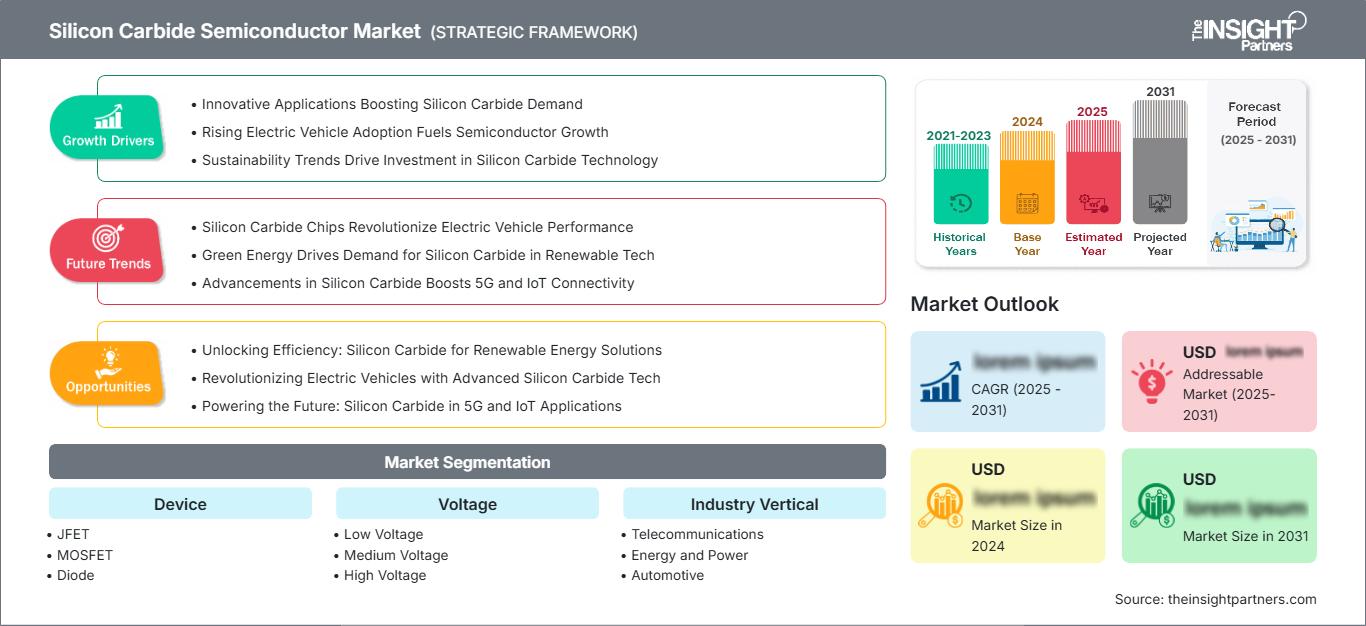
Silicon Carbide Semiconductor Market: Strategic Insights
Regional Insights
North America Silicon Carbide Semiconductor Market
North America represented 31–34% of 2025 revenue and is projected to grow at 15.8–17.2% CAGR during 2026–2034. Silicon Carbide Semiconductor Market share in the region is supported by EV inverter qualification, defense power electronics, high-reliability industrial systems, and incentives for domestic semiconductor production. The US remains the anchor market because substrate, device, and module investments are concentrated around automotive and energy customers.
There is also growing demand for power architectures for AI data centers, fast charging, and grid storage. Announcements by Wolfspeed about its plans for 2026 regarding next-generation MOSFETs and larger-wafer technology reveal the priority on performance and manufacturability in the region. Canadian use cases, although limited, include the integration of renewable energy, mining, and automation of industry operations.
U.S. Silicon Carbide Semiconductor Market
The USA comprises 78%–82% of North America and is forecast to experience 16.0%–17.5% CAGR during 2025 due to its domestic expertise in substrates, programs for electric cars, aerospace and defense applications, and investments into semiconductors. Domestic strengths include Wolfspeed, Inc., GeneSiC Semiconductor, Inc., Microchip Technology, Inc., and Littelfuse, Inc., which operate in the wafer, discrete, module, and protection segments, respectively.
Application demand is highest for traction inverters, onboard chargers, DC fast chargers, solid-state circuit protection, and data center power supplies. Increasingly, US customers consider factors such as supplier reliability, packaging options, and product continuity when evaluating suppliers.
Europe Silicon Carbide Semiconductor Market
In 2025, Europe had a market share of 25-28%, which is forecast to grow at a 15.2-16.8% CAGR. Germany takes the lead owing to its premium EV platform, industrial drives, and power module development. The UK participates via compound semiconductors and defense electronics. On the other hand, France takes advantage of automotive supply chains and grid modernization programs, making power conversion efficient.
Italy plays a significant role because STMicroelectronics N.V. is developing vertically integrated SiC technology. Spain becomes more prominent owing to renewable power generation and charging systems. Infineon Technologies AG and ROHM Co., Ltd. influence packaging, which improves second sourcing in Europe.
APAC Silicon Carbide Semiconductor Market
Asia Pacific had a 33–36% market share in 2025 and is projected to see a 16.8–18.4% CAGR. China is the largest country because of its production of EVs, renewable inverters, and wafers. Japan and South Korea contribute owing to their experience in the automotive, industrial, and materials sectors, and India and Australia – owing to their experience in the power electronics, railway, solar, and grid storage markets.
Industrial policies have been contributing to the localization of supply chains; however, quality stability still matters for automotive applications. Mitsubishi Electric Corporation, ROHM Co., Ltd., Renesas Electronics Corporation, and Toshiba Electronic Devices & Storage Corporation are major APAC-based companies. APAC market growth is connected with high-volume module packaging and fast product certification by EV and renewable energy system producers.
Middle East & Africa Silicon Carbide Semiconductor Market
The projected growth rate for the Middle East & Africa is 13.8–15.4% CAGR, with Saudi Arabia leading demand in the region through renewable energy production, infrastructure upgrades, and industrial electrification. UAE is encouraging its adoption by developing data centers, intelligent infrastructure, and solar energy conversion. South Africa is important from the perspective of mining, electrification and power grid stabilization.
Lower adoption than in North America, Europe, and APAC; however, extremely high operating temperatures make the adoption of Silicon Carbide devices more technologically viable. RoMEA adoption opportunities are limited to renewable power generation facilities, oil and gas electrification, and power grid infrastructure. Success will be determined by system integrators and utility companies.
Segmentation Analysis
Device
Device is projected to grow at 16.2–17.8% CAGR during 2026–2034 as designers select SiC according to switching speed, voltage stress, thermal load, and packaging requirements. The Silicon Carbide Semiconductor Market scope is broadening from discrete diodes toward MOSFETs and modules, while JFETs remain relevant for specialized high-reliability and normally-on circuit designs.
- JFET devices serve niche high-temperature and low-loss switching applications where ruggedness, fast response, and specific circuit topology advantages justify adoption in industrial, defense, and specialized power systems.
- MOSFET devices dominate demand because they support traction inverters, onboard chargers, fast chargers, and industrial drives requiring high efficiency, compact thermal design, and lower switching losses.
- Diode products remain strategically important in power factor correction, solar inverters, and auxiliary power systems, offering fast recovery, low reverse losses, and reliability under high-voltage operating conditions.
- Module solutions integrate multiple SiC devices with optimized thermal paths and low-inductance packaging, reducing design complexity for EV drivetrains, renewable power conversion, rail, and high-power industrial equipment.
Voltage
Voltage is projected to grow at 15.9–17.3% CAGR during 2026–2034 as adoption shifts toward medium- and high-voltage platforms. Low-voltage uses remain relevant in auxiliary converters, but medium-voltage demand is expanding with 800 V EV architectures, while high-voltage devices support grid equipment, rail traction, renewable power, and defense systems.
- Low Voltage devices are used in compact converters, auxiliary power, and embedded industrial electronics where efficiency gains, heat reduction, and smaller passive components improve system-level economics.
- Medium Voltage devices are central to EV traction inverters, onboard chargers, solar inverters, and industrial drives, balancing manufacturability, cost, and performance across high-volume applications.
- High Voltage devices address grid conversion, rail, aerospace, defense, and high-power renewable systems, where insulation design, thermal reliability, and long operating life are decisive procurement factors.
Industry Vertical
Industry Vertical is projected to grow at 16.1–17.6% CAGR during 2026–2034 because SiC value differs by system economics. Automotive remains the largest pull through inverter efficiency, while renewable power, telecommunications, defense, and industrial power electronics increasingly require compact, thermally resilient, and high-frequency conversion platforms.
- Telecommunications demand is tied to efficient power supplies for 5G infrastructure, edge computing, and network backup systems where compact conversion and thermal efficiency lower operating costs.
- Energy and Power applications include grid converters, storage interfaces, and industrial distribution equipment where high-voltage switching, reduced losses, and reliability support modernization programs.
- Automotive remains central as EV traction inverters, onboard chargers, and DC-DC converters use SiC to extend range, reduce cooling needs, and enable faster charging.
- Renewable Power Generation relies on SiC in solar and wind conversion systems to improve inverter efficiency, reduce heat, and increase power density in utility and distributed assets.
- Defense adoption reflects demand for rugged power electronics in radar, aerospace platforms, directed-energy support systems, and electrified mobility where reliability under harsh conditions is essential.
- Power Electronics covers industrial drives, power supplies, UPS systems, and data center conversion platforms where high switching frequency and compact packaging support energy efficiency.
Opportunity Snapshot
| Industry Vertical | Revenue Contribution | Trend Tag | Adoption Stage |
| Telecommunications | Medium | 5G Power | Scaling |
| Energy and Power | High | Grid Storage | Scaling |
| Automotive | High | 800V EVs | Mature |
| Renewable Power Generation | High | Solar Inverters | Scaling |
| Defense | Medium | Rugged Power | Emerging |
| Power Electronics | High | Data Centers | Scaling |
Silicon Carbide Semiconductor Market Growth Drivers and Impact Analysis
EV Platform Shift Toward Higher Voltage Architectures
The higher voltage platforms for electric vehicles are fostering a demand that is robust because silicon carbide MOSFETs are able to cut down switching losses, allow for smaller cooling systems, and offer quick charging. The automakers who have chosen to develop platforms with an 800 volts architecture need power devices that will be efficient when exposed to high heat and electrical load. It creates a trend towards platform rather than product purchases, which implies qualifying suppliers years in advance, prior to launching vehicles.
Renewable Integration and Grid Modernization
Solar inverters, storage converters, solid-state transformers, and grid-interactive systems will demand higher efficiency switching as renewable generation increases and power flow becomes more uncertain. SiC-based solutions can reduce energy losses at the conversion stage, improve thermal performance, and enable smaller enclosures in energy-generation assets. Both utilities and energy developers appreciate such an approach as efficiency improvements multiply in highly utilized equipment. Such an effect takes place in locations where network improvements, renewable generation goals, and storage acquisitions coincide, presenting an opportunity for module makers to qualify and help integrators design solutions.
Manufacturing Scale and Wafer Diameter Transition
The move toward 200 mm SiC production is a structural driver because larger wafers can improve die output and create a pathway to lower unit costs when yields mature. The transition is technically difficult due to crystal defects, epitaxy uniformity, and process control requirements, but successful scale-up can change supplier economics. Customers benefit from better availability and more predictable pricing, while manufacturers gain leverage through automation and capacity utilization. This driver favors vertically integrated companies and disciplined specialists with proven materials expertise.
Silicon Carbide Semiconductor Market Future Trends
AI Data Center Power Conversion Becomes a New Demand Layer
Silicon Carbide Semiconductor Market trends are likely to include broader adoption in AI data center power architectures as operators pursue higher rack densities and lower conversion losses. Migration toward higher-voltage distribution inside facilities can improve efficiency, but it requires compact, thermally stable power devices. SiC suppliers that adapt modules for server power, UPS systems, and solid-state protection could diversify beyond cyclical EV demand. This trend may also accelerate collaboration between semiconductor firms, power supply manufacturers, and hyperscale infrastructure providers.
Package Standardization and Second-Source Compatibility
Package compatibility is becoming a future differentiator as customers seek flexibility without redesigning boards, cooling systems, or qualification plans. Standardized top-side cooling, low-inductance layouts, and interoperable footprints can reduce engineering risk and shorten procurement decisions. The direction is visible in supplier collaborations that allow compatible packages across selected SiC devices. Over time, customers may reward companies that combine proprietary device performance with practical interchangeability, especially in automotive, renewable, and industrial programs where redesign costs are substantial.
Silicon Carbide Semiconductor Market Opportunities
Localized Supply Chains for Strategic Power Electronics
Governments and OEMs are prioritizing resilient supply for semiconductors used in mobility, defense, energy, and critical infrastructure. This creates an opportunity for suppliers to invest in regional wafering, epitaxy, device fabrication, or module assembly while aligning with customer localization requirements. The most attractive projects will combine policy support with committed demand from automotive and energy customers. Companies that demonstrate qualified local output, transparent cost roadmaps, and secure sourcing of substrates can strengthen negotiating power and reduce exposure to trade friction.
High-Power Modules for Renewable and Industrial Systems
High-power modules offer investment potential because they solve system-level challenges that discrete devices cannot address alone. Renewable inverters, storage converters, industrial drives, rail systems, and heavy-duty charging equipment need thermal management, low inductance, and reliable operation under continuous load. Suppliers can capture value by offering validated module platforms, gate-driver support, and reference designs that reduce customer engineering effort. The opportunity is strongest where equipment makers face efficiency standards, space constraints, and rising demand for higher-voltage conversion.
Recent Developments
- July 2026: Bosch has started sample production of silicon carbide (SiC) semiconductor chips at its Roseville, California, facility, marking a key step toward bringing advanced power chip manufacturing back to the United States. The company also secured up to US$ 225 million in direct funding from the U.S. Department of Commerce’s CHIPS Program Office to support its planned investment of up to US$ 2 billion at the site.
- June 2026: Infineon Technologies AG introduces silicon carbide (SiC) bidirectional switches (BDS) built on rugged 750 V CoolSiC G2 technology. A vertically integrated dual-die with common drain design in a top-side-cooled Q-DPAK package integrates two power switches into one for simplifying design and enable revolution of legacy topologies. The 750V CoolSiC BDS delivers reliability margin what modern grids and energy systems demand resulting lowest Total Cost of Ownership during the application lifetime.
- December 2025: Toyota’s new RAV4, launched in Japan marks the first use of SiC power semiconductors in a Toyota hybrid system. The previous-generation-RAV4 was the world’s best-selling passenger vehicle in 2024 in terms of new car sales volume. The installation of silicon carbide (SiC) power semiconductors in hybrid vehicles—considered a real solution for electric vehicles by balancing environmental impact and economic efficiency—as well as in high-volume, popular models is expected to make 2026 an inflection point for the rapid adoption of SiC power semiconductors.
Frequently Asked Questions

- Comprehensive Market Sizing and Forecast Analysis
- Detailed Segmentation Analysis
- In-Depth Market Dynamics Assessment
- Regional and Country-Level Insights
- Competitive Landscape and Company Benchmarking
- Strategic Business Intelligence
Recent Reports
Testimonials

The Insight Partners provided valuable market intelligence that supported our global go-to-market strategy. Their team was professional, responsive, and attentive to our feedback, providing thoughtful analysis and helpful methodological clarifications throughout the project.
Junmo Kim Chief Financial Officer (CFO), Enertech Co., Ltd.
The Insight Partners' SCADA System Market report is comprehensive, with valuable insights on current trends and future forecasts. The team was highly professional, responsive, and supportive throughout. We are very satisfied and highly recommend their services.
RAN KEDEM Partner, Reali Technologies LTDs
I requested a report on a very specific software market and the team produced the report in a few days. The information was very relevant and well presented. I then requested some changes and additions to the report. The team was again very responsive and I got the final report in less than a week.
JEAN-HERVE JENN Chairman, Future Analytica
We worked with The Insight Partners for an important market study and forecast. They gave us clear insights into opportunities and risks, which helped shape our plans. Their research was easy to use and based on solid data. It helped us make smart, confident decisions. We highly recommend them.
PIYUSH NAGPAL Sr. Vice President, High Beam Global
The Insight Partners delivered insightful, well-structured market research with strong domain expertise. Their team was professional and responsive throughout. The user-friendly website made accessing industry reports seamless. We highly recommend them for reliable, high-quality research services
YUKIHIKO ADACHI CEO, Deep Blue, LLC.
This is the first time I have purchased a market report from The Insight Partners.While I was unsure at first, I visited their web site and felt more comfortable to take the risk and purchase a market report.I am completely satisfied with the quality of the report and customer service. I had several questions and comments with the initial report, but after a couple of dialogs over email with their analyst I believe I have a report that I can use as input to our strategic planning process.Thank you so much for taking the extra time and making this a positive experience.I will definitely recommend your service to others and you will be my first call when we need further market data.
JOHN SUZUKI President and Chief Executive Officer, Board Director, BK Technologies
I wish to appreciate your support and the professionalism you displayed in the course of attending to my request for information regarding to infectious disease IVD market in Nigeria. I appreciate your patience, your guidance, and the fact that you were willing to offer a discount, which eventually made it possible for us to close a deal. I look forward to engaging The Insight Partners in the future, all thanks to the impression you have created in me as a result of this first encounter.
DR CHIJIOKE ONYIA MANAGING DIRECTOR, PineCrest Healthcare Ltd.Reason to Buy
- Informed Decision-Making
- Understanding Market Dynamics
- Competitive Analysis
- Identifying Emerging Markets
- Customer Insights
- Market Forecasts
- Risk Mitigation
- Boosting Operational Efficiency
- Strategic Planning
- Investment Justification
- Tracking Industry Innovations
- Aligning with Regulatory Trends





 Get Free Sample for