
Slag Handling Equipment Market Size, Growth & Demand by 2034
Coverage: by Application (Steel Slag Handling, Iron Slag Handling, Furnace Slag Handling); Industry (Building and Construction, Railways, Mining, Manufacturing, Agriculture, Others) , and Geography (North America, Europe, Asia Pacific, and South and Central America)
- Status : Data Released
- Report Code : TIPRE00010151
- Category : Manufacturing and Construction
- No. of Pages : 150
- Available Report Formats :


- Last update date : July 24, 2026


2025 Market Size
US$ 3.44 Bn
Base year value
2034 Forecast
US$ 6.1 Bn
Projected by 2034
CAGR 2026-2034
6.60 %
Growth rate
Addressable Market
US$ 43.20 Bn
(2026-2034)
The Slag Handling Equipment Market is projected to expand from US$ 3.44 Billion in 2025 to US$ 6.1 Billion by 2034, registering a CAGR of 6.60% during 2026–2034. Demand is tied to steelmaking intensity, slag valorization, and safer hot-material movement across integrated mills. The market also reflects rising adoption of automated cranes, conveyors, crushers, metal recovery systems, and cooling solutions that reduce manual exposure in high-temperature operating zones.
North America is expected to record a 5.8–6.4% CAGR as mills modernize melt shops, improve slag recovery, and comply with environmental handling standards. The Slag Handling Equipment Market size in the region is supported by electric arc furnace investment, infrastructure-linked steel demand, and increased use of processed slag in construction materials, rail ballast, and industrial aggregate applications.
Slag Handling Equipment Market Assessment and Insights
- North America held 26–29% share in 2025 and is projected to grow at a CAGR of 5.8–6.4% between 2026–2034, supported by EAF capacity additions and mature recycling practices.
- US accounted for 72–76% of North America in 2025 and is likely to grow at a CAGR of 5.9–6.5% between 2026–2034, driven by mill modernization.
- Europe represented 22–25% share in 2025 and is expected to grow at a CAGR of 5.2–5.8% between 2026–2034, led by Germany, the UK, France, Italy, and Spain.
- Asia Pacific held 36–39% share in 2025 and is forecast to grow at a CAGR of 7.1–7.8% between 2026–2034, led by China, India, Japan, and South Korea.
- Largest Segment Steel Slag Handling captured 48–52% market share in 2025 and is projected to grow at a CAGR of 6.2–6.8% between 2026–2034.
- High Growth Segment Building and Construction held 34–38% market share in 2025 and is expected to grow at a CAGR of 7.0–7.6% between 2026–2034.
- Key companies analyzed in detail: AFEX Fire Suppression Systems, LLC; ALTA, a.s.; American Crane & Equipment Corporation; BHS-Sonthofen GmbH; Henan Dongqi Machinery Co., Ltd.; Enviri Corporation; HORN & CO. GROUP; Kompass International SA; Konecranes Plc; Larsen & Toubro Limited.
Source: The Insight Partners' analysis based on proprietary research, government publications, company annual reports, investor presentations, industry databases, and expert interviews.
The technological development of slag processing has expanded from mere collecting and conveying into cooling, crushing, recovering, sorting, and distributing slag for recycling. Automatic ladle handling, remote crane handling, magnetic separation, and wet milling have been contributing to faster processing while increasing metal yields. According to data provided by the World Steel Association, material efficiency reached 98.15% in 2023 for steel industry raw materials and co-products. This confirms the economic sense of efficient slag recycling.
Future demand may be expected in India, Southeast Asia, the Middle East, and selected steel regions of North America, which would overlap with increased capacity and regulations on waste-to-resource conversions. Funding is moving to plants capable of processing hot slag safely and converting slag into raw materials for roads, cement, rail, and soil conditioners. The OECD has noted differing regional steel demands, which are greater in ASEAN and MENA than in mature economies.
Slag Handling Equipment Market Report Scope
| Report Attribute | Details |
|---|---|
| Market size in 2025 | US$ 3.44 Billion |
| Market Size by 2034 | US$ 6.1 Billion |
| Global CAGR (2026 - 2034) | 6.60% |
| Historical Data | 2021-2024 |
| Forecast period | 2026-2034 |
Slag Handling Equipment Market Analysis
Slag Handling Equipment Market growth is supported by steel output, downstream construction demand, and stricter operating discipline around molten waste. Reliable systems for transfers, pots, cooling, and crushing of slag are required by integrated producers since slag is constantly generated in iron, steel, and furnace processing. Manufacturers are also benefiting from the shift from the landfill to the recovery process, where residual metal is extracted and calibrated aggregate is produced.
Supply fundamentals continue to be determined by the capacity of heavy fabrications, availability of wear-resistant materials, and availability of services close to steel plants. Lifecycle cost, heat resistance, automation ability, and downtime have become more important than equipment price in buying decisions. The above requirements favor companies that provide cranes, shredders, conveyor systems, filtration and fire suppression systems in harsh conditions.
Competitive positioning in the Slag Handling Equipment Market analysis is shifting toward integrated process ownership. Enviri Corporation works through Harsco Environmental on long-term slag treatment agreements. At the same time, Konecranes Plc focuses on durable lifting and the digitization of its services. BHS-Sonthofen GmbH assists in crushing and recycling activities, while American Crane & Equipment Corporation provides solutions in customized overhead material handling for steelmaking sites.
The investment trend is geared toward the addition of modules instead of complete plant replacement when both blast furnaces and EAFs are in operation. The competitive factors include project engineering, safety, regionality, and equipment integration offered by Larsen & Toubro Limited, ALTA, a.s., HORN & CO. GROUP, Henan Dongqi Machinery Co., Ltd., AFEX Fire Suppression Systems, LLC, and Kompass International SA.
● REPORT CUSTOMIZATION
Tailor This Report To Align With Your Specific Business Requirements
This report can be customized to align precisely with your business objectives, scope, and target markets. Customization options include tailored segmentation, geography, competitive analysis, and strategic insights to support informed decision-making.
Customize This Report →WHAT YOU CAN ADJUST
- ● Segmentations
- ● Geography
- ● Competitive Analysis
- ● Language Preferences
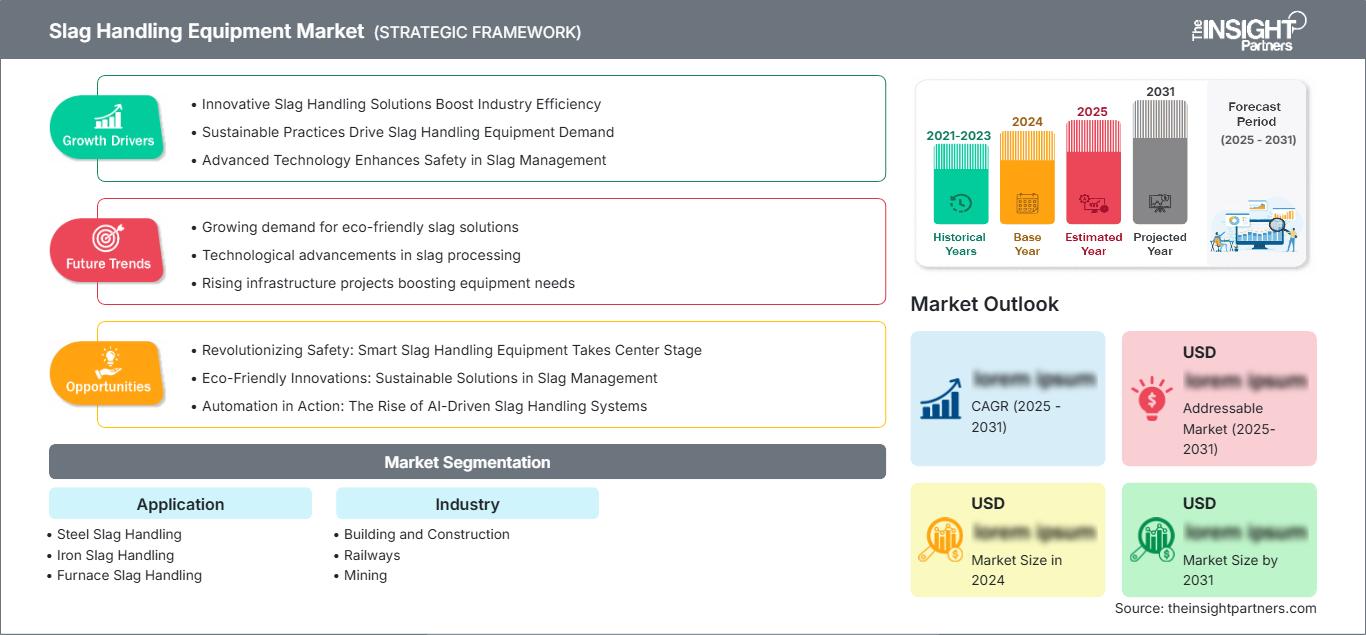
Slag Handling Equipment Market: Strategic Insights
Regional Insights
North America Slag Handling Equipment Market
North America held 26–29% share in 2025 and is projected to grow at a CAGR of 5.8–6.4% through 2034. The Slag Handling Equipment Market share in the region is anchored by electric arc furnace steelmaking, scrap-based production, and the need for high-reliability slag pot carriers, cranes, and cooling systems.
Structural demand comes from steel-intensive construction, rail upgrades, reshoring of manufacturing, and tighter waste management controls. U.S. and Canadian mills are prioritizing automation that limits worker exposure near molten material. Processed slag use in aggregates and cement substitutes further improves the investment case for recovery equipment.
U.S. Slag Handling Equipment Market
The U.S. represented 72–76% of North America in 2025 and is forecast to grow at a CAGR of 5.9–6.5% between 2026–2034. The demand is centered on the flat steel, long steel, foundry operations, and modernizations requiring safe transportation of hot slag and reliable cranes.
The companies are widespread, such as American Crane & Equipment Corporation, dealing with customized lifting equipment, Konecranes Plc, providing industrial cranes, and Enviri Corporation, offering slag services. The application trends revolve around the handling of steel slag for metals extraction, railroad aggregates, construction fill, and controlled cooling applications.
Europe Slag Handling Equipment Market
Europe accounted for 22–25% share in 2025 and is expected to grow at a CAGR of 5.2–5.8% through 2034. Germany remains the leading country because of its steelmaking scale, advanced recycling infrastructure, and engineering depth. Decarbonization programs are increasing scrutiny of by-product utilization and material circularity.
The UK benefits from steel plant restructuring and infrastructure renewal, creating demand for equipment that lowers handling risk while improving slag grading. Germany emphasizes automated lifting, dust control, and recovery economics around integrated and EAF mills. France, Italy, and Spain are advancing circular construction materials, with processed slag supporting cement, road base, and industrial aggregate substitution.
APAC Slag Handling Equipment Market
APAC held 36–39% share in 2025 and is projected to grow at a CAGR of 7.1–7.8% through 2034, the fastest regional pace. China remains the leading country due to its steel output scale, while India is increasing its investment in stainless and carbon steel capacity.
Japan and South Korea emphasize automation, plant reliability, and high recovery yields, whereas Australia links demand to mining, rail, and industrial aggregate use. Policy support for infrastructure, resource efficiency, and lower landfill dependence strengthens equipment procurement across mills and recycling-oriented slag processors.
Middle East & Africa Slag Handling Equipment Market
The Middle East & Africa is forecast to grow at a CAGR of 6.0–6.7% through 2034, with Saudi Arabia leading regional demand. Steel capacity linked to energy, construction, ports, and industrial diversification is raising requirements for furnace slag handling, cooling, and downstream material reuse.
The UAE is expanding infrastructure-linked steel consumption, South Africa maintains demand from mining and manufacturing, and the rest of MEA is developing smaller processing clusters. Equipment investment is strongest where energy projects, rail corridors, and industrial zones create repeatable slag generation and aggregate outlets.
Segmentation Analysis
Application
Application is projected to grow at a CAGR of 6.3–6.9% between 2026–2034 as producers prioritize reliable handling across steel slag, iron slag, and furnace slag streams. The Slag Handling Equipment Market scope within application categories is widening because each slag type requires different cooling, crushing, lifting, and recovery configurations to manage temperature, chemistry, and downstream reuse quality.
- Steel Slag Handling remains the largest application, supported by high slag volumes from carbon and stainless steel production, metal recovery potential, and established reuse in roads, cement, rail ballast, and industrial fill.
- Iron Slag Handling serves blast furnace and pig iron operations where cooling, granulation, and controlled transport are critical to producing reusable material for cementitious applications and reducing open-yard storage pressure.
- Furnace Slag Handling is strategically important in foundry, alloy, and specialty furnace settings, where smaller but frequent slag streams require compact equipment, safety controls, and flexible recovery layouts.
Industry
Industry is expected to grow at a CAGR of 6.5–7.2% between 2026–2034, led by building and construction, railways, mining, manufacturing, and agriculture. Adoption is linked to the ability of processed slag to substitute natural aggregates, improve circular material flows, and support operational safety in industries exposed to abrasive, dense, and high-temperature residues, reflecting the Slag Handling Equipment Market forecast.
- Building and Construction leads demand because processed slag supports road base, asphalt, cement, concrete, and embankment applications while lowering dependence on virgin aggregates and improving project-level sustainability metrics.
- Railways use selected slag aggregates in ballast and civil works where durability, angularity, and availability matter, creating demand for screening, crushing, and quality-controlled processing systems.
- Mining requires robust handling equipment for abrasive residues and heavy material flows, with slag processing technologies often adapted for metal recovery, crushing, and site-level waste minimization.
- Manufacturing demand arises from foundries, metal processing units, and industrial plants that require compact, safe, and reliable slag transfer systems to reduce downtime and workplace exposure.
- Agriculture is an emerging outlet where processed slag can support soil conditioning and liming applications, provided chemistry, particle size, and regulatory compliance are consistently managed.
Opportunity Snapshot
| Application | Revenue Contribution | Trend Tag | Adoption Stage |
|---|---|---|---|
| Steel Slag Handling | High | Metal Recovery | Mature |
| Iron Slag Handling | Medium | Cement Feed | Scaling |
| Furnace Slag Handling | Medium | Compact Systems | Emerging |
Slag Handling Equipment Market Growth Drivers and Impact Analysis
Steel Capacity Modernization and Hot-Material Safety
Steelmakers are replacing manual or semi-mechanized slag movement with automated cranes, slag pot carriers, protected control cabins, and remote monitoring because safety expectations around molten material are rising. The impact is visible in procurement criteria that now emphasize operator separation, emergency response, predictable maintenance, and high-temperature reliability. Worldsteel reported a steel industry lost-time injury frequency rate of 0.70 injuries per million hours in 2024, highlighting the sector’s focus on safer operations. For Slag Handling Equipment Market participants, this creates demand for engineered systems that reduce exposure while maintaining melt-shop throughput.
Circular Economy Demand for Processed Slag
The use of slag is becoming more recognized as a co-product than waste for disposal in cases where agencies responsible for roads, production of cement, and rail construction take in the processed slag. More equipment is required where processing plants can make money out of recovered metals and aggregate instead of setting aside resources to stockpile slag. Worldsteel material efficiency performance indicator, standing at 98.15% as of 2023 is an indication of how steelmakers have managed to make a co-product out of raw materials.
Infrastructure Spending and Aggregate Substitution
Construction of public infrastructure and industrial projects will continue to provide a need for aggregates that are both durable and cost-effective. Slag processed with proper quality assurance will be suitable for use as road base, asphalt, rail ballast, cement production, and embankments. This makes it economically viable to have equipment that processes different kinds of slag into construction material. This trend will be particularly significant in Asia Pacific, North America, and the Middle East, where steel plants are situated along infrastructure corridors. The potential for equipment manufacturers is in slag processing, combined with grading and dispatching facilities.
Slag Handling Equipment Market Future Trends
Digital Slag Yards and Predictive Maintenance
Slag Handling Equipment Market trends will increasingly center on digital yard control, sensor-enabled cranes, temperature monitoring, and predictive maintenance for high-wear assets. Operators will use equipment data to schedule pot relining, bearing replacement, conveyor inspection, and crusher maintenance before failures interrupt melt-shop operations. Digitalization will also improve traceability from hot slag generation to aggregate dispatch, supporting customer assurance in construction and rail applications. As steel plants integrate material flow platforms, vendors with control software, service analytics, and automation expertise will gain stronger lifecycle relationships than suppliers focused only on standalone hardware.
Low-Carbon Construction Material Integration
Future demand will depend on the relationship between slag processing and low-carbon building procurement. Government agencies and project sponsors are beginning to evaluate embodied carbon, recyclability, and natural aggregates conservation in their infrastructure procurement processes. As a result, steel manufacturers will have an incentive to invest in machinery that produces consistently standardized slag products and not simply waste heaps. The process will require better cooling technology, contamination separation, and documentation. The trend is in favor of collaboration between mills, machinery companies, road authorities, cement manufacturers, and test laboratories capable of turning industrial waste into construction material.
Slag Handling Equipment Market Opportunities
Integrated Recovery Plants for Emerging Steel Hubs
Emerging steel hubs in India, Southeast Asia, and the Middle East offer investment potential for integrated slag recovery plants that combine hot handling, wet milling, magnetic separation, crushing, and classified storage. Slag Handling Equipment Market opportunities are strongest where new steel capacity is being planned with circularity requirements from the outset. Investors can reduce execution risk by bundling equipment supply, operations support, and off-take partnerships with cement, road, and rail users. This model also improves bankability because revenue comes from both steel service contracts and recovered material sales.
Retrofit Packages for Aging Mills
Many mature steel plants operate legacy slag yards with fragmented cranes, conveyors, loaders, and manual inspection practices. Retrofit packages create a practical route to improve safety, metal recovery, dust control, and uptime without replacing the entire melt-shop layout. Vendors can target modular cranes, automated pot tracking, upgraded crushers, fire suppression, and maintenance analytics. The strongest business case will come from payback calculations tied to recovered metal, reduced disposal costs, fewer unplanned stoppages, and improved compliance. This opportunity is particularly relevant across North America and Europe, where brownfield assets remain central to steel supply.
Recent Developments
- April 2026: In a major breakthrough for Russia's steel industry, a high-performance slag pot carrier has successfully passed strict acceptance tests at a leading Russian steel mill on April 2, 2026. This achievement not only addresses the long-standing challenges of slag handling in the region's harsh operating environments but also sets a new benchmark for efficiency and safety in the global steel sector.
- March 2024: A set of MODULAR STEEL SLAG PROCESSING EQUIPMENT developed and manufactured by DSMAC was arranged to be sent to the United Arab Emirates for delivery. As a new business field of our company, the steel slag processing solution solves the problem of metal recycling and purification and improves the utilization rate of resources. The modular equipment also saves the investment cost for customers, which has been welcomed by many overseas customers once it is launched.
- September 2023: Volvo Construction Equipment (Volvo CE) has launched a new slag handling bucket intended for use with vehicles such as wheel loaders. It has designed the slag bucket specifically for this application, unlike previously, where a rock bucket was used as the base for its steel mill buckets.
Frequently Asked Questions

- Comprehensive Market Sizing and Forecast Analysis
- Detailed Segmentation Analysis
- In-Depth Market Dynamics Assessment
- Regional and Country-Level Insights
- Competitive Landscape and Company Benchmarking
- Strategic Business Intelligence
Recent Reports
Testimonials

The Insight Partners provided valuable market intelligence that supported our global go-to-market strategy. Their team was professional, responsive, and attentive to our feedback, providing thoughtful analysis and helpful methodological clarifications throughout the project.
Junmo Kim Chief Financial Officer (CFO), Enertech Co., Ltd.
The Insight Partners' SCADA System Market report is comprehensive, with valuable insights on current trends and future forecasts. The team was highly professional, responsive, and supportive throughout. We are very satisfied and highly recommend their services.
RAN KEDEM Partner, Reali Technologies LTDs
I requested a report on a very specific software market and the team produced the report in a few days. The information was very relevant and well presented. I then requested some changes and additions to the report. The team was again very responsive and I got the final report in less than a week.
JEAN-HERVE JENN Chairman, Future Analytica
We worked with The Insight Partners for an important market study and forecast. They gave us clear insights into opportunities and risks, which helped shape our plans. Their research was easy to use and based on solid data. It helped us make smart, confident decisions. We highly recommend them.
PIYUSH NAGPAL Sr. Vice President, High Beam Global
The Insight Partners delivered insightful, well-structured market research with strong domain expertise. Their team was professional and responsive throughout. The user-friendly website made accessing industry reports seamless. We highly recommend them for reliable, high-quality research services
YUKIHIKO ADACHI CEO, Deep Blue, LLC.
This is the first time I have purchased a market report from The Insight Partners.While I was unsure at first, I visited their web site and felt more comfortable to take the risk and purchase a market report.I am completely satisfied with the quality of the report and customer service. I had several questions and comments with the initial report, but after a couple of dialogs over email with their analyst I believe I have a report that I can use as input to our strategic planning process.Thank you so much for taking the extra time and making this a positive experience.I will definitely recommend your service to others and you will be my first call when we need further market data.
JOHN SUZUKI President and Chief Executive Officer, Board Director, BK Technologies
I wish to appreciate your support and the professionalism you displayed in the course of attending to my request for information regarding to infectious disease IVD market in Nigeria. I appreciate your patience, your guidance, and the fact that you were willing to offer a discount, which eventually made it possible for us to close a deal. I look forward to engaging The Insight Partners in the future, all thanks to the impression you have created in me as a result of this first encounter.
DR CHIJIOKE ONYIA MANAGING DIRECTOR, PineCrest Healthcare Ltd.Reason to Buy
- Informed Decision-Making
- Understanding Market Dynamics
- Competitive Analysis
- Identifying Emerging Markets
- Customer Insights
- Market Forecasts
- Risk Mitigation
- Boosting Operational Efficiency
- Strategic Planning
- Investment Justification
- Tracking Industry Innovations
- Aligning with Regulatory Trends





 Get Free Sample for