
Smart Beacon Market Trends, Size & Forecast by 2034
Coverage: By Offering (Hardware, Software, Services); Connectivity Type (Bluetooth Low Energy (BLE), Hybrid); Beacon Standard (IBeacon, Eddystone, Others); End-use (Retail, Transportation and Logistics, Public Gathering and Spaces, Sports, Automotive, Others), and Geography (North America, Europe, Asia Pacific, and South and Central America)
- Status : Data Released
- Report Code : TIPRE00015378
- Category : Electronics and Semiconductor
- No. of Pages : 150
- Available Report Formats :


- Last update date : July 31, 2026


2025 Market Size
US$ 963.64 Mn
Base year value
2034 Forecast
US$ 4,768.85 Mn
Projected by 2034
CAGR 2026-2034
19.44 %
Growth rate
Addressable Market
US$ 23,369.17 Mn
(2026-2034)
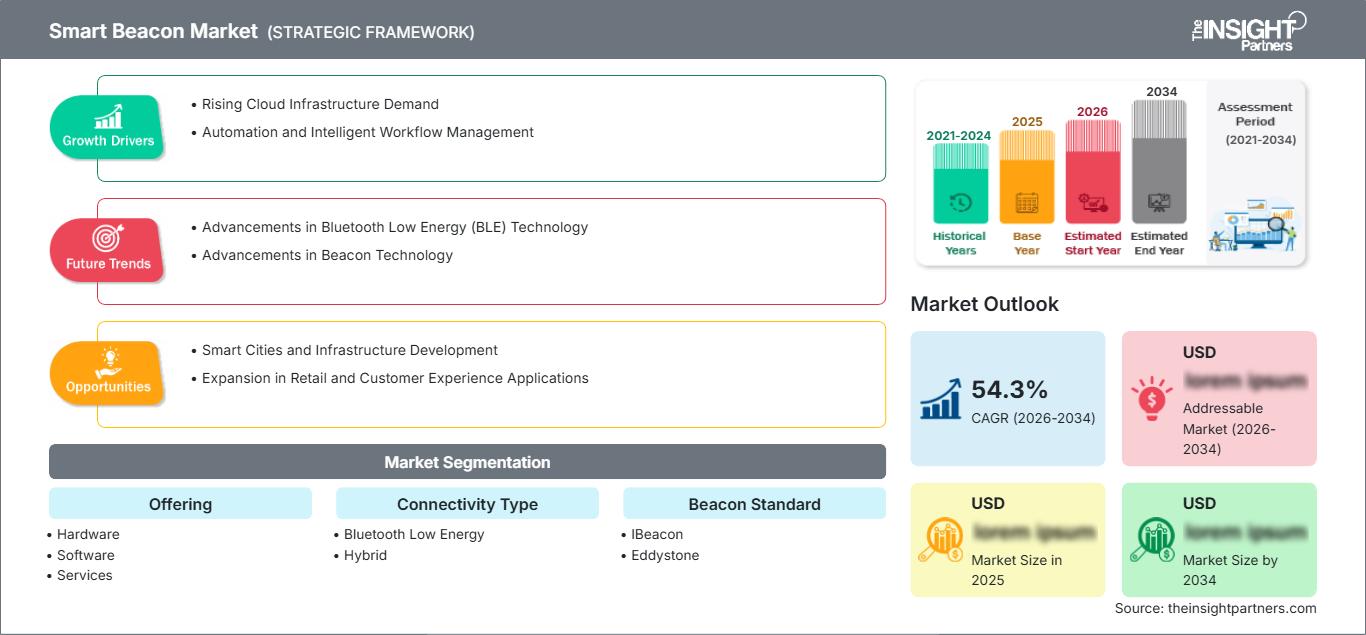
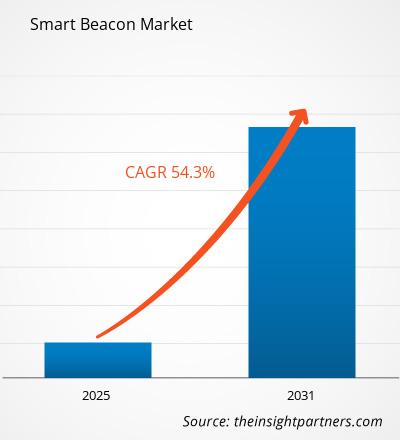
The Smart Beacon Market Size is expected to grow from US$ 963.64 Million in 2025 to US$ 4,768.85 Million by 2034, growing at a CAGR of 19.44% for the period 2026-2034. Driving factors for market growth include location-based engagement, indoor navigation, asset tracking, and real-time visibility in applications such as retail, transport, public spaces, stadiums, and automotive.
North America will be one of the key regions of demand, buoyed by a projected CAGR in the range of 18.2%–19.6% as companies link physical locations with analytical systems. The Smart Beacon Market size in North America is also backed by high penetration of smartphones, retail industry evolution through omnichannel retail, airport modernization, and adoption of Bluetooth Low Energy technology in hospitals, universities, and logistics companies.
Smart Beacon Market Assessment and Insights
- North America accounted for 34–37% share in 2025 and is expected to grow at a CAGR range of 18.2–19.6% during 2026–2034, led by retail analytics, airport wayfinding, healthcare RTLS, and enterprise campus modernization.
- US represented 78–82% of North America in 2025 and is forecast to grow at 18.4–19.8%, supported by large store networks, airports, stadiums, and hospital systems.
- Europe held 23–26% share in 2025 and is projected to grow at 17.6–18.9%, with the UK, Germany, and France leading adoption in retail, public spaces, and transportation hubs.
- Asia Pacific captured 27–30% share in 2025 and is expected to expand at 20.8–22.4%, driven by China, Japan, South Korea, India, and Australia through smart infrastructure and mobile-first services.
- Largest Segment Hardware held 48–52% market share in 2025 and is expected to grow at 17.8–19.1%, reflecting beacon device replacement, sensor integration, and enterprise-scale deployments.
- High Growth Segment Services held 18–21% market share in 2025 and is forecast to grow at 22.1–24.3%, as deployment design, integration, managed monitoring, and analytics support become more critical.
- Key companies analyzed in detail: Accent Advanced Systems, S.L.U.; Hewlett Packard Enterprise Development LP; Bluvision Inc.; Onyx Beacon; Cisco Systems, Inc.; Estimote, Inc.; Gimbal, Inc.; JAALEE Technology Co., Ltd.; Kontakt.io, Inc.; Leantegra Inc.
Source: The Insight Partners' analysis based on proprietary research, government publications, company annual reports, investor presentations, industry databases, and expert interviews.
The technological progression has taken the market from the initial trigger-based proximity models to location intelligence networks that are managed. The technology stack includes Bluetooth Low Energy at its base with iBeacon and Eddystone being interoperable standards in mobile OS and enterprise software. New production trends involve higher battery capacity, better firmware security, sensors-loaded devices and gateway compatibility. Increasingly more vendors start to provide hardware with cloud-based dashboards, APIs, and analytics services to simplify deployments.
The forecast period will see growing applications in high-density public places, logistic routes, hospitals, airports, and smart retailing. Factors influencing the investments in beacons are smart city projects, digital identities solutions, analytics by design concept, and mobile applications ecosystem. Developing countries will apply the beacons in the sphere of transport infrastructure development and venue management, while regulated industries will prefer to use consents management, telemetry, and device management solutions.
Smart Beacon Market Report Scope
| Report Attribute | Details |
|---|---|
| Market size in 2025 | US$ 963.64 Million |
| Market Size by 2034 | US$ 4,768.85 Million |
| Global CAGR (2026 - 2034) | 19.44% |
| Historical Data | 2021-2024 |
| Forecast period | 2026-2034 |
Smart Beacon Market Analysis
The growth drivers for the Smart Beacon Market lie in the requirement to analyze movement within indoor spaces where GPS doesn't work. Retailers use beacon-powered engagement to link customer flow and loyalty programs while airports and logistics providers use beacons to locate their assets and direct passengers. The hardware vendors, software platforms, system integration companies, and venues make up an ecosystem where inexpensive transmitters are transformed into valuable operational insights.
Better supply-side dynamics are visible in standardization of BLE chipsets, device management in the cloud, and mobile SDKs. The enterprises are now looking at less standalone pilot projects and more integration of their systems with Wi-Fi access points, customer data platforms, and facility management systems. It's a trend favoring vendors who can integrate their beacon fleets, gateways, analytics, and service packages without requiring expensive infrastructure.
The Smart Beacon Market analysis shows a competitive field split between networking incumbents and specialist proximity technology providers. Cisco Systems, Inc. and Hewlett Packard Enterprise Development LP benefit from installed enterprise access point bases, while Kontakt.io, Inc., Estimote, Inc., Gimbal, Inc., Onyx Beacon, Leantegra Inc., and Accent Advanced Systems, S.L.U. compete through specialized devices, software, and vertical solutions.
Innovation is being directed towards the healthcare RTLS, retail, airports, and industrial applications for assets due to the recurring revenue opportunity from software and services. Positioning will require consideration of battery efficiency, privacy settings, API accessibility, quick installation, and integration of beacon data into the larger Internet of Things and analytics landscape.
● REPORT CUSTOMIZATION
Tailor This Report To Align With Your Specific Business Requirements
This report can be customized to align precisely with your business objectives, scope, and target markets. Customization options include tailored segmentation, geography, competitive analysis, and strategic insights to support informed decision-making.
Customize This Report →WHAT YOU CAN ADJUST
- ● Segmentations
- ● Geography
- ● Competitive Analysis
- ● Language Preferences
Smart Beacon Market: Strategic Insights
Regional Insights
North America Smart Beacon Market
The North American Smart Beacons Market is estimated to have been worth 34-37% of total revenues in 2025 and expected to grow at a CAGR of 18.2-19.6% from 2026 to 2034. The share of the North America Smart Beacon Market can be attributed to a high density of retail sites, sophisticated healthcare facilities, upgraded airports, and extensive enterprise WiFi networks enabling BLE scanning and beacons.
The use of beacons is high where location information helps in improving efficiency, safety, or conversion rates. The retail industry uses beacon technology for performing dwelling analysis and engagement using mobile phones. Airports utilize beacons for way-finding and asset location, while hospitals use beacons for staff safety and asset location.
U.S. Smart Beacon Market
In 2025, the U.S. accounted for 78–82% of the North American market and is projected to achieve 18.4–19.8% growth until 2034. The presence of large retailers, hospitals, universities, stadium owners, and airport authorities results in a need for indoor navigation, visitor analytics, mobile alerts, and real-time location management.
Cisco Systems, Inc., Hewlett Packard Enterprise Development LP, Gimbal, Inc., Estimote, Inc., and Kontakt.io, Inc. have significant presence in the U.S. due to networking, cloud, and proximity ecosystem technologies. Current applications are shifting from the marketing use of beacons to operational implementations in patient flow, safety of employees, assets monitoring, and facility intelligence automation.
Europe Smart Beacon Market
In 2025, Europe will account for 23-26%, while the expected growth in 2026-2034 would be 17.6-18.9%. In Europe, the leading use cases for adoption include retail analytics, museums, sport venues, and transport hubs in the UK, industrial logistics and automotive, as well as smart buildings in Germany, tourism, public venues, and urban mobility environments in France, Italy, and Spain.
The acquisition of the solution in Europe is prompted by the fact that there are very high standards set in terms of data security. This means that vendors must concentrate on such aspects as anonymity, user consent, and fleet management. The implementation of the technology favors those solutions that are integrated into facility management systems and produce results in terms of guiding passengers and managing occupancy without intrusive customer tracking systems.
APAC Smart Beacon Market
The share of APAC in 2025 was 27-30%, with an expected growth of 20.8-22.4%, which makes it the fastest regional cluster. China dominates due to smart retail, airports, and urban infrastructure projects; Japan and South Korea focus on connected venues; India and Australia benefit from growth in transportation, malls, campuses, and healthcare systems.
Policies in the industrial sector, a mobile phone-first consumer culture, and investments in infrastructure play a role in demand. Consumers from this region often seek cost-effective and scalable methods that can be easily integrated into mobile wallets and super-apps. Local manufacturing reduces the costs of producing the hardware and speeds up customization.
Middle East & Africa Smart Beacon Market
MEA region is predicted to experience a growth of 18.9 to 20.7 percent from 2026 to 2034, driven by UAE's leadership in airports, shopping districts, and smart venue management. The second mover is Saudi Arabia with giga-projects, tourism infrastructure and logistics upgrade, followed by South Africa with demand for malls, transport hubs and corporate campuses.
The energy-sector campuses, mixed-use developments and transport investments offer practical opportunities for the implementation. The customers seek reliable devices which can work in large indoor venues, interact with security systems and help navigate visitors or manage assets.
Segmentation Analysis
Offering
Offering is projected to grow at a CAGR range of 19.0–20.8% during 2026–2034. The Smart Beacon Market scope across offering categories is expanding as enterprises combine physical devices with cloud software, deployment services, analytics, and lifecycle support. Hardware remains the largest revenue contributor, while services grow faster because enterprises require design, calibration, maintenance, and integration support.
- Hardware dominates deployments because beacons, gateways, sensors, and tags form the physical layer for indoor positioning, proximity engagement, and asset tracking across complex enterprise and public environments.
- Software enables fleet configuration, campaign rules, analytics dashboards, APIs, and security controls, making it strategically important for turning beacon signals into repeatable operational decisions.
- Services are gaining importance as customers need site surveys, installation planning, calibration, integration, monitoring, and support to maintain accuracy and reliability across large beacon networks.
Connectivity Type
Connectivity Type is expected to grow at a CAGR range of 18.8–20.5% during 2026–2034. Bluetooth Low Energy remains the standard foundation because it supports low power consumption and compatibility with mobile devices. Hybrid approaches gain relevance where venues combine BLE with Wi-Fi, cellular, or sensor networks to improve coverage, analytics depth, and application resilience.
- Bluetooth Low Energy is preferred for cost-sensitive, battery-powered deployments that require proximity detection, indoor navigation, and app-triggered engagement across retail, healthcare, transportation, and venue environments.
- Hybrid connectivity supports more advanced deployments by combining beacon signals with Wi-Fi, cloud, gateway, or sensor inputs to strengthen accuracy, monitoring, and enterprise integration.
Beacon Standard
Beacon Standard is projected to grow at a CAGR range of 18.5–20.2% during 2026–2034. iBeacon retains strong relevance in iOS-centric environments and retail applications. Eddystone supports more flexible frame types, including identifiers, URLs, and telemetry, helping developers address asset tracking, web-based interactions, and device health monitoring within broader proximity ecosystems.
- IBeacon maintains strong market position because Apple ecosystem compatibility supports reliable app-triggered proximity use cases in retail, hospitality, events, and visitor experience applications.
- Eddystone remains strategically useful for cross-platform deployments, telemetry, and URL-based interactions, particularly where developers need flexible message formats and broader ecosystem customization.
End-use
End-use is expected to grow at a CAGR range of 19.3–21.2% during 2026–2034. Retail remains a major use case because store operators seek measurable engagement and footfall intelligence. Transportation, public venues, sports, and automotive applications are expanding as operators prioritize wayfinding, safety, utilization tracking, and asset visibility across large indoor and semi-indoor spaces.
- Retail uses beacons for proximity engagement, indoor navigation, loyalty integration, and traffic analytics, making the segment strategically important for omnichannel conversion and store productivity.
- Transportation and Logistics adopts beacons for passenger guidance, cargo visibility, yard operations, and equipment tracking where GPS limitations create a need for indoor location intelligence.
- Public Gathering and Spaces includes malls, museums, campuses, and civic venues where wayfinding, crowd flow, accessibility support, and visitor analytics improve service delivery.
- Sports venues deploy beacons to support seat navigation, fan engagement, concession routing, security coordination, and event operations across stadiums and arenas.
- Automotive applications focus on manufacturing facilities, dealerships, parking environments, and connected mobility services where location triggers improve workflow, service, and asset visibility.
Opportunity Snapshot
| End-use | Revenue Contribution | Trend Tag | Adoption Stage |
| Retail | High | Store Analytics | Mature |
| Transportation and Logistics | High | Asset Visibility | Scaling |
| Public Gathering and Spaces | Medium | Venue Wayfinding | Scaling |
| Sports | Medium | Fan Navigation | Scaling |
| Automotive | Low | Facility Tracking | Emerging |
Smart Beacon Market Growth Drivers and Impact Analysis
Expansion of Indoor Location Intelligence
There is an increasing need for indoor spaces to be visible in a digital world since GPS does not work well indoors in shopping malls, hospitals, airports, storage facilities, and sports stadiums. Beacon technology meets this need through the transmission of low-powered signals, which can be interpreted in terms of proximity and location by smartphone applications, gateways, and access points. This technology has major commercial applications, including the ability to link foot traffic and marketing campaigns in retail locations, save time in finding equipment in hospitals, and monitor movement in logistics organizations.
Retail and Venue Digitization Programs
There is an increasing demand on retailers and venues to enhance the in-store experience, while tracking physical journeys with the same level of accuracy seen in digital environments. Beacons offer a natural solution, as they enable indoor navigation, contextual messaging, queue management, loyalty program connections, and event-driven communication. Shopping malls, museums, transportation hubs, and stadiums have the ability to employ such systems for optimization of the visitor flow and sales performance. The reason behind the chosen driver is its direct market application, through software subscriptions and deployment services instead of only hardware purchases..
Enterprise IoT Integration and Asset Tracking
Enterprises are integrating beacons into broader IoT architectures to improve asset visibility, staff safety, facility utilization, and workflow automation. BLE-enabled access points and gateways reduce incremental infrastructure cost, while cloud dashboards simplify device monitoring and firmware updates. This creates a stronger business case in hospitals, warehouses, campuses, and manufacturing plants where misplaced assets, inefficient routing, or poor utilization can create measurable operating losses. The Smart Beacon Market benefits as buyers increasingly evaluate solutions on integration depth, analytics quality, and lifecycle management instead of transmitter price alone.
Smart Beacon Market Future Trends
AI-Enabled Location Analytics
The next phase of Smart Beacon Market trends will center on AI-enabled interpretation of location signals rather than simple proximity events. Beacon data will be combined with occupancy, Wi-Fi, app, and operational datasets to predict congestion, identify underused assets, and recommend staffing or layout changes. In hospitals, this could support patient flow optimization; in retail, it could improve merchandising decisions; in airports, it could anticipate bottlenecks. Vendors that deliver explainable analytics, anonymization, and workflow automation are likely to gain advantage as buyers demand outcomes rather than raw location feeds.
Privacy-Centric Proximity Infrastructure
Future deployments will increasingly be designed around consent, anonymization, limited data retention, and transparent user value. As regulators and consumers scrutinize location-based technologies, enterprises will prefer beacon systems that separate operational telemetry from personally identifiable information. Privacy-centric architecture will influence vendor selection, especially in Europe and healthcare environments. This trend will encourage investment in secure identifiers, encrypted telemetry, permission-based mobile engagement, and audit-ready dashboards. Providers that make compliance easier while preserving location accuracy can unlock adoption in sensitive public, medical, and workplace settings.
Smart Beacon Market Opportunities
Healthcare RTLS and Care Operations
Healthcare offers a strong opportunity because hospitals need better visibility into equipment, staff movement, patient flow, and environmental conditions. Beacon networks can support asset tracking, hand hygiene workflows, temperature monitoring, staff safety, and journey analytics when integrated with clinical and facility systems. Smart Beacon Market Forecasts point to growing value in service-heavy deployments where providers design, calibrate, monitor, and optimize networks over time. Vendors should prioritize healthcare-grade security, minimal workflow disruption, and measurable operational outcomes such as reduced search time, improved utilization, and faster patient throughput.
Airport and Multimodal Transport Modernization
Airports, rail stations, logistics hubs, and multimodal terminals need indoor positioning to manage passenger movement, baggage flows, equipment, and service teams. Beacons can provide wayfinding, accessibility support, gate navigation, asset location, and contextual notifications without the high cost of dense alternative infrastructure. The opportunity is attractive because transport operators often deploy across multiple terminals or sites, creating recurring demand for planning, maintenance, analytics, and integration. Partnerships with airport technology providers, facility managers, and mobile app developers can accelerate adoption and improve project scalability.
Recent Developments
- May 2026: Peachtree Corners is expanding its accessibility efforts with new smart beacon technology designed to help blind and visually impaired residents navigate public spaces independently. City leaders recently demonstrated the Here2There system, which uses a combination of GPS and smart beacons to provide real-time audio guidance through a cellphone app. The technology gives users spoken directions as they move along sidewalks and through buildings.
- May 2025: Nokia introduces new entry-level and mid-tier Beacons that can deliver speeds over 3x faster than Wi-Fi 6 devices. Nokia Beacons bring affordable Wi-Fi 7 to customers globally, providing multi-gigabit capacity needed to support future devices and services in the home. Nokia’s Beacon 4 and 9, powered by Corteca software, simplify device management and support enhanced services via applications available on the Corteca marketplace.
- Kontakt.io, Inc. — launched a Universal Dispenser Module for its hand hygiene solution, enabling hospitals to attach monitoring capability to existing dispensers and capture hygiene events automatically. The release strengthens beacon-enabled healthcare workflows by linking staff proximity, room context, and compliance analytics. — https://www.prnewswire.com/news/Kontakt.io/
- June 2026: Cisco Systems, Inc. — updated Cisco Meraki Bluetooth Low Energy documentation covering BLE beaconing, scanning, Bluetooth clients, location APIs, and wayfinding features across supported Meraki access points. Meraki access points with an integrated Bluetooth Low Energy radio have the ability to transmit BLE Beacons, as well as to scan and locate BLE devices. Client devices like smartphones “hear” the BLE Beacon emitted by a Meraki AP, and an app on the smartphone can respond to a recognized Beacon. BLE scanning allows the Meraki AP to listen for and locate all Bluetooth Low Energy devices. The BLE scanner can hear other Beacons, BLE asset tags, and devices like fitness monitors that communicate using BLE data protocols. The Bluetooth Location API allows third party applications to provide asset tracking and analytics using battery-based bluetooth tags or wearables like fitness monitors.
Frequently Asked Questions

- Comprehensive Market Sizing and Forecast Analysis
- Detailed Segmentation Analysis
- In-Depth Market Dynamics Assessment
- Regional and Country-Level Insights
- Competitive Landscape and Company Benchmarking
- Strategic Business Intelligence
Recent Reports
Testimonials

The Insight Partners' SCADA System Market report is comprehensive, with valuable insights on current trends and future forecasts. The team was highly professional, responsive, and supportive throughout. We are very satisfied and highly recommend their services.
RAN KEDEM Partner, Reali Technologies LTDs
I requested a report on a very specific software market and the team produced the report in a few days. The information was very relevant and well presented. I then requested some changes and additions to the report. The team was again very responsive and I got the final report in less than a week.
JEAN-HERVE JENN Chairman, Future Analytica
We worked with The Insight Partners for an important market study and forecast. They gave us clear insights into opportunities and risks, which helped shape our plans. Their research was easy to use and based on solid data. It helped us make smart, confident decisions. We highly recommend them.
PIYUSH NAGPAL Sr. Vice President, High Beam Global
The Insight Partners delivered insightful, well-structured market research with strong domain expertise. Their team was professional and responsive throughout. The user-friendly website made accessing industry reports seamless. We highly recommend them for reliable, high-quality research services
YUKIHIKO ADACHI CEO, Deep Blue, LLC.
This is the first time I have purchased a market report from The Insight Partners.While I was unsure at first, I visited their web site and felt more comfortable to take the risk and purchase a market report.I am completely satisfied with the quality of the report and customer service. I had several questions and comments with the initial report, but after a couple of dialogs over email with their analyst I believe I have a report that I can use as input to our strategic planning process.Thank you so much for taking the extra time and making this a positive experience.I will definitely recommend your service to others and you will be my first call when we need further market data.
JOHN SUZUKI President and Chief Executive Officer, Board Director, BK Technologies
I wish to appreciate your support and the professionalism you displayed in the course of attending to my request for information regarding to infectious disease IVD market in Nigeria. I appreciate your patience, your guidance, and the fact that you were willing to offer a discount, which eventually made it possible for us to close a deal. I look forward to engaging The Insight Partners in the future, all thanks to the impression you have created in me as a result of this first encounter.
DR CHIJIOKE ONYIA MANAGING DIRECTOR, PineCrest Healthcare Ltd.Reason to Buy
- Informed Decision-Making
- Understanding Market Dynamics
- Competitive Analysis
- Identifying Emerging Markets
- Customer Insights
- Market Forecasts
- Risk Mitigation
- Boosting Operational Efficiency
- Strategic Planning
- Investment Justification
- Tracking Industry Innovations
- Aligning with Regulatory Trends





 Get Free Sample for