
Smart Card Market Trends, Demand & Growth by 2034
Coverage: By Interface (Contact, Contactless, Dual Interface); Functionality (Transaction, Communication, Security & Access Control); End User (BFSI, Telecommunication, Government & Healthcare, Retail & E-commerce, Transportation, Others), and Geography (North America, Europe, Asia Pacific, and South and Central America)
- Status : Data Released
- Report Code : TIPRE00003244
- Category : Electronics and Semiconductor
- No. of Pages : 150
- Available Report Formats :


- Last update date : July 31, 2026


2025 Market Size
US$ 16.06 Bn
Base year value
2034 Forecast
US$ 28.02 Bn
Projected by 2034
CAGR 2026-2034
6.38 %
Growth rate
Addressable Market
US$ 199.44 Bn
(2026-2034)
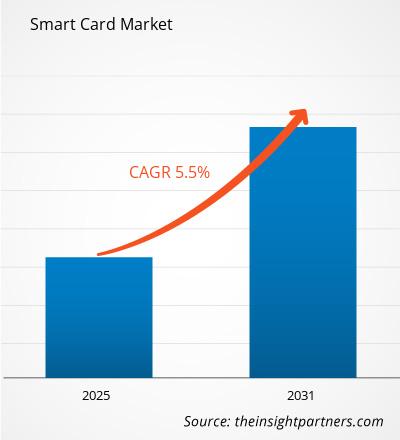
The Smart Card Market size is forecasted to increase from US$ 16.06 billion in 2025 to US$ 28.02 billion in 2034, growing at a rate of 6.38% CAGR during the period of 2026–2034. The growth is due to the shift towards a secure mode of payment, improvement in governmental identity programs, SIM technology in the telecommunication industry, and increased usage of embedded chips for authentication purposes.
The adoption of smart cards is predicted to increase in North America at a 5.9–6.4% CAGR due to upgrades of banks’ EMV portfolio, scaling up of open-loop ticketing systems in transportations, and increased need for secure identification from public sector organizations. The market size of Smart Card Market in North America is influenced by regular card replacements, established payment infrastructure, and growing demand for secure entry into hospitals, governments, and enterprises.
Smart Card Market Assessment and Insights
- North America accounted for 21–23% share in 2025 and is growing at a 5.9–6.4% CAGR between 2026–2034, supported by payment card renewal, healthcare credentials, and government access-control modernization.
- US represented 82–86% of North America in 2025 and is growing at a 5.8–6.3% CAGR between 2026–2034, led by EMV, prepaid, and federal identity programs.
- Europe held 26–28% share in 2025 and is growing at a 5.6–6.1% CAGR between 2026–2034, with Germany, France, the UK, Italy, and Spain leading secure payments and identity issuance.
- Asia Pacific held 39–42% share in 2025 and is growing at a 7.0–7.6% CAGR between 2026–2034, driven by China, India, Japan, and South Korea across telecom, banking, and public-ID programs.
- Largest Segment Contact cards held 43–47% market share in 2025 and are growing at a 4.8–5.4% CAGR between 2026–2034 as banking and SIM uses remain resilient.
- High Growth Segment Contactless cards held 31–34% market share in 2025 and are growing at a 7.4–8.1% CAGR between 2026–2034 due to tap-to-pay, transit, and access convenience.
- Key companies analyzed in detail: Atos SE, BrilliantTS Co., Ltd., CPI Card Group Inc., Thales DIS, Giesecke+Devrient GmbH, Identiv, Inc., Inside Secure SA, Fujian Newland Payment Technology Co., Ltd., Rambus Inc., Watchdata Technologies Pte. Ltd.
Source: The Insight Partners' analysis based on proprietary research, government publications, company annual reports, investor presentations, industry databases, and expert interviews.
These chip-based cards have evolved from simple information carriers to advanced security tools that consist of memory, microcontroller, cryptography, and applications management. Manufacturing has shifted towards dual interface products, environmentally-friendly card construction and personalization solutions that work with smaller card issuers batches. The Smart Card Market manufacturers seek to find a balance between low-cost manufacturing of mature SIMs and banking cards, and high-value cards that are needed for identification, healthcare, and secure access to enterprises.
Future demand will be determined by developing countries introducing electronic solutions for citizens’ services, banks trying to reduce fraud risks, and telecom operators dealing with transformation from physical SIM to eSIM. Legislation paying special attention to data protection, strong customer authentication, and electronic identification of citizens gives a stable position to the market because of its hardware-based approach.
Smart Card Market Report Scope
| Report Attribute | Details |
|---|---|
| Market size in 2025 | US$ 16.06 Billion |
| Market Size by 2034 | US$ 28.02 Billion |
| Global CAGR (2026 - 2034) | 6.38% |
| Historical Data | 2021-2024 |
| Forecast period | 2026-2034 |
Smart Card Market Analysis
Fundamentals of demand consist of anti-fraud mechanisms, identification verification, access to telecommunication services, and rapid processing of transactions. Factors contributing to growth of the market are the implementation of the EMV chip, government ID programs, and transport systems requiring robust credentials. Banks keep migrating from magnetic stripe cards and the older chip cards, and governments prefer cards which ensure safe credential storage.
The market consists of players from the chip providers, module providers, smart card manufacturing companies, operating system software developers, personalization bureaux, issuers, and payment or identity networks. The supply situation is becoming favorable following improvements in the semiconductor segment, but the certification process, cryptography development, and compliance still affect the procurement process. The issuers more and more demand lifecycle services.
The competitive environment consists mainly of integrated security companies and manufacturers of cards only. As per the findings from the Smart Card Market Report, Giesecke+Devrient GmbH, Thales DIS, CPI Card Group Inc., and Watchdata Technologies Pte. Ltd. are competitors on the basis of platform certification, personalization services, and partnerships with issuers, while Identiv, Inc. and Inside Secure SA serve access control, embedded security, and authentication needs.
Funding is shifting towards quantum-safe identity cards, card validation on the go, sustainable material, and multi-applications. Contribution to this market by Atos SE and Rambus Inc. comes from digital security and cryptography technology, while BrilliantTS Co., Ltd. and Fujian Newland Payment Technology Co., Ltd. play a role in card acceptance and secure transaction ecosystems.
● REPORT CUSTOMIZATION
Tailor This Report To Align With Your Specific Business Requirements
This report can be customized to align precisely with your business objectives, scope, and target markets. Customization options include tailored segmentation, geography, competitive analysis, and strategic insights to support informed decision-making.
Customize This Report →WHAT YOU CAN ADJUST
- ● Segmentations
- ● Geography
- ● Competitive Analysis
- ● Language Preferences
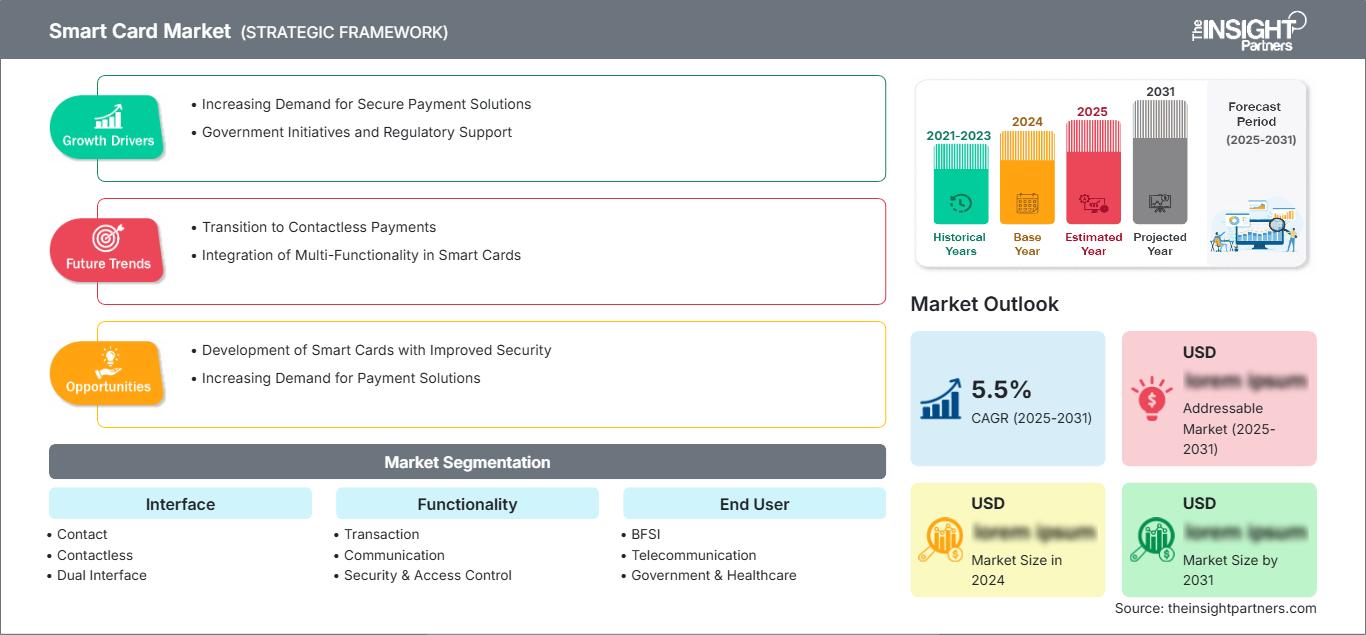
Smart Card Market: Strategic Insights
Regional Insights
North America Smart Card Market
The North America region had 21-23% market share in 2025 and is forecasted to witness growth of 5.9-6.4% CAGR during 2025-2034. Factors driving the market including advanced EMV issuance, strong demand for prepaid cards, transit fare card evolution, federal credential programs, and healthcare provider credentialing systems for patient authentication and restricted entry.
Replacing old issuers remains significant as banks issue new portfolios to incorporate contactless payments, secure card payment against frauds, and to stand out from competitors. U.S. and Canadian agencies have invested in building a safe identity system. Employers use smart converged cards for physical and logical access.
U.S. Smart Card Market
The U.S. accounts for 82%–86% of the continent of North America in 2025 and is forecasted to exhibit a 5.8%–6.3% CAGR. The application areas include payment issuance, prepaid security, government credentialing, healthcare access, and enterprise badges. CPI Card Group Inc. has a robust manufacturing and personalization position of payment cards in the country.
Trends in applications include growing adoption of contactless prepaid card technology, instant issuance and smart credentials for secure buildings, as well as security expansion in the U.S. by Giesecke+Devrient GmbH and portfolio of credentials by Identiv, Inc. The banks are using dual interface card technology to facilitate faster checkout while maintaining fallback infrastructure based on chip technology.
Europe Smart Card Market
In 2025, Europe held 26–28% market share and will grow at a 5.6–6.1% CAGR. Germany is the market leader owing to factors such as payment security, eID, and health card infrastructure, driven by companies such as Giesecke+Devrient GmbH and robust government security standards. The banks will be switching over to contactless cards and sustainable materials.
Payment convenience, transport acceptance, and corporate accessibility drive the UK, whereas Thales DIS technology drives France with its capabilities in identity and payment solutions. Italy and Spain are making investments in the modernization of their public services and health credentials. Europe has a regulatory environment that encourages use of certified chips, privacy-by-design architecture, and card life cycles.
APAC Smart Card Market
APAC maintained 39-42% share in 2025 and is expected to grow at a 7.0-7.6% CAGR, thus becoming the dominant regional base. China holds dominance in the sector due to banking, SIM card, and transit schemes; however, India is supported by financial inclusion, national identification, and digital payment schemes.
The region is supported by Japan and South Korea that are focused on secure payments, transportation and enterprise identity schemes, and Australia is assisted by contactless banking and transportation schemes. Industrial policies, domestic chip ecosystems, and government modernization initiatives help regional providers to grow. The market is supported by large subscriber bases requiring secure connectivity credentials.
Middle East & Africa Smart Card Market
The CAGR for Middle East and Africa is predicted to be 6.5–7.1%, driven by Saudi Arabia’s progress in digital government, healthcare, and transport infrastructure applications. The UAE concentrates its efforts on providing secure public services and payment systems modernization, whereas South Africa backs up banking cards and ID applications.
In Gulf nations, energy industry sites, border control, and urban infrastructure projects need access credentials in a secure manner. Rest of MEA is relatively unpredictable market, which grows with further adoption of digitization from telecoms, financial institutions, and government institutions. Hardware-based authentication remains in demand until mobile-based identity framework develops.
Segmentation Analysis
Interface
Interface is projected to grow at a 6.0–6.7% CAGR between 2026–2034 as issuers balance legacy compatibility with faster tap-based experiences. The Smart Card Market scope across interface types reflects different infrastructure realities: contact cards remain cost-effective, contactless cards improve convenience, and dual-interface cards protect investments by operating across both terminal environments.
- Contact cards retain a strong position in banking, SIM, and identity applications where installed readers, lower unit costs, and proven chip-and-PIN workflows remain operationally important.
- Contactless cards gain demand from retail payments, transport ticketing, and workplace access because tap-based use reduces transaction time and supports high-volume, low-friction environments.
- Dual Interface cards are strategically important for issuers seeking one credential that works across legacy contact readers and newer NFC terminals without forcing infrastructure replacement.
Functionality
Functionality is expected to grow at a 6.1–6.8% CAGR between 2026–2034, reflecting wider use of cards as transaction, communication, and authentication devices. Demand differs by risk profile: payment cards prioritize fraud reduction, telecom cards ensure secure network access, and security cards support controlled identity validation in regulated environments.
- Transaction functionality dominates payment, prepaid, transit, and loyalty use cases where secure chip authentication, fast authorization, and consumer familiarity support recurring issuance volumes.
- Communication functionality is tied to SIM, UICC, and eSIM transition pathways, helping telecom operators authenticate subscribers and manage connectivity across consumer and IoT devices.
- Security & Access Control functionality is critical for government, healthcare, enterprise, and industrial sites requiring strong identity proofing, certificate storage, and physical-logical access convergence.
End User
End User is forecast to grow at a 6.2–6.9% CAGR between 2026–2034. BFSI remains central because card portfolios require recurring refresh, while telecommunication provides large-volume credential demand. Government, healthcare, retail, e-commerce, and transportation add higher-security or high-frequency use cases that sustain the market beyond traditional banking issuance.
- BFSI contributes high revenue because issuers need EMV, contactless, prepaid, premium, and fraud-resistant card portfolios supported by personalization and lifecycle management services.
- Telecommunication remains volume-intensive as SIM and UICC credentials authenticate mobile subscribers, while eSIM growth shifts value toward secure provisioning and embedded connectivity management.
- Government & Healthcare demand is driven by national ID, health cards, benefits access, and facility security, where certified credentials help reduce fraud and improve service delivery.
- Retail & E-commerce uses smart cards for prepaid, loyalty, closed-loop payment, and secure customer engagement programs that bridge physical shopping and digital transaction environments.
- Transportation benefits from contactless fare media, open-loop payments, and commuter credentials, especially in cities prioritizing faster boarding and multimodal mobility integration.
Opportunity Snapshot
| End User | Revenue Contribution | Trend Tag | Adoption Stage |
| BFSI | High | Fraud Defense | Mature |
| Telecommunication | High | eSIM Shift | Scaling |
| Government & Healthcare | Medium | Digital ID | Scaling |
| Retail & E-commerce | Medium | Prepaid Security | Scaling |
| Transportation | Medium | Open Loop | Scaling |
| Others | Low | Campus Access | Emerging |
Smart Card Market Growth Drivers and Impact Analysis
Secure Payments and Fraud Reduction
Payment networks reported that 97% of global card-present transactions were EMV chip-based by Q4 2025, showing why chip credentials remain foundational to in-person commerce. Banks are refreshing cards for contactless acceptance, dynamic verification, prepaid protection, and stronger authentication. The impact on the Smart Card Market share is direct: issuers need certified hardware, secure personalization, and lifecycle services that reduce fraud exposure while preserving consumer familiarity at the checkout counter.
Government Identity and Healthcare Credential Modernization
Public-sector programs increasingly require secure cards that can store identity data, certificates, biometric references, or health entitlements. National IDs, driving licenses, e-passports, and health cards need long lifecycles, certified chips, and interoperability with agency systems. This driver raises demand for higher-value cards and trusted operating systems. It also strengthens supplier relationships with governments, where procurement favors proven security certifications, domestic resilience, and post-issuance update capability.
Telecom Connectivity and IoT Provisioning
Telecommunication remains a structural demand source because SIM, UICC, and embedded secure elements authenticate subscribers and devices. GSMA’s IoT eSIM specification is being commercialized, and industry monitoring indicated 605 million eSIM shipments in 2025 with a 43% uplift in consumer profile downloads. The impact is a value shift from plastic SIM volumes toward secure provisioning, subscription management, and embedded connectivity across smartphones, vehicles, meters, and industrial devices.
Smart Card Market Future Trends
Quantum-Resistant Identity Cards
Smart Card Market trends are moving toward post-quantum cryptography as governments prepare identity infrastructure for longer credential lifecycles. Cards issued today may remain valid for several years, making future cryptographic resilience an immediate procurement concern. Certified quantum-resistant smartcards will become relevant for eID, healthcare, border control, and driving-license programs. Suppliers that can combine high-security certification, standards alignment, and scalable personalization will gain advantage as agencies revise tenders to address quantum-era risks before large-scale attacks become practical.
Card and Mobile Credential Convergence
The traditional card is likely to continue working with the mobile wallet, digital identities, and cloud-based authentication and not replace them entirely. The credential will be designed in such a way that it will be issued on the phone, serve as a backup to the physical device, or connect to account-based systems. This combination allows continuity where there is no battery, internet connection, or a need for regulated identity proofing.
Smart Card Market Opportunities
Secure Prepaid and Retail Card Programs
Retailers and prepaid issuers can create higher-security card programs that reduce gift-card draining, support wallet provisioning, and protect customer balances before activation. Smart Card Market Forecasts favor offerings that combine EMV chips, contactless validation, mobile app verification, and packaging designs that hide sensitive data. Card manufacturers should target issuers seeking measurable fraud reduction, while program managers can use secure physical credentials to bridge in-store purchase, online redemption, and mobile engagement without adding friction.
Multi-Application Public Service Credentials
Governments have the potential to create an integrated system using multi-application cards for identity, health care, benefits, and transport privileges. Governments have the best opportunity in areas where they seek to provide universal digital services that do not discriminate against citizens who do not have smartphones or reliable Internet access. Vendors will need to focus on interoperability of their operating systems, personalization, and updating services which allow application loading over time.
Recent Developments
- April 2026: In a significant push towards digitising public transport services, Maharashtra Chief Minister Devendra Fadnavis launched the ‘RuPay On-The-Go' National Common Mobility Card (NCMC)-enabled smart card for the Maharashtra State Road Transport Corporation (MSRTC) at Mantralaya in Mumbai.
- March 2026: Starting March 20, Saskatoon Transit will improve customer convenience with the launch of new reloadable smart cards. These cards will integrate with the current Masabi mobile ticketing platform, allowing riders to tap their new card or device on the same validator. This upgrade creates a unified fare system that aims to reduce boarding confusion, eliminate the need for multiple validators, and improve how customers purchase, manage, and use their fare products.
- February 2026: SecurityTech company Giesecke+Devrient (G+D) has taken a decisive step in its international growth strategy with the acquisition of XTec Incorporated, a U.S.-based leader in secure authentication solutions. The transaction closed on February 27, marking a strategic expansion into a core growth market for digital identity and public-sector security. For G+D, the acquisition secures a strong foothold in North America, adding a highly experienced team and expanding its reach within key U.S. government agencies.
Frequently Asked Questions

- Comprehensive Market Sizing and Forecast Analysis
- Detailed Segmentation Analysis
- In-Depth Market Dynamics Assessment
- Regional and Country-Level Insights
- Competitive Landscape and Company Benchmarking
- Strategic Business Intelligence
Recent Reports
Testimonials

The Insight Partners' SCADA System Market report is comprehensive, with valuable insights on current trends and future forecasts. The team was highly professional, responsive, and supportive throughout. We are very satisfied and highly recommend their services.
RAN KEDEM Partner, Reali Technologies LTDs
I requested a report on a very specific software market and the team produced the report in a few days. The information was very relevant and well presented. I then requested some changes and additions to the report. The team was again very responsive and I got the final report in less than a week.
JEAN-HERVE JENN Chairman, Future Analytica
We worked with The Insight Partners for an important market study and forecast. They gave us clear insights into opportunities and risks, which helped shape our plans. Their research was easy to use and based on solid data. It helped us make smart, confident decisions. We highly recommend them.
PIYUSH NAGPAL Sr. Vice President, High Beam Global
The Insight Partners delivered insightful, well-structured market research with strong domain expertise. Their team was professional and responsive throughout. The user-friendly website made accessing industry reports seamless. We highly recommend them for reliable, high-quality research services
YUKIHIKO ADACHI CEO, Deep Blue, LLC.
This is the first time I have purchased a market report from The Insight Partners.While I was unsure at first, I visited their web site and felt more comfortable to take the risk and purchase a market report.I am completely satisfied with the quality of the report and customer service. I had several questions and comments with the initial report, but after a couple of dialogs over email with their analyst I believe I have a report that I can use as input to our strategic planning process.Thank you so much for taking the extra time and making this a positive experience.I will definitely recommend your service to others and you will be my first call when we need further market data.
JOHN SUZUKI President and Chief Executive Officer, Board Director, BK Technologies
I wish to appreciate your support and the professionalism you displayed in the course of attending to my request for information regarding to infectious disease IVD market in Nigeria. I appreciate your patience, your guidance, and the fact that you were willing to offer a discount, which eventually made it possible for us to close a deal. I look forward to engaging The Insight Partners in the future, all thanks to the impression you have created in me as a result of this first encounter.
DR CHIJIOKE ONYIA MANAGING DIRECTOR, PineCrest Healthcare Ltd.Reason to Buy
- Informed Decision-Making
- Understanding Market Dynamics
- Competitive Analysis
- Identifying Emerging Markets
- Customer Insights
- Market Forecasts
- Risk Mitigation
- Boosting Operational Efficiency
- Strategic Planning
- Investment Justification
- Tracking Industry Innovations
- Aligning with Regulatory Trends





 Get Free Sample for