
Smart Appliances Market Share, Growth & Forecast by 2034
Coverage: by Product (Home Appliances, Kitchen Appliances); Services (Professional Services, Managed Services); Technology (Wi-Fi, ZigBee, RFID, Bluetooth, Others) , and Geography (North America, Europe, Asia Pacific, and South and Central America)
- Status : Data Released
- Report Code : TIPTE100001076
- Category : Electronics and Semiconductor
- No. of Pages : 150
- Available Report Formats :


- Last update date : July 31, 2026


2025 Market Size
US$ 56.14 Bn
Base year value
2034 Forecast
US$ 218.76 Bn
Projected by 2034
CAGR 2026-2034
16.31 %
Growth rate
Addressable Market
US$ 1,159.17 Bn
(2026-2034)
The Smart Appliances Market was valued at US$ 56.14 Billion in 2025 and is expected to reach US$ 218.76 Billion by 2034, demonstrating a CAGR of 16.31% between 2026 and 2034. Consumers increasingly prefer moving beyond just connecting individual items to creating ecosystem integration with energy platforms, mobile applications, and voice-activated services in their homes that provide efficiency and convenience.
In North America, the Smart Appliances Market size has been driven by widespread availability of broadband internet, high-end housing developments, and utility-based energy management systems. The market in North America is expected to exhibit a CAGR of 14.8–15.6% during 2026–2034, led by adoption of connected laundry appliances, refrigerators, cooking appliances, and air-conditioning systems.
Smart Appliances Market Assessment and Insights
- North America accounted for 31–34% share in 2025 and is expected to grow at a CAGR of 14.8–15.6% during 2026–2034, driven by smart-home penetration, energy-efficiency standards, and premium appliance replacement.
- US represented 78–82% of North America in 2025 and is projected to expand at a CAGR of 14.9–15.7% during 2026–2034.
- Europe held 23–26% share in 2025 and is forecast to grow at a CAGR of 13.6–14.4% during 2026–2034, led by Germany, the UK, France, Italy, and Spain.
- Asia Pacific captured 32–35% share in 2025 and is projected to record a CAGR of 17.2–18.4% during 2026–2034, led by China, Japan, South Korea, India, and Australia.
- Largest Segment Home Appliances held 58–62% market share in 2025 and is expected to grow at a CAGR of 15.4–16.2% during 2026–2034.
- High Growth Segment Managed Services held 36–40% market share in 2025 and is expected to grow at a CAGR of 18.1–19.3% during 2026–2034.
- Key companies analyzed in detail: BSH Hausgeräte GmbH, Electrolux AB, General Electric Company, Haier Smart Home Co., Ltd., LG Electronics Inc., Miele & Cie. KG, Panasonic Holdings Corporation, Koninklijke Philips N.V., Samsung Electronics Co., Ltd., Whirlpool Corporation.
Source: The Insight Partners' analysis based on proprietary research, government publications, company annual reports, investor presentations, industry databases, and expert interviews.
The development of connected appliances has progressed from remotely operated switches to sensor-based optimizations, inbuilt diagnostic capability, and app-driven lifecycle management. The companies are overhauling their manufacturing systems to accommodate modular electronics, firmware upgrades, and cloud-based service readiness. This has affected supply chains since the chipset, connectivity, cybersecurity and user experience platforms have an equal say in defining product strategies, just like the compressor, motor, and mechanical resilience.
During the forecast period, the growth in emerging urban markets, policy on electrification and efficiency labels will expand addressable demand. Investments will be made in AI-based cooking, predictive maintenance, and appliances capable of working in response to fluctuating electricity prices. The policies that promote reduced domestic energy intensity and repairable appliances will help the development of connected products.
Smart Appliances Market Report Scope
| Report Attribute | Details |
|---|---|
| Market size in 2025 | US$ 56.14 Billion |
| Market Size by 2034 | US$ 218.76 Billion |
| Global CAGR (2026 - 2034) | 16.31% |
| Historical Data | 2021-2024 |
| Forecast period | 2026-2034 |
Smart Appliances Market Analysis
The Smart Appliance market growth is being spurred by the demand for savings in utilities, convenience, and connected homes among consumers. Efficiencies within building structures and appliance use remain a priority for energy agencies, while European labeling policy impacts on upgrade choices. The strongest demand is from places where consumers use smart speakers, mobile applications, and broadband-enabled homes.
The supply chain comprises the manufacturers of appliances, suppliers of components, software developers, connectivity service providers, retailers, installers, and operators. Current dynamics within the supply chain are being dictated by the availability of semiconductors, cybersecurity considerations, and cost of cloud integration. Efficient hardware and reliable software-supported brands have an easier time converting upgrades into connected sales.
The Smart Appliances Market Report indicates that competition is moving from hardware offerings to ecosystem offerings. Samsung Electronics Co., Ltd., LG Electronics Inc., Haier Smart Home Co., Ltd., and Whirlpool Corporation are focusing on platform-based connected devices whereas BSH Hausgeräte GmbH, Electrolux AB, and Miele & Cie. KG are focused on offering premium performance and efficiency.
Moreover, strategic positioning of players is also driven by service monetization. Panasonic Holdings Corporation, Koninklijke Philips N.V., and General Electric Company have aligned their connected products portfolio with health, kitchen, and home management application. Partnerships with utility companies, retailers, and installation services have become key as consumers need help for installation and ongoing improvement of products.
● REPORT CUSTOMIZATION
Tailor This Report To Align With Your Specific Business Requirements
This report can be customized to align precisely with your business objectives, scope, and target markets. Customization options include tailored segmentation, geography, competitive analysis, and strategic insights to support informed decision-making.
Customize This Report →WHAT YOU CAN ADJUST
- ● Segmentations
- ● Geography
- ● Competitive Analysis
- ● Language Preferences
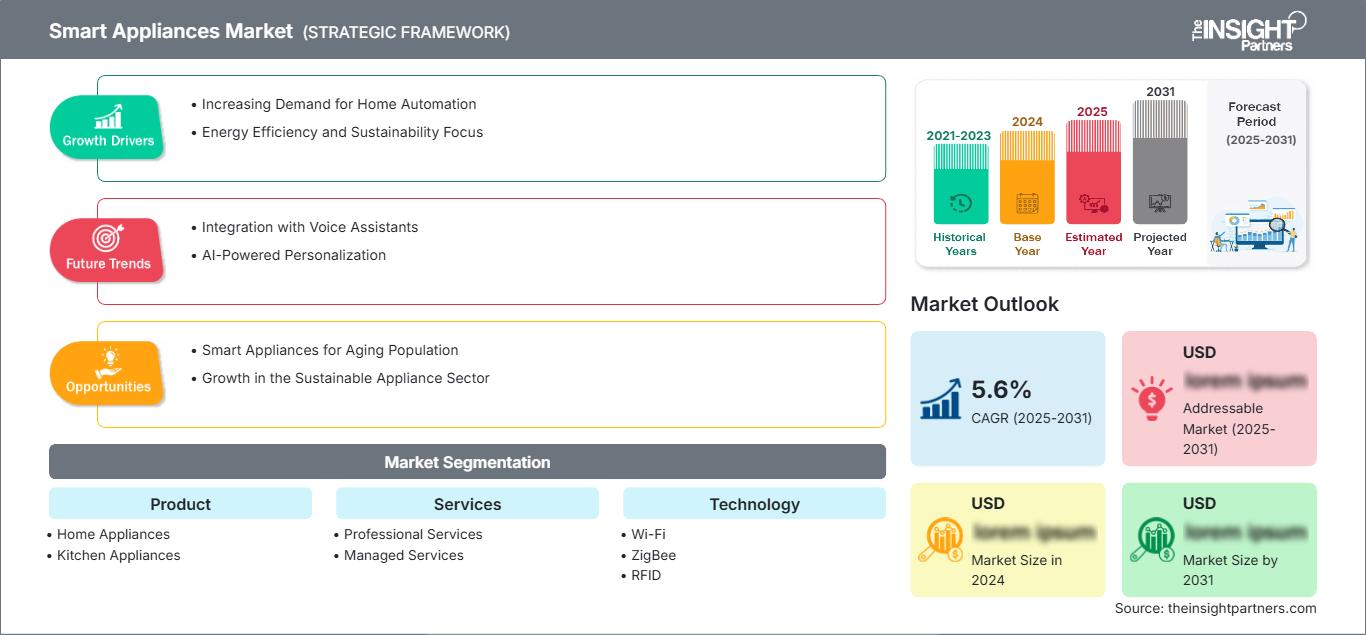
Smart Appliances Market: Strategic Insights
Regional Insights
North America Smart Appliances Market
North America accounted for 31–34% share in 2025 and is expected to register a CAGR of 14.8–15.6% during 2026–2034. The region benefits from high smart-home adoption, established retail channels, and strong replacement demand for laundry, refrigeration, and cooking appliances. The Smart Appliances Market share in North America is reinforced by connected energy management and service-led ownership models.
Utility incentives, ENERGY STAR awareness, and consumer familiarity with voice assistants support broader acceptance of connected appliances. Large homes, premium kitchens, and app-based maintenance programs create a favorable environment for higher-value products. Growth will remain tied to interoperability, cybersecurity trust, and affordability as brands target mainstream households beyond early adopters.
U.S. Smart Appliances Market
The U.S. represented 78–82% of North America in 2025 and is projected to grow at a CAGR of 14.9–15.7% during 2026–2034. Adoption is supported by large replacement volumes, premium kitchen remodeling, and wide availability of connected refrigerators, ovens, dishwashers, washers, dryers, and HVAC-linked appliances.
Samsung Electronics Co., Ltd., LG Electronics Inc., Whirlpool Corporation, General Electric Company, and Haier Smart Home Co., Ltd. maintain meaningful U.S. presence through retail, manufacturing, service, and brand portfolios. Application trends center on predictive maintenance, energy optimization, remote cycle control, and integration with home security, lighting, and voice platforms.
Europe Smart Appliances Market
Europe held 23–26% share in 2025 and is expected to expand at a CAGR of 13.6–14.4% during 2026–2034. Germany leads due to appliance manufacturing depth, premium consumer preferences, and stringent efficiency expectations. The UK shows strong demand for smart laundry, compact kitchens, and connected energy monitoring.
France, Italy, and Spain support regional adoption through replacement demand, urban living patterns, and rising attention to electricity costs. EU energy labeling recognition, ecodesign rules, and repairability priorities encourage efficient connected products. BSH Hausgeräte GmbH, Electrolux AB, Miele & Cie. KG, Philips N.V., and Whirlpool Corporation remain central to regional competition.
APAC Smart Appliances Market
APAC accounted for 32–35% share in 2025 and is forecast to grow at a CAGR of 17.2–18.4% during 2026–2034. China is the leading country, supported by domestic manufacturing scale, smart-city programs, and mature e-commerce channels. Japan and South Korea add premium innovation in compact, energy-efficient appliances.
India and Australia contribute through urban housing growth, rising appliance ownership, and stronger digital payment and retail ecosystems. Industrial policy, local production incentives, and expanding broadband access support adoption. Regional growth is also shaped by affordable connected models designed for smaller homes and climate-specific needs.
Middle East & Africa Smart Appliances Market
Middle East & Africa is projected to grow at a CAGR of 12.4–13.2% during 2026–2034, with Saudi Arabia leading adoption. High cooling demand, premium residential projects, and smart-city infrastructure support connected climate-control and kitchen appliances in Gulf markets.
The UAE benefits from luxury housing and connected living platforms, while South Africa shows gradual demand from urban middle-income households. Rest of MEA growth is tied to electrification, retail modernization, and energy-cost awareness. Adoption remains uneven because affordability and service availability still constrain penetration.
Segmentation Analysis
Product
Product is expected to grow at a CAGR of 15.8–16.6% during 2026–2034. The Smart Appliances Market scope across products is broadening as manufacturers embed connectivity, sensors, and software features into core household and kitchen categories. Demand is shaped by replacement cycles, energy labels, remote diagnostics, and consumer preference for app-enabled convenience.
- Home Appliances maintain the largest position, supported by connected laundry, refrigeration, air treatment, and climate-control products that offer energy visibility, predictive maintenance, and remote operation.
- Kitchen Appliances are strategically important as consumers adopt connected ovens, cooktops, refrigerators, dishwashers, and coffee systems to improve meal planning, safety, efficiency, and user personalization.
Services
Services are projected to grow at a CAGR of 17.5–18.8% during 2026–2034. Service revenue is expanding as connected appliances generate data for diagnostics, warranty management, software updates, and lifecycle support. Brands are using service models to reduce downtime, improve customer retention, and create recurring revenue beyond hardware sales.
- Professional Services support installation, integration, consulting, and configuration, particularly where households need interoperability across appliances, routers, smart speakers, energy platforms, and security systems.
- Managed Services are becoming more strategic as brands and partners monitor performance, deliver updates, manage alerts, and support maintenance subscriptions for connected appliance fleets.
Technology
Technology is expected to grow at a CAGR of 16.2–17.1% during 2026–2034. Connectivity choices influence device cost, interoperability, latency, and reliability. Wi-Fi remains central for bandwidth-intensive appliances, while ZigBee, RFID, and Bluetooth support proximity control, tagging, automation, and low-power communication within broader smart-home environments.
- Wi-Fi dominates connected appliance deployments because it supports firmware updates, remote control, diagnostics, and cloud connectivity without requiring consumers to purchase dedicated home-network hubs.
- ZigBee supports low-power mesh networking where appliances need reliable communication with sensors, gateways, lighting, and home automation systems across larger indoor environments.
- RFID is important in inventory-aware kitchens, service authentication, supply-chain traceability, and maintenance workflows where product identification and component tracking improve operational visibility.
- Bluetooth supports short-range setup, pairing, diagnostics, and local control, helping consumers onboard appliances quickly before linking them to broader home networks.
Opportunity Snapshot
| Application | Revenue Contribution | Trend Tag | Adoption Stage |
| Home Appliances | High | Remote Care | Mature |
| Kitchen Appliances | High | AI Cooking | Scaling |
| Professional Services | Medium | Smart Setup | Scaling |
| Managed Services | Medium | Predictive Care | Emerging |
| Wi-Fi | High | Cloud Control | Mature |
| ZigBee | Medium | Mesh Links | Scaling |
| RFID | Low | Asset Trace | Emerging |
| Bluetooth | Medium | Quick Pair | Mature |
Smart Appliances Market Growth Drivers and Impact Analysis
Energy Efficiency and Utility Cost Pressure
Families are emphasizing appliances that help save energy, water, and gas but still work effectively. The energy efficiency measures, which include labeling in Europe and energy efficiency in the world, make operating costs part of considerations when buying products. Appliances that are connected can tailor cycles, operate at low tariff times, and remind the user of inefficient use. This driver affects the business as the consumers choose based on overall operating cost instead of the initial cost of the appliance. This is beneficial for the manufacturers who will be able to present connected devices as an energy-saving tool.
Interoperable Smart-Home Ecosystems
Consumers expect their appliances to interface with their phones, voice assistants, energy management dashboards, and even home automation systems. Interoperability decreases the barriers of adoption since the consumer manages the appliance from an interface he/she already knows and understands. The result of this is competitive advantage for those companies who ensure that their appliances offer smooth interoperability, standards, and updates. There is a clear commercial reason behind this; ecosystem interoperability determines repeat purchase and brand loyalty. Companies that do not provide for interoperable appliances will have their premium customers go to other brands who do.
Urbanization and Premium Replacement Demand
The development of urban housing, the reduction of space sizes, and the rise of middle-class consumer spending have led to an increase in demand for efficient appliances that are multifunctional and networked. In advanced economies, consumers are moving from regular replacement to premium products that are quiet, optimize energy use, and enable remote monitoring. In developing countries, first-time appliance purchasers are becoming familiar with the networking abilities of the product through online shopping and phone-based campaigns. The effect of the trend is an expanded target audience for smart products regardless of price categories.
Smart Appliances Market Future Trends
AI-Led Appliance Personalization
Smart Appliances Market trends will increasingly center on appliances that learn household behavior and adjust performance without constant user input. Refrigerators may optimize cooling by usage frequency, washers may recommend cycles from fabric and load patterns, and ovens may personalize cooking profiles. The next stage is less about connectivity as a feature and more about adaptive performance. As processors become cheaper and cloud models improve, brands will differentiate through useful automation, transparent controls, and privacy safeguards. Successful products will reduce decision effort while giving users confidence that data is protected and energy outcomes are measurable.
Repairability and Circular Appliance Models
Repairability is bound to emerge as a trend because attention will be paid to extending the lifetime of products. Through connected diagnostics, it would be possible to detect component malfunctions in advance, direct technicians and avoid unnecessary replacement of parts. It is expected that manufacturers will make their appliances more modular, using standardized components and software accessible for servicing. The approach can change the source of profits, which will not come from sales, but rather from parts, maintenance and certified refurbishing. Circular business models will help companies meet their sustainability requirements as well as address the needs of budget-conscious consumers.
Smart Appliances Market Opportunities
Utility-Linked Energy Management Programs
Smart Appliances Market Forecasts indicate attractive opportunities for brands that connect appliances with utility demand-response and home energy platforms. Refrigerators, water heaters, dryers, and dishwashers can shift operation away from peak periods when users permit automated scheduling. Appliance makers can partner with utilities, software providers, and smart-meter companies to create value propositions based on savings, grid flexibility, and carbon reduction. This opportunity is investment-oriented because it requires secure data sharing, consumer consent tools, and verified performance metrics. Companies that demonstrate dependable load control without reducing convenience can access incentives and recurring service revenue.
Managed Lifecycle Services for Connected Homes
Managed services clearly represent a great opportunity, as people need assistance in installing, updating, troubleshooting, and maintaining their devices. Performance data collected from appliance fleets can be leveraged to create predictive alerts, plan warranties, optimize spare parts logistics, and offer customized services. These opportunities can be cashed via subscriptions, extended-care packages, and retailer collaborations. However, the best opportunity would be creating a simpler ownership experience for people who are interested in smart appliances but lack the necessary tech knowledge. Money should be invested into cloud security, technician training, multilingual customer support, and transparency in data handling practices.
Recent Developments
- July 2026: Samsung Electronics announced the launch of its new Bespoke AI Washer and Dryer lineup, designed to meet growing consumer demand for appliances that can reduce everyday effort, help manage energy consumption and integrate seamlessly into connected homes. Combining enhanced AI features, an intuitive Smart Screen experience and SmartThings-enabled energy management, the lineup helps users manage laundry more conveniently and efficiently.
- February 2026: Panasonic Life Solutions India announced the launch of the Roma Urban Smart Touch Series, a next-generation smart home IoT solution designed to deliver enhanced convenience, safety, and lifestyle efficiency for modern Indian homes. Built for connected, design-led spaces, the new switch range combines Smart Home control with premium aesthetics. Designed for today’s fast-paced lifestyle, the Roma Urban Smart Touch Switch enables users to manage electrical devices through three interfaces - a mobile application, voice commands, and a feather-touch physical switch. This hybrid control model delivers smart functionality while preserving the familiarity of manual use.
- November 2025: IKEA is launching 21 new smart home products focusing on lighting, sensors, and control — all built to work with Matter, the universal smart home standard. The launch marks a significant step in making smart home technology easier to use, more affordable, and better adapted to real-life needs in the home.
Frequently Asked Questions

- Comprehensive Market Sizing and Forecast Analysis
- Detailed Segmentation Analysis
- In-Depth Market Dynamics Assessment
- Regional and Country-Level Insights
- Competitive Landscape and Company Benchmarking
- Strategic Business Intelligence
Recent Reports
Testimonials

The Insight Partners' SCADA System Market report is comprehensive, with valuable insights on current trends and future forecasts. The team was highly professional, responsive, and supportive throughout. We are very satisfied and highly recommend their services.
RAN KEDEM Partner, Reali Technologies LTDs
I requested a report on a very specific software market and the team produced the report in a few days. The information was very relevant and well presented. I then requested some changes and additions to the report. The team was again very responsive and I got the final report in less than a week.
JEAN-HERVE JENN Chairman, Future Analytica
We worked with The Insight Partners for an important market study and forecast. They gave us clear insights into opportunities and risks, which helped shape our plans. Their research was easy to use and based on solid data. It helped us make smart, confident decisions. We highly recommend them.
PIYUSH NAGPAL Sr. Vice President, High Beam Global
The Insight Partners delivered insightful, well-structured market research with strong domain expertise. Their team was professional and responsive throughout. The user-friendly website made accessing industry reports seamless. We highly recommend them for reliable, high-quality research services
YUKIHIKO ADACHI CEO, Deep Blue, LLC.
This is the first time I have purchased a market report from The Insight Partners.While I was unsure at first, I visited their web site and felt more comfortable to take the risk and purchase a market report.I am completely satisfied with the quality of the report and customer service. I had several questions and comments with the initial report, but after a couple of dialogs over email with their analyst I believe I have a report that I can use as input to our strategic planning process.Thank you so much for taking the extra time and making this a positive experience.I will definitely recommend your service to others and you will be my first call when we need further market data.
JOHN SUZUKI President and Chief Executive Officer, Board Director, BK Technologies
I wish to appreciate your support and the professionalism you displayed in the course of attending to my request for information regarding to infectious disease IVD market in Nigeria. I appreciate your patience, your guidance, and the fact that you were willing to offer a discount, which eventually made it possible for us to close a deal. I look forward to engaging The Insight Partners in the future, all thanks to the impression you have created in me as a result of this first encounter.
DR CHIJIOKE ONYIA MANAGING DIRECTOR, PineCrest Healthcare Ltd.Reason to Buy
- Informed Decision-Making
- Understanding Market Dynamics
- Competitive Analysis
- Identifying Emerging Markets
- Customer Insights
- Market Forecasts
- Risk Mitigation
- Boosting Operational Efficiency
- Strategic Planning
- Investment Justification
- Tracking Industry Innovations
- Aligning with Regulatory Trends





 Get Free Sample for