
Smart Packaging Market Size, Growth & Trends by 2034
Coverage: by Type (Active Packaging, Intelligent Packaging); End-user (Food and Beverage, Automotive, Healthcare, Personal Care, Others) , and Geography (North America, Europe, Asia Pacific, and South and Central America)
- Status : Data Released
- Report Code : TIPRE00007865
- Category : Electronics and Semiconductor
- No. of Pages : 150
- Available Report Formats :


- Last update date : August 26, 2026


2025 Market Size
US$ 40.78 Bn
Base year value
2034 Forecast
US$ 91.69 Bn
Projected by 2034
CAGR 2026-2034
9.42 %
Growth rate
Addressable Market
US$ 591.35 Bn
(2026-2034)
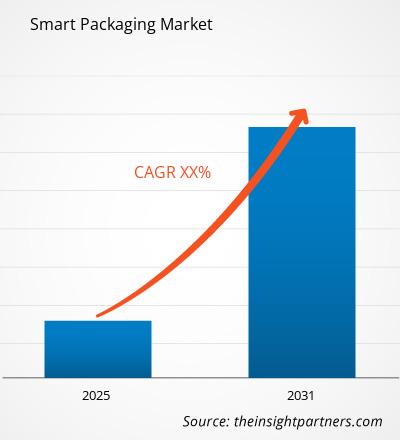
The Smart Packaging Market size was valued at US$ 40.78 billion in 2025 and is projected to reach US$ 91.69 billion by 2034, registering a CAGR of 9.42% over the forecast period from 2026 to 2034. The market expansion is primarily driven by the increasing demand for enhanced food safety, rising need to extend product shelf life, and the growing integration of intelligent technologies such as sensors, indicators, and RFID tags into packaging solutions to improve supply chain transparency and consumer engagement.
North America holds a substantial Smart Packaging Market share of 28-32% of the global market in 2025, with a projected CAGR of 8-10% through 2034. The region's market is propelled by advanced retail data infrastructure, healthcare serialization mandates such as the U.S. Drug Supply Chain Security Act (DSCSA), FDA traceability requirements under FSMA Section 204, and strong adoption of connected consumer engagement across food, beverage, healthcare, and personal care sectors.
Smart Packaging Market Assessment and Insights
- North America – Estimated to hold 28-32% of the global market in 2025, growing at a CAGR of 8-10% from 2026 to 2034. The region benefits from healthcare serialization, FDA traceability requirements, and strong adoption of connected packaging for consumer engagement.
- US – Represents approximately 85-90% of the North American market in 2025, with a CAGR of 8-10% projected through 2034. Market strength is reinforced by pharmaceutical serialization, connected retail, QR commerce, cold-chain monitoring, and FDA traceability rules.
- Europe – Accounts for 22-26% of the global market in 2025, growing at an estimated CAGR of 8-10% during the forecast period. Germany, the UK, and France are leading countries, driven by strict sustainability regulation, circular economy policy, digital product transparency, and the EU Falsified Medicines Directive.
- Asia Pacific – Captures 30-34% of global market share in 2025 and is projected to grow at the fastest CAGR of 10-12% through 2034. China leads the region with large food, beverage, and pharmaceutical manufacturing bases, followed by Japan, South Korea, and India.
- Largest Segment – The active packaging type segment represented the largest share with 55-60% of the market in 2025, growing at a CAGR of 9-11% through 2034, driven by its ability to extend shelf life through oxygen scavenging, moisture control, and antimicrobial protection.
- High Growth Segment – The intelligent packaging type segment is projected as a high-growth segment with a CAGR of 10-12% from 2026 to 2034, driven by the integration of RFID, NFC, and sensors for real-time monitoring and supply chain transparency.
- Key companies analyzed in detail – 3M, Amcor Limited, Avery Dennison Corporation, BASF, DuPont, Huhtamaki Group, International Paper, Sealed Air Corporation, Smartrac N.V., and Thin Film Electronics ASA.
Source: The Insight Partners' analysis based on proprietary research, government publications, company annual reports, investor presentations, industry databases, and expert interviews.
From traditional packaging used for protection purposes, the Smart Packaging Market is developing into an advanced system that incorporates sensors, indicators, RFID tags, and digital elements like QR Codes and NFC Technology. Contemporary smart packaging systems offer capabilities like tracking, authentication, freshness control, and supply chain management, thereby making packaging a cost-effective asset for quality, regulatory compliance, and end-consumer experience. This market is getting reshaped by the advancements of connected labeling, sensor miniaturization, cloud analytics, and circular packaging.
Some emerging geographies include the Asia-Pacific, where the fast-growing urban areas, developing e-commerce ecosystem, and increasing demand for packaged products create tremendous growth opportunities. Product visibility and adoption are being boosted by the investments made in the IoT infrastructure and digital platform. The favorable regulatory environment is another factor encouraging end-users to adopt smart packaging that is traceable, efficient, and sustainable. This includes the FDA Food Traceability Rule and EU packaging sustainability rules. Leading companies like 3M, Avery Dennison, BASF, and Sealed Air are making substantial investments in the technologies and digital platforms to capitalize on market share.
Smart Packaging Market Report Scope
| Report Attribute | Details |
|---|---|
| Market size in 2025 | US$ 40.78 Billion |
| Market Size by 2034 | US$ 91.69 Billion |
| Global CAGR (2026 - 2034) | 9.42% |
| Historical Data | 2021-2024 |
| Forecast period | 2026-2034 |
Smart Packaging Market Analysis
The Smart Packaging Market is fundamentally driven by the convergence of food safety requirements, pharmaceutical serialization mandates, and the growing need for supply chain transparency. In the food and beverage sector, smart packaging technologies such as modified atmosphere packaging (MAP), oxygen scavengers, and moisture control solutions play a crucial role in preserving product freshness, reducing spoilage, and minimizing food waste across the value chain.
In healthcare and pharmaceuticals, serialization requirements under the DSCSA and the EU Falsified Medicines Directive are driving adoption of RFID-enabled packaging, tamper-evident features, and authentication systems. The value chain encompasses packaging converters, materials and ink specialists, sensor and semiconductor vendors, software platforms, and systems integrators, with alliances between converters and technology firms accelerating platformization and scale.
The competitive landscape features established players such as Amcor Limited, Sealed Air Corporation, and Avery Dennison Corporation alongside material science leaders like 3M and BASF. The Smart Packaging Market trends indicate a strategic focus on digital features, with companies integrating IoT, NFC, blockchain, and augmented reality (AR) to enhance product tracking, consumer engagement, and security.
Strategic positioning in the Smart Packaging Market increasingly emphasizes sustainability at the design stage, with smart components designed for compatibility with recyclability, compostability, and material recovery. Partnerships between packaging manufacturers and technology providers are becoming increasingly common, reflecting the need for cross-industry collaboration to scale these solutions. Companies are also exploring opportunities in emerging markets and adapting products to meet regional preferences and regulations.
● REPORT CUSTOMIZATION
Tailor This Report To Align With Your Specific Business Requirements
This report can be customized to align precisely with your business objectives, scope, and target markets. Customization options include tailored segmentation, geography, competitive analysis, and strategic insights to support informed decision-making.
Customize This Report →WHAT YOU CAN ADJUST
- ● Segmentations
- ● Geography
- ● Competitive Analysis
- ● Language Preferences
Smart Packaging Market: Strategic Insights
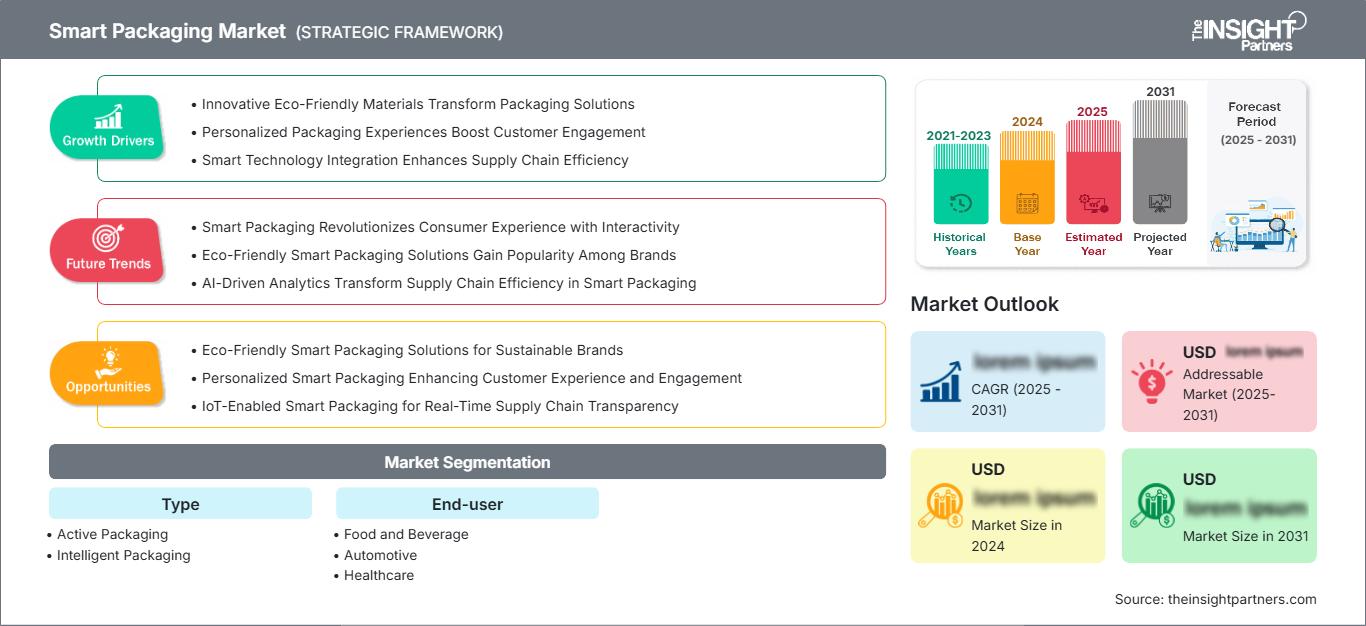
Regional Insights
North America Smart Packaging Market
The Smart Packaging Market forecast indicates that North America is estimated to hold 28-32% of the global market in 2025, with a projected CAGR of 8-10% through 2034. The United States serves as the primary engine, supported by healthcare serialization mandates including the DSCSA and FDA traceability requirements under FSMA Section 204. The region benefits from advanced retail data infrastructure, strong adoption of connected consumer engagement across food, beverage, healthcare, and personal care, and significant investments in IoT-based packaging systems. The U.S. market is projected at USD 6.82 billion by 2026, fueled by IoT adoption and rising intelligent packaging demand in food and pharma sectors. Canada emphasizes food safety, bilingual labeling, recycling policy alignment, and sustainable packaging. The sophisticated supply chain and logistics networks in the region are well-suited for the integration of smart packaging technologies.
U.S. Smart Packaging Market
According to the Smart Packaging Market report, the U.S. market accounts for approximately 85-90% of North American revenue, with a CAGR of 8-10% projected through 2034. The market is driven by pharmaceutical serialization, connected retail, QR commerce, cold-chain monitoring, and FDA traceability rules. The U.S. is home to numerous technology hubs and leading innovation centers, supporting the development of cutting-edge technologies that can be integrated into smart packaging. Companies like Zebra Technologies Corporation report increasing investment in technologies including RFID, sensors, and augmented reality in warehousing, showing the increasing growth opportunity of smart packaging. The demand for intelligent inventory and product tracking in retail and healthcare industries is improving consumer interaction, inventory management, and supply chain transparency.
Europe Smart Packaging Market
Europe is estimated to capture 22-26% of the global market in 2025, growing at a CAGR of 8-10% through 2034. Germany leads the region, with a market projected at USD 1.49 billion by 2026, driven by strong automotive and manufacturing industries and a focus on Industry 4.0 technologies. The UK market benefits from high adoption of smart packaging in pharmaceutical and premium food sectors, with the market projected at USD 1.12 billion by 2026. France, Italy, and Spain are emerging as significant markets, supported by EU initiatives promoting digital transformation and renewable energy integration. The region is characterized by a strong emphasis on circular economy aspirations and digitalization in the value chain of packaging, with stringent waste, recycling, and digital product passport agendas accelerating interoperable IDs and low-migration chemistries. Premium beverages and cosmetics drive anti-counterfeit and engagement use-cases, while grocery retailers trial freshness indicators at scale.
APAC Smart Packaging Market
Asia Pacific accounted for 30-34% of global market share in 2025 and is projected to grow at the fastest CAGR of 10-12% through 2034. Asia-Pacific dominated the global smart packaging market in 2025 with a 37.52% share, valued at approximately USD 9.78 billion. China leads the region with significant contributions to food, beverage, consumer electronics, and pharmaceutical manufacturing, with the market projected at USD 3.41 billion by 2026. Japan demonstrates strong growth driven by high-quality materials and electronics integration, with the market projected at USD 2.3 billion by 2026. India is emerging as a key market, supported by pharmaceutical exports, food safety, retail digitization, and smartphone-enabled QR adoption, with the market projected at USD 2.03 billion by 2026. The region's dense retail networks, fast eCommerce adoption, smartphone penetration, and cold-chain investment support the use of connected labels, RFID logistics, freshness indicators, serialization, and anti-counterfeit technologies.
Middle East & Africa Smart Packaging Market
The MEA region exhibits emerging adoption of smart packaging technologies, with a projected CAGR of 7-9% through 2034. Saudi Arabia and the UAE are leading the region, driven by significant investments in premium retail, halal assurance, pharmaceutical logistics, and temperature-controlled supply-chain visibility. The UAE's position as a major global travel and tourism hub supports the demand for premium and secure packaging solutions. South Africa represents the largest African market, with growing commercial adoption driven by food security, pharmaceutical authenticity, informal-market verification, and mobile-first QR engagement. Infrastructure development and smart city investments create additional application opportunities across the region.
Segmentation Analysis
Type
The type segment comprises Active Packaging and Intelligent Packaging. Active Packaging dominates the segment, accounting for 55-60% of the market in 2025, driven by its ability to extend shelf life through functions such as oxygen scavenging, moisture control, and antimicrobial protection. The segment is growing at a CAGR of 9-11%. Intelligent Packaging, however, represents a high-growth segment with a CAGR of 10-12%, reflecting the shift toward RFID, NFC, and sensors for real-time monitoring and supply chain transparency. Active packaging builds on the traditional concept of packaging by adding functionality to the packaged product, going beyond mere containment and protection to limit destructive processes. Intelligent packaging incorporates cutting-edge technologies like RFID, NFC, and sensors to take traceability and real-time monitoring to the next level for full transparency in the supply chain and security of a product.
- Active Packaging – Dominant segment, extending shelf life through oxygen scavenging, moisture control, antimicrobial protection, and corrosion control. Widely used in food and beverage to preserve perishable items and maintain quality standards.
- Intelligent Packaging – High-growth segment, incorporating RFID, NFC, sensors, and indicators for real-time monitoring, traceability, and authentication. Enables supply chain transparency and consumer engagement through digital features.
End-user
The end-user segment includes Food and Beverage, Automotive, Healthcare, and Personal Care. The Food and Beverage sector holds the largest market share, driven by the need for food safety, freshness monitoring, and shelf life extension. The segment is growing at a CAGR of 9-11%. Healthcare and Pharmaceuticals represent a high-growth segment with a CAGR of 10-12%, supported by serialization mandates, anti-counterfeiting measures, and temperature-sensitive medication monitoring. The food and beverage industry extensively utilizes smart packaging to preserve perishable items and prevent spoilage, making it the largest end-use segment. In healthcare, smart packaging supports product integrity, patient adherence, dosage tracking, and real-time monitoring of temperature-sensitive medication.
- Food and Beverage – Largest end-user segment, driven by demand for enhanced food safety, extended shelf life, and reduced food waste. Utilizes active packaging, MAP, and freshness indicators extensively.
- Automotive – Employs smart packaging for secure and efficient transportation of parts. Focus on protective and anti-counterfeiting packaging solutions.
- Healthcare – High-growth segment, driven by pharmaceutical serialization, patient adherence, dosage tracking, and anti-counterfeiting measures. Supports temperature-sensitive medication monitoring.
- Personal Care – Increasingly employing smart packaging to engage customers with QR codes and NFC for personalized product information and promotional offers.
Opportunity Snapshot
| End-user | Revenue Contribution | Trend Tag | Adoption Stage |
|---|---|---|---|
| Food and Beverage | High | Shelf-Life Extension | Mature |
| Automotive | Medium | Secure Logistics | Scaling |
| Healthcare | High | Serialization | Scaling |
| Personal Care | Medium | Consumer Engagement | Emerging |
Smart Packaging Market Growth Drivers and Impact Analysis
Enhanced Food Safety and Shelf Life Extension
The increasing emphasis on enhancing food safety and extending the shelf life of perishable products is a primary driver for the smart packaging market. As global food supply chains become more complex and consumer awareness regarding product quality continues to rise, manufacturers are increasingly adopting advanced packaging technologies such as modified atmosphere packaging, oxygen scavengers, and moisture control solutions . These technologies play a crucial role in preserving product freshness, reducing spoilage, and minimizing food waste across the value chain . With regulatory authorities worldwide implementing stricter food safety standards, the adoption of smart packaging solutions is becoming essential for ensuring compliance, maintaining product integrity, and safeguarding consumer health. According to the Dubai Chamber of Commerce and Industry Euromonitor, between 2020 and 2025, the growth rate of packaged staple food in the United Arab Emirates was the highest at 4%, reflecting the increasing demand for packaged food requiring smart packaging solutions.
Regulatory Mandates and Serialization Requirements
Stringent government mandates and regulatory frameworks are compelling the adoption of smart packaging technologies across healthcare, food, and consumer goods sectors. Verified regulatory drivers, including the U.S. Drug Supply Chain Security Act (DSCSA), the FDA Food Traceability Rule under FSMA Section 204, the EU Falsified Medicines Directive, and EU packaging sustainability rules, are accelerating adoption of traceable, compliant, and resource-efficient smart packaging solutions . In healthcare, serialization requirements for pharmaceuticals are driving RFID-enabled packaging and authentication systems, ensuring product integrity and patient safety . In the food sector, traceability regulations are promoting the use of QR codes, sensors, and freshness indicators to enable rapid recalls and enhance supply chain transparency. These regulations create non-discretionary demand for smart packaging as manufacturers seek compliance with evolving standards.
Digital Transformation and IoT Integration
The growing integration of intelligent and connected packaging technologies in the Smart Packaging Market is significantly contributing to market expansion. Solutions such as sensors, indicators, and RFID-based data carriers enable real-time monitoring of product conditions, including temperature, humidity, and gas composition, thereby enhancing supply chain visibility and operational efficiency . The increasing incorporation of digital features such as QR codes and augmented matrix codes is transforming packaging into an interactive communication platform, allowing brands to offer product transparency, enable authenticity verification, and deliver enhanced consumer engagement . The integration of Internet of Things (IoT) allows advanced functionalities, such as remote monitoring and analytics, while the rise of omnichannel retailing, wherein people can buy products through various channels like online platforms, mobile apps, and physical stores, is favoring market growth .
Smart Packaging Market Future Trends
Integration of AI and Predictive Analytics
Artificial intelligence is compounding the value of smart packaging by converting package-level signals into predictive intelligence. AI-enabled image recognition can verify label accuracy, inspect defects, identify misprints, and detect tampering, while machine learning can analyze sensor data from connected packaging to predict spoilage, cold-chain excursions, inventory risks, and replenishment needs . The cumulative impact is strongest when AI connects packaging data with enterprise resource planning, warehouse management, transportation monitoring, quality systems, and consumer engagement platforms . The rise of specialized AI platforms and edge analytics is enabling smart packaging to not only monitor conditions but also anticipate risks, optimize logistics, and support circular economy models . As businesses prioritize efficiency, transparency, and environmental responsibility, AI-integrated smart packaging is set to become a core component of digital transformation strategies across industries .
Sustainability and Circular Economy Integration
The growing environmental concerns and rising awareness among individuals about the importance of sustainable solutions are positively influencing the Smart Packaging Market. The shift towards sustainable resources is driving the use of recyclable and biodegradable materials in smart packaging, which is contributing to market growth . Smart packaging enables better tracking of product freshness and quality and aids in reducing unnecessary waste, while leading market players are introducing green packaging solutions to minimize harmful emissions and promote environmental health . Smart layers are being re-engineered for mono-material packs, delaminable labels, and ink selections compatible with recycling streams, with condition monitoring reducing spoilage and reinforcing lifecycle impact claims . According to official statistics by Gitnux, sustainability is a major growth driver, with 60% of consumers preferring eco-friendly options and recycled plastics now representing 18% of packaging materials globally .
Smart Packaging Market Opportunities
Pharmaceutical and Healthcare Serialization
Significant opportunities exist in pharmaceutical and healthcare applications for smart packaging, driven by serialization mandates and the need for patient safety. The U.S. Drug Supply Chain Security Act (DSCSA) and the EU Falsified Medicines Directive are creating substantial demand for RFID-enabled packaging, tamper-evident features, and authentication systems . NFC-enabled packs, e-leaflets, and tamper-evident closures support authentication and patient guidance, while audit-ready logs and interoperable identifiers align with serialization and post-market surveillance expectations . The global temperature-controlled pharmaceutical logistics market growth is further driving demand for condition-monitoring smart packaging solutions. Companies that develop clinically validated, regulatory-compliant packaging solutions with real-time monitoring capabilities are positioned to capture premium segments of this market.
E-Commerce and Last-Mile Delivery Optimization
The rapid growth of e-commerce and last-mile delivery presents a substantial opportunity for the Smart Packaging Market. E-commerce necessitates durable and connected packaging solutions that provide tracking, monitoring, and enhanced user experiences . The rise of omnichannel retailing is driving demand for efficient packaging like smart packaging as it offers logistic solutions, including real-time tracking, and ensures efficient transportation . According to Gitnux, the global packaging industry reached a market size of USD 1.07 trillion in 2023 and is projected to grow through 2030, with flexible packaging leading . Smart packaging helps in complying with varied international trade regulations, simplifying global business operations, while expanding global networks is driving the need for versatile packaging solutions that cater to different regional needs . Companies that integrate smart packaging with AI, standards-based data exchange, and secure digital identities will be better positioned to reduce waste, protect products, comply with evolving rules, and create differentiated consumer experiences .
Recent Developments
- August 2026: Aldi and the UK’s largest dairy cooperative, Arla, are collaborating with recycling platform, Polytag, on an operational pilot to track milk bottle packaging through the recycling process using innovative UV-tagging technology to get a better understanding of the product lifecycle.
- April 2025: Spectrum Brands, Inc., a leading supplier of pet products of exceptional value and quality for dogs, cats, birds, fish and small animals, will offer an innovative new delivery system for its FURminator brand of pet shedding and grooming solutions. The FURminator deShedding Ultra Premium Shampoo squeeze packaging, developed in partnership with the liquid packaging specialists at AeroFlexx, gives pet parents a spill-resistant, self-sealing option in a next-generation container that uses less plastic than conventional FURminator shampoo bottles.
- October 2023: Digital technology studio Appetite Creative, in collaboration with packaging company Tetra Pak, has launched a new interactive smart packaging for European fruit juice producer Rauch. This smart packaging has been launched to support Rauch’s winter drinks theme. It has been introduced for one-litre juice packs in three different flavours, including orange, pineapple, and apple.
Frequently Asked Questions

- Comprehensive Market Sizing and Forecast Analysis
- Detailed Segmentation Analysis
- In-Depth Market Dynamics Assessment
- Regional and Country-Level Insights
- Competitive Landscape and Company Benchmarking
- Strategic Business Intelligence
Recent Reports
Testimonials

The Insight Partners' SCADA System Market report is comprehensive, with valuable insights on current trends and future forecasts. The team was highly professional, responsive, and supportive throughout. We are very satisfied and highly recommend their services.
RAN KEDEM Partner, Reali Technologies LTDs
I requested a report on a very specific software market and the team produced the report in a few days. The information was very relevant and well presented. I then requested some changes and additions to the report. The team was again very responsive and I got the final report in less than a week.
JEAN-HERVE JENN Chairman, Future Analytica
We worked with The Insight Partners for an important market study and forecast. They gave us clear insights into opportunities and risks, which helped shape our plans. Their research was easy to use and based on solid data. It helped us make smart, confident decisions. We highly recommend them.
PIYUSH NAGPAL Sr. Vice President, High Beam Global
The Insight Partners delivered insightful, well-structured market research with strong domain expertise. Their team was professional and responsive throughout. The user-friendly website made accessing industry reports seamless. We highly recommend them for reliable, high-quality research services
YUKIHIKO ADACHI CEO, Deep Blue, LLC.
This is the first time I have purchased a market report from The Insight Partners.While I was unsure at first, I visited their web site and felt more comfortable to take the risk and purchase a market report.I am completely satisfied with the quality of the report and customer service. I had several questions and comments with the initial report, but after a couple of dialogs over email with their analyst I believe I have a report that I can use as input to our strategic planning process.Thank you so much for taking the extra time and making this a positive experience.I will definitely recommend your service to others and you will be my first call when we need further market data.
JOHN SUZUKI President and Chief Executive Officer, Board Director, BK Technologies
I wish to appreciate your support and the professionalism you displayed in the course of attending to my request for information regarding to infectious disease IVD market in Nigeria. I appreciate your patience, your guidance, and the fact that you were willing to offer a discount, which eventually made it possible for us to close a deal. I look forward to engaging The Insight Partners in the future, all thanks to the impression you have created in me as a result of this first encounter.
DR CHIJIOKE ONYIA MANAGING DIRECTOR, PineCrest Healthcare Ltd.Reason to Buy
- Informed Decision-Making
- Understanding Market Dynamics
- Competitive Analysis
- Identifying Emerging Markets
- Customer Insights
- Market Forecasts
- Risk Mitigation
- Boosting Operational Efficiency
- Strategic Planning
- Investment Justification
- Tracking Industry Innovations
- Aligning with Regulatory Trends





 Get Free Sample for