
Smart Parking Systems Market Size, Share & Forecast to 2034
Coverage: By Parking Site (Off-street parking, On-street parking); Component (Hardware, Software, Services); End-User Industry (Transport Facilities, Government & Municipalities, Commercial Institutions, Corporate Institutions), and Geography
- Status : Data Released
- Report Code : TIPTE100000102
- Category : Electronics and Semiconductor
- No. of Pages : 150
- Available Report Formats :


- Last update date : August 26, 2026


2025 Market Size
US$ 5.43 Bn
Base year value
2034 Forecast
US$ 18.65 Bn
Projected by 2034
CAGR 2026-2034
16.68 %
Growth rate
Addressable Market
US$ 114.27 Bn
(2026-2034)
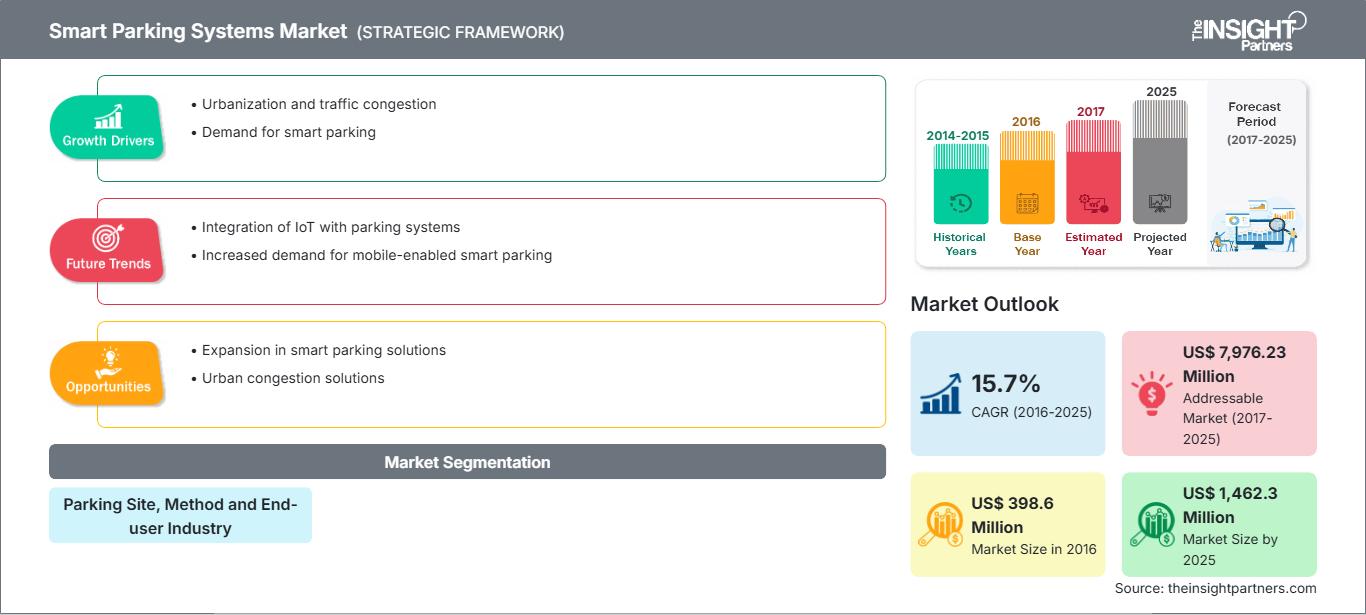
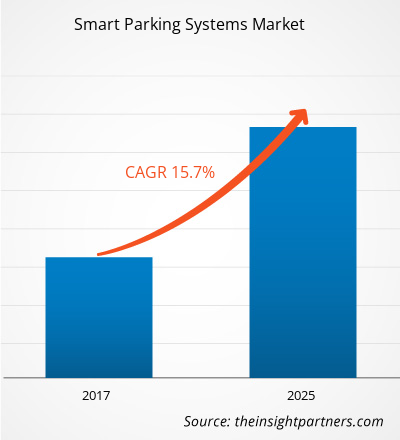
The Smart Parking Systems Market size was valued at US$ 5.43 billion in 2025 and is projected to reach US$ 18.65 billion by 2034, registering a CAGR of 16.68% over the forecast period from 2026 to 2034. This growth is driven by rapid urbanization, increasing vehicle density, and the global push for smart city infrastructure that integrates IoT-enabled solutions to reduce traffic congestion, lower emissions, and enhance urban mobility.
North America holds a significant share of 34-38% of the global Smart Parking Systems Market in 2025, with a projected CAGR of 15-17% through 2034. The region's leadership is supported by advanced urban infrastructure, early adoption of smart city technologies, strong municipal investment in curbside digitization, and the presence of major technology providers driving innovation in sensor-based occupancy management and cloud-hosted parking platforms.
Smart Parking Systems Market Assessment and Insights
- North America – Estimated to hold 34-38% of the global Smart Parking Systems Market share in 2025, growing at a CAGR of 15-17% from 2026 to 2034. The region benefits from high vehicle ownership, advanced smart city infrastructure, and significant deployment in major metropolitan areas like New York, Los Angeles, and Chicago.
- US – Represents approximately 85-90% of the North American market in 2025, with a CAGR of 15-17% projected through 2034. Market strength is reinforced by federal initiatives promoting intelligent transportation systems and the presence of key players like Amano McGann and Cisco Systems.
- Europe – Accounts for 24-28% of the global market in 2025, growing at an estimated CAGR of 15-17% during the forecast period. Germany, the UK, and France are leading countries, driven by low-emission policies, strict data governance under GDPR, and sustainable mobility mandates.
- Asia Pacific – Captures 28-32% of global market share in 2025 and is projected to grow at the fastest CAGR of 17-19% through 2034. China leads the region with large smart city programs and strong EV adoption, followed by Japan, South Korea, and India, where rapid urbanization is fueling demand.
- Largest Segment – The off-street parking segment held the largest share with 58-62% of the market in 2025, growing at a CAGR of 16-18% through 2034, driven by widespread deployment in commercial complexes, airports, and corporate campuses.
- High Growth Segment – The software component segment is projected as a high-growth segment with a CAGR of 18-20% from 2026 to 2034, fueled by the migration from on-premises systems to cloud-hosted and SaaS-based platforms offering continuous feature updates and integration capabilities.
- Key companies analyzed in detail – Amano McGann, Inc., Cisco Systems, Inc., Kapsch, Nedap N.V., Parkmobile, LLC, Skidata AG, Smart Parking Ltd., Swarco AG, Urbiotica, and Xerox Corp.
Source: The Insight Partners' analysis based on proprietary research, government publications, company annual reports, investor presentations, industry databases, and expert interviews.
From metered parking to the more advanced IoT sensor networks, cloud platforms, big data analytics, and mobile applications, the Smart Parking Systems Market is evolving into an ecosystem that can sense, process, and deliver actionable insights about parking lots in real time. Modern smart parking systems are providing real-time occupancy detection, ANPR (automatic license plate recognition), dynamic parking pricing, reservation and digital payment features. They are revolutionizing traditional parking by converting parking lots into a mobility service that is intelligent and connected.
There are emerging regions that will fuel Smart Parking Systems market growth. The Asia-Pacific region is a major example of a region where rapid urbanization and increasing number of cars coupled with smart city projects are driving the need for intelligent parking systems. Smart parking services can generate revenues through mobility services which include EV Charging network and navigation applications. Regulatory headwinds include the European Union mandates for sustainable mobility as well as reducing congestion in the city.
Smart Parking Systems Market Report Scope
| Report Attribute | Details |
|---|---|
| Market size in 2025 | US$ 5.43 Billion |
| Market Size by 2034 | US$ 18.65 Billion |
| Global CAGR (2026 - 2034) | 16.68% |
| Historical Data | 2021-2024 |
| Forecast period | 2026-2034 |
Smart Parking Systems Market Analysis
The Smart Parking Systems Market report indicates that rapid urbanization and vehicle density are the two key factors driving market growth. According to the United Nations, the number of people living in urban areas across the world will increase to 68% by the year 2050, making the need for smart parking solutions more critical than ever before. In fact, on average, finding a parking spot takes 20 minutes.
Smart parking systems are designed to solve such issues by providing information on available spots and navigation through parking lots. Value Chain includes sensors, cameras and gates manufacturers as well as software providers, which develop analytics tools and mobile applications for navigation and parking reservation purposes.
The Smart Parking Systems Market is comprised of established companies such as Amano McGann, Inc., SKIDATA AG, and SWARCO AG in addition to technological firms such as Cisco Systems, Inc. and Parkmobile, LLC. The trends in investment include the strategic focus on cloud computing, use of AI in analyzing data, and interoperability within the smart city framework. Companies are employing strategies including new product development, partnerships, and mergers in order to enhance their market position.
One example of a strategy employed by a company within the industry includes that Amano McGann has concluded an agreement for the modernization of its system in the West Palm Beach municipality in the year 2026 wherein they have replaced their legacy system with the cloud-based Amano ONE system.
● REPORT CUSTOMIZATION
Tailor This Report To Align With Your Specific Business Requirements
This report can be customized to align precisely with your business objectives, scope, and target markets. Customization options include tailored segmentation, geography, competitive analysis, and strategic insights to support informed decision-making.
Customize This Report →WHAT YOU CAN ADJUST
- ● Segmentations
- ● Geography
- ● Competitive Analysis
- ● Language Preferences
Smart Parking Systems Market: Strategic Insights
Regional Insights
North America Smart Parking Systems Market
According to the Smart Parking Systems Market forecast, North America is estimated to hold 34-38% of the global market in 2025, with a projected CAGR of 15-17% through 2034. The United States is the major driver for growth because of its highly developed infrastructure, early adoption of smart city solutions, and high municipal investments in curb-side digitization. Vehicle ownership rate and successful implementation in cities like New York, Los Angeles, and Chicago are expected to fuel market growth. Dynamic pricing and real-time availability solutions are implemented in order to increase space usage efficiency and reduce carbon emissions. Federal government programs on development of intelligent transportation systems and sustainable mobility solutions help with growing market of the United States. Growth of innovations is fueled by the presence of major market players and active venture capital investments in mobility solutions startups.
U.S. Smart Parking Systems Market
The U.S. Smart Parking Systems Market accounts for approximately 85-90% of North American revenue, with a CAGR of 15-17% projected through 2034. The market is supported by the high level of car ownership, sophisticated payment systems, and an early uptake of smart city solutions. Cities are using sensors for the purpose of occupancy management, artificial intelligence for the ANPR process, and cloud-based platforms to manage the parking demands. The presence of major companies and the venture capital funding in the mobility startups speeds up innovations. Cities have already introduced smart parking solutions on a large scale and have been able to achieve noticeable results such as congestion and emission reductions. The ATCMTD program of the US Department of Transportation funded smart parking pilots in over 30 cities.
Europe Smart Parking Systems Market
Europe is estimated to capture 24-28% of the global market in 2025, growing at a CAGR of 15-17% through 2034. Germany leads the region, with the UK and France also representing significant markets, driven by low-emission policies, public transit integration, and strict data governance under GDPR. The European market is characterized by a strong focus on sustainability, multimodal mobility, and data privacy. The implementation of the EU's sustainable mobility mandates is driving the adoption of smart parking systems as cities seek to meet air quality targets and reduce emissions. The European Regional Development Fund channels smart city capital across EU member states, with parking systems frequently bundled into urban mobility packages.
APAC Smart Parking Systems Market
Asia Pacific accounted for 28-32% of global market share in 2025 and is projected to grow at the fastest CAGR of 17-19% through 2034. China leads the region with large smart city programs and strong EV adoption, followed by Japan, South Korea, and India. The region's growth is driven by rapid urbanization, exploding vehicle populations, and massive government investments in smart city infrastructure. Aggressive national smart city programs provide funding and policy support for intelligent transportation systems, including smart parking. China is deploying smart parking at scale through urban digitalization and connected infrastructure, while India's Smart Cities Mission, covering over 100 cities, explicitly lists parking management as a priority under its ICT-enabled services.
Middle East & Africa Smart Parking Systems Market
The MEA region exhibits emerging adoption of smart parking technologies, with a projected CAGR of 14-16% through 2034. Saudi Arabia and the UAE are leading the region, driven by significant investments in smart city, airport, retail, and tourism infrastructure. The UAE's position as a global hub for tourism and business supports the demand for premium smart parking solutions. South Africa represents the largest African market, with growing commercial adoption and infrastructure development. Government initiatives in Saudi Arabia, aligned with Vision 2030, are promoting the adoption of advanced technologies, including smart parking systems, as part of broader urban modernization efforts.
Segmentation Analysis
Parking Site
The parking site segment comprises Off-street parking and On-street parking. Off-street parking dominates the segment, accounting for 58-62% of the market in 2025, driven by widespread deployment in commercial complexes, airports, and corporate campuses. The segment is growing at a CAGR of 16-18%. Off-street parking solutions are often deployed in controlled environments such as parking garages and lots, offering scalability and integration with building management systems. On-street parking is also experiencing significant growth, driven by the need for efficient curbside management and the expansion of smart city initiatives. The convergence of curbside management with loading zones, micromobility docks, and EV charging bays is creating demand for interoperable platforms that combine occupancy data, enforcement automation, and pricing intelligence.
- Off-Street – Dominant segment, encompassing parking garages, lots, and commercial facilities. Widely adopted for its scalability and integration with building management systems.
- On-Street – Growing segment, driven by the need for efficient curbside management and smart city initiatives. Supports dynamic pricing and real-time availability.
Component
The component segment includes Hardware, Software, and Services. Hardware holds the largest market share, accounting for 45-50% of the market in 2025, driven by the essential need for sensors, cameras, parking meters, and barrier gates. The segment is growing at a CAGR of 16-18%. Software, however, represents the fastest-growing segment with a CAGR of 18-20%, reflecting the shift toward cloud-based management platforms, AI-enabled analytics, and mobile applications that enable real-time monitoring, dynamic pricing, and predictive analytics. The Software segment's high growth is driven by the migration from on-premises software to subscription-based platforms offering continuous feature updates and integration capabilities for navigation services, payment processors, and city mobility systems.
- Hardware – Forms the physical backbone of the system, including in-ground sensors, ANPR cameras, payment terminals, and barrier gates. Substantial capital investment ensures dominance.
- Software – Enables centralized management, real-time analytics, and integration with mobile apps. Rapidly growing due to demand for data-driven decision-making and dynamic pricing.
- Services – Includes consulting, installation, maintenance, and integration services. Critical for ensuring optimal performance and seamless system integration.
End-User Industry
The end-user segment includes Transport Facilities, Government & Municipalities, Commercial Institutions, and Corporate Institutions. Government & Municipalities hold the largest market share, driven by the need to manage urban congestion and meet sustainability goals. The segment is growing at a CAGR of 16-18%. Commercial Institutions, including shopping malls, offices, and airports, represent a high-growth segment with a CAGR of 17-19%, fueled by private operators seeking to maximize revenue and enhance customer experiences through dynamic pricing and advanced reservations. The government segment benefits from public funding and smart city mandates, while the commercial segment is driven by revenue optimization and operational efficiency.
- Transport Facilities – Includes airports, train stations, and bus depots. Adoption driven by high traffic volumes and the need for efficient passenger management.
- Government & Municipalities – Largest segment, driven by congestion reduction goals and smart city initiatives. Focus on curbside management and revenue transparency.
- Commercial Institutions – High-growth segment, including shopping malls, offices, and entertainment venues. Driven by revenue optimization and customer experience enhancement.
- Corporate Institutions – Encompasses private office campuses and corporate parking facilities. Adoption driven by operational efficiency and employee convenience.
Opportunity Snapshot
| End-User Industry | Revenue Contribution | Trend Tag | Adoption Stage |
|---|---|---|---|
| Transport Facilities | Medium | Airport Automation | Scaling |
| Government & Municipalities | High | Curbside Management | Mature |
| Commercial Institutions | High | Revenue Optimization | Scaling |
| Corporate Institutions | Medium | Employee Convenience | Emerging |
Smart Parking Systems Market Growth Drivers and Impact Analysis
Rapid Urbanization and Growing Vehicle Density
Rapid urbanization, particularly across emerging economies, is significantly increasing the number of vehicles on roads, intensifying the demand for efficient parking solutions. The United Nations projects that 68% of the world's population will live in urban areas by 2050, exacerbating parking shortages and traffic congestion. Smart parking systems address these challenges by optimizing space utilization, enabling real-time monitoring, and guiding drivers efficiently, reducing search time, fuel consumption, and emissions. The structural nature of this driver, driven by permanent urbanization trends, creates sustained demand for intelligent parking solutions.
Expansion of Smart City and Digital Infrastructure Initiatives
The global expansion of smart city initiatives is a primary driver for the smart parking systems market. Governments and municipalities are investing heavily in intelligent transportation systems to enhance efficiency, safety, and sustainability. Smart parking systems integrate IoT sensors, cameras, cloud platforms, and data analytics to facilitate centralized monitoring and automate parking management, supporting features such as dynamic pricing, predictive analytics, and seamless enforcement. In the United States, the Department of Transportation's ATCMTD program has funded smart parking pilots in more than 30 cities, while the European Regional Development Fund channels smart city capital across EU member states, creating a publicly funded demand pipeline structurally insulated from commercial capital budget cycles.
Integration of IoT and AI Technologies
One of the prominent Smart Parking Systems Market trends includes technological advancements in IoT and AI. Enhanced sensor technologies, real-time data analytics, and seamless mobile integration are improving system accuracy, scalability, and user experience. AI-enabled video analytics reduce dependence on single-purpose sensors, while machine learning helps operators anticipate peak demand around events, retail corridors, and airports. The proliferation of low-power wide-area networks (LPWAN) including NB-IoT and LoRaWAN alongside expanding 5G coverage in dense urban environments has materially reduced per-node connectivity cost for distributed sensor deployments, lowering the total cost of deploying wireless smart parking grids at scale.
Smart Parking Systems Market Future Trends
AI-Powered Camera-Based Parking Management
Camera-based systems incorporating computer vision and AI, specifically AI-powered license plate recognition (LPR), register the fastest technology adoption rates within the smart parking landscape. This segment is projected to expand at a CAGR of 22.4% through 2035, outpacing ultrasonic sensor-based systems across most new installation categories. The underlying driver is a fundamental shift in cost-performance economics: AI-LPR systems eliminate the need for individual in-ground sensors, reduce per-space installation cost, and simultaneously deliver capabilities including enforcement analytics, permit validation, and occupancy heat mapping that conventional sensor arrays cannot provide from a single infrastructure node. Real-world deployment momentum confirms this directional shift at scale, with the Los Angeles Department of Transportation expanding its AI-LPR-based on-street management program to cover 28,000 monitored curb spaces by Q3 2025.
Integration of Parking and EV Charging Infrastructure
The convergence of smart parking and EV charging infrastructure is a major long-term trend reshaping deployment models across key markets. Global EV stock exceeded 40 million units in 2024, and the IEA projects that EVs could account for 35% of new vehicle sales in leading markets by 2030, expanding demand for energy management during parking dwell time. This integration takes three main forms: reservation-based EV slot allocation through parking apps, dynamic load balancing across co-located chargers, and consolidated billing that combines parking and charging fees in a single transaction. Major players such as Nedap and SKIDATA have already integrated EV charging across hundreds of facilities, creating a competitive advantage for commercial operators.
Smart Parking Systems Market Opportunities
Cloud-Based and Scalable SaaS Platforms
Significant opportunities exist in the deployment of cloud-based and scalable SaaS platforms for smart parking systems. The migration from on-premises software to cloud-hosted platforms is reshaping the software revenue model, as multi-site operators and municipalities replace legacy installed software with subscription platforms offering continuous feature updates, mobile operator dashboards, and integration APIs for navigation services, payment processors, and city mobility systems. SaaS pricing converts large upfront software license expenditure into predictable monthly or annual subscription fees, substantially lowering the entry barrier for smaller operators and municipalities with constrained capital budgets. Flowbird's cloud-based platform now serves over 4,000 municipalities and operators globally, processing more than 2 billion parking transactions annually.
Integration with AI and Predictive Analytics
Artificial intelligence and big data technologies offer promising growth opportunities for smart parking systems. AI can manage parking distribution, forecast congestion, and suggest optimal routes based on historical and live data. Predictive analytics helps cities plan infrastructure improvements and manage traffic proactively, while big data insights support better decision-making and operational efficiency. As AI technology evolves, these platforms will offer more personalized, automated, and adaptable traffic solutions, presenting strong growth prospects across urban and suburban areas. The integration of advanced analytics enhances performance, increases convenience for commuters, and expands market potential for smart mobility platforms.
Recent Developments
- July 2026 Smart Parking acquires American parking and accelerates US market expansion. The strategic acquisition adds 54 managed parking locations across Oklahoma, Texas, and Arkansas, positioning Smart Parking for rapid technology deployment in the US market.
- September 2025: clicknpark, a Canadian leader in smart parking solutions, acquired ParkChamp, a Calgary-based parking technology company serving thousands of users and managed spaces across Western Canada. This acquisition combines clicknpark’s and ParkChamp’s expertise in parking technologies to deliver Canada’s first truly national smart parking solution. The acquisition strengthens clicknpark’s national footprint and supports its goal of building Canada’s first coast-to-coast smart parking platform.
- August 2024: Cocoparks, a leading curb and parking management startup based in France, announced the deployment of its innovative smart parking technology in the city of Shimla, India. This project marks a significant milestone in Cocoparks’ mission to transform urban mobility and optimize parking management globally through cutting-edge technology.
Frequently Asked Questions

- Comprehensive Market Sizing and Forecast Analysis
- Detailed Segmentation Analysis
- In-Depth Market Dynamics Assessment
- Regional and Country-Level Insights
- Competitive Landscape and Company Benchmarking
- Strategic Business Intelligence
Recent Reports
Testimonials

The Insight Partners' SCADA System Market report is comprehensive, with valuable insights on current trends and future forecasts. The team was highly professional, responsive, and supportive throughout. We are very satisfied and highly recommend their services.
RAN KEDEM Partner, Reali Technologies LTDs
I requested a report on a very specific software market and the team produced the report in a few days. The information was very relevant and well presented. I then requested some changes and additions to the report. The team was again very responsive and I got the final report in less than a week.
JEAN-HERVE JENN Chairman, Future Analytica
We worked with The Insight Partners for an important market study and forecast. They gave us clear insights into opportunities and risks, which helped shape our plans. Their research was easy to use and based on solid data. It helped us make smart, confident decisions. We highly recommend them.
PIYUSH NAGPAL Sr. Vice President, High Beam Global
The Insight Partners delivered insightful, well-structured market research with strong domain expertise. Their team was professional and responsive throughout. The user-friendly website made accessing industry reports seamless. We highly recommend them for reliable, high-quality research services
YUKIHIKO ADACHI CEO, Deep Blue, LLC.
This is the first time I have purchased a market report from The Insight Partners.While I was unsure at first, I visited their web site and felt more comfortable to take the risk and purchase a market report.I am completely satisfied with the quality of the report and customer service. I had several questions and comments with the initial report, but after a couple of dialogs over email with their analyst I believe I have a report that I can use as input to our strategic planning process.Thank you so much for taking the extra time and making this a positive experience.I will definitely recommend your service to others and you will be my first call when we need further market data.
JOHN SUZUKI President and Chief Executive Officer, Board Director, BK Technologies
I wish to appreciate your support and the professionalism you displayed in the course of attending to my request for information regarding to infectious disease IVD market in Nigeria. I appreciate your patience, your guidance, and the fact that you were willing to offer a discount, which eventually made it possible for us to close a deal. I look forward to engaging The Insight Partners in the future, all thanks to the impression you have created in me as a result of this first encounter.
DR CHIJIOKE ONYIA MANAGING DIRECTOR, PineCrest Healthcare Ltd.Reason to Buy
- Informed Decision-Making
- Understanding Market Dynamics
- Competitive Analysis
- Identifying Emerging Markets
- Customer Insights
- Market Forecasts
- Risk Mitigation
- Boosting Operational Efficiency
- Strategic Planning
- Investment Justification
- Tracking Industry Innovations
- Aligning with Regulatory Trends





 Get Free Sample for