
Smart Security Market Growth, Trends & Forecast by 2034
Coverage: By Product (Electronic Security Products, Video Surveillance Products, Safety and Security Products, Access Control Systems, Others); End user (Residential, Non residential) , and Geography (North America, Europe, Asia Pacific, and South and Central America)
- Status : Data Released
- Report Code : TIPRE00003037
- Category : Electronics and Semiconductor
- No. of Pages : 150
- Available Report Formats :


- Last update date : August 26, 2026


2025 Market Size
US$ 84.64 Bn
Base year value
2034 Forecast
US$ 239.7 Bn
Projected by 2034
CAGR 2026-2034
12.26 %
Growth rate
Addressable Market
US$ 1,419.48 Bn
(2026-2034)
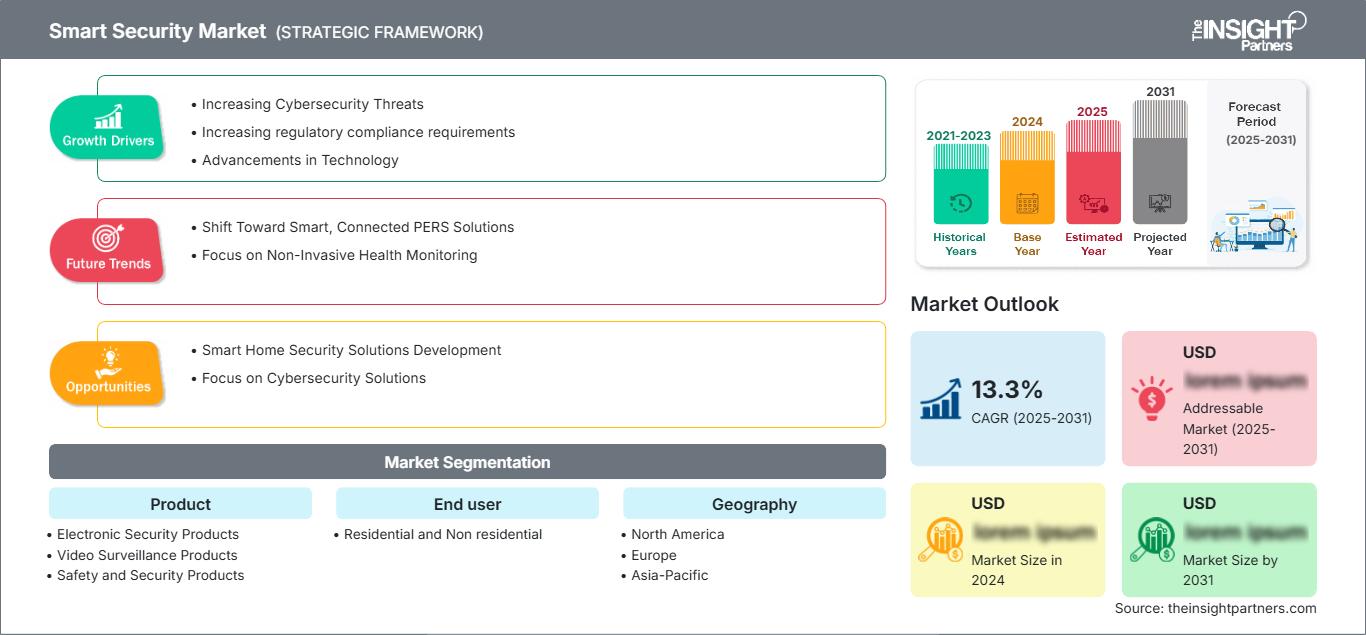
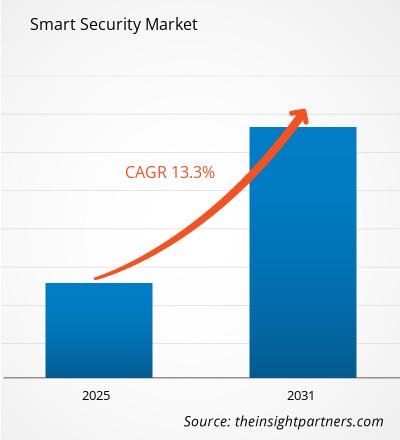
The global smart security market was valued at US$ 84.64 billion in 2025 and is projected to reach US$ 239.70 billion by 2034, registering a compound annual growth rate (CAGR) of 12.26% from 2026 to 2034. This growth trajectory is underpinned by rising crime rates, increasing adoption of IoT-enabled devices, and the expansion of smart city infrastructure projects worldwide .
North America accounted for a substantial portion of the global smart security market size in 2025, estimated at 32-36%, and is projected to grow at a CAGR of 10-12% from 2026 to 2034. Structural growth drivers in the region include the high penetration of smart home ecosystems and the presence of major technology providers, alongside the growing integration of video analytics and facial recognition technologies in surveillance systems .
Smart Security Market Assessment and Insights
- North America: North America is a leading market, driven by high consumer awareness and the rapid adoption of smart home technologies. It is estimated to hold a 32-36% share in 2025 and is projected to grow at a CAGR of 10-12% from 2026 to 2034.
- U.S.: The U.S. dominates the North American market, accounting for 82-86% of the region's share in 2025. Its growth is propelled by high spending on residential security and the presence of key players like ADT, Alphabet Inc., and Comcast. The market is expected to grow at a CAGR of 11-13% from 2026 to 2034 .
- Europe: Europe holds an estimated 25-29% share of the global market in 2025, with a projected CAGR of 9-11% from 2026 to 2034. Leading countries include Germany, the UK, and France, driven by stringent data protection regulations and a focus on advanced security solutions .
- Asia Pacific: APAC is estimated to hold a 27-31% share in 2025 and is projected to grow at the fastest CAGR of 13-15% from 2026 to 2034. China, Japan, South Korea, and India are key markets, fueled by rapid urbanization, smart city investments, and the expansion of public safety infrastructure .
- Largest Segment: The Video Surveillance Products segment is estimated to be the largest product segment, holding a 34-38% share in 2025 and projected to grow at a CAGR of 11-13% from 2026 to 2034 .
- High Growth Segment: The Access Control Systems segment is projected to be the fastest-growing product segment, driven by the increasing demand for secure and contactless entry systems. It holds a 16-20% share in 2025 and is expected to grow at a CAGR of 13-15% from 2026 to 2034.
- Key companies analyzed in detail: ADT, Alphabet Inc., Incorporated, Canary Connect, Inc., Comcast, Honeywell International Inc., Hangzhou Hikvision Digital Technology Co., Ltd., NETGEAR, Bosch Security Systems, and Johnson Controls International .
Source: The Insight Partners' analysis based on proprietary research, government publications, company annual reports, investor presentations, industry databases, and expert interviews.
There have been many changes in the global smart security market in the recent past where it has shifted from the alarm systems to an integrated smart security ecosystem. These changes have been attributed to innovations such as video analytics, cloud monitoring, and connected devices which help in real-time threat detection and automated incident response. The production dynamics of the smart security products have shifted towards developing hardware and software that are inter-operable, scalable and accessible by the users.
In the future, the market is expected to grow significantly in the emerging countries due to rapid urbanization and spending on infrastructure where the need for smart surveillance and access control will increase. Large amounts of capital are being invested in AI-based video analytics platforms and cloud-based security services to increase operational efficiencies and minimize response time. Favorable regulatory headwinds include government programs for the development of smart cities and cybersecurity regulations.
Smart Security Market Report Scope
| Report Attribute | Details |
|---|---|
| Market size in 2025 | US$ 84.64 Billion |
| Market Size by 2034 | US$ 239.7 Billion |
| Global CAGR (2026 - 2034) | 12.26% |
| Historical Data | 2021-2024 |
| Forecast period | 2026-2034 |
Smart Security Market Analysis
The global smart security market is propelled by escalating concerns over property crime and the need for enhanced public safety, with increasing adoption of smart devices by homeowners . The integration of artificial intelligence and machine learning into video surveillance and access control systems is enhancing threat detection capabilities and driving market demand .
The ecosystem comprises component suppliers, hardware manufacturers, software developers, and system integrators collaborating to deliver comprehensive security solutions. Supply-side dynamics are characterized by strategic partnerships and product launches by key players such as Hangzhou Hikvision Digital Technology Co., Ltd. and Incorporated.
The competitive landscape is diverse, with established appliance giants and new technology-driven entrants vying for market share. Companies such as Honeywell International Inc. and ADT are focusing on expanding their cloud-based service portfolios to strengthen their market position .
Investment trends indicate a strong shift toward developing solutions that integrate video surveillance with access control and intrusion detection within unified platforms . The market is also witnessing a growing emphasis on cybersecurity measures to address vulnerabilities in connected security devices .
● REPORT CUSTOMIZATION
Tailor This Report To Align With Your Specific Business Requirements
This report can be customized to align precisely with your business objectives, scope, and target markets. Customization options include tailored segmentation, geography, competitive analysis, and strategic insights to support informed decision-making.
Customize This Report →WHAT YOU CAN ADJUST
- ● Segmentations
- ● Geography
- ● Competitive Analysis
- ● Language Preferences
Smart Security Market: Strategic Insights
Regional Insights
North America Smart Security Market
North America is a dominant force in the global smart security market, holding an estimated 32-36% share in 2025 and projected to grow at a CAGR of 10-12% from 2026 to 2034. The region's growth is underpinned by high consumer spending on home security systems and the early adoption of video surveillance technologies. The U.S. leads the region, with strong participation from both established security providers and technology companies in the residential and commercial sectors .
U.S. Smart Security Market
The U.S. accounts for approximately 82-86% of the North American smart security market share in 2025. The market is characterized by robust spending on residential security and the presence of major players such as ADT and Comcast. The market is projected to grow at a CAGR of 11-13% from 2026 to 2034, driven by the integration of AI and cloud-based monitoring services. Application trends show a strong leaning toward comprehensive home automation systems, with increasing interest in smart locks and video doorbells .
Europe Smart Security Market
Europe is estimated to hold a 25-29% share of the global market in 2025, with a projected CAGR of 9-11% from 2026 to 2034. Germany and the UK are leading countries, driven by strong regulatory frameworks and a focus on data privacy. France, Italy, and Spain are also significant markets, with demand fueled by investments in commercial security and the modernization of public infrastructure. The region's emphasis on compliance with GDPR is accelerating the adoption of secure and integrated security solutions .
APAC Smart Security Market
APAC is estimated to hold a 27-31% share of the global market in 2025 and is projected to grow at the fastest CAGR of 13-15% from 2026 to 2034. China, Japan, South Korea, India, and Australia are key markets, driven by rapid urbanization, expanding smart city initiatives, and increasing investments in public safety infrastructure. China holds the largest share in the region, supported by its strong domestic manufacturing base and aggressive infrastructure modernization plans. The presence of major electronics manufacturers and government policies promoting digital security are significant growth drivers in the region .
Middle East & Africa Smart Security Market
According to the Smart Security market report, the MEA region is estimated to hold a 4-6% share of the global market in 2025, with a projected CAGR of 8-10% from 2026 to 2034. Saudi Arabia, the UAE, and South Africa are key markets, with growth driven by ambitious infrastructure development projects and increasing investments in digital security solutions. The UAE is a leader in the region, implementing integrated security systems with AI-based surveillance and access control. Energy infrastructure protection and tourism development are important contextual factors influencing market growth .
Segmentation Analysis
Product
The product segment is categorized into Electronic Security Products, Video Surveillance Products, Safety and Security Products, and Access Control Systems. The Video Surveillance Products segment is estimated to be the largest, holding a 34-38% share in 2025, with a projected CAGR of 11-13% from 2026 to 2034. These systems are critical for deterring crime, providing evidence, and enabling real-time monitoring across residential, commercial, and public spaces. The rising adoption of IP-based cameras with high-definition imaging and AI capabilities is a key growth driver .
- Electronic Security Products: Electronic security products encompass a broad range of devices, including sensors, alarms, and control panels. They form the foundation of intrusion detection systems, serving as the primary line of defense in residential and commercial properties.
- Video Surveillance Products: This is the leading sub-segment, driven by the need for visual monitoring and evidence collection. It includes analog and IP cameras, video recorders, and software for managing and analyzing video footage. The integration of AI for facial recognition is a major trend .
- Safety and Security Products: This category includes safety devices such as smoke detectors, carbon monoxide alarms, and environmental monitoring sensors. They are increasingly integrated into smart home security platforms for enhanced protection.
- Access Control Systems: Access control systems include electronic locks, card readers, and biometric systems. They are essential for managing entry to buildings and secure areas. The shift toward mobile-based credentials and cloud-managed systems is a key trend.
End User
The end user segment is divided into Residential and Non-residential. The Residential segment is estimated to be the largest, holding a 55-60% share in 2025, with a projected CAGR of 11-13% from 2026 to 2034. This dominance is driven by the increasing consumer demand for smart home safety and convenience, with features such as remote monitoring, mobile alerts, and integration with voice assistants .
- Residential: The residential segment encompasses smart security solutions in private households. The growth is driven by rising crime awareness, the desire for convenience, and the availability of affordable, DIY-installable systems. Demand is strong for video doorbells, smart locks, and indoor/outdoor cameras.
- Non-residential: The non-residential segment includes commercial, industrial, and government facilities. This segment is driven by the need to protect assets, ensure employee safety, and comply with regulations. Growth is fueled by the adoption of integrated systems combining surveillance, access control, and intrusion detection.
Opportunity Snapshot
| End User | Revenue Contribution | Trend Tag | Adoption Stage |
|---|---|---|---|
| Residential | High | DIY Security | Scaling |
| Non-residential | High | Integrated Systems | Mature |
Smart Security Market Growth Drivers and Impact Analysis
Rising Crime Rates and Safety Concerns
Increasing global crime rates and heightened safety concerns are compelling both residential and commercial property owners to invest in advanced security systems. As per industry reports, over one million home burglaries occur annually in the U.S., driving significant spending on security devices . This is a primary driver for the smart security market, as consumers and businesses seek intelligent solutions for real-time monitoring, deterrence, and rapid response to threats .
Furthermore, growing concerns about theft, vandalism, unauthorized access, and property damage are encouraging users to move beyond conventional security measures. Smart cameras, connected alarms, access control systems, and motion sensors provide continuous monitoring and can send instant notifications to property owners or security personnel. The increasing affordability and accessibility of connected security devices are also making advanced protection solutions more attractive to small businesses and households. As consumers become more aware of security risks, demand for integrated systems capable of providing remote monitoring, automated alerts, and rapid incident detection is expected to continue increasing across residential and commercial applications.
Technological Advancements in AI and Video Analytics
The Smart Security market forecast indicates that the market is propelled by continuous innovation in artificial intelligence and video analytics, enabling the development of more intelligent and proactive security solutions. These technologies allow for features like facial recognition, object detection, and behavioral analysis, which enhance threat identification and reduce false alarms. The integration of AI with edge computing is also improving processing speed and system efficiency .
The increasing availability of advanced machine learning algorithms is enabling security systems to analyze large volumes of video data with greater accuracy and speed. AI-powered platforms can distinguish between people, vehicles, animals, and other movements, allowing operators to prioritize genuine security events. Edge-based processing can further reduce latency by analyzing data closer to the source rather than relying entirely on cloud infrastructure. In addition, improvements in image quality, low-light performance, and automated anomaly detection are expanding the usefulness of smart surveillance systems. These capabilities are encouraging organizations to replace traditional monitoring solutions with more intelligent, scalable, and data-driven security technologies.
Expansion of Smart City and Smart Home Initiatives
Government investments in smart city infrastructure and the growing popularity of smart homes are prominent Smart Security market trends. Smart city initiatives are deploying intelligent surveillance networks to improve public safety and traffic management, while smart home ecosystems are integrating security devices as a core component . These trends are creating a favorable environment for the widespread adoption of smart security solutions .
The growing deployment of connected infrastructure is also encouraging greater interoperability between cameras, sensors, access control systems, alarms, and centralized management platforms. In smart homes, consumers increasingly expect security devices to integrate with smartphones, voice assistants, home automation systems, and other connected appliances. Meanwhile, municipalities are adopting networked surveillance and monitoring technologies to support emergency response, crowd management, and infrastructure protection. The expansion of high-speed internet and connected device ecosystems is further supporting these applications. As smart city and smart home investments increase, demand for integrated security solutions that provide centralized control, automation, and real-time visibility is expected to grow steadily.
Smart Security Market Future Trends
Integration of AI and Deep Learning Platforms
A key future trend is the deep integration of AI and deep learning platforms into security systems. This will transform passive monitoring into proactive threat detection, enabling predictive analytics to identify potential security breaches before they occur. AI will also drive automation, with systems capable of autonomously responding to incidents, such as locking doors or alerting authorities, based on learned patterns .
Expansion of Cloud-Based and Subscription Security Services
The market is moving toward cloud-based security solutions and subscription-based service models. This trend is enabling remote access, scalable storage, and continuous software updates. For consumers and businesses, it lowers upfront hardware costs and provides professional monitoring services, creating a recurring revenue stream for providers .
Smart Security Market Opportunities
Untapped Growth in Commercial and Industrial Sectors
A significant opportunity lies in addressing the evolving security needs of commercial and industrial sectors, including retail, healthcare, and logistics. These sectors require integrated solutions that combine video surveillance, access control, and operational analytics. Tailoring solutions for specific industry verticals can unlock substantial market potential, particularly as businesses look to protect assets and ensure workplace safety .
Development of Cybersecurity-Integrated Solutions
As smart security devices become more connected, the threat of cyberattacks on these systems is increasing. A major opportunity exists in developing integrated security solutions that address both physical and digital threats. Companies that prioritize robust cybersecurity measures, offering end-to-end encryption and secure firmware updates, will gain a significant competitive advantage in the market .
Recent Developments
- March 2026: Hikvision has launched a brand new TalkVu Video Intercom series. This next-generation family of products transforms how homeowners experience security and communication. Embodying the brand vision ‘Talk Clear, View Smart’, the TalkVu series combines crystal-clear 4 MP imaging, AI-powered audio optimization, and intuitive controls to deliver exceptional clarity in monitoring doorstep activities, distortion-free conversations, and seamless management of connected environments.
- October 2025: Hikvision, a global leader in the AI-powered Internet of Things (AIoT), recently launched its new AOV SolarVu Camera Series. The introduction of the new series delivers reliable, continuous video security in remote, off-grid environments.
- September 2025: Dahua Technology, a world-leading video-centric AIoT solution and service provider, announced the global debut of WITHS Series at IFA Berlin 2025. Developed to meet the specific needs of small and medium-sized businesses (SMBs), WITHS provides intelligent, simple-to-deploy, and reliable wireless surveillance solutions that enable owners to safeguard their shops, offices, warehouses, and outdoor facilities with ease.
Frequently Asked Questions

- Comprehensive Market Sizing and Forecast Analysis
- Detailed Segmentation Analysis
- In-Depth Market Dynamics Assessment
- Regional and Country-Level Insights
- Competitive Landscape and Company Benchmarking
- Strategic Business Intelligence
Recent Reports
Testimonials

The Insight Partners' SCADA System Market report is comprehensive, with valuable insights on current trends and future forecasts. The team was highly professional, responsive, and supportive throughout. We are very satisfied and highly recommend their services.
RAN KEDEM Partner, Reali Technologies LTDs
I requested a report on a very specific software market and the team produced the report in a few days. The information was very relevant and well presented. I then requested some changes and additions to the report. The team was again very responsive and I got the final report in less than a week.
JEAN-HERVE JENN Chairman, Future Analytica
We worked with The Insight Partners for an important market study and forecast. They gave us clear insights into opportunities and risks, which helped shape our plans. Their research was easy to use and based on solid data. It helped us make smart, confident decisions. We highly recommend them.
PIYUSH NAGPAL Sr. Vice President, High Beam Global
The Insight Partners delivered insightful, well-structured market research with strong domain expertise. Their team was professional and responsive throughout. The user-friendly website made accessing industry reports seamless. We highly recommend them for reliable, high-quality research services
YUKIHIKO ADACHI CEO, Deep Blue, LLC.
This is the first time I have purchased a market report from The Insight Partners.While I was unsure at first, I visited their web site and felt more comfortable to take the risk and purchase a market report.I am completely satisfied with the quality of the report and customer service. I had several questions and comments with the initial report, but after a couple of dialogs over email with their analyst I believe I have a report that I can use as input to our strategic planning process.Thank you so much for taking the extra time and making this a positive experience.I will definitely recommend your service to others and you will be my first call when we need further market data.
JOHN SUZUKI President and Chief Executive Officer, Board Director, BK Technologies
I wish to appreciate your support and the professionalism you displayed in the course of attending to my request for information regarding to infectious disease IVD market in Nigeria. I appreciate your patience, your guidance, and the fact that you were willing to offer a discount, which eventually made it possible for us to close a deal. I look forward to engaging The Insight Partners in the future, all thanks to the impression you have created in me as a result of this first encounter.
DR CHIJIOKE ONYIA MANAGING DIRECTOR, PineCrest Healthcare Ltd.Reason to Buy
- Informed Decision-Making
- Understanding Market Dynamics
- Competitive Analysis
- Identifying Emerging Markets
- Customer Insights
- Market Forecasts
- Risk Mitigation
- Boosting Operational Efficiency
- Strategic Planning
- Investment Justification
- Tracking Industry Innovations
- Aligning with Regulatory Trends





 Get Free Sample for