
Smart Sensors for Aerospace Market Size, Share & Trends by 2034
Coverage: By Type (Fiber Optic Sensor, MEMS Sensor, Nano Sensor, Ultrasonic Sensor, Acoustic Sensor, Imaging Sensor, Temperature Sensor, Others); Aircraft Type (Commercial, Military) , and Geography (North America, Europe, Asia Pacific, and South and Central America)
- Status : Data Released
- Report Code : TIPRE00024663
- Category : Electronics and Semiconductor
- No. of Pages : 150
- Available Report Formats :


- Last update date : August 26, 2026


2025 Market Size
US$ 4.01 Bn
Base year value
2034 Forecast
US$ 19.88 Bn
Projected by 2034
CAGR 2026-2034
19.47 %
Growth rate
Addressable Market
US$ 97.40 Bn
(2026-2034)
The global smart sensors for aerospace market was valued at US$ 4.01 billion in 2025 and is projected to reach US$ 19.88 billion by 2034, registering a compound annual growth rate (CAGR) of 19.47% from 2026 to 2034. This robust growth trajectory is underpinned by the increasing demand for advanced avionics, the rising adoption of unmanned aerial vehicles (UAVs), and the growing emphasis on predictive maintenance and structural health monitoring across commercial and military aviation sectors.
North America accounted for a substantial portion of the global smart sensors for aerospace market size in 2025, estimated at 38-42%, and is projected to grow at a CAGR of 18-20% from 2026 to 2034. Structural growth drivers in the region includes the presence of major aircraft manufacturers like Boeing and Lockheed Martin, along with significant government investments in advanced military aircraft programs such as the F-35 and B-21 Raider.
Smart Sensors for Aerospace Market Assessment and Insights
- North America: North America is the leading regional market, driven by its position as the world's premier aerospace manufacturing hub and strong defense spending. It is estimated to hold a 38-42% share in 2025 and is projected to grow at a CAGR of 18-20% from 2026 to 2034.
- U.S.: The U.S. dominates the North American market, accounting for 85-89% of the region's share in 2025. Its growth is propelled by high defense budgets and the presence of key OEMs. The market is expected to grow at a CAGR of 19-21% from 2026 to 2034.
- Europe: Europe holds an estimated 28-32% share of the global market in 2025, with a projected CAGR of 17-19% from 2026 to 2034. Leading countries include Germany, the UK, and France, driven by the presence of Airbus, a strong aerospace supply chain, and a focus on technological innovation in sensor systems.
- Asia Pacific: APAC is estimated to hold a 22-26% share in 2025 and is projected to grow at the fastest CAGR of 20-22% from 2026 to 2034. China, Japan, South Korea, and India are key markets, fueled by rapid aircraft production expansion, homegrown programs like the COMAC C919, and increasing defense modernization initiatives.
- Largest Segment: The Fiber Optic Sensor segment is estimated to be the largest type segment, holding a 20-24% share in 2025 and projected to grow at a CAGR of 18-20% from 2026 to 2034.
- High Growth Segment: The MEMS Sensor segment is projected to be the fastest-growing type segment, driven by its advantages of miniaturization, low power consumption, and high reliability. It holds a 16-20% share in 2025 and is expected to grow at a CAGR of 21-23% from 2026 to 2034.
- Key companies analyzed in detail: Avnet, Inc., Analog Devices, Inc., Eaton, Emerson Electric Co., Infineon Technologies AG, NXP Semiconductors, Renesas Electronics Corporation, STMicroelectronics, BAE Systems, and ABB Ltd.
Source: The Insight Partners' analysis based on proprietary research, government publications, company annual reports, investor presentations, industry databases, and expert interviews.
There has been a drastic change in the global smart sensors for aerospace market that has changed from simple transducers to advanced multi-functional components required for controlling flight, navigation, and monitoring purposes. This change has come about due to improvements in MEMS, nanotechnology, and fiber optic technology that have increased the ability of sensors to process information more effectively while ensuring accurate and reliable information processing under the harsh conditions in aerospace environment. The production dynamics in the sector have also changed where robust, lightweight, and radiation tolerant sensor systems are being produced to meet the requirements of commercial and military airlines.
The smart sensors for aerospace market report indicates that the market is likely to witness tremendous growth due to the emergence of new economies that have rapidly been growing their fleets of aircraft as well as launching of new programs on a large scale. Heavy investments are being made to develop sensors that will be able to power themselves as well as establish wireless sensor network to monitor the condition of the structure continuously.
Smart Sensors for Aerospace Market Report Scope
| Report Attribute | Details |
|---|---|
| Market size in 2025 | US$ 4.01 Billion |
| Market Size by 2034 | US$ 19.88 Billion |
| Global CAGR (2026 - 2034) | 19.47% |
| Historical Data | 2021-2024 |
| Forecast period | 2026-2034 |
Smart Sensors for Aerospace Market Analysis
The global smart sensors for aerospace market is propelled by escalating demand for advanced avionics systems, real-time health monitoring, and enhanced operational safety across the aviation sector. The increasing production of commercial aircraft and the integration of IoT-enabled smart sensors for predictive maintenance are significant demand drivers.
The ecosystem comprises component suppliers, sensor manufacturers, system integrators, and OEMs collaborating to deliver comprehensive sensing solutions. Supply-side dynamics are characterized by strategic partnerships and product launches by key players to strengthen their technology portfolios.
The competitive landscape includes established electronics giants and specialized sensor manufacturers, with companies such as Analog Devices, Inc. and Infineon Technologies AG focusing on expanding their aerospace-grade sensor offerings.
STMicroelectronics and NXP Semiconductors are also active in developing innovative sensor solutions for flight control and engine monitoring applications. The smart sensors for aerospace market trends include investments that indicate a strong shift toward developing advanced MEMS and optical sensor technologies capable of operating in harsh environmental conditions, with a growing emphasis on sensor fusion and edge computing capabilities.
● REPORT CUSTOMIZATION
Tailor This Report To Align With Your Specific Business Requirements
This report can be customized to align precisely with your business objectives, scope, and target markets. Customization options include tailored segmentation, geography, competitive analysis, and strategic insights to support informed decision-making.
Customize This Report →WHAT YOU CAN ADJUST
- ● Segmentations
- ● Geography
- ● Competitive Analysis
- ● Language Preferences
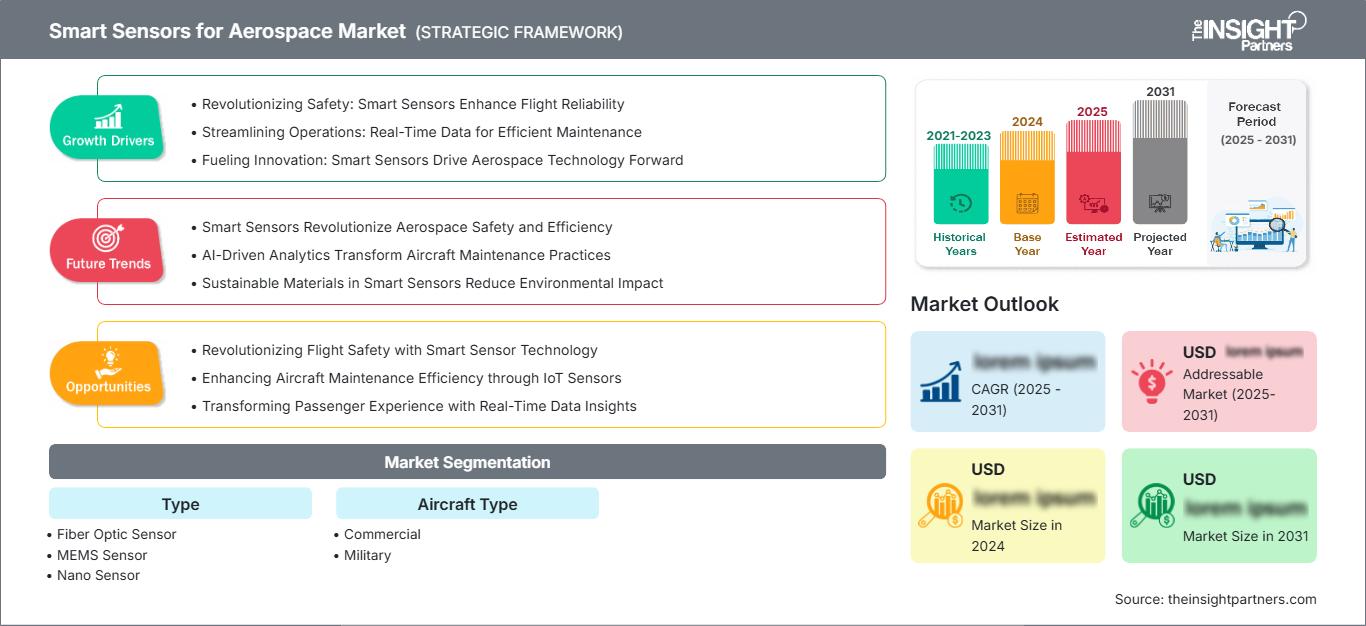
Smart Sensors for Aerospace Market: Strategic Insights
Regional Insights
North America Smart Sensors for Aerospace Market
North America is the dominant force in the global smart sensors for aerospace market, holding an estimated 38-42% share in 2025 and projected to grow at a CAGR of 18-20% from 2026 to 2034. The region's growth is underpinned by its position as the world's leading aerospace manufacturing hub, housing major OEMs like Boeing and Lockheed Martin . The U.S. leads the region, with strong participation from both defense contractors and technology companies in developing next-generation sensor technologies for military and commercial platforms.
U.S. Smart Sensors for Aerospace Market
The U.S. accounts for approximately 85-89% of the North American smart sensors for aerospace market share in 2025. The market is characterized by robust defense spending and the presence of a well-established aerospace supply chain. The market is projected to grow at a CAGR of 19-21% from 2026 to 2034, driven by the integration of AI and advanced sensor technologies for predictive maintenance and autonomous operations. Major military programs like the F-35 and B-21 Raider are key demand drivers for advanced sensing solutions.
Europe Smart Sensors for Aerospace Market
Europe is estimated to hold a 28-32% share of the global market in 2025, with a projected CAGR of 17-19% from 2026 to 2034. Germany and the UK are leading countries, driven by the presence of Airbus and a strong aerospace supply chain. France, Italy, and Spain are also significant markets, with demand fueled by investments in commercial aircraft production and defense modernization. The region's emphasis on innovation and environmental sustainability is accelerating the adoption of energy-efficient sensor technologies.
APAC Smart Sensors for Aerospace Market
APAC is estimated to hold a 22-26% share of the global market in 2025 and is projected to grow at the fastest CAGR of 20-22% from 2026 to 2034. China, Japan, South Korea, India, and Australia are key markets, driven by rapid aircraft production expansion, homegrown aircraft programs like the COMAC C919, HAL Tejas, and Mitsubishi SpaceJet, and increasing defense modernization initiatives. China holds the largest share in the region, supported by its strong domestic manufacturing base and aggressive infrastructure modernization plans. Government policies promoting aerospace innovation and digital transformation are significant growth drivers in the region.
Middle East & Africa Smart Sensors for Aerospace Market
The MEA region is estimated to hold a 4-6% share of the global market in 2025, with a projected CAGR of 15-17% from 2026 to 2034. Saudi Arabia, the UAE, and South Africa are key markets, with growth driven by ambitious infrastructure development projects and increasing investments in defense modernization. The UAE is a leader in the region, implementing advanced aerospace technologies and services. Energy diversification and tourism development are important contextual factors influencing market growth.
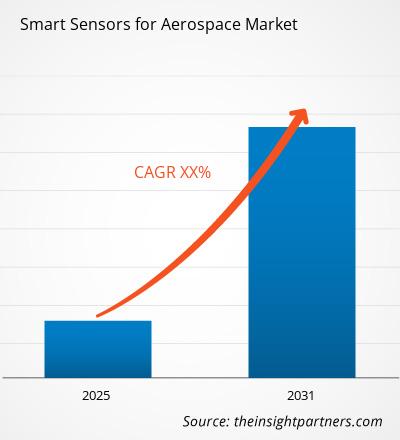
Segmentation Analysis
Type
The type segment of the smart sensors for aerospace market is categorized into Fiber Optic Sensor, MEMS Sensor, Nano Sensor, Ultrasonic Sensor, Acoustic Sensor, Imaging Sensor, and Temperature Sensor. The Fiber Optic Sensor segment is estimated to be the largest, holding a 20-24% share in 2025, with a projected CAGR of 18-20% from 2026 to 2034 . These sensors are critical for monitoring strain, pressure, and temperature in aircraft structures and engines, offering high immunity to electromagnetic interference and enabling distributed sensing capabilities. The smart sensors for aerospace scope covers a wide range of applications, from structural health monitoring to engine performance optimization.
- Fiber Optic Sensor: Fiber optic sensors are used for measuring strain, temperature, and pressure in aircraft structures and engines. Their immunity to electromagnetic interference and ability to provide distributed sensing make them ideal for structural health monitoring applications.
- MEMS Sensor: MEMS sensors are miniaturized devices that combine mechanical and electrical components on a single chip. They are used in inertial measurement units, pressure sensors, and microphones, offering advantages of small size, low power consumption, and high reliability.
- Nano Sensor: Nano sensors utilize nanotechnology for enhanced sensitivity and selectivity in detecting physical and chemical parameters. They are emerging for applications such as gas detection and advanced material monitoring in extreme environments.
- Ultrasonic Sensor: Ultrasonic sensors use sound waves for distance measurement and non-destructive testing. They are used for proximity sensing and structural flaw detection in aircraft components.
- Acoustic Sensor: Acoustic sensors detect sound and vibration for monitoring engine health and detecting structural damage. They are used for early fault detection and condition-based maintenance.
- Imaging Sensor: Imaging sensors include cameras and infrared detectors used for surveillance, navigation, and thermal imaging. They are increasingly integrated into aircraft for enhanced situational awareness and safety.
- Temperature Sensor: Temperature sensors are essential for monitoring engine and environmental conditions. They ensure safe and efficient operation by providing critical data for engine control and thermal management systems.
Aircraft Type
The aircraft type segment is divided into Commercial and Military. The Commercial segment is estimated to be the largest, holding a 60-65% share in 2025, with a projected CAGR of 18-20% from 2026 to 2034. This dominance is driven by the increasing production of commercial aircraft and the growing integration of advanced sensing systems for improved fuel efficiency and passenger safety.
- Commercial: The commercial segment includes smart sensors used in passenger and cargo aircraft. The growth is driven by rising air travel demand, fleet modernization, and the need for efficient maintenance, with sensors playing a key role in health monitoring and avionics.
- Military: The military segment includes smart sensors used in fighter jets, transport aircraft, and UAVs. This segment is driven by defense modernization programs and the need for advanced capabilities in surveillance, navigation, and situational awareness.
Opportunity Snapshot
| Aircraft Type | Revenue Contribution | Trend Tag | Adoption Stage |
|---|---|---|---|
| Commercial | High | Fleet Health | Scaling |
| Military | High | Combat Tech | Mature |
Smart Sensors for Aerospace Market Growth Drivers and Impact Analysis
Increasing Production of Commercial Aircraft
The rising production rates of commercial aircraft, driven by growing global air travel demand and the emergence of low-cost carriers, are significantly boosting the demand for smart sensors. The expansion of production programs for next-generation aircraft like the Boeing 737 MAX and Airbus A320neo is creating substantial opportunities for sensor manufacturers. This growth is further supported by the increasing adoption of advanced avionics and fly-by-wire systems that require high-performance sensing solutions.
Rising Adoption of Unmanned Aerial Vehicles (UAVs)
The increasing deployment of UAVs for military, commercial, and civilian applications is a key growth driver for the smart sensors for aerospace market. UAVs require a diverse range of advanced sensors for navigation, surveillance, and payload operations, driving demand for compact, lightweight, and low-power solutions. The expansion of UAV applications across various sectors is creating new opportunities for sensor innovation and deployment.
Growing Emphasis on Predictive Maintenance and Structural Health Monitoring
The increasing focus on predictive maintenance and structural health monitoring to enhance aircraft safety, reduce unplanned downtime, and optimize maintenance costs is a significant market driver. Smart sensors enable real-time data collection and analysis, facilitating the early detection of potential faults and enabling proactive maintenance. This approach is gaining traction in both commercial and military aviation, driving investment in advanced sensor technologies.
Smart Sensors for Aerospace Market Future Trends
Development of Self-Powered and Wireless Sensor Networks
A key future trend is the development of self-powered and wireless sensor networks for aircraft health monitoring. Advances in energy harvesting technologies, such as solar and vibration-based power, are enabling the deployment of autonomous sensor nodes that eliminate the need for extensive wiring. This trend, which is a significant part of the smart sensors for aerospace trends, simplifies installation, reduces weight, and enables continuous monitoring of critical aircraft components.
Integration of AI and Edge Computing for Real-Time Analytics
The integration of artificial intelligence (AI) and edge computing capabilities into sensor systems is a defining trend. Processing data at the sensor level enables real-time analytics, reducing latency and the need for extensive data transmission. This approach will empower faster decision-making for critical applications like fault detection and flight control, making aircraft systems more intelligent and responsive.
Smart Sensors for Aerospace Market Opportunities
Expansion in Emerging Economies with Large-Scale Aerospace Programs
A significant opportunity lies in the expanding aerospace programs in emerging economies across Asia Pacific, Latin America, and the Middle East. The development of new aircraft programs and the expansion of manufacturing facilities are creating substantial demand for advanced sensor technologies. Companies that can establish strong partnerships with local OEMs and offer cost-effective, high-performance solutions are poised to capture significant market share in these high-growth regions, as highlighted in smart sensors for aerospace market forecasts.
Development of Sensors for Advanced Air Mobility (AAM) and eVTOL Platforms
The development of sensors for emerging advanced air mobility (AAM) and electric vertical takeoff and landing (eVTOL) platforms represents a major market opportunity. These new platforms require specialized sensing solutions for navigation, collision avoidance, and autonomous flight operations. Companies pioneering sensor technologies tailored for these applications are well-positioned to benefit from this growing segment.
Recent Developments
- August 2026: MicroVision, Inc, a leader in advanced perception solutions for industrial, security and defense, and automotive applications, announced the launch of its MOVIA Air product family, purpose-built for autonomous aerial systems. The portfolio includes MOVIA Air, a lightweight lidar sensor optimized specifically for unmanned aerial vehicles (UAVs), and MOVIA Air Plus, which combines the MOVIA Air sensor with edge processing and video imaging. On its own, MOVIA Air runs MicroVision's embedded algorithms to support autonomous landing, obstacle avoidance, and object tracking. MOVIA Air Plus combines an edge processor and optional camera to extend these capabilities to real-time 3D environmental awareness, generating realistic world maps in real time, and simultaneous localization and mapping (SLAM) navigation.
- August 2026: Lockheed Martin (NYSE: LMT), in collaboration with Verizon, NVIDIA, Keysight Technologies, ODC and Astris AI, recently showcased how commercial off-the-shelf (COTS) technologies can make detecting and tracking unmanned aircraft systems (UAS) more accessible, faster to deploy, and easier to scale for public and critical infrastructure protection. In a July demonstration in the Miami area, the NetSense Airspace Awareness-as-a-Service system demonstrated an AI-enabled system capable of identifying, tracking and monitoring UAS utilizing existing 5G networks.
- June 2025: The Chemical Species Gas Sensors Team at NASA’s Glenn Research Center in Cleveland is developing microsensing technology for aerospace applications. Their approach is to implement sensitive and selective sensor systems capable of providing quantitative measurements of the environment, enabling better cognition and decision-making. The sensors can be used for leak detection and emission, safety, human health, and planetary exploration. The resulting sensor system is meant to be small, smart, and rugged with capabilities tailored for the targeted application.
Frequently Asked Questions

- Comprehensive Market Sizing and Forecast Analysis
- Detailed Segmentation Analysis
- In-Depth Market Dynamics Assessment
- Regional and Country-Level Insights
- Competitive Landscape and Company Benchmarking
- Strategic Business Intelligence
Recent Reports
Testimonials

The Insight Partners provided valuable market intelligence that supported our global go-to-market strategy. Their team was professional, responsive, and attentive to our feedback, providing thoughtful analysis and helpful methodological clarifications throughout the project.
Junmo Kim Chief Financial Officer (CFO), Enertech Co., Ltd.
The Insight Partners' SCADA System Market report is comprehensive, with valuable insights on current trends and future forecasts. The team was highly professional, responsive, and supportive throughout. We are very satisfied and highly recommend their services.
RAN KEDEM Partner, Reali Technologies LTDs
I requested a report on a very specific software market and the team produced the report in a few days. The information was very relevant and well presented. I then requested some changes and additions to the report. The team was again very responsive and I got the final report in less than a week.
JEAN-HERVE JENN Chairman, Future Analytica
We worked with The Insight Partners for an important market study and forecast. They gave us clear insights into opportunities and risks, which helped shape our plans. Their research was easy to use and based on solid data. It helped us make smart, confident decisions. We highly recommend them.
PIYUSH NAGPAL Sr. Vice President, High Beam Global
The Insight Partners delivered insightful, well-structured market research with strong domain expertise. Their team was professional and responsive throughout. The user-friendly website made accessing industry reports seamless. We highly recommend them for reliable, high-quality research services
YUKIHIKO ADACHI CEO, Deep Blue, LLC.
This is the first time I have purchased a market report from The Insight Partners.While I was unsure at first, I visited their web site and felt more comfortable to take the risk and purchase a market report.I am completely satisfied with the quality of the report and customer service. I had several questions and comments with the initial report, but after a couple of dialogs over email with their analyst I believe I have a report that I can use as input to our strategic planning process.Thank you so much for taking the extra time and making this a positive experience.I will definitely recommend your service to others and you will be my first call when we need further market data.
JOHN SUZUKI President and Chief Executive Officer, Board Director, BK Technologies
I wish to appreciate your support and the professionalism you displayed in the course of attending to my request for information regarding to infectious disease IVD market in Nigeria. I appreciate your patience, your guidance, and the fact that you were willing to offer a discount, which eventually made it possible for us to close a deal. I look forward to engaging The Insight Partners in the future, all thanks to the impression you have created in me as a result of this first encounter.
DR CHIJIOKE ONYIA MANAGING DIRECTOR, PineCrest Healthcare Ltd.Reason to Buy
- Informed Decision-Making
- Understanding Market Dynamics
- Competitive Analysis
- Identifying Emerging Markets
- Customer Insights
- Market Forecasts
- Risk Mitigation
- Boosting Operational Efficiency
- Strategic Planning
- Investment Justification
- Tracking Industry Innovations
- Aligning with Regulatory Trends





 Get Free Sample for