
Smart Shade Devices Market Share, Growth & Demand by 2034
Coverage: By Technology (BLE, Wi-Fi, ZIGBEE, Z Wave); End User (Residential, Commercial), and Geography (North America, Europe, Asia Pacific, and South and Central America)
- Status : Data Released
- Report Code : TIPRE00014542
- Category : Electronics and Semiconductor
- No. of Pages : 150
- Available Report Formats :


- Last update date : August 26, 2026


2025 Market Size
US$ 3.6 Bn
Base year value
2034 Forecast
US$ 9.69 Bn
Projected by 2034
CAGR 2026-2034
11.62 %
Growth rate
Addressable Market
US$ 58.43 Bn
(2026-2034)
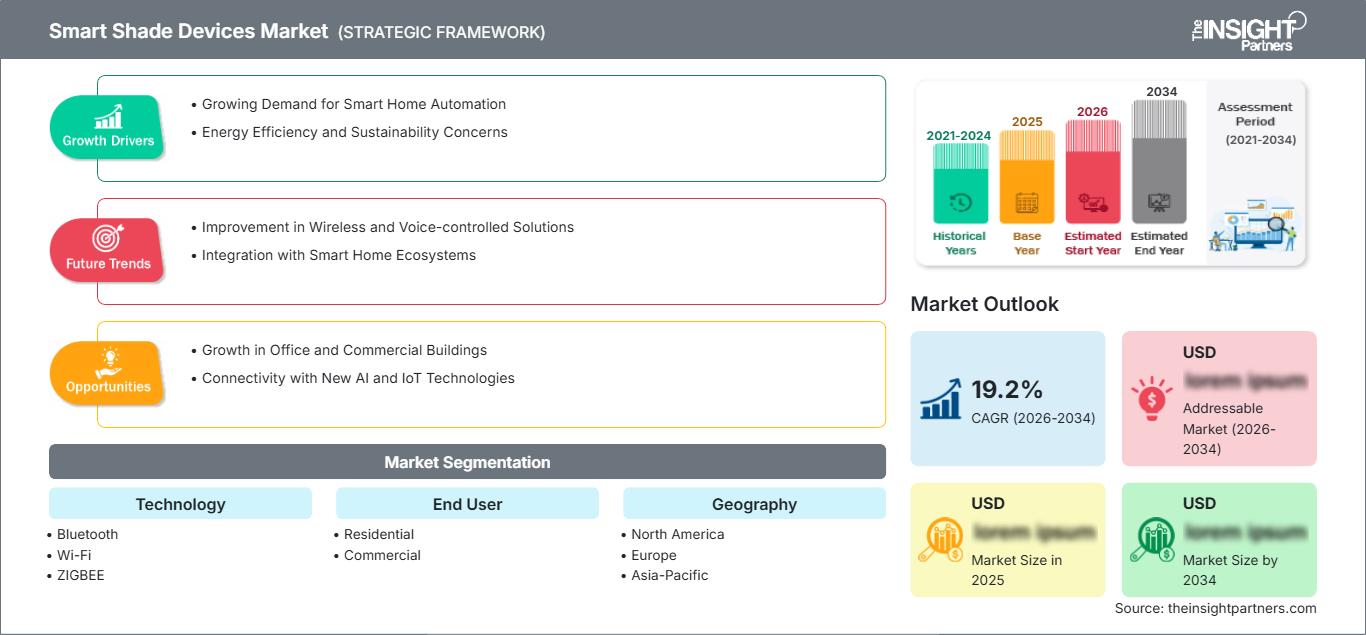
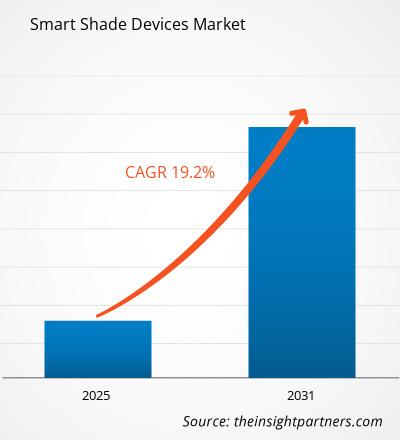
The global smart shade devices market was valued at US$ 3.60 billion in 2025 and is projected to reach US$ 9.69 billion by 2034, registering a compound annual growth rate (CAGR) of 11.62% from 2026 to 2034. This growth trajectory is underpinned by the increasing adoption of smart home automation systems and the growing consumer demand for energy-efficient and convenient window treatment solutions that integrate with connected living environments.
North America accounted for a substantial portion of the global smart shade devices market size in 2025, estimated at 42-46%, and is projected to grow at a CAGR of 10-12% from 2026 to 2034. Structural growth drivers in the region include the high penetration of smart home ecosystems and strong consumer spending on home renovation and automation, along with a well-established distribution network for motorized shading solutions.
Smart Shade Devices Market Assessment and Insights
- North America: North America is the leading regional market, driven by high consumer awareness, early adoption of smart home technologies, and significant spending on home automation. It is estimated to hold a 42-46% share in 2025 and is projected to grow at a CAGR of 10-12% from 2026 to 2034 .
- U.S.: The U.S. dominates the North American market, accounting for 85-89% of the region's share in 2025. Its growth is propelled by the presence of key players like Hunter Douglas and Lutron Electronics, alongside a strong culture of DIY home improvement . The market is expected to grow at a CAGR of 11-13% from 2026 to 2034 .
- Europe: Europe holds an estimated 28-32% share of the global market in 2025, with a projected CAGR of 9-11% from 2026 to 2034. Leading countries include Germany, the UK, and France, driven by a strong focus on energy efficiency and sustainable building design .
- Asia Pacific: APAC is estimated to hold a 18-22% share in 2025 and is projected to grow at the fastest CAGR of 12-14% from 2026 to 2034. China, Japan, South Korea, and Australia are key markets, fueled by rapid urbanization, rising disposable incomes, and the expansion of modern real estate developments .
- Largest Segment: The Residential end-user segment is estimated to be the largest, holding a 65-70% share in 2025 and projected to grow at a CAGR of 10-12% from 2026 to 2034 .
- High Growth Segment: The Commercial end-user segment is projected to be the fastest-growing, driven by increasing adoption in offices, hospitality, and institutional buildings . It holds a 30-35% share in 2025 and is expected to grow at a CAGR of 12-14% from 2026 to 2034 .
- Key companies analyzed in detail: Appeal Home Shading, Btx Inc, Hunter Douglas, Loxone, Lutron Electronics, inc, Mecho Systems, Misdar shade co ltd, Pella, Q Motion Shades, and Skyco Shading Systems.
Source: The Insight Partners' analysis based on proprietary research, government publications, company annual reports, investor presentations, industry databases, and expert interviews.
The smart shade devices market report indicates that the market has evolved from basic motorized blinds to sophisticated, IoT-enabled systems offering automated light and temperature control. This evolution has been driven by advancements in wireless communication protocols such as Zigbee and Z-Wave, enabling seamless integration with broader smart home ecosystems and voice-controlled assistants . Production dynamics have shifted toward developing quieter motors, longer-lasting batteries, and more durable materials to meet consumer expectations for reliability and performance .
Looking forward, the smart shade devices market is poised for substantial expansion in emerging economies, where rapid urbanization and the growth of commercial real estate are creating new demand for automated window treatments . Significant investments are being channeled into retrofit solutions and solar-powered devices to lower adoption barriers and appeal to a broader consumer base . Regulatory tailwinds, including green building standards and energy efficiency mandates, are expected to further catalyze market growth and innovation .
Smart Shade Devices Market Report Scope
| Report Attribute | Details |
|---|---|
| Market size in 2025 | US$ 3.6 Billion |
| Market Size by 2034 | US$ 9.69 Billion |
| Global CAGR (2026 - 2034) | 11.62% |
| Historical Data | 2021-2024 |
| Forecast period | 2026-2034 |
Smart Shade Devices Market Analysis
The smart shade devices market operates under the influence of increasing consumer preference for comfort, energy saving, and improved home security . The smart shading devices' compatibility with platforms such as Amazon Alexa and Google Home has provided voice-based operation and schedule-based functioning of the device, thus making smart shading devices an important constituent of a modern smart home . The industry has been formed from various suppliers, hardware providers, software providers, and system integrators.
Market conditions on the supply side have included several product launches and collaborations by the key players for expanding their technological offerings. For instance, companies such as Hunter Douglas and Lutron Electronics, inc. are concentrating on providing connectivity to several connectivity protocols in their products to make them marketable . The market is relatively fragmented, having a combination of established window treatments companies along with new players who offer retrofit smart shading solutions. There has been a major trend of investments towards designing energy harvesting devices and AI-based automation technologies that learn user preferences over time .
● REPORT CUSTOMIZATION
Tailor This Report To Align With Your Specific Business Requirements
This report can be customized to align precisely with your business objectives, scope, and target markets. Customization options include tailored segmentation, geography, competitive analysis, and strategic insights to support informed decision-making.
Customize This Report →WHAT YOU CAN ADJUST
- ● Segmentations
- ● Geography
- ● Competitive Analysis
- ● Language Preferences
Smart Shade Devices Market: Strategic Insights
Regional Insights
North America Smart Shade Devices Market
North America is the dominant force in the global smart shade devices market, holding an estimated 42-46% share in 2025 and projected to grow at a CAGR of 10-12% from 2026 to 2034. The region's growth is underpinned by high consumer spending on home automation and the widespread availability of smart home products. The U.S. leads the region, with strong participation from both established window treatment companies and technology-driven startups in the residential and commercial sectors.
U.S. Smart Shade Devices Market
The U.S. accounts for approximately 85-89% of the North American smart shade devices market share in 2025. The market is characterized by robust consumer interest in smart home technology and the presence of major players such as Hunter Douglas and Lutron Electronics. The market is projected to grow at a CAGR of 11-13% from 2026 to 2034, driven by the integration of IoT and voice control features. Application trends show a strong leaning toward whole-home automation, with increasing interest in motorized shades for hard-to-reach windows.
Europe Smart Shade Devices Market
Europe is estimated to hold a 28-32% share of the global market in 2025, with a projected CAGR of 9-11% from 2026 to 2034. Germany and the UK are leading countries, driven by stringent energy efficiency regulations and a focus on sustainable building design. France, Italy, and Spain are also significant markets, with demand fueled by investments in commercial real estate and the renovation of existing residential buildings. The region's emphasis on reducing energy consumption is accelerating the adoption of automated shading solutions.
APAC Smart Shade Devices Market
APAC is estimated to hold a 18-22% share of the global market in 2025 and is projected to grow at the fastest CAGR of 12-14% from 2026 to 2034. China, Japan, South Korea, Australia, and India are key markets, driven by rapid urbanization, rising disposable incomes, and the expansion of modern real estate developments. China holds the largest share in the region, supported by its strong domestic manufacturing base and growing middle class with an interest in smart home technology. The presence of major electronics manufacturers and the rapid growth of online distribution channels are significant growth drivers in the region.
Middle East & Africa Smart Shade Devices Market
The MEA region is estimated to hold a 3-5% share of the global market in 2025, with a projected CAGR of 8-10% from 2026 to 2034. Saudi Arabia, the UAE, and South Africa are key markets, with growth driven by ambitious infrastructure development projects and increasing investments in commercial and hospitality real estate. The UAE is a leader in the region, implementing smart building technologies in new developments. Energy efficiency and luxury design trends are important contextual factors influencing market growth.
Segmentation Analysis
Technology
The technology segment includes Bluetooth, Wi-Fi, ZIGBEE, and Z-Wave. Wi-Fi technology is estimated to be the dominant segment, holding a 35-40% share in 2025, with a projected CAGR of 11-13% from 2026 to 2034. Wi-Fi's ubiquity and direct compatibility with home networks make it the preferred choice for many consumers, enabling straightforward integration with voice assistants and smartphones without the need for additional hubs . The smart shade devices scope encompasses a wide range of connectivity options to suit various installation environments and user preferences.
- Bluetooth: Bluetooth connectivity is popular for direct, local control and is often used in retrofit solutions. It offers simple setup and low power consumption for battery-operated devices, making it suitable for smaller installations.
- Wi-Fi: Wi-Fi is the most common connectivity protocol, enabling direct connection to home networks. It supports cloud-based control, voice integration, and remote access, making it the preferred choice for most residential and commercial applications.
- ZIGBEE: Zigbee is a low-power, mesh network protocol that is widely used in smart home ecosystems. It offers reliable connectivity and is often integrated with hubs from major platform providers, ensuring compatibility with a wide range of devices.
- Z-Wave: Z-Wave is another low-power mesh network protocol that prioritizes interoperability and security. It is used in many professional-grade smart home installations and is valued for its reliability in larger homes.
End User
The end user segment is divided into Residential and Commercial. The Residential segment is estimated to be the largest, holding a 65-70% share in 2025, with a projected CAGR of 10-12% from 2026 to 2034. This dominance is driven by the growing consumer interest in smart home technology for convenience, energy savings, and security, with features such as remote control and automated scheduling.
- Residential: The residential segment encompasses smart shade devices in private homes. The growth is driven by rising disposable incomes, the desire for enhanced comfort and security, and the increasing availability of affordable, DIY-installable products. Demand is strong for motorized blinds, shades, and curtains.
- Commercial: The commercial segment includes offices, hotels, healthcare facilities, and educational institutions. This segment is projected to be the fastest-growing, driven by the need for automated lighting management, improved occupant comfort, and compliance with energy efficiency regulations.
Opportunity Snapshot
| End User | Revenue Contribution | Trend Tag | Adoption Stage |
|---|---|---|---|
| Residential | High | Smart Living | Scaling |
| Commercial | Medium | Green Building | Scaling |
Smart Shade Devices Market Growth Drivers and Impact Analysis
Growing Demand for Smart Home Automation and Voice Control
The surging popularity of smart home ecosystems is a primary driver for the smart shade devices market. Consumers increasingly seek connected solutions that offer centralized control, convenience, and personalized comfort through smartphones and voice assistants . The ability to integrate shades with existing smart lighting, security, and climate control systems creates a seamless user experience, making them an integral part of the modern home and driving market demand.
Increasing Focus on Energy Efficiency and Sustainable Living
A significant driver is the rising global emphasis on energy conservation and sustainability . Smart shades contribute to energy efficiency by dynamically adjusting to sunlight patterns, thereby reducing the need for artificial lighting and optimizing indoor temperatures. This translates to lower utility bills for consumers and helps building owners meet stringent energy codes and green building certifications, which are key factors in commercial adoption.
Rising Consumer Preference for Convenience and Personalized Comfort
The demand for enhanced convenience and personalized comfort is a strong motivator for adopting smart shade devices. Automation eliminates the manual effort of adjusting blinds and shades, allowing users to control light, glare, and privacy with a touch or a voice command. Features like pre-set schedules and sensors that react to sunlight and temperature create an optimal indoor environment tailored to individual schedules and preferences, which is a significant driver in both residential and commercial settings.
Smart Shade Devices Market Future Trends
Integration of AI and Predictive Automation
A key Smart Shade Devices Market trend is the integration of artificial intelligence and machine learning into smart shade devices to enable predictive automation. Instead of relying on manual schedules or simple sensor triggers, AI algorithms will learn user behavior and environmental patterns to automatically adjust shades for optimal light, temperature, and energy efficiency. This will be a major part of the smart shade devices trends, with systems that can anticipate user needs and fine-tune the indoor environment proactively, enhancing both comfort and energy savings.
Expansion of Solar-Powered and Energy-Harvesting Solutions
The Smart Shade Devices Market is expected to move toward more sustainable and maintenance-free solutions through the expansion of solar-powered and energy-harvesting smart shades. Advances in solar cell technology and low-power connectivity protocols will enable devices to operate indefinitely without battery changes or wired connections. This trend simplifies installation, reduces total cost of ownership, and aligns with the growing consumer preference for environmentally friendly products.
Smart Shade Devices Market Opportunities
Untapped Growth in Commercial and Institutional Sectors
A significant opportunity lies in the expanding adoption of smart shade devices in the commercial and institutional sectors, including offices, educational institutions, and healthcare facilities. These sectors require solutions that manage natural light for occupant comfort and energy efficiency, and smart shades are increasingly seen as a key component of intelligent building design . Companies that can offer tailored solutions for these specific verticals and integrate with building management systems are poised to capture substantial market share, as indicated in smart shade devices market forecasts.
Development of Retrofit Solutions for Existing Window Treatments
A major opportunity for the Smart Shade Devices Market exists in the development of retrofit solutions that allow consumers to convert their existing manual shades into smart, motorized devices. These solutions lower the barrier to entry by offering a cost-effective alternative to full system replacement. Companies that innovate in this space, offering easy-to-install, universal-fit products, can tap into a vast existing customer base and accelerate mainstream adoption.
Recent Developments
- December 2025: Josh.ai continues expanding the power of artificial intelligence in the home with the launch of its Shade Innovations partnership. The addition of direct wired and wireless TRO.Y IP Bridge shade support enhances flexibility to the Josh.ai environmental ecosystem while empowering custom installers, interior designers, and homeowners seeking bespoke, high-performance window-covering solutions. The integration delivers full feature parity across Josh.ai’s intuitive app and natural voice control interfaces. Shade Innovations (SI) customers can enjoy precise percentage-base control when opening or closing their horizontal and vertically oriented shades, enabling effortless daylight management throughout their living spaces.
- May 2025: Aqara, a global leader in IoT innovation, announces its partnership with A-OK, a specialized manufacturer of motorized window covering systems, to introduce a comprehensive lineup of Matter-certified smart shades — for both indoor and outdoor use — to the global market. This collaboration blends Aqara's expertise in smart home technology with A-OK's innovation in automated home closure systems, offering consumers stylish and truly intelligent sun shading solutions.
- February 2022: Lutron Electronics, the trusted leader in lighting control and automated shading solutions, is introducing new Serena Smart Architectural Honeycomb Shades. As more people than ever are working from home and using their living spaces in new ways, they are relying more on smart home devices to help make life more inspired, pleasant, and convenient. New Serena by Lutron smart architectural honeycomb shades is perfect for those looking to effortlessly create a more comfortable environment customized to reflect their own personal style. These new shades are built using the same ultra-reliable smart shading technology as the rest of the Serena shade line, while offering significant enhancements in both décor sophistication and light blocking performance.
Frequently Asked Questions

- Comprehensive Market Sizing and Forecast Analysis
- Detailed Segmentation Analysis
- In-Depth Market Dynamics Assessment
- Regional and Country-Level Insights
- Competitive Landscape and Company Benchmarking
- Strategic Business Intelligence
Recent Reports
Testimonials

The Insight Partners provided valuable market intelligence that supported our global go-to-market strategy. Their team was professional, responsive, and attentive to our feedback, providing thoughtful analysis and helpful methodological clarifications throughout the project.
Junmo Kim Chief Financial Officer (CFO), Enertech Co., Ltd.
The Insight Partners' SCADA System Market report is comprehensive, with valuable insights on current trends and future forecasts. The team was highly professional, responsive, and supportive throughout. We are very satisfied and highly recommend their services.
RAN KEDEM Partner, Reali Technologies LTDs
I requested a report on a very specific software market and the team produced the report in a few days. The information was very relevant and well presented. I then requested some changes and additions to the report. The team was again very responsive and I got the final report in less than a week.
JEAN-HERVE JENN Chairman, Future Analytica
We worked with The Insight Partners for an important market study and forecast. They gave us clear insights into opportunities and risks, which helped shape our plans. Their research was easy to use and based on solid data. It helped us make smart, confident decisions. We highly recommend them.
PIYUSH NAGPAL Sr. Vice President, High Beam Global
The Insight Partners delivered insightful, well-structured market research with strong domain expertise. Their team was professional and responsive throughout. The user-friendly website made accessing industry reports seamless. We highly recommend them for reliable, high-quality research services
YUKIHIKO ADACHI CEO, Deep Blue, LLC.
This is the first time I have purchased a market report from The Insight Partners.While I was unsure at first, I visited their web site and felt more comfortable to take the risk and purchase a market report.I am completely satisfied with the quality of the report and customer service. I had several questions and comments with the initial report, but after a couple of dialogs over email with their analyst I believe I have a report that I can use as input to our strategic planning process.Thank you so much for taking the extra time and making this a positive experience.I will definitely recommend your service to others and you will be my first call when we need further market data.
JOHN SUZUKI President and Chief Executive Officer, Board Director, BK Technologies
I wish to appreciate your support and the professionalism you displayed in the course of attending to my request for information regarding to infectious disease IVD market in Nigeria. I appreciate your patience, your guidance, and the fact that you were willing to offer a discount, which eventually made it possible for us to close a deal. I look forward to engaging The Insight Partners in the future, all thanks to the impression you have created in me as a result of this first encounter.
DR CHIJIOKE ONYIA MANAGING DIRECTOR, PineCrest Healthcare Ltd.Reason to Buy
- Informed Decision-Making
- Understanding Market Dynamics
- Competitive Analysis
- Identifying Emerging Markets
- Customer Insights
- Market Forecasts
- Risk Mitigation
- Boosting Operational Efficiency
- Strategic Planning
- Investment Justification
- Tracking Industry Innovations
- Aligning with Regulatory Trends





 Get Free Sample for