
Smart Shoe Market Growth, Size & Forecast by 2034
Coverage: By Function (Step-counting smart shoes, Navigation smart shoes, Auto-tightening smart shoes, Positioning shoes); Distribution Channel (Online, Brick and Mortar Store); End-User (Adults, Senior citizens, People with Disabilities, Kids) , and Geography (North America, Europe, Asia Pacific, and South and Central America)
- Status : Data Released
- Report Code : TIPRE00005280
- Category : Electronics and Semiconductor
- No. of Pages : 150
- Available Report Formats :


- Last update date : September 03, 2026


2025 Market Size
US$ 552.47 Mn
Base year value
2034 Forecast
US$ 1,094.5 Mn
Projected by 2034
CAGR 2026-2034
8.92 %
Growth rate
Addressable Market
US$ 7,809.19 Mn
(2026-2034)
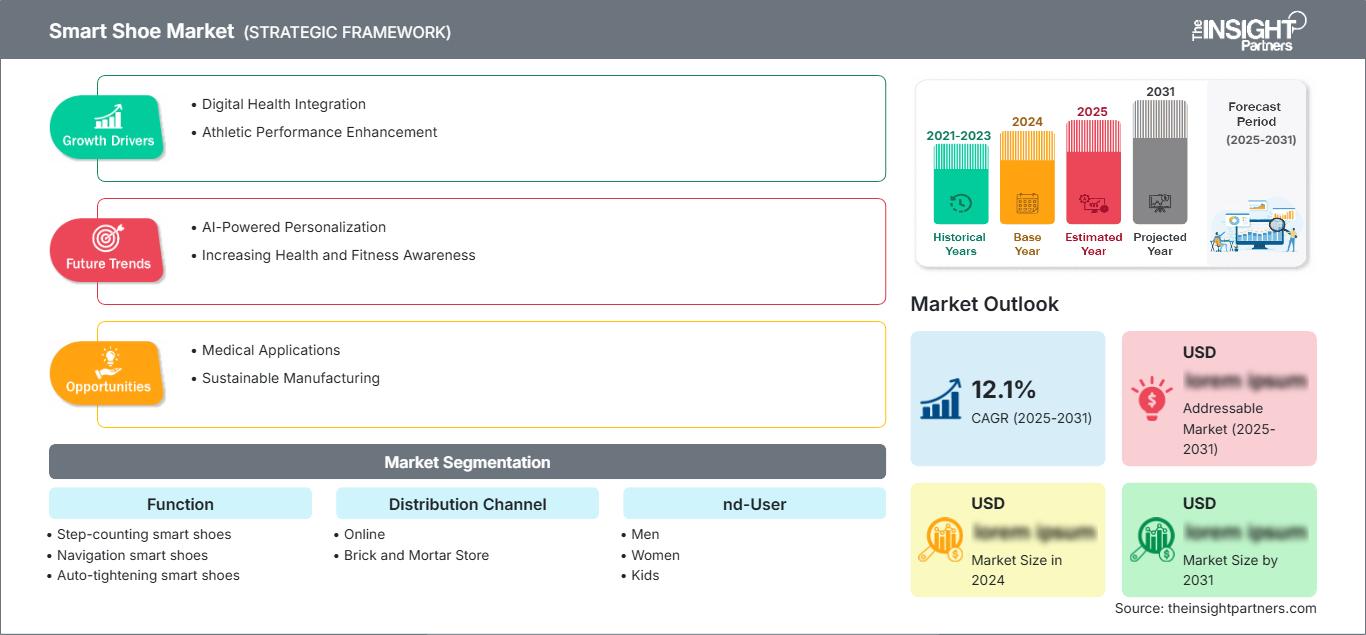
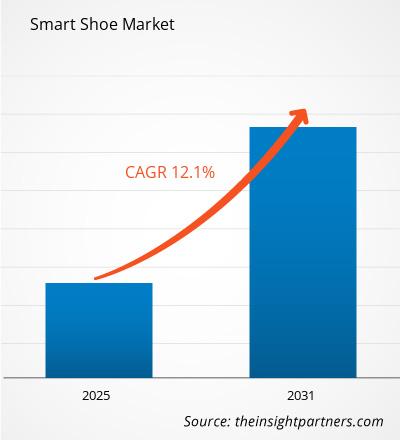
The global smart shoe market was valued at US$ 552.47 million in 2025 and is projected to reach US$ 1094.50 million by 2034, registering a compound annual growth rate (CAGR) of 8.92% from 2026 to 2034. This growth trajectory is underpinned by the increasing consumer focus on health and fitness monitoring, along with rapid advancements in sensor technology, Bluetooth connectivity, and embedded electronics that enhance footwear functionality.
North America accounted for a substantial portion of the global smart shoe market size in 2025, estimated at 35.27%, and is projected to grow at a CAGR of approximately 14-16% from 2026 to 2034. Structural growth drivers in the region include high consumer adoption of wearable technologies, strong purchasing power, and the presence of major athletic footwear companies like Nike and Under Armour that are continuously innovating in the connected footwear space.
Smart Shoe Market Assessment and Insights
- North America: North America is the largest regional market, driven by a strong fitness culture and widespread awareness of health monitoring solutions. It is estimated to hold a 35.27% share in 2025 and is projected to grow at a CAGR of 14-16% from 2026 to 2034.
- U.S.: The U.S. dominates the North American market, accounting for over 35% of the global market share. Its growth is propelled by high consumer spending on fitness technology and the presence of leading footwear brands. The market is expected to grow at a CAGR of 15-17% from 2026 to 2034.
- Europe: Europe holds a significant market share, with the UK, Germany, and France being leading countries driven by strong interest in fitness, sports technology, and sustainable innovation. The market is expected to grow at a CAGR of 13-15% from 2026 to 2034.
- Asia Pacific: APAC is estimated to hold a notable market share and is projected to grow at the fastest CAGR of 16.14% from 2026 to 2034. China, Japan, South Korea, and India are key markets, fueled by rising disposable incomes, rapid urbanization, and increasing health consciousness.
- Largest Segment: The Step-counting smart shoes segment is estimated to be the largest function segment, holding over 65% of the market share in 2025 and projected to grow at a CAGR of 15-17% from 2026 to 2034.
- High Growth Segment: The Navigation smart shoes segment is projected to be the fastest-growing, driven by increasing demand for assistive technologies and applications for visually impaired users. It is expected to grow at a CAGR of 18-20% from 2026 to 2034.
- Key companies analyzed in detail: Adidas AG, Boltt, DIGITSOLE, Li Ning (China) Sports Goods Co., Ltd., Nike, Inc., PUMA SE, ShiftWear, Under Armour, Inc., ASICS Corporation, and Xiaomi Corporation.
Source: The Insight Partners' analysis based on proprietary research, government publications, company annual reports, investor presentations, industry databases, and expert interviews.
There have been remarkable changes in the development of smart shoes around the world since the simple step-counting footwear has been transformed into advanced systems using artificial intelligence (AI) for analytics, gait analysis, and coaching. The changes have been facilitated by technological improvements in sensor capabilities, electronic parts miniaturization, and IoT ecosystem. Manufacturing has been focused on creating durable, washable, and modular electronics.
The smart shoe market report indicates that the market is set to experience major growth in healthcare due to the use of the footwear in remote patient monitoring, management of diabetic foot, and fall detection among the elderly. Large investments are currently being made in AI analytics and subscription-based coaching service for generating revenues through recurring revenue model. Digital health projects and programs for active aging will further promote market growth.
Smart Shoe Market Report Scope
| Report Attribute | Details |
|---|---|
| Market size in 2025 | US$ 552.47 Million |
| Market Size by 2034 | US$ 1,094.5 Million |
| Global CAGR (2026 - 2034) | 8.92% |
| Historical Data | 2021-2024 |
| Forecast period | 2026-2034 |
Smart Shoe Market Analysis
The global smart shoe market is driven by the growing consumer concern regarding health and fitness, resulting in a need for real-time fitness tracking and analysis of performance metrics. The application of advanced technologies, including sensors, artificial intelligence algorithms, and IoT connectivity adds value to smart shoes and expands the scope of use of these products. The industry includes component manufacturers, footwear producers, and software providers that together form an ecosystem to deliver connected footwear solutions.
On the supply side, there are collaboration efforts and innovation. The market leaders, including Nike, Inc. and Adidas AG benefit from their advanced R&D activities to provide technologically innovative footwear solutions improving comfort and performance while adding connectivity capabilities. The competitive environment is impacted by such technological factors as AI integration, pressure sensing, and biometrics. The investment activity demonstrates a clear trend towards direct sales and digital ecosystems where companies provide their customers with companion applications and cloud analytics.
● REPORT CUSTOMIZATION
Tailor This Report To Align With Your Specific Business Requirements
This report can be customized to align precisely with your business objectives, scope, and target markets. Customization options include tailored segmentation, geography, competitive analysis, and strategic insights to support informed decision-making.
Customize This Report →WHAT YOU CAN ADJUST
- ● Segmentations
- ● Geography
- ● Competitive Analysis
- ● Language Preferences
Smart Shoe Market: Strategic Insights
Regional Insights
North America Smart Shoe Market
North America is the dominant force in the global smart shoe market, holding an estimated 35.27% share in 2025 and projected to grow at a CAGR of 14-16% from 2026 to 2034. The region's growth is underpinned by high consumer purchasing power, a strong fitness culture, and the presence of major footwear and technology companies. The U.S. leads the region, with continuous innovation and aggressive marketing campaigns supporting market penetration.
U.S. Smart Shoe Market
The U.S. accounts for over 35% of the global smart shoe market share in 2025. The market is characterized by strong consumer interest in high-end smart shoes integrated with existing digital health and fitness solutions. The market is projected to grow at a CAGR of 15-17% from 2026 to 2034, driven by the presence of leading global footwear brands including Nike, Under Armour, and Puma, ensuring continuous product innovation and competitive pricing.
Europe Smart Shoe Market
Europe is a significant market for smart shoes, holding an estimated 22-26% share in 2025, with a projected CAGR of 13-15% from 2026 to 2034. The UK, Germany, and France are leading countries, driven by strong consumer emphasis on health, sustainability, and technological innovation in footwear. The region's focus on green manufacturing and circular economy principles is incentivizing brands to develop environmentally responsible smart footwear.
APAC Smart Shoe Market
APAC is estimated to hold an 18-22% share of the global market in 2025 and is projected to grow at the fastest CAGR of 16.14% from 2026 to 2034. China, Japan, South Korea, and India are key markets, fueled by rising disposable incomes, rapid urbanization, and a burgeoning middle class with increasing health consciousness. The proliferation of e-commerce platforms and digital retail channels enhances product accessibility across the region.
Middle East & Africa Smart Shoe Market
The MEA region presents emerging opportunities for the smart shoe market, with a projected CAGR of 10-12% from 2026 to 2034. Saudi Arabia, the UAE, and South Africa are key markets, driven by rapid urbanization, increasing disposable incomes, and growing penetration of smart technologies. Government initiatives promoting sports participation and healthy lifestyles are supporting demand for connected fitness products, including smart footwear. The UAE's National Sports Strategy 2031 reflects the region's commitment to promoting active lifestyles through technology-enabled solutions.
Segmentation Analysis
Function
The function segment is categorized into Step-counting smart shoes, Navigation smart shoes, Auto-tightening smart shoes, and Positioning shoes. The Step-counting smart shoes segment is estimated to be the largest, holding over 65% of the market share in 2025, with a projected CAGR of 15-17% from 2026 to 2034. These shoes are widely adopted among runners, fitness enthusiasts, and professional athletes seeking real-time performance insights and activity tracking. The smart shoe scope encompasses a wide range of functions to cater to diverse consumer needs.
- Step-counting smart shoes: This is the leading segment, driven by the strong adoption of smart footwear among fitness enthusiasts. These shoes are equipped with sensors that track metrics such as distance, pace, cadence, and calorie expenditure.
- Navigation smart shoes: Navigation shoes are gaining traction, particularly for visually impaired users, as they incorporate GPS and haptic feedback to improve mobility and safety. This segment is projected to be the fastest growing.
- Auto-tightening smart shoes: These shoes utilize motors and sensors to automatically adjust fit based on user activity or stored profiles. Nike has developed smart footwear capable of adjusting fit based on processor commands.
- Positioning shoes: Positioning shoes integrate GPS tracking and are used for location-based applications, such as monitoring children or individuals with cognitive impairments.
Distribution Channel
The distribution channel segment is divided into Online and Brick and Mortar Store. The Online segment is projected to be the fastest growing, driven by the increasing penetration of e-commerce platforms and digital retail channels. Online channels offer greater product accessibility, competitive pricing, and convenience for tech-savvy consumers.
- Online: Online distribution channels are experiencing rapid growth due to the proliferation of e-commerce platforms. They provide consumers with access to a wide range of smart shoe products, reviews, and competitive pricing, enhancing market reach.
- Brick and Mortar Store: Brick and mortar stores remain a significant channel, particularly for consumers who prefer to try on footwear before purchasing. Specialty stores and brand outlets offer personalized service and product demonstrations.
End-User
The end-user segment is divided into Men, Women, and Kids. The Men segment is estimated to be the largest, driven by traditional marketing campaigns and sponsorship deals with male athletes. The Women segment is projected to grow at a significant rate, supported by increasing female participation in fitness and sports activities.
- Men: The men's segment holds the largest market share due to high engagement in sports and fitness activities. Brands have historically invested heavily in marketing to male consumers, which continues to fuel demand in this segment.
- Women: The women's segment is witnessing strong growth, driven by increasing health awareness and participation in fitness activities. Brands are expanding their product lines to cater to female consumers with features like personalized coaching and health tracking.
- Kids: The kids' segment is emerging as a growth area, with parents seeking smart footwear for activity monitoring and safety features for their children.
Opportunity Snapshot
| Function | Revenue Contribution | Trend Tag | Adoption Stage |
|---|---|---|---|
| Step-counting smart shoes | High | Fitness Tracking | Mature |
| Navigation smart shoes | Medium | Assistive Tech | Emerging |
| Auto-tightening smart shoes | Medium | Adaptive Fit | Scaling |
| Positioning shoes | Low | Safety Monitoring | Emerging |
Smart Shoe Market Growth Drivers and Impact Analysis
Growing Focus on Health, Fitness, and Preventive Healthcare
Increased global focus on preventive health care and physical fitness has been one of the major factors behind the growth of the smart shoe market. Consumers are becoming more interested in having their performance analyzed by wearing smart shoes that can provide information on how much activity they have undertaken in a particular period of time. There has been increased participation in sporting activities and preventive health care measures in recent years.
Advancements in Sensor, Bluetooth, and Embedded Electronics Technologies
This is driven by innovations made in the areas of sensor technologies, Bluetooth technology, and embedded electronics, thus creating smart shoes that are increasingly becoming efficient, more durable, and affordable. Innovations in the area of accelerometers, gyros, and pressure sensors have improved the features of the smart shoes, whereas innovations in battery life and wireless connectivity have increased their user experience.
Increasing Adoption in Healthcare and Assistive Applications
Smart shoes have become a popular technology for healthcare uses such as remote patient monitoring, rehabilitation, management of diabetic feet, and detecting falls in the elderly. The use of AI and machine learning makes it easier to predict injuries, correct posture, and prevent falls. The increasing number of elderly people and affordable ways to provide quality health care are some factors contributing to the popularity of smart shoes.
Smart Shoe Market Future Trends
Integration of AI and Predictive Analytics
A key Smart Shoe Market trend is the deep integration of artificial intelligence and predictive analytics into smart shoe systems. AI algorithms will analyze gait patterns, identify subtle changes indicating fatigue or injury, and provide real-time feedback or corrective actions. This trend, which is a major part of smart shoe trends, will elevate smart shoes from mere data collection devices to proactive health management tools that enhance user well-being and athletic performance.
Expansion of Direct-to-Consumer Channels and Connected Digital Ecosystems
The market is moving towards direct consumer channels and connected ecosystems, with businesses offering applications and analytics clouds. The subscription health information model, personalized coaching programs, and updates on software are helping them generate recurring revenues and increasing customer engagement and loyalty. This helps companies to have long-term business relationships with their customers beyond just selling their products.
Smart Shoe Market Opportunities
Untapped Growth in Healthcare and Clinical Monitoring
A significant opportunity lies in the expanding use of smart shoes for healthcare and clinical monitoring applications. With continuous improvement in sensor accuracy and regulatory clarity, these devices can be used for remote patient monitoring, rehabilitation, and managing chronic conditions like diabetes. Companies that validate their devices for clinical use and secure partnerships with healthcare providers are well-positioned to capture a growing market segment, as highlighted in smart shoe market forecasts.
Development of Sustainable and Eco-Friendly Smart Shoes
A major opportunity exists in the development of sustainable and eco-friendly smart shoes that align with growing consumer demand for environmentally responsible products. Companies that incorporate recycled materials, modular electronics for easy repair, and end-of-life recyclability into their designs will gain a competitive advantage. This trend is particularly strong in Europe, where regulatory frameworks promote green manufacturing and circular economy principles.
Recent Developments
- May 2025: Båstadgruppen’s Monitor is launching the world’s first smart safety shoe, developed in collaboration with safety technology company Quin. The shoe uses advanced sensors to detect falls and automatically send alerts in emergency situations.
- October 2025: Nike is unveiling Project Amplify: the world’s first powered footwear system for running and walking, designed to help everyday athletes go a little bit faster and farther — all with less effort. Engineered to augment natural lower leg and ankle movement, the Project Amplify system breaks the perception of possibility by providing an unparalleled boost to anyone who wants to move, creating a new future for running, jogging and walking.
- January 2023: Ajanta Shoes launches India's first smart shoe 'Impakto Navigator’. The smart shoe inspired by artificial intelligence offers features like step tracking, workout tracking, fall detection, quick call dial, access to music apps, and other customizations.
Frequently Asked Questions

- Comprehensive Market Sizing and Forecast Analysis
- Detailed Segmentation Analysis
- In-Depth Market Dynamics Assessment
- Regional and Country-Level Insights
- Competitive Landscape and Company Benchmarking
- Strategic Business Intelligence
Recent Reports
Testimonials

The Insight Partners' SCADA System Market report is comprehensive, with valuable insights on current trends and future forecasts. The team was highly professional, responsive, and supportive throughout. We are very satisfied and highly recommend their services.
RAN KEDEM Partner, Reali Technologies LTDs
I requested a report on a very specific software market and the team produced the report in a few days. The information was very relevant and well presented. I then requested some changes and additions to the report. The team was again very responsive and I got the final report in less than a week.
JEAN-HERVE JENN Chairman, Future Analytica
We worked with The Insight Partners for an important market study and forecast. They gave us clear insights into opportunities and risks, which helped shape our plans. Their research was easy to use and based on solid data. It helped us make smart, confident decisions. We highly recommend them.
PIYUSH NAGPAL Sr. Vice President, High Beam Global
The Insight Partners delivered insightful, well-structured market research with strong domain expertise. Their team was professional and responsive throughout. The user-friendly website made accessing industry reports seamless. We highly recommend them for reliable, high-quality research services
YUKIHIKO ADACHI CEO, Deep Blue, LLC.
This is the first time I have purchased a market report from The Insight Partners.While I was unsure at first, I visited their web site and felt more comfortable to take the risk and purchase a market report.I am completely satisfied with the quality of the report and customer service. I had several questions and comments with the initial report, but after a couple of dialogs over email with their analyst I believe I have a report that I can use as input to our strategic planning process.Thank you so much for taking the extra time and making this a positive experience.I will definitely recommend your service to others and you will be my first call when we need further market data.
JOHN SUZUKI President and Chief Executive Officer, Board Director, BK Technologies
I wish to appreciate your support and the professionalism you displayed in the course of attending to my request for information regarding to infectious disease IVD market in Nigeria. I appreciate your patience, your guidance, and the fact that you were willing to offer a discount, which eventually made it possible for us to close a deal. I look forward to engaging The Insight Partners in the future, all thanks to the impression you have created in me as a result of this first encounter.
DR CHIJIOKE ONYIA MANAGING DIRECTOR, PineCrest Healthcare Ltd.Reason to Buy
- Informed Decision-Making
- Understanding Market Dynamics
- Competitive Analysis
- Identifying Emerging Markets
- Customer Insights
- Market Forecasts
- Risk Mitigation
- Boosting Operational Efficiency
- Strategic Planning
- Investment Justification
- Tracking Industry Innovations
- Aligning with Regulatory Trends





 Get Free Sample for