
Smart Shopping Cart Market Growth, Trends & Demand by 2034
Coverage: By Application (Supermarket, Shopping Malls, Others); Technology (RFIDs, Bar Codes, ZigBee) , and Geography (North America, Europe, Asia Pacific, and South and Central America)
- Status : Data Released
- Report Code : TIPRE00019794
- Category : Electronics and Semiconductor
- No. of Pages : 150
- Available Report Formats :


- Last update date : August 26, 2026


2025 Market Size
US$ 3.07 Bn
Base year value
2034 Forecast
US$ 28.15 Bn
Projected by 2034
CAGR 2026-2034
27.91 %
Growth rate
Addressable Market
US$ 114.88 Bn
(2026-2034)
The global smart shopping cart market was valued at US$ 3.07 billion in 2025 and is projected to reach US$ 28.15 billion by 2034, registering a compound annual growth rate (CAGR) of 27.91% from 2026 to 2034. This remarkable growth trajectory is underpinned by the escalating demand for frictionless checkout experiences and the rising adoption of AI and IoT technologies in retail environments.
North America accounted for a substantial portion of the global smart shopping cart market size in 2025, estimated at 42.74%, and is projected to grow at a CAGR of approximately 23-25% from 2026 to 2034. Structural growth drivers in the region include the early adoption of autonomous retail concepts by major chains such as Kroger, Albertsons, and Amazon Fresh, alongside high consumer expectations for seamless shopping experiences.
Smart Shopping Cart Market Assessment and Insights
- North America: North America is the leading regional market, driven by high consumer demand for contactless shopping and strong retail technology investments. It is estimated to hold a 42-46% share in 2025 and is projected to grow at a CAGR of 23-25% from 2026 to 2034.
- U.S.: The U.S. dominates the North American market, accounting for 85-89% of the region's share in 2025. Its growth is propelled by major deployments of fully integrated carts by retailers such as Kroger, Schnucks, ShopRite, Albertsons, and Amazon Fresh. The market is expected to grow at a CAGR of 24-26% from 2026 to 2034.
- Europe: Europe holds an estimated 22-26% share of the global market in 2025, with a projected CAGR of 21-23% from 2026 to 2034. Leading countries include Germany, the UK, and France, driven by a strong focus on retail automation and labor efficiency.
- Asia Pacific: APAC is estimated to hold a 22-26% share in 2025 and is projected to grow at the fastest CAGR of 26-28% from 2026 to 2034. China, Japan, South Korea, and India are key markets, fueled by rapid retail modernization, smart city initiatives, and a high concentration of mobile-first consumers.
- Largest Segment: The Supermarket application segment is estimated to be the largest, holding a 60-65% share in 2025 and projected to grow at a CAGR of 26-28% from 2026 to 2034.
- High Growth Segment: The Shopping Malls application segment is projected to be the fastest-growing, driven by increasing adoption in large-scale retail complexes. It holds a 20-24% share in 2025 and is expected to grow at a CAGR of 28-30% from 2026 to 2034.
- Key companies analyzed in detail: Caper, VEEVE INC., TRACXPOINT, INC, Imagr, Amazon.com, Inc., chaohi Incorporated, cust2mate, V-MARK ENTERPRISE LIMITED, Retail AI, inc, and Smart Cart (Pty) Ltd.
Source: The Insight Partners' analysis based on proprietary research, government publications, company annual reports, investor presentations, industry databases, and expert interviews.
According to the smart shopping cart market report, there has been a considerable shift in the market dynamics globally, where there has been a transition from simple grocery shopping carts to advanced IoT systems that act as data collection centers for retail stores. This development has been fueled by the progress made in computer vision technology, sensor fusion and edge computing, which have helped achieve better accuracy and precision in basket tracking and item identification. There has been a shift in production dynamics in the direction of building rugged and modular systems that can endure the rigors of daily retail operations.
As far as the future of the smart shopping cart market is concerned, it is all set to witness considerable growth across the globe as retailers struggle to cope with labor issues and changing customer expectations in terms of convenience. A large number of investments are being made in the area of retrofit kits that will enable retailers to turn conventional carts into smart shopping carts, which will reduce the deployment cost for mid-level players.
Smart Shopping Cart Market Report Scope
| Report Attribute | Details |
|---|---|
| Market size in 2025 | US$ 3.07 Billion |
| Market Size by 2034 | US$ 28.15 Billion |
| Global CAGR (2026 - 2034) | 27.91% |
| Historical Data | 2021-2024 |
| Forecast period | 2026-2034 |
Smart Shopping Cart Market Analysis
Globally, the smart shopping cart market is driven by an increasing demand from consumers for seamless, frictionless, and personalized shopping experiences. The use of technologies such as artificial intelligence (AI), computer vision, and Internet of Things (IoT) sensors has made smart carts offer real-time basket totals, in-cart promotions, and avoidance of long queues during checkouts.
The supply chain consists of hardware manufacturers (cameras, sensors, weight module, touch display), software providers, and system integrators working together to come up with all-round retail automation solutions.
The supply side dynamics in the smart shopping cart market are marked by strategic partnerships and products launches aimed at expanding their technological offerings. Companies such as Amazon.com, Inc., with its Dash Cart and Caper (a subsidiary of Instacart) have set the industry standards regarding computer vision integration. VEEVE INC and cust2mate concentrate more on the user experience with the provision of good interfaces and payment security.
New entrants such as TRACXPOINT, INC and Imagr also concentrate on offering retrofitting solutions and computer vision. Investments in this market are increasingly focusing on AI-based data analytics and retail media monetization with recurring revenue from in-cart promotions.
● REPORT CUSTOMIZATION
Tailor This Report To Align With Your Specific Business Requirements
This report can be customized to align precisely with your business objectives, scope, and target markets. Customization options include tailored segmentation, geography, competitive analysis, and strategic insights to support informed decision-making.
Customize This Report →WHAT YOU CAN ADJUST
- ● Segmentations
- ● Geography
- ● Competitive Analysis
- ● Language Preferences
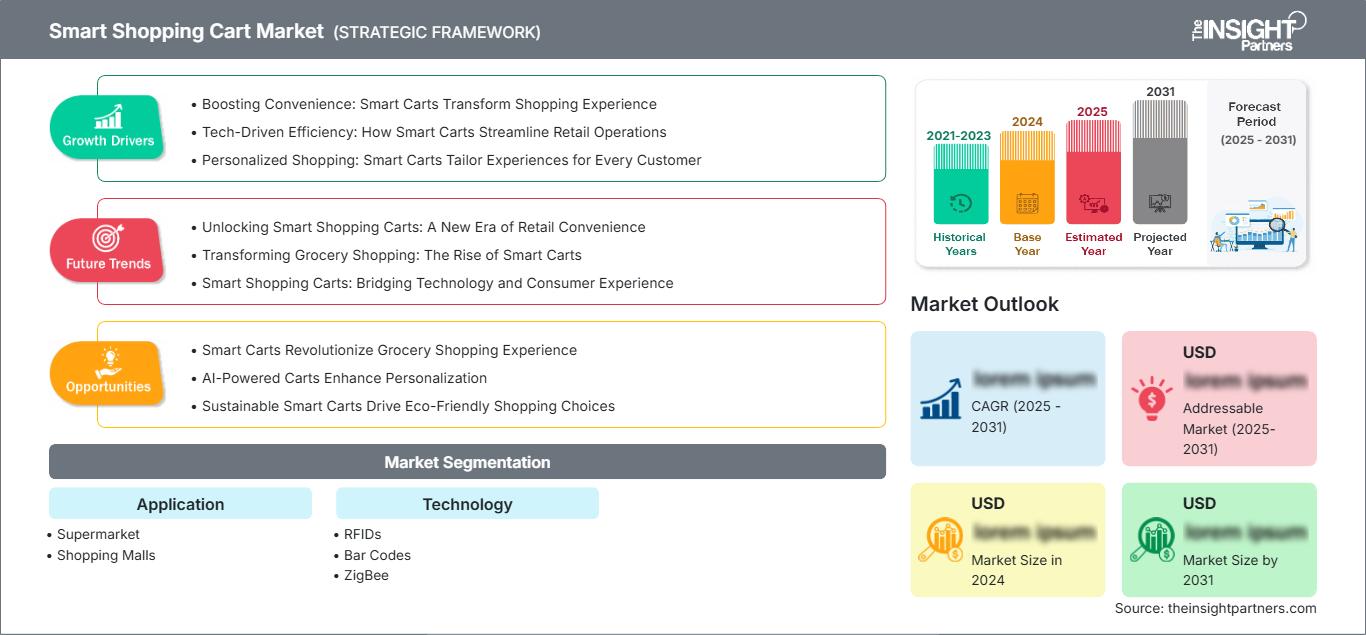
Smart Shopping Cart Market: Strategic Insights
Regional Insights
North America Smart Shopping Cart Market
North America is the dominant force in the global smart shopping cart market, holding an estimated 42-46% share in 2025 and projected to grow at a CAGR of 23-25% from 2026 to 2034. The region's growth is underpinned by early adoption of autonomous retail concepts and significant investments from major chains such as Kroger, Albertsons, and Amazon Fresh. The U.S. leads the region, with fully integrated carts deployed across thousands of stores, reducing queue times and enhancing in-store efficiency.
U.S. Smart Shopping Cart Market
The U.S. accounts for approximately 85-89% of the North American smart shopping cart market share in 2025. The market is characterized by leading deployments from Caper at Kroger, Schnucks, and ShopRite, Veeve at Albertsons, and Amazon Dash Cart at Amazon Fresh locations. The market is projected to grow at a CAGR of 24-26% from 2026 to 2034, driven by the integration of AI-powered analytics and retail media platforms. Application trends show a strong leaning toward fully integrated carts that combine item recognition, dynamic pricing, and in-cart payment systems.
Europe Smart Shopping Cart Market
Europe is estimated to hold a 22-26% share of the global market in 2025, with a projected CAGR of 21-23% from 2026 to 2034. Germany and the UK are leading countries, driven by a strong focus on retail automation and labor efficiency. France, Italy, and Spain are also significant markets, with demand fueled by investments in modernizing retail infrastructure. The region's emphasis on data privacy and sustainability is accelerating the adoption of compliant, energy-efficient smart cart solutions.
APAC Smart Shopping Cart Market
APAC is estimated to hold a 22-26% share of the global market in 2025 and is projected to grow at the fastest CAGR of 26-28% from 2026 to 2034. China, Japan, South Korea, India, and Australia are key markets, driven by rapid urbanization, the expansion of modern retail formats, and smart city initiatives. China holds a significant share, supported by a strong domestic manufacturing base and a high concentration of mobile-first consumers. Retailers like Aeon (Japan), Reliance Retail (India), and Alibaba's Freshippo (China) are investing heavily in AI-enabled carts that combine mobile payment integration with personalized recommendations.
Middle East & Africa Smart Shopping Cart Market
The MEA region is estimated to hold a 4-6% share of the global market in 2025, with a projected CAGR of 18-20% from 2026 to 2034. Saudi Arabia, the UAE, and South Africa are key markets, with growth driven by infrastructure development and the modernization of the retail sector. The UAE is a leader in the region, implementing smart retail technologies in new developments. Energy and infrastructure context are important factors in the region's gradual adoption of smart shopping cart solutions.
Segmentation Analysis
Application
The application segment is categorized into Supermarket and Shopping Malls. The Supermarket segment is estimated to be the largest, holding a 60-65% share in 2025, with a projected CAGR of 26-28% from 2026 to 2034. Supermarkets are the primary adopters due to their vast product assortments, large basket sizes, and efficiency goals. The smart shopping cart scope encompasses a wide range of deployment scenarios in both large-format and small-format retail environments.
- Supermarket: This segment leads the market, driven by the need for operational efficiency in large grocery stores. Smart carts enable swift item recognition, dynamic pricing, and in-cart payment, eliminating traditional checkout queues. Retailers benefit from granular behavioral analytics on customer routes and product interactions.
- Shopping Malls: This segment is projected to be the fastest-growing, driven by increasing adoption in large-scale retail complexes. Shopping malls leverage smart carts to enhance customer experience, reduce wait times, and gather actionable insights into shopper behavior across multiple retail categories.
Technology
The technology segment includes RFIDs, Bar Codes, and ZigBee. RFID technology is estimated to be a dominant segment, enabling real-time inventory tracking and automated item recognition. Barcode scanning provides a cost-effective solution for many retailers. ZigBee is emerging as a key wireless protocol for seamless connectivity between carts and store infrastructure.
- RFIDs: RFID technology is widely adopted in smart shopping carts for automated item tracking and inventory management. It enables real-time visibility into basket composition, supports loss prevention, and enhances operational efficiency .
- Bar Codes: Barcode scanning is a prevalent technology, particularly in retrofit solutions. It allows customers to scan items while shopping, providing real-time basket totals and reducing checkout queues.
- ZigBee: ZigBee is a low-power wireless protocol used for reliable communication between smart carts and in-store networks, ensuring seamless data synchronization and connectivity.
Opportunity Snapshot
| Application | Revenue Contribution | Trend Tag | Adoption Stage |
|---|---|---|---|
| Supermarket | High | Frictionless Checkout | Scaling |
| Shopping Malls | Medium | Mall Automation | Emerging |
Smart Shopping Cart Market Growth Drivers and Impact Analysis
Growing Consumer Demand for Frictionless, Contactless Shopping Experiences
Consumer desires for efficient and hassle-free shopping become one of the main factors influencing the development of smart shopping cart market. Nowadays customers expect convenient and quick transactions in-store, and therefore require solutions that will help get rid of queues at the check-out point. Smart shopping cart becomes the solution because it allows for real-time basket total calculation, in-cart payments, and personalized offers.
Also, consumers are getting used to various digital payment options, mobile applications, and personalized online shopping experience, which raises expectations of such services in physical stores. Smart carts become helpful because it allows for automatic product scanning and in-basket monitoring of the amount of money spent on shopping during the entire process of shopping. Integration with loyalty program and offers becomes even more convenient tool that encourages people to shop in this store and return. In the competition for differentiation of physical locations from online websites, fast and convenient shopping experience provided with the help of technologies becomes more significant.
Technological Advancements in Computer Vision, Sensors, and Edge Computing
The market drives innovation through improvements in the computer vision, sensor technology, and edge computing which allow for highly accurate item recognition and processing in real time. This development helps to increase reliability and cost-efficiency of smart carts, making their implementation in large scale retail possible. In addition, innovations related to AI and machine learning improve the analysis of consumer behaviors.
Technological advancements in cameras, proximity sensors, weight sensors, and machine learning help to make smart carts detect items more accurately and recognize changes in cart content. Edge computing allows for most of the processing of the collected data to be done locally rather than on remote servers. This technology can be used to develop various additional features of smart carts such as automated billing system, theft detection, navigation services, etc. Smaller, more energy-efficient and cheaper hardware makes implementation of smart carts in retail flexible.
High Labor Costs and Staffing Shortages in Retail Environments
Rising labor expenses and labor shortages are prompting the use of automation in physical retail spaces. Self-checkout through smart shopping carts decreases the need for cashier workers and allows retailers to shift workers to valuable tasks like handling customers, replenishing products, and filling online orders. These efficiencies create a compelling economic case for retailers to utilize smart cart systems.
Retailers are searching for solutions that will improve workforce productivity without negatively impacting service quality due to challenges in staffing their stores adequately. Through automation of product scanning, transactions processing, and selective checkout procedures, smart shopping carts are able to cut down repetitive labor tasks for workers. Workers can then be assigned tasks like helping customers, managing stock, packing online orders, and running the store. Smart carts are especially appealing to big box supermarket and grocery chains by virtue of their ability to minimize labor intensive tasks while maximizing transaction speed.
Smart Shopping Cart Market Future Trends
Integration of AI-Powered Consumer Behavior Analytics and Data Monetization
One of the smart shopping cart market trends is the deep integration of AI-powered analytics and data monetization strategies into smart shopping cart platforms. Smart carts will serve as high-value intelligence tools, providing real-time insights into shopper behavior, dwell times, and product interactions. Retailers and brands will increasingly leverage this data to optimize store layouts, refine category strategies, and deliver targeted in-cart advertising, creating new recurring revenue streams, as highlighted in smart shopping cart trends analysis.
Expansion of Retrofit Solutions and Cost-Effective Deployment Models
The market is shifting toward retrofit solutions that convert existing shopping carts into smart devices, reducing upfront deployment costs and enabling faster, more scalable adoption. These attachable solutions lower the entry barrier for mid-market retailers and smaller chains, expanding the total addressable market. This trend is expected to accelerate adoption across diverse retail formats, including convenience stores and specialty shops.
Smart Shopping Cart Market Opportunities
Untapped Growth in Emerging Retail Formats and Convenience Stores
A significant opportunity lies in the expanding adoption of smart shopping carts in emerging retail formats, including convenience stores and smaller-format retailers. Manufacturers are developing smaller, more agile smart baskets suitable for these environments, which are prevalent across Asian cities. This segment represents a substantial growth avenue, as smart carts can enhance operational efficiency and customer experience in compact retail spaces.
Development of Data-Driven Retail Media Networks and In-Cart Promotions
A major opportunity exists in the development of data-driven retail media networks that leverage smart cart technology for targeted advertising. Brands can deliver personalized promotions and coupons directly to customers at the exact moment of purchase decision-making, creating a high-value advertising channel. This capability, combined with loyalty program integration and mobile wallet compatibility, offers a significant revenue opportunity for retailers and technology providers, as outlined in smart shopping cart market forecasts.
Recent Developments
- December 2025: Retailetics Sdn Bhd, a retail-technology innovator from Malaysia announced the official launch of ezyCart, its self-developed, patented, next-generation smart shopping cart, with Village Grocer in Kuala Lumpuras its first deployment partner. Launched in 2018 by Manirajah Kulanthavelu and Shaji Rajappan, the company described the collaboration as a milestone in transforming the Malaysian grocery shopping experience—bringing convenience, personalization, and seamless checkout directly to the cart.
- February 2025: famila Nordost, in cooperation with shopreme, launches the jointly developed Smart Shopping Cart snap cart to expand its self-scanning offer. In cooperation with shopreme, famila Nordost expands its self-checkout offering and introduces snap cart, a smart shopping cart solution that sets a new standard for seamless and efficient shopping within a resilient investment framework. The solution combines the convenience of a traditional shopping cart with the advantages of Scan & Go, creating a new user-oriented experience for the shopper in the customer journey.
- November 2024: As part of a collaboration with Shopic and Capgemini, Intermarché is the first European retailer to trial a Smart Cart solution at its store in Provins, France (77 - Seine-et-Marne). Using a unique AI-powered device, each cart can automatically detect items. This initiative aims to enhance the shopping experience for customers and streamline the checkout process.
Frequently Asked Questions

- Comprehensive Market Sizing and Forecast Analysis
- Detailed Segmentation Analysis
- In-Depth Market Dynamics Assessment
- Regional and Country-Level Insights
- Competitive Landscape and Company Benchmarking
- Strategic Business Intelligence
Recent Reports
Testimonials

The Insight Partners' SCADA System Market report is comprehensive, with valuable insights on current trends and future forecasts. The team was highly professional, responsive, and supportive throughout. We are very satisfied and highly recommend their services.
RAN KEDEM Partner, Reali Technologies LTDs
I requested a report on a very specific software market and the team produced the report in a few days. The information was very relevant and well presented. I then requested some changes and additions to the report. The team was again very responsive and I got the final report in less than a week.
JEAN-HERVE JENN Chairman, Future Analytica
We worked with The Insight Partners for an important market study and forecast. They gave us clear insights into opportunities and risks, which helped shape our plans. Their research was easy to use and based on solid data. It helped us make smart, confident decisions. We highly recommend them.
PIYUSH NAGPAL Sr. Vice President, High Beam Global
The Insight Partners delivered insightful, well-structured market research with strong domain expertise. Their team was professional and responsive throughout. The user-friendly website made accessing industry reports seamless. We highly recommend them for reliable, high-quality research services
YUKIHIKO ADACHI CEO, Deep Blue, LLC.
This is the first time I have purchased a market report from The Insight Partners.While I was unsure at first, I visited their web site and felt more comfortable to take the risk and purchase a market report.I am completely satisfied with the quality of the report and customer service. I had several questions and comments with the initial report, but after a couple of dialogs over email with their analyst I believe I have a report that I can use as input to our strategic planning process.Thank you so much for taking the extra time and making this a positive experience.I will definitely recommend your service to others and you will be my first call when we need further market data.
JOHN SUZUKI President and Chief Executive Officer, Board Director, BK Technologies
I wish to appreciate your support and the professionalism you displayed in the course of attending to my request for information regarding to infectious disease IVD market in Nigeria. I appreciate your patience, your guidance, and the fact that you were willing to offer a discount, which eventually made it possible for us to close a deal. I look forward to engaging The Insight Partners in the future, all thanks to the impression you have created in me as a result of this first encounter.
DR CHIJIOKE ONYIA MANAGING DIRECTOR, PineCrest Healthcare Ltd.Reason to Buy
- Informed Decision-Making
- Understanding Market Dynamics
- Competitive Analysis
- Identifying Emerging Markets
- Customer Insights
- Market Forecasts
- Risk Mitigation
- Boosting Operational Efficiency
- Strategic Planning
- Investment Justification
- Tracking Industry Innovations
- Aligning with Regulatory Trends





 Get Free Sample for