
Smart Speaker Market Growth, Trends & Forecast by 2034
Coverage: By Virtual Personal Assistant (Amazon Alexa, Google Assistant, Apple Siri, Others), Component (Hardware, Software), Application (Residential, Non-Residential)
- Status : Data Released
- Report Code : TIPRE00003623
- Category : Electronics and Semiconductor
- No. of Pages : 150
- Available Report Formats :


- Last update date : September 03, 2026


2025 Market Size
US$ 11.4 Bn
Base year value
2034 Forecast
US$ 37.08 Bn
Projected by 2034
CAGR 2026-2034
14.00 %
Growth rate
Addressable Market
US$ 209.05 Bn
(2026-2034)
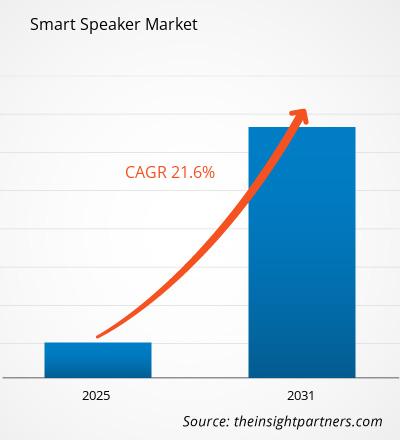
The global smart speaker market was valued at US$ 11.40 billion in 2025 and is projected to reach US$ 37.08 billion by 2034, registering a compound annual growth rate (CAGR) of 14.00% from 2026 to 2034. This growth trajectory is underpinned by the increasing adoption of voice-activated smart home ecosystems, the integration of generative AI into voice assistants, and the growing consumer preference for hands-free control of connected devices.
North America accounted for a substantial portion of the global smart speaker market size in 2025, estimated at 40-44%, and is projected to grow at a CAGR of 12-14% from 2026 to 2034. Structural growth drivers in the region includes the early adoption of smart home technologies and the presence of major AI companies, alongside a high concentration of connected device users. The U.S. market alone was valued at approximately US$ 5.37 billion in 2026.
Smart Speaker Market Assessment and Insights
- North America: North America is the largest regional market, driven by high consumer adoption of voice assistants and smart home infrastructure. It is estimated to hold a 40-44% share in 2025 and is projected to grow at a CAGR of 12-14% from 2026 to 2034.
- U.S.: The U.S. dominates the North American market, accounting for 85-89% of the region's share in 2025. Its growth is propelled by strong demand for voice-driven home control and AI-driven assistance. The market is expected to grow at a CAGR of 13-15% from 2026 to 2034.
- Europe: Europe holds an estimated 22-26% share of the global market in 2025, with a projected CAGR of 11-13% from 2026 to 2034. Leading countries include Germany, the UK, and France, driven by a strong focus on smart home automation and data privacy regulations.
- Asia Pacific: APAC is estimated to hold a 18-22% share in 2025 and is projected to grow at the fastest CAGR of 15-17% from 2026 to 2034. China, Japan, South Korea, and India are key markets, fueled by rapid urbanization, rising disposable incomes, and the expansion of smart home ecosystems.
- Largest Segment: Residential applications represented a modelled 76–80% market share in 2025 and are projected to register 13.6–14.2% CAGR during 2026–2034, reflecting smart-home control and home entertainment demand.
- High Growth Segment: Software represented a modelled 25–29% market share in 2025 and is expected to register 15.8–16.6% CAGR during 2026–2034, supported by generative AI assistants, subscriptions, cloud services, personalization, and software upgrades.
- Key companies analyzed in detail: Alphabet Inc, Amazon.com, Inc, Apple Inc, HARMAN International, Bose Corporation, Panasonic Corporation, Pioneer Corporation, Sonos, Inc, Sony, and Xiaomi.
Source: The Insight Partners' analysis based on proprietary research, government publications, company annual reports, investor presentations, industry databases, and expert interviews.
According to the smart speaker market report, there have been numerous changes in the market landscape, which can be attributed to the shift in the development of technologies that have led to their evolution from basic voice-controlled speakers to advanced AI hubs used for the management of smart homes through natural language processing (NLP) and large language models (LLMs). As for production dynamics, more effort has been put into creating smart speakers with high-quality sound and far-field voice recognition capabilities, alongside on-device AI to solve privacy issues.
When it comes to the future prospects of the smart speaker market, the forecast shows that there will be a major market growth due to the growing population with internet access and higher incomes in developing countries. Much funding goes into providing smart speakers with local languages, vertical healthcare and hospitality solutions, and monetizing the services via premium hardware packages and subscription packages.
Smart Speaker Market Report Scope
| Report Attribute | Details |
|---|---|
| Market size in 2025 | US$ 11.4 Billion |
| Market Size by 2034 | US$ 37.08 Billion |
| Global CAGR (2026 - 2034) | 14.00% |
| Historical Data | 2021-2024 |
| Forecast period | 2026-2034 |
Smart Speaker Market Analysis
The growth in the global smart speaker market is being driven by the rising penetration of IoT technology and the growing need for home automation. Smart speakers are increasingly becoming integral hubs for managing various kinds of devices, ranging from lights, thermostats, and even security systems, improving the convenience as well as the energy consumption in homes. In addition, the use of more advanced technologies like voice recognition and AI has been important in improving the user experience.
Supply-side forces include collaboration between technology firms and consumer electronics companies, as well as content providers in the form of streaming services. Major players like Amazon.com, Inc and Alphabet Inc are capitalizing on their advanced AI technology to come up with better voice assistants that can understand and respond in a context-specific way. The competitive environment is dominated by a few firms while competition from higher-end audio brands is rising. In terms of investment trends, there is a clear move towards the development of devices with on-board AI and improvement in service ecosystems through subscriptions and developer platform.
● REPORT CUSTOMIZATION
Tailor This Report To Align With Your Specific Business Requirements
This report can be customized to align precisely with your business objectives, scope, and target markets. Customization options include tailored segmentation, geography, competitive analysis, and strategic insights to support informed decision-making.
Customize This Report →WHAT YOU CAN ADJUST
- ● Segmentations
- ● Geography
- ● Competitive Analysis
- ● Language Preferences
Smart Speaker Market: Strategic Insights
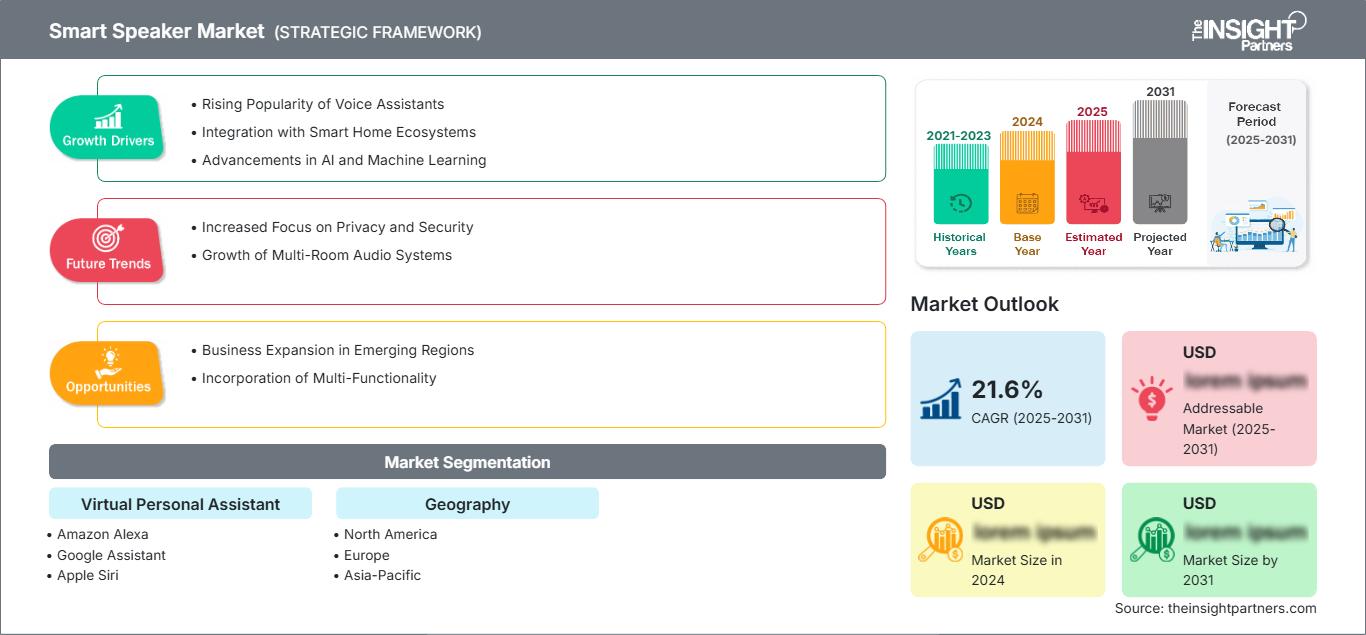
Regional Insights
North America Smart Speaker Market
North America is the dominant force in the global smart speaker market, holding an estimated 40-44% share in 2025 and projected to grow at a CAGR of 12-14% from 2026 to 2034. The region's growth is underpinned by high consumer adoption of voice assistants, a sophisticated smart home infrastructure, and the presence of major technology firms. The U.S. leads the region, with Amazon, Google, and Apple capturing the majority of the market. Demand for voice-driven home control, entertainment, and AI-driven assistance continues to fuel innovation and market growth.
U.S. Smart Speaker Market
The U.S. accounts for approximately 85-89% of the North American smart speaker market share in 2025. The market is characterized by strong consumer spending on connected devices and a deep penetration of digital assistants like Google Assistant, which was used by 85.4 million people in the U.S. The market is projected to grow at a CAGR of 13-15% from 2026 to 2034, driven by the integration of generative AI and the expansion of smart home use cases. Application trends show a strong leaning toward comprehensive home automation, entertainment, and voice-driven commerce.
Europe Smart Speaker Market
Europe is estimated to hold a 22-26% share of the global market in 2025, with a projected CAGR of 11-13% from 2026 to 2034. Germany and the UK are leading countries, driven by strong regulatory frameworks and a focus on data privacy. France, Italy, and Spain are also significant markets, with demand fueled by investments in smart home technology and AI-powered devices. The region's emphasis on compliance with GDPR is accelerating the adoption of secure and localized smart speaker solutions.
APAC Smart Speaker Market
APAC is estimated to hold a 18-22% of the smart speaker market in 2025 and is projected to grow at the fastest CAGR of 15-17% from 2026 to 2034. China, Japan, South Korea, and India are key markets, driven by rapid urbanization, rising disposable incomes, and the expansion of smart home ecosystems. India's market is growing fast, supported by the introduction of voice assistants in Hindi and local languages, which address a diverse customer base. China is a significant market, with companies like Xiaomi and Baidu leading the domestic market.
Middle East & Africa Smart Speaker Market
The MEA region is estimated to hold a 8-12% of the smart speaker market in 2025, with a projected CAGR of 10-12% from 2026 to 2034. Saudi Arabia and the UAE are key markets, with growth driven by infrastructure development, rising AI technology momentum, and increasing demand for voice-guided smart home devices, particularly in luxury residences and technology-based industries. Arabic-language support on voice assistants enhances accessibility in the region.
Segmentation Analysis
Virtual Personal Assistant
Virtual Personal Assistant is projected to register a modelled 14.2–14.8% CAGR during 2026–2034. The Smart Speaker Market scope is increasingly shaped by the capabilities of the underlying AI assistant because intelligence, personalization, connected-device support, and ecosystem integration directly influence product utility and consumer retention.
- Amazon Alexa: Alexa remains a major smart-speaker ecosystem and is transitioning toward Alexa+, a generative AI-based assistant capable of more natural conversations, personalization, service integration, and task completion.
- Google Assistant: Google is transitioning compatible home speakers and displays from Google Assistant toward Gemini for Home, providing greater conversational understanding, context retention, reasoning, and automation creation.
- Apple Siri: Siri connects HomePod with Apple Music, HomeKit-compatible devices, Apple TV, communications, reminders, and other Apple ecosystem services, reinforcing HomePod's role as both an audio system and home hub.
- Others: Other assistant ecosystems include proprietary and regional AI platforms integrated into speakers, smart displays, televisions, consumer electronics, and connected appliances, particularly across Asian markets.
Component
Component is projected to register a modelled 14.0–14.6% CAGR during 2026–2034. Hardware remains the largest revenue contributor, while software is expected to grow faster as generative AI, cloud processing, subscriptions, personalization, and application integration increase recurring value creation.
- Hardware: Smart-speaker hardware integrates acoustic drivers, microphones, processors, memory, wireless connectivity, power management, sensors, and enclosures. New-generation products increasingly include dedicated AI acceleration and improved far-field voice detection.
- Software: Software encompasses virtual assistants, operating systems, cloud services, speech recognition, natural language processing, smart-home orchestration, music integration, personalization, security, and AI subscriptions. Generative AI is significantly expanding software's functional contribution.
Application
Application is expected to register a modelled 13.8–14.4% CAGR during 2026–2034. Residential environments dominate adoption because speakers provide an always-available interface for entertainment and smart-home control, while commercial environments represent a smaller but expanding opportunity.
- Residential: Residential applications include music streaming, home automation, information retrieval, reminders, communications, entertainment control, security integration, shopping, and increasingly conversational AI assistance across multiple rooms.
- Non-Residential: Commercial applications include hospitality, offices, healthcare facilities, senior living, retail environments, educational facilities, and selected public spaces where voice-controlled information, audio, automation, or accessibility can improve user experiences.
Opportunity Snapshot
| Virtual Personal Assistant | Revenue Contribution | Trend Tag | Adoption Stage |
|---|---|---|---|
| Amazon Alexa | High | Ecosystem Leader | Mature |
| Google Assistant | High | AI Integration | Mature |
| Apple Siri | Medium | Privacy Focus | Scaling |
Smart Speaker Market Growth Drivers and Impact Analysis
Growing Adoption of Smart Home Ecosystems and Voice Control
Another major factor is the growing consumer demand for connectivity in the home and voice-control enabled automation. In the modern smart home, a smart speaker becomes the control point for all the devices that are compatible and include lighting, heating and cooling systems, security and entertainment devices. The benefits provided by voice control capabilities make a strong reason for consumers to adopt smart speakers and make them essential elements of a modern home.
Increasingly available range of connected devices makes the role of a smart speaker even more important in household environments. The ability to control a variety of devices, adjust their settings, get information and perform routine tasks using voice commands makes a smarter house possible. Also, more and more companies are focused on improving the integration of smart speakers, household appliances, entertainment and security devices. With the growing availability of connected-home technologies and easy configuration options, consumers start to consider smart speakers not just as entertainment devices but as tools for controlling their homes.
Advancements in AI-Powered Voice Assistants
The smart speaker market trends include significant improvements in artificial intelligence, natural language processing, and generative AI. Such innovations contribute to the increased intuitiveness and effectiveness of voice assistants, which makes it possible to implement more complex and context-driven interaction. In addition, with LLMs, smart speakers are able to answer complex questions and perform various tasks, which positively impacts the user experience and broadens the market reach.
In addition, innovations related to speech recognition and natural language processing help voice assistants understand various accents and complex phrases. Generative AI, in its turn, can help smart speakers offer personalized answers, have contextual conversations, generate content, and assist with performing various tasks. In addition, such innovations make manufacturers focus on creating smart speakers as digital assistants rather than just audio devices. With the growth of AI-based features, users are expected to interact with smart speakers more often in order to get information, entertain themselves, communicate, manage their households, and perform other daily tasks.
Declining Component Costs and E-Commerce Penetration
Cost reductions in system-on-chips (SoCs), microphones, and wireless modules have enabled vendors to offer capable smart speakers at lower price points, broadening the addressable market. The growth of e-commerce platforms and direct-to-consumer (D2C) channels has further reduced distribution friction, allowing manufacturers to scale quickly with competitive pricing and promotional bundles tied to streaming or smart-home services.
Lower manufacturing costs are allowing companies to introduce smart speakers across a wider range of price segments, from entry-level models to premium devices with advanced audio and AI capabilities. Economies of scale in semiconductor production and wireless connectivity components are further supporting competitive pricing. At the same time, e-commerce platforms provide consumers with easy access to product comparisons, reviews, discounts, and bundled offers, encouraging purchasing decisions. Direct-to-consumer sales also enable manufacturers to reach customers without relying exclusively on traditional retail networks. These trends are helping expand market penetration, particularly among price-sensitive consumers and households adopting connected devices for the first time.
Smart Speaker Market Future Trends
Integration of Generative AI and Enhanced Conversational Experiences
A key future trend is the deep integration of generative AI into smart speakers, which is a major part of the smart speaker trends analysis. This evolution allows devices to move beyond simple command-response frameworks to offering engaging, conversational interactions. Smart speakers will increasingly function as intelligent companions capable of summarizing information, maintaining context over prolonged dialogues, and providing personalized assistance.
Expansion of Service Monetization and Premium Hardware
The market is shifting toward service monetization models, where integrated service offerings become crucial revenue levers as hardware average selling prices (ASPs) compress in entry tiers. Pairing premium hardware with exclusive subscription features, personalized voice models, and on-device AI creates differentiated value propositions and higher lifetime revenue per user. This trend is driving vendors to expand their service offerings and build more robust developer ecosystems.
Smart Speaker Market Opportunities
Untapped Growth in Healthcare, Hospitality, and Enterprise Verticals
A significant opportunity lies in expanding smart speaker applications beyond residential use into specialized verticals such as healthcare, hospitality, and enterprise. In healthcare, devices can be tailored for patient assistance and medication reminders. In hospitality, voice concierge services in hotel rooms offer high-value opportunities, while enterprise applications include voice-enabled meeting rooms. These verticals value privacy, compliance, and bespoke integrations, where certified devices can command premium pricing, as noted in smart speaker market forecasts.
Development of Localized Solutions for Emerging Markets
A major opportunity exists in under-penetrated regions of South Asia, Latin America, and parts of Africa, where low device penetration and rising internet access create new addressable markets. Vendors that invest in local language NLP, culturally relevant assistant features, and price-competitive SKUs can capture first-mover advantages. Strategic partnerships with local telecom providers and retailers to bundle speakers with broadband or mobile services can accelerate scale in these high-growth regions.
Recent Developments
- August 2026: LG Electronics introduces the LG xboom Power Series, a new flagship lineup of powerful party speakers, designed for gatherings from casual get-togethers to large outdoor celebrations. The lineup includes the LG xboom Power 9000, Power 7000 and Power 5000. Interactive entertainment features, including AI Karaoke Master, help turn the energy up at any gathering, making it easier for guests to sing, perform and become part of the action. AI Vocal Remover and Key Changer help keep the party moving by making it easier for guests of different singing abilities and vocal ranges to grab a mic and join in.
- June 2026: Google has begun retail sales of its new Google Home Speaker, the first audio device built for its Gemini for Home voice assistant, intensifying competition in the voice assistant market as major technology firms race to embed generative artificial intelligence into connected-home hardware. The device, priced at $99.99 and available after a pre-order period, signals Google's push to replace command-based interaction with more natural, conversational voice control.
- March 2026: Amazon has launched the new Echo Dot Max and Echo Studio smart speakers in India. Both devices are built to deliver premium audio experiences, are powered by Amazon’s AZ3 custom silicon chips for fast performance and feature Omnisense technology, which enables automated smart home routines using presence, motion, and temperature detection. With Alexa built in, you can play music, manage smart home appliances and handle everyday tasks—all with just the voice.
Frequently Asked Questions

- Comprehensive Market Sizing and Forecast Analysis
- Detailed Segmentation Analysis
- In-Depth Market Dynamics Assessment
- Regional and Country-Level Insights
- Competitive Landscape and Company Benchmarking
- Strategic Business Intelligence
Recent Reports
Testimonials

The Insight Partners' SCADA System Market report is comprehensive, with valuable insights on current trends and future forecasts. The team was highly professional, responsive, and supportive throughout. We are very satisfied and highly recommend their services.
RAN KEDEM Partner, Reali Technologies LTDs
I requested a report on a very specific software market and the team produced the report in a few days. The information was very relevant and well presented. I then requested some changes and additions to the report. The team was again very responsive and I got the final report in less than a week.
JEAN-HERVE JENN Chairman, Future Analytica
We worked with The Insight Partners for an important market study and forecast. They gave us clear insights into opportunities and risks, which helped shape our plans. Their research was easy to use and based on solid data. It helped us make smart, confident decisions. We highly recommend them.
PIYUSH NAGPAL Sr. Vice President, High Beam Global
The Insight Partners delivered insightful, well-structured market research with strong domain expertise. Their team was professional and responsive throughout. The user-friendly website made accessing industry reports seamless. We highly recommend them for reliable, high-quality research services
YUKIHIKO ADACHI CEO, Deep Blue, LLC.
This is the first time I have purchased a market report from The Insight Partners.While I was unsure at first, I visited their web site and felt more comfortable to take the risk and purchase a market report.I am completely satisfied with the quality of the report and customer service. I had several questions and comments with the initial report, but after a couple of dialogs over email with their analyst I believe I have a report that I can use as input to our strategic planning process.Thank you so much for taking the extra time and making this a positive experience.I will definitely recommend your service to others and you will be my first call when we need further market data.
JOHN SUZUKI President and Chief Executive Officer, Board Director, BK Technologies
I wish to appreciate your support and the professionalism you displayed in the course of attending to my request for information regarding to infectious disease IVD market in Nigeria. I appreciate your patience, your guidance, and the fact that you were willing to offer a discount, which eventually made it possible for us to close a deal. I look forward to engaging The Insight Partners in the future, all thanks to the impression you have created in me as a result of this first encounter.
DR CHIJIOKE ONYIA MANAGING DIRECTOR, PineCrest Healthcare Ltd.Reason to Buy
- Informed Decision-Making
- Understanding Market Dynamics
- Competitive Analysis
- Identifying Emerging Markets
- Customer Insights
- Market Forecasts
- Risk Mitigation
- Boosting Operational Efficiency
- Strategic Planning
- Investment Justification
- Tracking Industry Innovations
- Aligning with Regulatory Trends





 Get Free Sample for