
Smart TV Market Size, Growth & Trends by 2034
Coverage: Resolution (1080P, 4K, 8K, Others), Dimensions (Below 32 inches, 32 to 45 inches, 46 to 55 inches, and 56 to 65 inches), Dynamic Range (Standard, HDR); Application (Residential, Commercial), and Geography
- Status : Data Released
- Report Code : TIPTE100000274
- Category : Electronics and Semiconductor
- No. of Pages : 150
- Available Report Formats :


- Last update date : August 28, 2026


2025 Market Size
US$ 253.13 Bn
Base year value
2034 Forecast
US$ 752. Bn
Projected by 2034
CAGR 2026-2034
12.86 %
Growth rate
Addressable Market
US$ 4,377.90 Bn
(2026-2034)
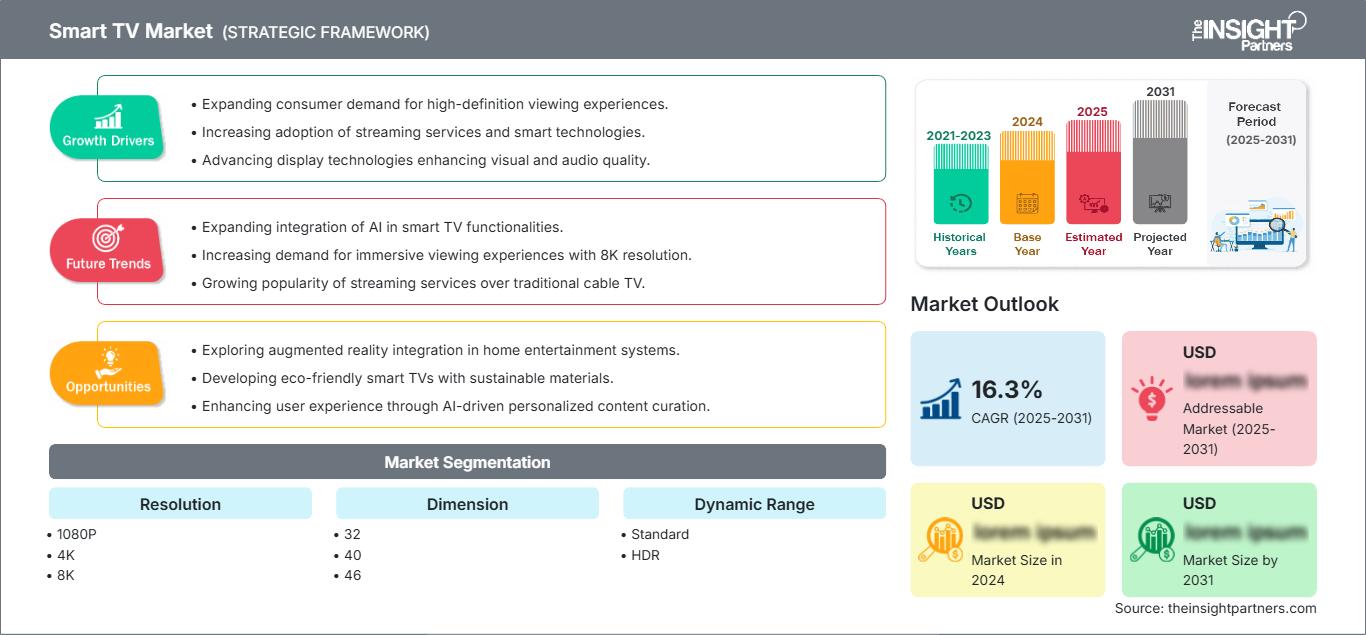
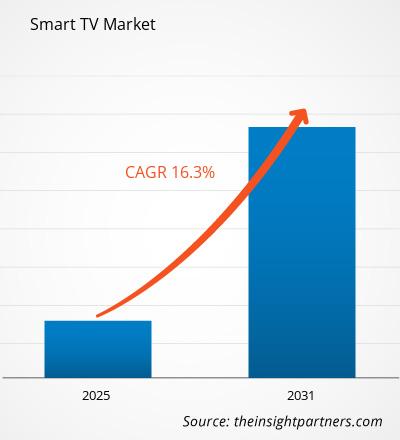
The global Smart TV Market size was valued at US$ 253.13 billion in 2025 and is projected to reach US$ 752.0 billion by 2034, registering a compound annual growth rate of 12.86% from 2026 to 2034. This growth is underpinned by the rapid proliferation of over-the-top (OTT) streaming platforms, widespread 5G and fiber internet access, and increasing consumer demand for AI-enhanced premium displays with superior picture quality.
North America represents a significant regional market, estimated to account for 28-32% of global share in 2025, growing at a CAGR of 11-13% during the forecast period. The regional market is propelled by high consumer demand for advanced entertainment systems, seamless integration with smart home devices, and the maturity of connected TV advertising and streaming bundles. The U.S. remains a highly advanced market for premium smart TV adoption and voice-enabled interfaces.
Smart TV Market Assessment and Insights
- North America accounts for a substantial Smart TV Market share, estimated at 28-32% in 2025, growing at a CAGR of 11-13% from 2026 to 2034. The region benefits from high broadband penetration, strong consumer spending on premium electronics, and a mature ecosystem for connected TV advertising and streaming services.
- U.S. dominates the North American market, representing approximately 80-85% of regional share in 2025, with a growth rate of 11-13% through 2034. The U.S. market is characterized by high adoption of 4K/8K resolution displays and strong demand for OLED and QLED premium models .
- Europe holds a significant market share of 22-26% in 2025, with a projected CAGR of 10-12%. Leading countries include Germany, the U.K., and France, where regulatory frameworks around energy efficiency and privacy encourage innovation in power management and open-platform architectures.
- Asia Pacific is the largest and fastest-growing region, capturing a 34-38% market share in 2025 with a CAGR of 14-16%. Key markets include China, India, Japan, and South Korea, driven by rising disposable incomes, a burgeoning middle class, and massive manufacturing scale in panel technology .
- Largest Segment by resolution, the 4K segment, held a dominant share exceeding 60% of shipments in 2025 and is expected to grow at a strong CAGR through 2034, driven by its position as the baseline for premium viewing experiences .
- High Growth Segment by resolution, the 8K segment, is projected to grow at the fastest CAGR of 13-15% during 2026-2034, reflecting its emergence as a niche innovation platform for ultra-premium displays .
- Key companies analyzed in detail: Apple Inc., Hitachi Ltd., Haier Inc., Koninklijke Philips N.V., LG Electronics, TCL, Panasonic Corporation, Samsung, Sony Corporation, Toshiba Visual Solutions Corporation, Metz, Acer Inc., ASUS, Bang & Olufsen, BPL Group, Changhong, Element Electronics, Google, Kogan, Micromax.
Source: The Insight Partners' analysis based on proprietary research, government publications, company annual reports, investor presentations, industry databases, and expert interviews.
Smart TV products are currently going through a shift that arises due to the convergence of display technologies, artificial intelligence-based operating systems, and platform-centric approaches in the business model. Such products are currently shifting from passive display hardware into interactive entertainment devices, content sales channels, and data platforms. The manufacturing environment is associated with fierce competition in the development of LCD and OLED/QLED display technologies, as well as margin expansion through the combination of premium technology and operating system monetization.
In terms of future growth in the smart TV market, there are a number of tailwinds arising from emerging markets, such as those located in the Asia-Pacific region, where urbanization and growing middle classes are becoming a valuable opportunity for the industry. Currently, there are more investments in AI-friendly interfaces, voice recognition, and content discovery features, as well as regulatory tailwinds connected with energy efficiency and data privacy regulations.
Smart TV Market Report Scope
| Report Attribute | Details |
|---|---|
| Market size in 2025 | US$ 253.13 Billion |
| Market Size by 2034 | US$ 752. Billion |
| Global CAGR (2026 - 2034) | 12.86% |
| Historical Data | 2021-2024 |
| Forecast period | 2026-2034 |
Smart TV Market Analysis
According to the Smart TV Market report, demand has been primarily shaped by the rising consumption of OTT content where global OTT subscription growth has accounted for more than 85% of smart TV usage. As per the industry data, global TV unit shipments amounted to 218 million units in 2024, witnessing 0.9% year-over-year growth due to sporting events such as UEFA Euros and Paris Olympics. The supply chain has become a mix of panel makers, chipmakers, operating systems makers, and aggregators of content. Factors affecting the supply dynamics include fluctuations in panel prices, trade policies across geographies, and strategic movement of manufacturing facilities from developed nations to places such as Mexico and Vietnam.
There is competition among conglomerate firms and small Chinese producers within the market. According to the data provided by Counterpoint Research, Samsung accounted for 15% of the market in 2025, followed by TCL (13%) and Hisense (12%), while LG represented 9%, and Sony had 2%. Nevertheless, there is a great amount of success shown by TCL, which gained 22% growth from Q1 2025 and overtook Samsung in shipments per month. Trends in investment show that the current focus is on creating differentiation through software and customer experience when companies such as Samsung, LG, and TCL invest in proprietary operating systems Tizen, webOS, and Google TV respectively in order to earn some money through advertisement and services. Firms like Samsung and TCL are now involved in "super close battle" in the segment of LCD TV where the gap is 0.1 percentage point, and LG Electronics dominates in the premium OLED TV segment with more than 50% of the market share.
● REPORT CUSTOMIZATION
Tailor This Report To Align With Your Specific Business Requirements
This report can be customized to align precisely with your business objectives, scope, and target markets. Customization options include tailored segmentation, geography, competitive analysis, and strategic insights to support informed decision-making.
Customize This Report →WHAT YOU CAN ADJUST
- ● Segmentations
- ● Geography
- ● Competitive Analysis
- ● Language Preferences
Smart TV Market: Strategic Insights
Regional Insights
North America Smart TV Market
North America continues to be a key market, holding a share of approximately 28-32% in 2025 and growing at a CAGR of 11-13% from 2026 to 2034. The region's market strength is anchored in high consumer demand for premium entertainment systems and seamless smart home integration. It can be seen that the United States is one of the most technologically advanced countries in terms of connected TV advertising, streaming services, and voice-based interface. There is widespread availability of broadband connection and consumers favoring OLED and QLED displays. Due to the well-developed infrastructure for content streaming and advertising in the region, OS-based revenue generation has become more prominent.
U.S. Smart TV Market
The U.S. market dominates North America, representing approximately 80-85% of the regional share in 2025 and growing at a CAGR of 11-13% through 2034. The abundance of rich consumers in the country along with technological advances play a major role in expanding the market. Leading players include Samsung, LG, and TCL, which provide complete systems where hardware is complemented by an AI-based interface and content platform. There is high demand in the market for quality large screens (55 inches and above), as well as 4K and 8K resolution monitors, due to growing use of streaming and gaming apps.
Europe Smart TV Market
The Smart TV Market forecast indicates that Europe represents a substantial market, holding a share of approximately 22-26% in 2025, with a projected CAGR of 10-12% through 2034. The leading country in this region is Germany, where the importance of quality, efficiency in using energy, and data protection is highly valued. Next in line is the U.K., where a developed market of streaming services and public service broadcasting results in very high penetration of smart TVs. In France, there is an importance placed on content localization and compliance, whereas in Italy and Spain, a great demand exists for sports and entertainment streaming. Regulatory restrictions on energy efficiency and interoperability have a great impact on the market in this region.
APAC Smart TV Market
The Asia Pacific market is the largest and fastest-growing region, capturing a dominant share of 34-38% in 2025 and projected to grow at a robust CAGR of 14-16% during 2026-2034. China leads the region, combining massive manufacturing scale with powerful domestic platform ecosystems. India offers large-volume growth, driven by affordable broadband, local-language content, and a burgeoning middle class. Japan prioritizes premium display quality and broadcast integration, while South Korea leads in OLED, QLED, and display innovation. The market is propelled by strong government backing for digital infrastructure and smart city initiatives, as well as the urgent need to serve a rapidly growing consumer base with feature-rich yet affordable smart TVs. Southeast Asian markets demonstrate a willingness to embrace cost-effective offerings, supported by expanding online distribution networks.
Middle East & Africa Smart TV Market
The Middle East & Africa region is an emerging market for smart TVs, projected to grow at a steady CAGR through 2034. The market is driven by rapid urbanization, rising disposable incomes, and digital transformation initiatives, particularly in GCC countries like Saudi Arabia and the UAE, which are investing heavily in smart city developments. South Africa represents a key market in Africa, supported by a growing middle class and increasing internet penetration. The region's focus on enhancing digital infrastructure and improving access to online content creates a positive outlook for smart TV adoption, with demand primarily for cost-effective models that offer essential smart features and streaming capabilities.
Segmentation Analysis
Resolution
The 4K UHD segment is the dominant resolution category, accounting for over 60% of global smart TV shipments in 2025 and is projected to maintain its leadership through 2034. The segment is expected to achieve a steady CAGR of 11-13% during the forecast period. This dominance is driven by 4K's position as the baseline resolution for premium viewing experiences, bundled with better processors, interface performance, and platform features. The demand for this segment is fueled by the widespread availability of 4K content on streaming platforms and the declining price points for 4K displays, making them accessible to a broad consumer base.
- 1080P: Full HD displays remain relevant for entry-level and budget-conscious consumers, particularly in emerging markets. They offer a cost-effective solution for basic smart TV functionality and are still widely available in smaller screen sizes.
- 4K: This is the market-leading resolution, accounting for the majority of shipments in 2025. It offers four times the resolution of 1080P, providing a crisp, detailed picture essential for modern streaming and gaming.
- 8K: This is the fastest-growing segment, albeit from a smaller base, as it represents the ultra-premium tier. While currently a niche innovation platform, its adoption is expected to gain momentum as content availability and panel costs improve.
Dimension
The 55-inch segment is the dominant screen size category, representing a significant share of the market in 2025 and is expected to grow at a robust CAGR through 2034. The demand for this size is driven by its balance of immersive viewing experience and reasonable price point, making it the preferred choice for residential living rooms. The market is seeing a clear shift toward larger screens, with the 55-inch and above categories driving premium revenue growth.
- 32: These smaller screens are popular for secondary rooms, kitchens, and bedrooms. They are an entry-level option, often with 1080P resolution, and are widely available at competitive price points.
- 40: This size serves as a mid-range option, offering a balance between affordability and screen real estate. It is a common choice for smaller living spaces and is often available with 4K resolution.
- 46: This screen size was historically popular but is seeing reduced demand as consumers shift toward larger formats like 55 inches and above.
- 55: This is the leading screen size, offering premium viewing experience for most living rooms. It is the primary battleground for 4K, OLED, and QLED technologies and drives significant volume.
- 75 and Above: This is the fastest-growing segment in terms of revenue, driven by consumer preference for cinematic, immersive experiences. This ultra-large category is increasingly available with 8K resolution and advanced display technologies.
Dynamic Range
The HDR (High Dynamic Range) segment is experiencing robust growth as it becomes a standard feature in premium smart TVs. This segment is expected to grow at a significant CAGR through 2034, driven by increasing consumer awareness of superior picture quality and the growing availability of HDR content on major streaming platforms.
- Standard: This refers to displays without advanced HDR capabilities, offering a baseline dynamic range. It is increasingly confined to entry-level and budget models.
- HDR: This feature provides greater contrast, brighter highlights, and a wider color gamut. It is becoming the standard for mid-range to premium smart TVs, driven by consumer demand for a more realistic viewing experience.
Application
The Residential segment is the dominant application area, holding a substantial share of the smart TV market in 2025 and is expected to grow at a steady CAGR through 2034. This dominance is driven by the role of the smart TV as the central screen for digital entertainment, gaming, and home connectivity in households. The demand is fueled by the proliferation of streaming services, gaming platforms, and the integration of smart home features.
- Residential: This is the largest application area, with smart TVs serving as the primary entertainment hub in homes. Demand is driven by OTT consumption, gaming, and the desire for smart home integration.
- Commercial: This segment includes applications in hospitality, corporate, and public spaces. It is growing steadily as digital signage and interactive displays are adopted in business environments.
Opportunity Snapshot
| Application Segment | Revenue Contribution | Trend Tag | Adoption Stage |
|---|---|---|---|
| Residential | High | OTT Hub | Mature |
| Commercial | Medium | Digital Signage | Scaling |
Smart TV Market Growth Drivers and Impact Analysis
Proliferation of OTT Streaming and On-Demand Content
The explosive growth of over-the-top (OTT) streaming platforms is a primary driver for the smart TV market. Services like Netflix, Disney+, and Amazon Prime Video have fundamentally changed consumer viewing habits, creating a massive demand for internet-connected televisions as the primary endpoint for content consumption. The convenience and variety of on-demand content have accelerated cord-cutting, making smart TVs an essential appliance for modern households. This shift is particularly pronounced in emerging economies, where affordable broadband and local-language content are expanding the consumer base. The direct linkage between OTT consumption and smart TV penetration underscores this driver's critical role in market expansion.
Technological Advancements in Display and AI Integration
Continuous innovation in display technologies, including 4K, 8K, OLED, and QLED, is a powerful driver encouraging consumer upgrades. These technologies offer superior picture quality, deeper blacks, and better colors, compelling consumers to replace older models. Simultaneously, the integration of Artificial Intelligence (AI) and machine learning is transforming the user experience. AI-powered features, such as personalized content recommendations, voice control, and intuitive user interfaces, are becoming key differentiators and significantly enhancing user engagement and satisfaction. This technological convergence is not just about "more pixels" but about creating an intelligent, seamless ecosystem.
Growing Smart Home Integration and OS Monetization
The evolution of smart TVs from standalone displays to central hubs for smart home ecosystems is a significant market driver. Manufacturers are leveraging proprietary operating systems like Tizen and webOS to foster robust application ecosystems, attract third-party developers, and create new revenue streams through advertising and services. This platform-centric approach extends the product's value proposition beyond hardware, generating recurring revenue and fostering brand loyalty. As hardware margins narrow, the ability to monetize the operating system through ads, content discovery, and premium services is crucial for long-term profitability, making it a central focus for industry leaders.
Smart TV Market Future Trends
AI-Powered Personalized User Experiences and Generative UI
The smart TV market trends show that there is an ongoing transition toward AI-native operating systems and generative user interfaces that fundamentally restructure content discovery. AI is moving beyond basic recommendations to create dynamic, personalized home screens that adapt to individual viewing habits in real-time. This trend aims to reduce discovery friction and increase time spent within the platform environment, directly impacting engagement and monetization. The focus is shifting from hardware specifications to lifetime value engineering, where user retention and service engagement become the primary economic drivers. This trend will likely see the rise of AI "agents" that proactively curate content and manage smart home tasks.
Strategic Alliances and the Evolution of the Competitive Landscape
The Smart TV Market is seeing a new phase of strategic alliances to consolidate technology and market reach. A notable trend is the potential for partnerships between traditional and emerging players, as exemplified by discussions of a joint venture between TCL and Sony Bravia to gain a stronger presence in the high-end segment. Simultaneously, the competitive landscape is marked by an intense battle for market share, particularly between Samsung and TCL in the LCD segment, while LG maintains a dominant position in the premium OLED market. This dynamic is pushing manufacturers to differentiate through product competitiveness, premium technology, and platform strength, making the TV market a key arena for technological and commercial rivalry.
Smart TV Market Opportunities
Expanding the OS as a Strategic Asset and Monetization Platform
A significant opportunity in the Smart TV Market lies in fully capitalizing on the smart TV operating system as a strategic asset. As hardware margins become increasingly slim, manufacturers have a clear opportunity to pivot toward monetizing user engagement and software services. This involves developing robust operating systems that can host advertising, integrate commerce, and offer premium subscription services. The goal is to create a "walled garden" where the smart TV is not just a display but a content hub, commerce portal, and data platform. Early leaders in platform monetization, such as Roku, demonstrate this model's viability, making it a critical area for investment and differentiation among traditional OEMs.
Developing AI-Native Discovery and Content Curation Solutions
There is a growing opportunity for companies in the Smart TV Market to invest in AI-native interfaces that provide "zero-click" content discovery and reduce the "endless scroll" currently plaguing streaming services. The emphasis is on moving from a UI based on channel surfing to a "task-based" interface where the TV can anticipate the user's mood and content preferences. This investment could involve acquiring or developing advanced AI capabilities to create a more intuitive and engaging user experience. Companies that can reduce content discovery friction will likely see higher user retention and increased time spent on the platform, creating a significant competitive advantage and opening new avenues for engagement-based monetization.
Recent Developments
- May 2026: Samsung India today announced the launch of its full 2026 Vision AI TV lineup, spanning Micro RGB, OLED, Neo QLED, The Frame, Mini LED and UHD TVs. With today’s launch, Samsung is expanding AI-powered features across all its models, bringing smarter picture, sound and personalised viewing experiences to more consumers in India. Samsung has been the Global No. 1 TV brand for 20 consecutive years. The expansion of Vision AI Companion (VAC) features across Samsung’s 4K-and-above TV line up, reflects the brand’s broader strategy to make AI a central part of the TV experience. The expansion brings AI-powered viewing to more categories, screen sizes and consumer needs.
- August 2026: Teads, the omnichannel outcomes platform, and V (formerly known as VIDAA), the Smart TV operating system powering Hisense and other leading OEM devices, announced a multi-year strategic partnership running through 2028 designed to transform how brands engage consumers on the biggest screen in the home. As the centerpiece of this collaboration, Teads will serve as the exclusive global partner for an unprecedented 10-day TV HomeScreen takeover during peak season sales across Black Friday and Cyber Monday.
- August 2026: LG Electronics announced a strategic partnership with stc tv, stc group's digital streaming and broadcasting service, to elevate the home entertainment experience for users across Saudi Arabia, Kuwait and Bahrain. The collaboration brings together LG's webOS platform with stc tv's established regional entertainment offering, making a broad selection of local and international content easier for viewers to discover and access. Through new webOS integration, users will be able to access stc tv directly from the LG Smart TV home screen via a dedicated Quick Access feature. Additionally, new stc tv subscribers who own LG TVs in Saudi Arabia, Kuwait, and Bahrain can enjoy a complimentary 3-month subscription, giving them unlimited access to a vast library of premium movies, series, sports, and live TV channels.
Frequently Asked Questions

- Comprehensive Market Sizing and Forecast Analysis
- Detailed Segmentation Analysis
- In-Depth Market Dynamics Assessment
- Regional and Country-Level Insights
- Competitive Landscape and Company Benchmarking
- Strategic Business Intelligence
Recent Reports
Testimonials

The Insight Partners' SCADA System Market report is comprehensive, with valuable insights on current trends and future forecasts. The team was highly professional, responsive, and supportive throughout. We are very satisfied and highly recommend their services.
RAN KEDEM Partner, Reali Technologies LTDs
I requested a report on a very specific software market and the team produced the report in a few days. The information was very relevant and well presented. I then requested some changes and additions to the report. The team was again very responsive and I got the final report in less than a week.
JEAN-HERVE JENN Chairman, Future Analytica
We worked with The Insight Partners for an important market study and forecast. They gave us clear insights into opportunities and risks, which helped shape our plans. Their research was easy to use and based on solid data. It helped us make smart, confident decisions. We highly recommend them.
PIYUSH NAGPAL Sr. Vice President, High Beam Global
The Insight Partners delivered insightful, well-structured market research with strong domain expertise. Their team was professional and responsive throughout. The user-friendly website made accessing industry reports seamless. We highly recommend them for reliable, high-quality research services
YUKIHIKO ADACHI CEO, Deep Blue, LLC.
This is the first time I have purchased a market report from The Insight Partners.While I was unsure at first, I visited their web site and felt more comfortable to take the risk and purchase a market report.I am completely satisfied with the quality of the report and customer service. I had several questions and comments with the initial report, but after a couple of dialogs over email with their analyst I believe I have a report that I can use as input to our strategic planning process.Thank you so much for taking the extra time and making this a positive experience.I will definitely recommend your service to others and you will be my first call when we need further market data.
JOHN SUZUKI President and Chief Executive Officer, Board Director, BK Technologies
I wish to appreciate your support and the professionalism you displayed in the course of attending to my request for information regarding to infectious disease IVD market in Nigeria. I appreciate your patience, your guidance, and the fact that you were willing to offer a discount, which eventually made it possible for us to close a deal. I look forward to engaging The Insight Partners in the future, all thanks to the impression you have created in me as a result of this first encounter.
DR CHIJIOKE ONYIA MANAGING DIRECTOR, PineCrest Healthcare Ltd.Reason to Buy
- Informed Decision-Making
- Understanding Market Dynamics
- Competitive Analysis
- Identifying Emerging Markets
- Customer Insights
- Market Forecasts
- Risk Mitigation
- Boosting Operational Efficiency
- Strategic Planning
- Investment Justification
- Tracking Industry Innovations
- Aligning with Regulatory Trends





 Get Free Sample for