
Intelligent Vending Machines Market Trends, Demand & Growth by 2034
Coverage: by Product Type (Beverages, Snacks, Others); Installation Site (Offices, Retail Stores, Public Places, Others) , and Geography (North America, Europe, Asia Pacific, and South and Central America)
- Status : Data Released
- Report Code : TIPEL00002161
- Category : Electronics and Semiconductor
- No. of Pages : 150
- Available Report Formats :


- Last update date : September 22, 2026


2025 Market Size
US$ 17.08 Bn
Base year value
2034 Forecast
US$ 43.15 Bn
Projected by 2034
CAGR 2026-2034
10.85 %
Growth rate
Addressable Market
US$ 266.48 Bn
(2026-2034)
The Intelligent Vending Machines Market was valued at US$ 17.08 Billion in 2025 and is projected to reach US$ 43.15 Billion by 2034, expanding at a CAGR of 10.85% during 2026–2034. The market covers automated dispensing systems for beverages and snacks across offices, retail stores, and public places, with intelligent capabilities increasingly incorporating cashless payments, telemetry, remote monitoring, digital interfaces, inventory analytics, and connected operating platforms.
North America remains a mature automated-retail environment, with the Intelligent Vending Machines Market size supported by widespread cashless payment adoption, workplace convenience programs, and modernization of legacy vending fleets. The regional market is estimated to grow at a 9.0–10.0% CAGR during 2026–2034, supported by unattended retail expansion and stronger integration of connected payment, inventory, and consumer-engagement technologies.
Intelligent Vending Machines Market Assessment and Insights
- North America: North America is estimated to account for 34–38% share in 2025 and expand at a 9.0–10.0% CAGR between 2026–2034, supported by cashless payments, connected vending infrastructure, workplace deployment, and automated retail adoption.
- US: The US represents approximately 82–86% of North American demand in 2025 and is expected to grow at a 9.0–10.0% CAGR during 2026–2034, supported by offices, retail, transportation, and public venues.
- Europe: Europe is estimated to hold 23–27% share in 2025 and is projected to grow at a 9.5–10.5% CAGR through 2034, with the UK, Germany, Italy, France, and Spain supporting connected vending adoption.
- Asia Pacific: Asia Pacific represents an estimated 29–33% share in 2025 and is expected to register a 12.0–13.0% CAGR through 2034, led by Japan, China, South Korea, India, and Australia.
- Largest Segment: Beverages represent an estimated 62–66% market share in 2025 and are projected to grow at a 10.0–11.0% CAGR during 2026–2034, supported by frequent consumption and broad machine deployment.
- High Growth Segment: Public Places account for approximately 29–33% share in 2025 and are projected to grow at a 12.0–13.0% CAGR, supported by transportation and high-footfall locations.
- Key companies analyzed in detail: Automated Merchandising Systems, Inc., Azkoyen, S.A., Crane Merchandising Systems Ltd., Evoca S.p.A., FAS International S.p.A., Fuji Electric Co., Ltd., Intel Corporation, The Coca-Cola Company, Vendors Exchange International, Inc., Westomatic Vending Services Ltd.
Source: The Insight Partners' analysis based on proprietary research, government publications, company annual reports, investor presentations, industry databases, and expert interviews.
The technological platform is shifting from an electromechanical dispense platform to the integration of connected retail systems with cashless payments, telemetry, touchscreen, digital displays, remote inventory, and machine health monitoring features. Connected vending enables operators to monitor sales and stock levels remotely, optimize route management, and minimize stock-outs. Evidence from industry highlights the following as key drivers that have shaped vending: cashless payments, data analytics, IoT, and AI-based functionality.
Future growth will arise from locations where high labor costs, restricted retail space, and the need for fast transactions favor the unattended business model. Growth will occur in Asia-Pacific through urbanization and acceptance of digital payments; replacement will be in North America and Europe. Sustainability will shape procurement through refrigeration efficiency, fewer maintenance visits, better route optimization, and higher machine efficiency.
Intelligent Vending Machines Market Report Scope
| Report Attribute | Details |
|---|---|
| Market size in 2025 | US$ 17.08 Billion |
| Market Size by 2034 | US$ 43.15 Billion |
| Global CAGR (2026 - 2034) | 10.85% |
| Historical Data | 2021-2024 |
| Forecast period | 2026-2034 |
Intelligent Vending Machines Market Analysis
The Growth of Intelligent Vending Machines Market comes from the interconnection of unattended retail, digital payments, smart devices, and consumer preferences for easy shopping. The ecosystem consists of the vendors of machines, digital payment companies, drink and snack producers, software platforms, operators, property owners, logistics providers, and servicing. Machine-level information would allow integrating sales, inventory, payments, and services information, making the routing more efficient and allowing more accurate replenishment.
Demand for intelligent vending machines is especially high where customers need easy and fast access to beverages and snacks regardless of the lack of the usual checkout process. There are many possibilities for the recurrent purchase of products from vending machines – offices, retail stores, transportation, education institutions, health care locations, and others. Now the competition among suppliers is made by machines' reliability, their refrigeration systems, payments' support, telemetry, design and management of machines.
As highlighted in the Intelligent Vending Machines Market Report, competition in the sector includes existing vending machine makers, tech firms, beverage brands, and payments providers. Automated Merchandising Systems, Azkoyen, Crane Merchandising Systems, Evoca, FAS International, Fuji Electric, and Westomatic all have equipment strength, whereas The Coca-Cola Company has beverage brand and dispensing strengths. Intel Corporation offers computing technology useful for intelligent retail solutions and edge computing.
Increasingly, strategic investment centers around connectivity of the equipment, payment compatibility, digital user interface, data analytics, and reduced operational costs. Evoca launched the Necta Barista and Gusto lines in 2025, with the beverage and snack vending offering now built around refreshed designs and market-oriented product brands. FAS currently offers connected retail technology as its offering.
● REPORT CUSTOMIZATION
Tailor This Report To Align With Your Specific Business Requirements
This report can be customized to align precisely with your business objectives, scope, and target markets. Customization options include tailored segmentation, geography, competitive analysis, and strategic insights to support informed decision-making.
Customize This Report →WHAT YOU CAN ADJUST
- ● Segmentations
- ● Geography
- ● Competitive Analysis
- ● Language Preferences
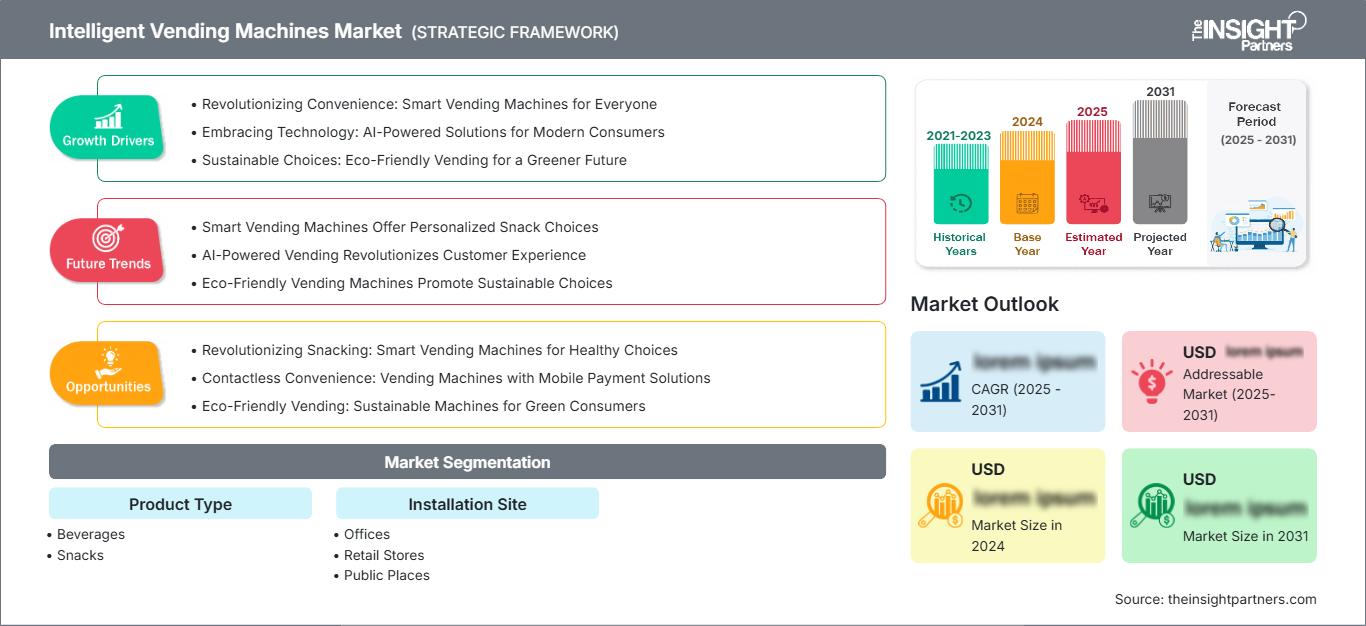
Intelligent Vending Machines Market: Strategic Insights
Regional Insights
North America Intelligent Vending Machines Market
North America is estimated to represent 34–38% of the Intelligent Vending Machines Market Share in 2025 and is projected to expand at a 9.0–10.0% CAGR through 2034. The region benefits from established vending infrastructure, strong card and mobile-payment penetration, mature office deployment, and extensive operator networks. Replacement of conventional machines with telemetry-enabled equipment provides an important source of demand.
In addition to the US which is the leading market in the region, Canada and Mexico present opportunities for business growth in workplaces, retail spaces, transit locations and hospitality services. There is also increased focus on machinery that is able to do remote inventory checks, payment without money, digital marketing, and predictive maintenance. Locations that can generate repeat business have more value due to increased utilization of the machines.
U.S. Intelligent Vending Machines Market
The US accounts for approximately 82–86% of North American demand in 2025 and is projected to grow at a 9.0–10.0% CAGR through 2034. The country has a mature vending ecosystem spanning offices, manufacturing facilities, retail environments, schools, hospitals, transportation locations, and public venues. Automated Merchandising Systems, Vendors Exchange International, and Crane Merchandising Systems support the domestic equipment ecosystem.
Increasingly, demand is moving towards devices that support card, mobile, and QR payments, remote inventory tracking, electronic screens, and centralized management. There is an increasing trend of setting up office-based micro-markets and unattended retail systems, which opens up opportunities beyond those for dispensing snacks and beverages. The existing installed base provides a replacement cycle for devices that do not have telemetry, payment mechanisms, energy efficient refrigeration, and remote diagnosis capabilities.
Europe Intelligent Vending Machines Market
It is expected that Europe will make up 23–27% market share by 2025, and is expected to register growth at 9.5–10.5% CAGR until 2034. The UK and Germany are the key players owing to the presence of well-established vending network as well as workplace installation. Italy, France, and Spain are other countries where the demand arises from hospitality, offices, transport, retail, and public sector deployments. European vendors also contribute significantly towards technology innovation.
The UK market has developed workplace vending and infrastructure for cashless payment, whereas Germany offers valuable industrial and corporate settings for deployment of such solutions. Italy still matters because of its vending manufacturing industry, which comprises FAS International and Evoca, while France and Spain are driven by hospitality, transport, offices, and public places. Sustainability needs prompt efficient refrigeration, use of recyclable parts, remote management, and reduction in service travel among European fleets.
APAC Intelligent Vending Machines Market
Asia-Pacific is expected to have a 29-33% share in 2025 and will witness a CAGR growth of 12.0-13.0% until 2034. Japan is the dominant market driven by extensive vending operations, while China, South Korea, India, and Australia present major growth opportunities. Urbanization, digitization, convenience retail, and technology adoption drive regional growth.
Japan presents a well-developed business model, while China and South Korea enjoy an ecosystem of interconnected consumers. India presents high growth opportunities due to the proliferation of smartphone payments and urban retail expansion. Australia enjoys demand drivers such as workplaces, universities, and public places. The adoption of technology in the region increasingly involves QR payments, mobile wallets, remote inventory management, and compact automated retail solutions that are viable in areas where traditional retail staffing is challenging.
Middle East & Africa Intelligent Vending Machines Market
Middle East and Africa is estimated to achieve growth of about 10.0% to 11.0% CAGR through 2034. Both Saudi Arabia and UAE are the main sources of regional opportunities in hospitality, airports, offices, retail developments, and major infrastructure projects. South Africa offers wider installed base in workplace, education, retail, and public venues, whereas Rest of MEA consists mainly of urban areas.
Opportunities in the region are highly correlated with high foot traffic facilities and premium hospitality environments. Suitable deployment sites include airports, transportation facilities, corporate campuses, hospitals, and retail sites. Remote management is a growing requirement among operators since the dispersed nature of machines results in increased maintenance expenses. In the Middle East, high ambient temperatures make refrigeration efficiency a significant criterion for equipment selection.
Segmentation Analysis
Product Type
The Product Type segment comprises Beverages and Snacks and is expected to expand at a 10.5–11.5% CAGR during 2026–2034. The Intelligent Vending Machines Market scope is strongly influenced by beverage consumption frequency, product shelf life, machine refrigeration, package dimensions, and consumer preference for immediate access. Beverage machines generally support higher transaction frequency and broader location coverage.
- Beverages: Beverage vending holds the dominant position because water, carbonated drinks, energy drinks, coffee, and other ready-to-consume products generate frequent purchases across offices, transport hubs, retail locations, and public venues.
- Snacks: Snack vending complements beverage demand by providing convenient packaged food options, supporting mixed assortments and increasing transaction opportunities where consumers seek quick refreshments without conventional retail checkout.
Installation Site
The Installation Site segment includes Offices, Retail Stores, and Public Places and is expected to grow at an 11.0–12.0% CAGR through 2034. Site selection determines traffic volume, product assortment, security requirements, machine utilization, and payment behavior. Public and retail environments increasingly favor connected systems because operators require centralized monitoring across multiple geographically distributed locations.
- Offices: Offices provide predictable recurring traffic and benefit from convenient employee access, cashless transactions, digital product selection, and reduced dependence on staffed food-service operations.
- Retail Stores: Retail stores use vending as a supplementary sales channel, enabling brands and operators to monetize compact spaces while providing products outside conventional checkout areas.
- Public Places: Public places include transportation hubs, hospitals, universities, entertainment venues, and civic locations where high footfall and extended operating hours make unattended dispensing particularly valuable.
Opportunity Snapshot
| Installation Site | Revenue Contribution (High/Medium/Low) | Trend Tag | Adoption Stage |
| Offices | High | Workplace Retail | Mature |
| Retail Stores | Medium | Retail Extension | Scaling |
| Public Places | High | Transit Convenience | Scaling |
Intelligent Vending Machines Market Growth Drivers and Impact Analysis
Cashless payments increase transaction convenience and machine utilization
The shift from cash toward cards, mobile wallets, QR codes, and contactless transactions is a fundamental driver of intelligent vending adoption. Modern payment acceptance reduces friction at the point of purchase and can make vending attractive to consumers who carry limited physical cash. Operators also benefit from faster transactions, reduced cash collection, improved reconciliation, and greater visibility into sales. In India, UPI processed 16.58 billion transactions worth ₹23.49 lakh crore in October 2024, illustrating the scale of digital payment activity in a major emerging economy. Such payment ecosystems make connected vending more commercially viable.
Remote monitoring improves vending operator productivity
Telemetry allows operators to monitor sales, stock levels, temperature, machine status, payment activity, and technical faults without visiting every installation. This capability can reduce unnecessary service trips, improve replenishment scheduling, and minimize lost sales caused by empty product slots. Intelligent vending systems increasingly combine telemetry with inventory analytics and automated alerts, enabling route managers to prioritize machines according to actual operating conditions. The impact is particularly important for large fleets spread across offices, retail locations, and public venues. Better route efficiency can improve asset utilization while lowering labor and logistics costs. Operators can also use aggregated transaction data to refine product assortment according to location-specific purchasing behavior.
AI and IoT enable data-driven unattended retail operations
IoT connectivity provides the infrastructure for continuous machine monitoring, while AI and analytics can convert transaction and inventory information into operational recommendations. Intelligent systems can identify fast-moving products, anticipate replenishment requirements, detect abnormal machine behavior, and support personalized promotions. The technology also enables operators to compare machine performance across locations and identify underperforming assets. Industry analysis identifies AI-powered inventory tracking, real-time data collection, touchscreens, and IoT connectivity as important developments in intelligent vending. As computing costs decline and connectivity becomes more standardized, these capabilities can increasingly be deployed across mid-sized fleets rather than remaining limited to large operators.
Intelligent Vending Machines Market Future Trends
Computer vision will strengthen frictionless vending experiences
The Intelligent Vending Machines Market trends are moving toward computer-vision-enabled purchasing, where cameras and edge computing can identify products selected by consumers and automate transaction confirmation. This model can reduce dependence on mechanical product-selection interfaces and support more flexible merchandise arrangements. Computer vision can also contribute to inventory verification and shelf monitoring, creating additional operational data. Privacy, cybersecurity, accuracy, and regulatory compliance will remain important deployment considerations. As edge processors become more capable, vending machines can perform more analysis locally rather than transferring all data to centralized platforms. The combination of vision, digital payments, and connected inventory systems could therefore transform vending into a more flexible form of unattended retail, particularly in premium offices, airports, campuses, and high-footfall commercial environments.
Energy-efficient equipment will become a procurement priority
Energy consumption is becoming increasingly relevant for vending operators because refrigeration can represent a significant portion of operating costs for beverage machines. Future equipment development is likely to emphasize high-efficiency compressors, improved insulation, LED lighting, intelligent temperature management, and sleep modes during low-traffic periods. Remote monitoring can further support energy optimization by identifying machines operating outside expected parameters. Sustainability requirements from corporate customers and property owners can also influence equipment procurement. Manufacturers that demonstrate lower energy use without compromising cooling performance may gain advantages in office, retail, and public-place contracts. The trend is particularly relevant in warmer climates where refrigeration loads are higher. Over time, energy data may also become part of fleet-level management dashboards, allowing operators to compare consumption across machines and locations.
Intelligent Vending Machines Market Opportunities
Smart micro-markets can extend unattended retail beyond machines
The Intelligent Vending Machines Market Forecasts indicate continued convergence between traditional vending and broader unattended retail. Micro-markets can combine refrigerated displays, shelving, self-checkout terminals, digital payments, and inventory software to offer substantially wider product assortments than conventional machines. This model is particularly relevant to offices, factories, hospitals, universities, and other controlled environments where recurring traffic supports larger assortments. Vendors can use vending infrastructure, payment platforms, and telemetry capabilities as building blocks for these formats. Investment opportunities exist in modular hardware, computer vision, inventory software, payment integration, and managed services. The transition allows operators to increase basket size while retaining the labor advantages of unattended commerce, creating a pathway from conventional beverage and snack vending toward broader automated convenience retail.
Digital merchandising can increase revenue per installed location
Connected vending equipment can become a digital merchandising channel rather than simply a dispensing asset. Screens can display product information, promotional offers, seasonal campaigns, nutritional details, loyalty incentives, and location-specific advertising. Operators and consumer brands can use transaction data to evaluate promotion effectiveness and adjust assortments according to purchasing behavior. The Coca-Cola Company demonstrated the direction of beverage dispensing technology in 2026 through its updated Freestyle platform, including a redesigned interface and modular equipment architecture designed to respond more quickly to consumer and venue requirements. Similar principles can be applied to conventional vending, allowing manufacturers and operators to generate additional value from screen real estate, transaction data, and targeted consumer engagement.
Recent Developments
- February 2026: Grupo Azkoyen, a multinational leader in the design, manufacture and commercialization of technological solutions in the areas of coffee, payment systems and security systems, will be present at the HIP (Horeca Professional Expo) trade fair, one of the main European events for the Horeca channel. The event will take place from February 16 to 18 at the IFEMA Madrid exhibition center. At this edition, the group will attend with three of its brands, Azkoyen, Ascaso and Cashlogy by Azkoyen, presenting proposals focused on the daily operations of Horeca businesses.
- November 2024: Archroma India has launched an innovative Reverse Vending Machine (RVM) Project at Viviana Mall in Thane, Mumbai. Inaugurated by Anjani Prasad - Vice President of South Asia, this initiative underscores Archroma's deep commitment to sustainability, marking a milestone in our ongoing effort of responsible waste management.
- January 2023: Thundercomm, the world-leading IoT product and solution provider, officially announced its all-new Smart Vending Machine Solution at CES 2023. This new solution will not only bring consumers a more convenient purchasing experience, but also help vending machine operators improve their operational efficiency and reduce costs.
Frequently Asked Questions

- Comprehensive Market Sizing and Forecast Analysis
- Detailed Segmentation Analysis
- In-Depth Market Dynamics Assessment
- Regional and Country-Level Insights
- Competitive Landscape and Company Benchmarking
- Strategic Business Intelligence
Recent Reports
Testimonials

The Insight Partners provided valuable market intelligence that supported our global go-to-market strategy. Their team was professional, responsive, and attentive to our feedback, providing thoughtful analysis and helpful methodological clarifications throughout the project.
Junmo Kim Chief Financial Officer (CFO), Enertech Co., Ltd.
The Insight Partners' SCADA System Market report is comprehensive, with valuable insights on current trends and future forecasts. The team was highly professional, responsive, and supportive throughout. We are very satisfied and highly recommend their services.
RAN KEDEM Partner, Reali Technologies LTDs
I requested a report on a very specific software market and the team produced the report in a few days. The information was very relevant and well presented. I then requested some changes and additions to the report. The team was again very responsive and I got the final report in less than a week.
JEAN-HERVE JENN Chairman, Future Analytica
We worked with The Insight Partners for an important market study and forecast. They gave us clear insights into opportunities and risks, which helped shape our plans. Their research was easy to use and based on solid data. It helped us make smart, confident decisions. We highly recommend them.
PIYUSH NAGPAL Sr. Vice President, High Beam Global
The Insight Partners delivered insightful, well-structured market research with strong domain expertise. Their team was professional and responsive throughout. The user-friendly website made accessing industry reports seamless. We highly recommend them for reliable, high-quality research services
YUKIHIKO ADACHI CEO, Deep Blue, LLC.
This is the first time I have purchased a market report from The Insight Partners.While I was unsure at first, I visited their web site and felt more comfortable to take the risk and purchase a market report.I am completely satisfied with the quality of the report and customer service. I had several questions and comments with the initial report, but after a couple of dialogs over email with their analyst I believe I have a report that I can use as input to our strategic planning process.Thank you so much for taking the extra time and making this a positive experience.I will definitely recommend your service to others and you will be my first call when we need further market data.
JOHN SUZUKI President and Chief Executive Officer, Board Director, BK Technologies
I wish to appreciate your support and the professionalism you displayed in the course of attending to my request for information regarding to infectious disease IVD market in Nigeria. I appreciate your patience, your guidance, and the fact that you were willing to offer a discount, which eventually made it possible for us to close a deal. I look forward to engaging The Insight Partners in the future, all thanks to the impression you have created in me as a result of this first encounter.
DR CHIJIOKE ONYIA MANAGING DIRECTOR, PineCrest Healthcare Ltd.Reason to Buy
- Informed Decision-Making
- Understanding Market Dynamics
- Competitive Analysis
- Identifying Emerging Markets
- Customer Insights
- Market Forecasts
- Risk Mitigation
- Boosting Operational Efficiency
- Strategic Planning
- Investment Justification
- Tracking Industry Innovations
- Aligning with Regulatory Trends





 Get Free Sample for