
Snow Sweeper Truck Market Size, Share & Demand by 2034
Coverage: By Type (Rotary Snow Sweeper Truck, Wedge Snow Sweeper Truck); Application (Strasse, Airport, Highway, Agriculture) , and Geography (North America, Europe, Asia Pacific, and South and Central America)
- Status : Data Released
- Report Code : TIPRE00021541
- Category : Manufacturing and Construction
- No. of Pages : 150
- Available Report Formats :


- Last update date : October 13, 2026


2025 Market Size
US$ 563.14 Mn
Base year value
2034 Forecast
US$ 735.54 Mn
Projected by 2034
CAGR 2026-2034
3.01 %
Growth rate
Addressable Market
US$ 5,895.60 Mn
(2026-2034)
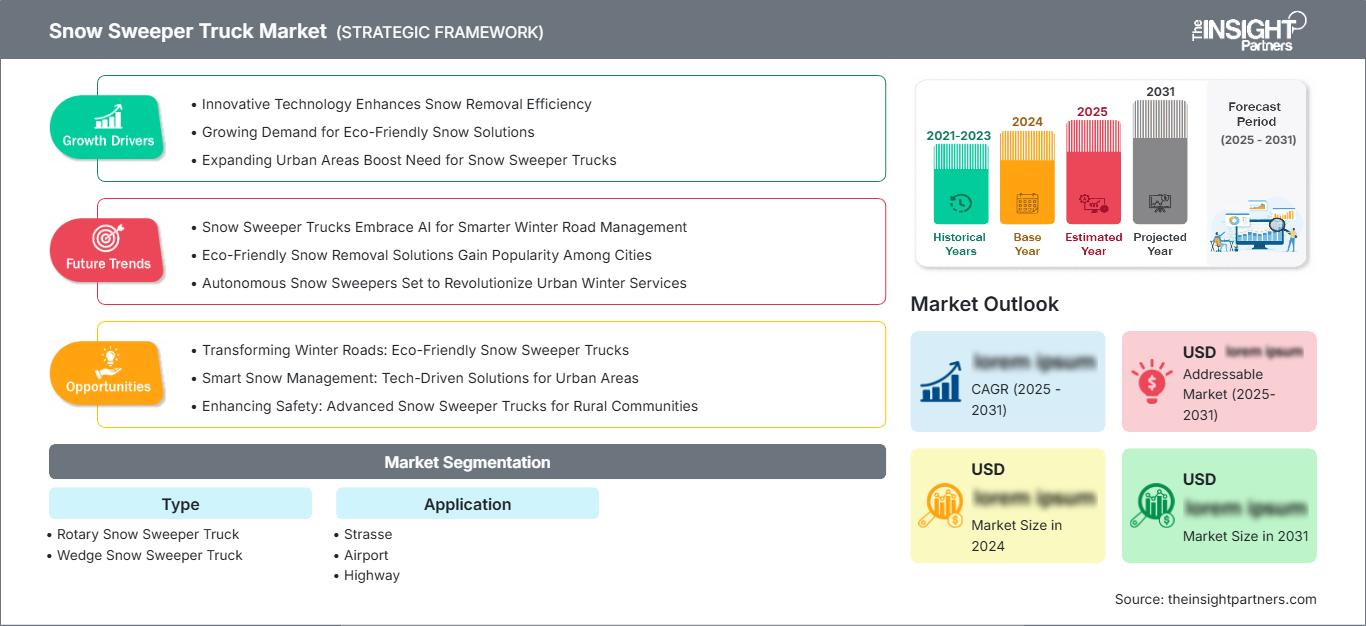
The Snow Sweeper Truck Market is undergoing steady modernization as road authorities, airports, and highway operators prioritize faster snow clearance, equipment reliability, and improved surface safety. The market is projected to increase from US$ 563.14 Million in 2025 to US$ 735.54 Million by 2034, registering a CAGR of 3.01% during 2026–2034. Demand is shaped by the replacement of aging winter-maintenance fleets, airport operational requirements, highway resilience programs, and increasing integration of multifunctional sweeping, blowing, plowing, and de-icing capabilities.
North America represents a mature demand center, supported by extensive winter road networks, airport snow-removal requirements, municipal procurement programs, and established equipment manufacturers. The region is expected to record a ~2% CAGR through 2034. The Snow Sweeper Truck Market size is also influenced by fleet replacement cycles, severe-weather preparedness, and investments in equipment capable of serving multiple winter-maintenance functions.
Snow Sweeper Truck Market Assessment and Insights
Regional Outlook
- North America: ~34% of the global market in 2025 | ~2% CAGR through 2034. Market position: North America maintains the largest regional position because municipalities, airports, and highway agencies operate extensive winter-maintenance fleets. Established procurement channels, replacement demand, and severe winter conditions sustain equipment utilization across public and private operators.
- US: ~78% of North American market revenue in 2025 | ~2% CAGR through 2034. Market position: The US represents the principal national market within North America, supported by widespread highway networks, airport snow-removal programs, municipal fleets, and established suppliers. Equipment demand spans truck-mounted brooms, blowers, plows, and integrated winter-maintenance systems.
- Europe: ~30% of the global market in 2025 | ~2% CAGR through 2034. Market position: Europe is a mature market supported by extensive road infrastructure and airport operations. Germany is the leading country in Europe, while the UK, France, Italy, and Spain contribute through highway maintenance, airport operations, municipal procurement, and specialized winter-service requirements.
- Asia Pacific: ~25% of the global market in 2025 | ~5% CAGR through 2034. Market position: Asia Pacific is the fastest-growing region as China, Japan, South Korea, India, and Australia expand transport infrastructure and winter-resilience capabilities. China is the leading country in Asia Pacific, supported by industrial manufacturing capacity and infrastructure development.
Segment Outlook
- Rotary Snow Sweeper Truck: ~64% Share in 2025 | ~3% CAGR through 2034. Market position: Rotary systems lead because rotating brushes provide continuous snow displacement and can support broad operating requirements across highways, airports, and municipal routes. Their compatibility with multifunctional chassis platforms strengthens replacement and fleet-standardization demand.
- Airport: ~38% Share in 2025 | ~4% CAGR through 2034. Market position: Airport applications have a strong growth outlook because runway and taxiway operations require rapid surface clearance, high equipment availability, and coordinated snow-removal workflows. Integrated brush, blower, plow, and de-icing systems improve utilization during severe weather events.
Competitive Coverage
Boschung, Alamo Group Inc., DIMARK, Douglas Dynamics, LLC, Henan Lutai Road Maintenance Machinery Co., Ltd., Kodiak America, Paladin Attachments, The Ash Group, Wausau Equipment Company, Inc., Zoomlion Heavy Industry Science and Technology Co., Ltd., M-B Companies, Inc.
Methodology
The Insight Partners follows Data Collection & Secondary Research, Primary Research, Data Analysis, and Data Triangulation & Final Review to validate market estimates and insights.
Source: The Insight Partners' analysis based on proprietary research, government publications, company annual reports, investor presentations, industry databases, and expert interviews.
The evolution of snow-clearing equipment has shifted from single-purpose plowing toward multifunctional platforms combining rotary brushing, air blowing, plowing, sweeping, and de-icing. Modern systems increasingly emphasize operator visibility, hydraulic control, maneuverability, and compatibility with specialized truck chassis. Airport-focused equipment demonstrates this transition particularly clearly, with high-performance systems combining large brushes and blower units for rapid runway treatment. These developments support the Snow Sweeper Truck Market growth by increasing productivity per vehicle and improving fleet utilization beyond individual snow events.
Looking ahead, Snow Sweeper Truck Market share is likely to be influenced by investment in fleet modernization, connected maintenance systems, lower-emission powertrains, and equipment capable of operating across different infrastructure environments. Emerging demand in Asia Pacific is linked to expanding transport networks and winter-weather preparedness, while European procurement is influenced by infrastructure resilience and environmental considerations. In North America, established airport and municipal procurement channels continue to support replacement demand. These factors create a gradual transition toward intelligent and multifunctional snow-maintenance fleets rather than rapid technology disruption.
Snow Sweeper Truck Market Report Scope
| Report Attribute | Details |
|---|---|
| Market size in 2025 | US$ 563.14 Million |
| Market Size by 2034 | US$ 735.54 Million |
| Global CAGR (2026 - 2034) | 3.01% |
| Historical Data | 2021-2024 |
| Forecast period | 2026-2034 |
Snow Sweeper Truck Market Analysis
Snow Sweeper Truck Market forecast is expected to be influenced by demand from airport authorities, national and regional highway agencies, municipalities, contractors, and specialized infrastructure operators. The value chain starts with the supply of chassis, engines, hydraulics, brushes, blowers, plows, controls, and de-icing units and continues with system integration, delivery, fleet commissioning, maintenance, and parts. Thus, equipment vendors not only compete in performance but also in reliability, attachment capability, serviceability, and life cycle cost.
Supply dynamics depend on the manufacturing capabilities in heavy equipment, special fabrication, hydraulic components, and seasonal manufacturing. Manufacturing facilities equipped with a network of dealers and services are better prepared to meet seasonal buying needs. In general, airport applications need custom design, while municipal and highway fleets prefer standard equipment that is supported locally. Such a difference offers an opportunity for a modular design, whereby one truck design may support various winter-maintenance attachments.
The competitive landscape of the Snow Sweeper Truck Market trends includes diversified industrial-equipment manufacturers and specialist winter-maintenance suppliers. Boschung differentiates through integrated airport and highway snow-clearing systems, while Alamo Group Inc. participates through its snow and ice equipment businesses, including Wausau Equipment. Douglas Dynamics focuses on commercial snow and ice control equipment, whereas Zoomlion brings broader construction and municipal-equipment manufacturing capabilities. DIMARK, Kodiak America, The Ash Group, and Henan Lutai Road Maintenance Machinery Co., Ltd. contribute specialized equipment and regional capabilities.
Investment focus is now shifting to production flexibility, after-market services, vehicle connectivity, and platform products that can perform multiple winter maintenance tasks. The competitive analysis for the Snow Sweeper Truck market highlights that there is an opportunity to develop a more favorable position through integrated control, enhanced interchangeability of attachments, predictive maintenance, and a regional service network. Complete fleet procurement agreements may further lead to bundled offerings.
● REPORT CUSTOMIZATION
Tailor This Report To Align With Your Specific Business Requirements
This report can be customized to align precisely with your business objectives, scope, and target markets. Customization options include tailored segmentation, geography, competitive analysis, and strategic insights to support informed decision-making.
Customize This Report →WHAT YOU CAN ADJUST
- ● Segmentations
- ● Geography
- ● Competitive Analysis
- ● Language Preferences
Snow Sweeper Truck Market: Strategic Insights
Regional Insights
North America Snow Sweeper Truck Market
North America accounted for ~34% of the global Snow Sweeper Truck Market in 2025 and is expected to expand at ~2% CAGR through 2034. The region benefits from extensive highway networks, large airport systems, municipal snow-removal programs, and a mature commercial equipment ecosystem. Winter-maintenance authorities require dependable equipment that can remain available during short, high-intensity weather windows. This favors truck-mounted sweeping, plowing, and blowing systems that can rapidly return transportation infrastructure to service.
The USA serves as the largest national demand market in this region, while Canadian cities and transport departments contribute to the demand. The procurement process becomes more and more associated with fleet replacement, airport upgrades, and life cycle maintenance. The suppliers that include Boschung, Douglas Dynamics, Alamo Group Inc., and Wausau Equipment Company, Inc., create competition in various applications, including airports, highways, municipalities, and businesses. Thus, regional demand remains quite stable, while any increases happen due to replacements, upgrades, and weather readiness.
U.S. Snow Sweeper Truck Market
The US represented ~78% of North American Snow Sweeper Truck Market revenue in 2025 and is projected to grow at ~2% CAGR through 2034. Its position reflects the scale of interstate highways, municipal road systems, airports, and winter-service contractors. Procurement requirements vary by geography, with northern states emphasizing high-capacity snow removal while airport authorities prioritize rapid runway and taxiway clearance. The result is demand for equipment configurations tailored to specific operating environments.
US suppliers and international manufacturers maintain established channels across public agencies and private contractors. Airport applications favor integrated brush, blower, plow, and de-icing configurations, while highway and municipal users often prioritize maneuverability, attachment flexibility, and maintenance accessibility. The US Snow Sweeper Truck Market also benefits from established replacement cycles because winter equipment experiences intensive seasonal use and must maintain operational availability during severe weather.
Europe Snow Sweeper Truck Market
Europe represented ~30% of the global Snow Sweeper Truck Market revenue in 2025 and is forecast to expand at ~2% CAGR through 2034. Germany is the leading country in Europe, supported by extensive road infrastructure, winter-service requirements, industrial manufacturing capabilities, and specialized airport operations. The UK relies on demand created through airport and road infrastructure maintenance, despite significant geographic variation in snow accumulation. The demand in France and Italy is derived from highway, urban and alpine infrastructure needs, while the demand for Spain is more localized in colder areas, mountainous locations and certain transport corridors.
Operators in Europe pay more attention to efficiency, long-term effectiveness, environmental sustainability and versatility of equipment. Airports demand specific high-speed runway maintenance equipment, while the need of road authorities is directed towards equipment that could perform snow sweep, removal and de-icing operations with a small fleet. Boschung is well-represented in Europe with its range of runway and highway maintenance equipment, while other manufacturers cater to regional needs related to municipal and industrial infrastructure.
APAC Snow Sweeper Truck Market
Asia Pacific represented ~25% of the global Snow Sweeper Truck Market revenue in 2025 and is expected to grow at ~5% CAGR through 2034, making it the fastest-growing region. Being a leader in Asia Pacific, China is backed up by its capability in producing huge amounts of machinery, transportation infrastructure investments and winter maintenance needs in north regions. Demand in Japan and South Korea is known to be stable for winter road and airport equipment, while in India and Australia is geographically more focused.
The development is associated with the construction of new highways and airports, urban infrastructure, as well as a focus on the continuity of transportation operations under harsh conditions. Additionally, China offers a significant production facility of specialized road maintenance equipment. Meanwhile, Japan and South Korea pay much attention to reliable operation and compact equipment for harsh winter conditions.
Middle East & Africa Snow Sweeper Truck Market
Middle East & Africa Snow Sweeper Truck Market represents a smaller portion of global demand but is developing through specialized infrastructure and airport requirements. The region is projected to record ~4% CAGR through 2034. Saudi Arabia is the leading country in the Middle East & Africa for specialized demand where large infrastructure programs, airports, and high-value transport facilities require comprehensive surface-maintenance equipment, although snow applications remain geographically limited.
The UAE contributes primarily through major airport infrastructure and specialized surface-maintenance requirements, while South Africa provides demand associated with mountainous and colder areas. The rest of the MEA demand is concentrated in selected high-altitude or winter-exposed locations. Airport infrastructure and infrastructure resilience are more important than broad municipal snow-clearing requirements, making specialized equipment and adaptable maintenance platforms commercially relevant.
Segmentation Analysis
Type
The Type dimension is characterized by rotary and wedge configurations. Rotary systems are particularly suited to continuous sweeping and snow displacement, while wedge systems emphasize pushing and directional clearing. Equipment selection depends on snow depth, surface characteristics, road geometry, operating speed, and whether the machine is deployed on highways, airports, or municipal routes. Overall Type demand is expected to expand at approximately ~3% CAGR through 2034 as operators replace aging equipment with more versatile platforms.
- Rotary Snow Sweeper Truck: Rotary systems hold the largest position because continuous brush rotation supports efficient removal of loose snow, slush, and residual surface material. Their compatibility with integrated blowers and plows increases operational flexibility and makes them suitable for airports, highways, and municipal routes.
- Wedge Snow Sweeper Truck: Wedge systems provide direct directional snow displacement and remain relevant where pushing capacity and straightforward operation are priorities. Their comparatively simple operating concept supports applications involving accumulated snow on roads, access routes, and selected infrastructure surfaces.
Application
Application demand differs according to infrastructure criticality, snowfall exposure, operating frequency, and required clearance speed. Airport operators place strong emphasis on rapid runway availability, whereas highways require broad-area treatment and municipal users prioritize maneuverability. Agriculture represents a smaller but specialized application area. Overall Application demand is projected at approximately ~3% CAGR through 2034, supported by infrastructure replacement and winter-resilience spending.
- Strasse: Road and street applications represent a broad addressable environment covering municipal routes, access roads, and transport corridors. Demand emphasizes maneuverability, rapid clearing, attachment flexibility, and equipment durability during repeated seasonal operations.
- Airport: Airport systems require high-performance snow removal to maintain runway, taxiway, and apron availability. Specialized sweeping and blowing equipment is strategically important because snow clearance must be coordinated with aviation operations and often completed within tightly managed operating windows.
- Highway: Highway applications prioritize large-area coverage, operational speed, reliability, and compatibility with existing maintenance fleets. Demand is supported by transportation agencies seeking equipment capable of maintaining traffic corridors during severe snowfall while limiting downtime and repeated passes.
- Agriculture: Agricultural applications are comparatively specialized and depend on local winter conditions, farm access requirements, storage yards, and operational continuity. Equipment can provide value where snow accumulation restricts access to agricultural facilities, livestock areas, or machinery storage locations.
Opportunity Snapshot
| Application | Revenue Contribution | Trend Tag | Adoption Stage |
|---|---|---|---|
| Strasse | High | Road Clearance | Mature |
| Airport | High | Runway Clearance | Scaling |
| Highway | High | Corridor Resilience | Mature |
| Agriculture | Low | Farm Access | Emerging |
Snow Sweeper Truck Market Growth Drivers and Impact Analysis
Expansion of Airport and Highway Winter-Resilience Programs
Airports and highway agencies have strong operational incentives to maintain transportation continuity during snowfall. Airport operators require equipment that can clear runways and taxiways rapidly, while highway authorities must prevent the accumulation from disrupting freight and passenger movement. This creates recurring procurement demand even when annual snowfall varies because equipment availability is itself an operational requirement. Modern systems can combine sweeping, blowing, plowing, and de-icing functions, reducing the need for separate specialized assets. For manufacturers, this shifts competition toward productivity, reliability, attachment integration, and service support. The resulting procurement environment supports the replacement of older fleets and encourages operators to select equipment with greater utilization potential. These requirements provide a durable foundation for the Snow Sweeper Truck Market across mature winter-service economies.
Replacement of Aging Municipal and Commercial Snow Equipment Fleets
Another factor that acts as a mechanism of demand is the replacement of equipment that has been put through many hours of operation during the season. Older machines may be less reliable and harder to maintain, having fewer attachments available and lacking advanced control systems. The decision-making process now takes into account not only the price of purchase, but the overall cost of ownership, especially if the availability of equipment has a direct impact on the performance of services. The replacement cycle offers an opportunity to select a brand that provides a range of standardized components, easy access to service, modularity in attachments, and good parts availability. Fleet replacements may also open up prospects of buying more efficient equipment, where the transportation infrastructure has developed since the last time equipment was purchased.
Multifunctional Equipment Improving Fleet Utilization
Equipment for snow removal is increasingly being judged based on its multi-functional abilities rather than a single winter task only. A machine that can sweep, blow, plow, or de-ice will allow a machine operator to increase the efficiency of using equipment on an annual basis, and thus the total number of machines that need to be bought by an operator is reduced. This is especially true for the airport or municipality, which requires certain equipment to be utilized during the wintertime, but can then be used for other surface maintenance tasks when it is warm outside. Multi-functionality affects the purchase decision, as an operator is able to standardize such items as the chassis, control mechanism, maintenance and spares.
Snow Sweeper Truck Market Future Trends
Integration of Connected Winter-Maintenance Management
Equipment connectivity and fleet management software systems are likely to assume greater significance in winter maintenance operations. Information collected by sensors, machine diagnostics, positioning, weather information, and operational data could help fleet managers manage their equipment scheduling and maintenance processes. Airports will be able to make use of the integrated system to gain an understanding of the equipment status and sequence clearing of runways, while road agencies can make use of it for better decision-making about equipment dispatching when weather conditions are not favorable. The next step will see reduced emphasis on connectivity alone and increased importance of the integration of operational information into maintenance practices.
Lower-Emission and Electrification-Ready Winter Equipment
The environmental needs are expected to affect the design of the equipment used in winter maintenance operations in the future, even though there are major issues related to the power required by snow clearance. Consequently, manufacturers will be inclined to combine better fuel efficiency, alternative energy sources, hybrid solutions, electric auxiliary systems, and, at some point, fully electric platforms when feasible. In the case of the airport, the operators could have an added reason to cut down on emissions since the equipment works in an intensive area near the terminals and airside facilities. Electrification does not imply full substitution of the conventional drive train since extreme low temperatures, high hydraulic power, and long operational time can make it challenging.
Snow Sweeper Truck Market Opportunities
Airport Fleet Modernization and Integrated Clearing Systems
The area of modernization of airports is an interesting business opportunity owing to the direct relation between snow removal and operational continuity and safety on the airfield surfaces. Procurement processes can include entire fleets rather than single pieces of equipment, thus offering opportunities to those suppliers who are capable of offering combinations of sweepers, blowers, plows, de-icers, systems of control, and training. The ability of the equipment to handle several tasks related to runway maintenance can make the business case for equipment purchase even more compelling. Suppliers may exploit their opportunities through the engineering for specific airports, fleet standardization, predictive maintenance, and service contracts.
Modular Platforms for Emerging Winter-Service Geographies
Asia Pacific and selected developing infrastructure markets offer opportunities for modular equipment architectures that can be configured according to local snowfall exposure and infrastructure requirements. Rather than replicating mature-market fleet structures, operators can adopt platforms that combine attachments and scale capacity according to actual winter conditions. Manufacturers can support this opportunity through localized assembly, regional distribution, operator training, financing arrangements, and spare-parts networks. China provides an important manufacturing ecosystem, while Japan, South Korea, India, and Australia present differentiated application requirements. Suppliers that balance standardized core components with locally adapted configurations can reduce complexity while improving market accessibility. This approach can also help manufacturers enter markets where snow-removal equipment remains specialized rather than routinely purchased across municipal fleets.
Recent Developments
- September 2026: Virnig Manufacturing has launched a completely redesigned range of two-stage snow blowers aimed at municipalities, contractors, and professional snow removal operators. The new lineup incorporates expanded width options, multiple hydraulic motor packages, different auger configurations, and several operator-focused improvements designed to enhance performance, durability, and ease of use.
- March 2025: M-B Companies, Inc. secured a major contract through Aebi Schmidt Group to supply Minneapolis-St. Paul International Airport with 58 specialized snow-removal vehicles between fall 2025 and 2027. The nearly US$56 million order covers a fleet modernization program and reinforces demand for specialized airport snow-clearing equipment.
- February 2025: Douglas Dynamics, LLC appointed Chris Bernauer as President of its Work Truck Attachments segment, responsible for commercial snow and ice control operations. The appointment supports leadership continuity across the company's snow and ice equipment activities, including its FISHER, SNOWEX, and WESTERN product businesses.
Frequently Asked Questions

- Comprehensive Market Sizing and Forecast Analysis
- Detailed Segmentation Analysis
- In-Depth Market Dynamics Assessment
- Regional and Country-Level Insights
- Competitive Landscape and Company Benchmarking
- Strategic Business Intelligence
Recent Reports
Testimonials

The Insight Partners provided valuable market intelligence that supported our global go-to-market strategy. Their team was professional, responsive, and attentive to our feedback, providing thoughtful analysis and helpful methodological clarifications throughout the project.
Junmo Kim Chief Financial Officer (CFO), Enertech Co., Ltd.
The Insight Partners' SCADA System Market report is comprehensive, with valuable insights on current trends and future forecasts. The team was highly professional, responsive, and supportive throughout. We are very satisfied and highly recommend their services.
RAN KEDEM Partner, Reali Technologies LTDs
I requested a report on a very specific software market and the team produced the report in a few days. The information was very relevant and well presented. I then requested some changes and additions to the report. The team was again very responsive and I got the final report in less than a week.
JEAN-HERVE JENN Chairman, Future Analytica
We worked with The Insight Partners for an important market study and forecast. They gave us clear insights into opportunities and risks, which helped shape our plans. Their research was easy to use and based on solid data. It helped us make smart, confident decisions. We highly recommend them.
PIYUSH NAGPAL Sr. Vice President, High Beam Global
The Insight Partners delivered insightful, well-structured market research with strong domain expertise. Their team was professional and responsive throughout. The user-friendly website made accessing industry reports seamless. We highly recommend them for reliable, high-quality research services
YUKIHIKO ADACHI CEO, Deep Blue, LLC.
This is the first time I have purchased a market report from The Insight Partners.While I was unsure at first, I visited their web site and felt more comfortable to take the risk and purchase a market report.I am completely satisfied with the quality of the report and customer service. I had several questions and comments with the initial report, but after a couple of dialogs over email with their analyst I believe I have a report that I can use as input to our strategic planning process.Thank you so much for taking the extra time and making this a positive experience.I will definitely recommend your service to others and you will be my first call when we need further market data.
JOHN SUZUKI President and Chief Executive Officer, Board Director, BK Technologies
I wish to appreciate your support and the professionalism you displayed in the course of attending to my request for information regarding to infectious disease IVD market in Nigeria. I appreciate your patience, your guidance, and the fact that you were willing to offer a discount, which eventually made it possible for us to close a deal. I look forward to engaging The Insight Partners in the future, all thanks to the impression you have created in me as a result of this first encounter.
DR CHIJIOKE ONYIA MANAGING DIRECTOR, PineCrest Healthcare Ltd.Reason to Buy
- Informed Decision-Making
- Understanding Market Dynamics
- Competitive Analysis
- Identifying Emerging Markets
- Customer Insights
- Market Forecasts
- Risk Mitigation
- Boosting Operational Efficiency
- Strategic Planning
- Investment Justification
- Tracking Industry Innovations
- Aligning with Regulatory Trends





 Get Free Sample for