
South & Central America Pharmaceutical Excipients Market Analysis and Forecast by Size, Share, Growth, Trends 2034
Coverage: By Type (Bioresorbable Polymers and Lipids and Liposome Based Formulation, Oleochemicals, Sugars, Cellulose, Starches, Petrochemicals, Plant Proteins Polyols and Cyclodextrins, Inorganic Chemicals, and Others), Oleochemicals For Type (Fatty Alcohols, Metal Stearates, Glycerin, and Other Oleochemicals), Sugars For Type (Actual Sugars, Sugar Alcohols, and Artificial Sweeteners), Cellulose For Type (Microcrystalline Cellulose, Cellulose Ethers, and Carboxymethylcellulose and Croscarmellose Sodium), Starches For Type (Modified Starches, Dried Starch, and Converted Starch and Pregelatinized Starch), Petrochemicals For Type (Glycols, Povidones, Mineral Hydrocarbons, and Other Petrochemicals), Inorganic Chemicals For Type (Magnesium and Calcium Carbonate, Calcium and Aluminum Phosphate, Silicon Dioxide, Titanium Dioxide, and Other Inorganic Chemicals), Clinical Indication (Cancer, Metabolic, Infectious Disease, Dental, Ophthalmic, Cardiovascular, and Other Clinical Indications), Functionality (Coloring Agents and Coating Agents, Sweetner and Flavoring Agents, Suspending and Viscosity Agents, Preservative and Controlled Release, Antioxidant and Oil, Tablet Filler and Diluent, Binder and Compression and Granulating Agents, Emulsifiers, Surfactants, and Others), Surfactants For Functionality (Polyoxyethylene Hydrogenated Castor Oil, Polysorbates, Sodium Dodecyl Sulfate, and Other Surfactants), Application (Oral, Injectable, Topical, and Others), Oral For Application (Tablet, Capsule, Liquid, and Others), Capsule For Oral (Hard Gel and Soft Gel), and End User (Pharma Industries, Biopharma Industries, Animal Health, and Other End User)
- Status : Published
- Report Code : TIPRE00022817
- Category : Life Sciences
- No. of Pages : 333
- Available Report Formats :


- Last update date : August 07, 2026


2025 Market Size
US$ 362.2 Mn
Base year value
2034 Forecast
US$ 597.5 Mn
Projected by 2034
CAGR 2026-2034
5.8 %
Growth rate
Addressable Market
US$ 4,367.28 Mn
(2026-2034)
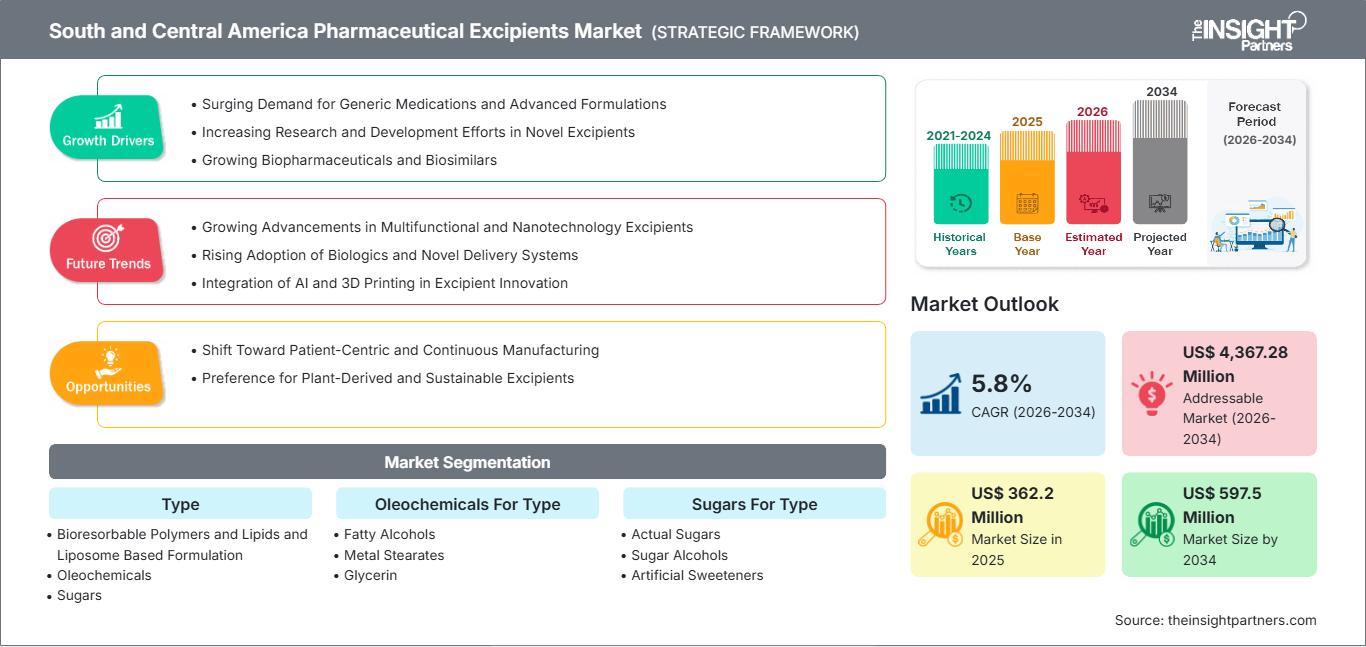
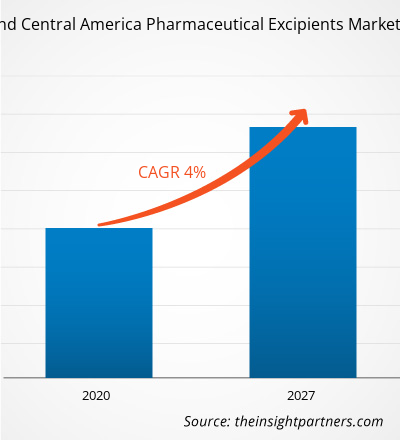
The South and Central America Pharmaceutical Excipients Market size is expected to reach US$ 597.5 Million by 2034 from US$ 362.2 Million in 2025. The market is estimated to record a CAGR of 5.8% from 2026 to 2034.
Executive Summary and South and Central America Pharmaceutical Excipients Market Analysis:
The pharmaceutical excipients market in South & Central America is segmented into Brazil, Argentina, and the Rest of South & Central America. One major driver is the expanding pharmaceutical manufacturing sector in countries such as Brazil, Mexico, and Argentina, where increasing investments in drug production have raised demand for excipients used in drug formulation. Rising prevalence of chronic diseases, including Diabetes Mellitus and Cardiovascular Diseases, has also increased the need for pharmaceutical products, boosting excipient consumption. Additionally, the growing market for generic drugs is encouraging manufacturers to use a wide range of functional excipients to improve stability, bioavailability, and shelf life. Government initiatives aimed at strengthening local pharmaceutical industries and improving healthcare infrastructure support market expansion. Moreover, increasing research and development activities and collaborations between regional pharmaceutical companies and global suppliers are accelerating innovation in excipient technologies.
● REPORT CUSTOMIZATION
Tailor This Report To Align With Your Specific Business Requirements
This report can be customized to align precisely with your business objectives, scope, and target markets. Customization options include tailored segmentation, geography, competitive analysis, and strategic insights to support informed decision-making.
Customize This Report →WHAT YOU CAN ADJUST
- ● Segmentations
- ● Geography
- ● Competitive Analysis
- ● Language Preferences
South & Central America Pharmaceutical Excipients Market: Strategic Insights
-
Get Top Key Market Trends of this report.This FREE sample will include data analysis, ranging from market trends to estimates and forecasts.
South and Central America Pharmaceutical Excipients Market Segmentation Analysis:
- By Type, the South and Central America Pharmaceutical Excipients Market is segmented into Bioresorbable Polymers and Lipids and Liposome Based Formulation, Oleochemicals, Sugars, Cellulose, Starches, Petrochemicals, Plant Proteins Polyols and Cyclodextrins, Inorganic Chemicals, and Others. The Cellulose segment dominated the market in 2025.
- By Oleochemicals For Type, the South and Central America Pharmaceutical Excipients Market is segmented into Fatty Alcohols, Metal Stearates, Glycerin, and Other Oleochemicals. The Fatty Alcohols segment dominated the market in 2025.
- By Sugars For Type, the South and Central America Pharmaceutical Excipients Market is segmented into Actual Sugars, Sugar Alcohols, and Artificial Sweeteners. The Actual Sugars segment dominated the market in 2025.
- By Cellulose For Type, the South and Central America Pharmaceutical Excipients Market is segmented into Microcrystalline Cellulose, Cellulose Ethers, and Carboxymethylcellulose and Croscarmellose Sodium. The Microcrystalline Cellulose segment dominated the market in 2025.
- By Starches For Type, the South and Central America Pharmaceutical Excipients Market is segmented into Modified Starches, Dried Starch, and Converted Starch and Pregelatinized Starch. The Modified Starches segment dominated the market in 2025.
- By Petrochemicals For Type, the South and Central America Pharmaceutical Excipients Market is segmented into Glycols, Povidones, Mineral Hydrocarbons, and Other Petrochemicals. The Glycols segment dominated the market in 2025.
- By Inorganic Chemicals For Type, the South and Central America Pharmaceutical Excipients Market is segmented into Magnesium and Calcium Carbonate, Calcium and Aluminum Phosphate, Silicon Dioxide, Titanium Dioxide, and Other Inorganic Chemicals. The Calcium and Aluminum Phosphate segment dominated the market in 2025.
- By Clinical Indication, the South and Central America Pharmaceutical Excipients Market is segmented into Cancer, Metabolic, Infectious Disease, Dental, Ophthalmic, Cardiovascular, and Other Clinical Indications. The Cancer segment dominated the market in 2025.
- By Functionality, the South and Central America Pharmaceutical Excipients Market is segmented into Coloring Agents and Coating Agents, Sweetner and Flavoring Agents, Suspending and Viscosity Agents, Preservative and Controlled Release, Antioxidant and Oil, Tablet Filler and Diluent, Binder and Compression and Granulating Agents, Emulsifiers, Surfactants, and Others. The Tablet Filler and Diluent segment dominated the market in 2025.
- By Surfactants For Functionality, the South and Central America Pharmaceutical Excipients Market is segmented into Polyoxyethylene Hydrogenated Castor Oil, Polysorbates, Sodium Dodecyl Sulfate, and Other Surfactants. The Polysorbates segment dominated the market in 2025.
- By Application, the South and Central America Pharmaceutical Excipients Market is segmented into Oral, Injectable, Topical, and Others. The Oral segment dominated the market in 2025.
- By Oral For Application, the South and Central America Pharmaceutical Excipients Market is segmented into Tablet, Capsule, Liquid, and Others. The Tablet segment dominated the market in 2025.
- By Capsule For Oral, the South and Central America Pharmaceutical Excipients Market is segmented into Hard Gel and Soft Gel. The Hard Gel segment dominated the market in 2025.
- By End User, the South and Central America Pharmaceutical Excipients Market is segmented into Pharma Industries, Biopharma Industries, Animal Health, and Other End User. The Pharma Industries segment dominated the market in 2025.
South & Central America Pharmaceutical Excipients Market Report Scope
| Report Attribute | Details |
|---|---|
| Market size in 2025 | US$ 362.2 Million |
| Market Size by 2034 | US$ 597.5 Million |
| CAGR (2026 - 2034) | 5.8% |
| Historical Data | 2021-2024 |
| Forecast period | 2026-2034 |
| Segments Covered |
By Type
|
| Regions and Countries Covered |
South and Central America
|
| Market leaders and key company profiles |
|
South & Central America Pharmaceutical Excipients Market Players Density: Understanding Its Impact on Business Dynamics
The South & Central America Pharmaceutical Excipients Market is growing rapidly, driven by increasing end-user demand due to factors such as evolving consumer preferences, technological advancements, and greater awareness of the product's benefits. As demand rises, businesses are expanding their offerings, innovating to meet consumer needs, and capitalizing on emerging trends, which further fuels market growth.
South and Central America Pharmaceutical Excipients Market Outlook
The pharmaceutical excipients market is evolving with a pronounced shift toward patient-centric and continuous manufacturing paradigms, prioritizing personalized formulations and streamlined production to improve adherence, efficacy, and efficiency. Patient-centric approaches focus on tailoring excipient selections to individual needs, such as ease of swallowing or reduced bitterness, particularly for vulnerable populations such as the elderly and pediatrics patients. A review of solid oral dosage form (SODF) attributes highlights preferences for smaller tablet sizes (under 12 mm diameter) and film-coated surfaces to minimize choking risks, with studies showing up to 70% of patients favoring mini-tablets over traditional ones for better compliance in chronic conditions. Compounding pharmacies exemplify this by customizing excipients such as flavor-masking agents (e.g., cyclodextrins) in liquid formulations for pediatric oncology drugs, addressing biopharmaceutical challenges in elderly patients where demographic shifts demand age-specific viscosity adjustments in suspensions.
Precision medicine integrates excipients in extemporaneous preparations; for example, tablet splitting or liquid dispensing with polymers such as hypromellose ensures dose accuracy for 30-50% of therapies requiring personalization, reducing errors in low-dose APIs. Continuous manufacturing enhances excipient integration by enabling real-time quality control, contrasting batch processes' variability. Additionally, continuous methods achieve blend uniformity with relative standard deviation (RSD) of 2-6% for binary and ternary mixtures (e.g., lactose, microcrystalline cellulose [MCC], and paracetamol at 2-30% API), compared to batch blending's up to 68% RSD due to segregation from density mismatches (0.34-0.72 g/cm³). This robustness persists across particle sizes (38-180 μm) and morphologies, with residence times of 30-60 seconds minimizing deagglomeration issues; for ternary blends at 1:1 ratios, continuous RSD remains under 8%, independent of excipient flowability. Examples include twin-screw wet granulation (TSWG) for quetiapine fumarate immediate-release tablets, optimizing excipient ratios (e.g., 50% MCC, 20% lactose) to yield consistent granule sizes (150-500 μm) and dissolution profiles (>80% in 30 minutes), outperforming batch granulation's 10-20% variability. Hot-melt extrusion (HME) for low-dose carvedilol self-emulsifying systems (2% API) demonstrates continuous superiority, with HME yielding uniform content (RSD <3%) versus spray-drying's higher fluctuations from excipient hygroscopicity. These trends align with FDA guidance on process analytical technology (PAT), where sensor networks monitor excipient moisture (2-5%) in real-time, reducing defects by 15-25% in pilot-scale lines. By combining patient-centric excipient design—such as natural sweeteners in orodispersible films—with continuous platforms such as direct compression (achieving 95% yield vs. batch's 85%), manufacturers address shortages impacting 20-30% of patients financially and clinically. This synergy not only boosts bioavailability but also supports sustainable scaling, with over 50% of new facilities adopting continuous lines for excipient-heavy generics.
South and Central America Pharmaceutical Excipients Market Country Insights
By country, the South and Central America Pharmaceutical Excipients Market is segmented into Brazil, Argentina, and the Rest of South and Central America. Brazil held the largest share in 2025.
The pharmaceutical excipients market in Brazil plays a vital role in formulating medications to address the growing burden of chronic diseases, enabling stable and effective drug delivery for conditions such as diabetes, cardiovascular diseases (CVD), and cancer, which dominate the nation's health challenges. According to the Pan American Health Organization (PAHO), the prevalence of diabetes among adults reached 10.2% in 2023, up from 8.3% in 2014, affecting millions and contributing to 33.7 deaths per 100,000 population as reported by the World Health Organization (WHO) in 2021. CVD remains the leading cause of mortality, with ischaemic heart disease claiming 73.8 lives per 100,000 and stroke 62.9 per 100,000 in the same year, per WHO data, often requiring excipient-enhanced formulations for antihypertensives and lipid-lowering agents. Cancer adds to this strain, with an estimated 627,193 new cases in 2022 according to GLOBOCAN estimates from the International Agency for Research on Cancer (IARC), where excipients ensure bioavailability in chemotherapy and supportive therapies. These diseases underscore the need for high-quality excipients to support Brazil's universal health system, SUS, in delivering affordable generics and biologics. Recent developments highlight regulatory advancements; in January 2024, the Brazilian Health Regulatory Agency (ANVISA) issued Guide No. 71/2024 on continuous production of active pharmaceutical ingredients (APIs), emphasizing excipient integration for consistent quality in manufacturing processes. This aligns with WHO's 2024 push for stronger excipient safety in supply chains, as noted in updates from the Expert Committee on Specifications for Pharmaceutical Preparations. Additionally, ANVISA's 2024 resolutions on clinical research (RDC No. 945/24) streamline the use of excipients in innovative trials, fostering local production at facilities such as Instituto Butantan, which expanded vaccine excipient capabilities following the 2023 WHO inspection. These steps aim to enhance supply chain resilience amid rising demand, reduce reliance on imports, and improve treatment adherence for chronic conditions.
South and Central America Pharmaceutical Excipients Market Company Profiles
Some of the key players operating in the market include BASF SE, JRS PHARMA GmbH & Co KG, Roquette Freres SA, Avantor Inc, Archer-Daniels-Midland Co, Evonik Industries AG, Merck KGaA, The Dow Chemical Co, The Lubrizol Corp, Ashland Inc, and MEGGLE GmbH & Co KG.
These players are adopting various strategies such as expansion, product innovation, and mergers and acquisitions to provide innovative products to their consumers and increase their market share.
South and Central America Pharmaceutical Excipients Market Research Methodology
The following methodology has been followed for the collection and analysis of data presented in this report:
Secondary Research
The research process begins with comprehensive secondary research, utilizing internal and external sources to gather qualitative and quantitative data for each market. Commonly referenced secondary research sources include, but are not limited to:
- Company websites, annual reports, financial statements, broker analyses, and investor presentations
- Industry trade journals and other relevant publications
- Government documents, statistical databases, and market reports
- News articles, press releases, and webcasts specific to companies operating in the market
Note:
All financial data included in the Company Profiles section has been standardized to US$. For companies reporting in other currencies, figures have been converted to US$ using the relevant exchange rates for the corresponding year.Primary Research
The Insight Partners conducts a significant number of primary interviews each year with industry stakeholders and experts to validate its data analysis and gain valuable insights. These research interviews are designed to:
- Validate and refine findings from secondary research
- Enhance the expertise and market understanding of the analysis team
- Gain insights into market size, trends, growth patterns, competitive dynamics, and future prospects
Primary research is conducted via email interactions and telephone interviews, encompassing various markets, categories, segments, and sub-segments across different regions. Participants typically include:
- Industry stakeholders: Vice Presidents, Business Development Managers, Market Intelligence Managers, and National Sales Managers
- External experts: Valuation specialists, research analysts, and key opinion leaders with industry-specific expertise

- Comprehensive Market Sizing and Forecast Analysis
- Detailed Segmentation Analysis
- In-Depth Market Dynamics Assessment
- Regional and Country-Level Insights
- Competitive Landscape and Company Benchmarking
- Strategic Business Intelligence
Recent Reports
Testimonials

The Insight Partners' SCADA System Market report is comprehensive, with valuable insights on current trends and future forecasts. The team was highly professional, responsive, and supportive throughout. We are very satisfied and highly recommend their services.
RAN KEDEM Partner, Reali Technologies LTDs
I requested a report on a very specific software market and the team produced the report in a few days. The information was very relevant and well presented. I then requested some changes and additions to the report. The team was again very responsive and I got the final report in less than a week.
JEAN-HERVE JENN Chairman, Future Analytica
We worked with The Insight Partners for an important market study and forecast. They gave us clear insights into opportunities and risks, which helped shape our plans. Their research was easy to use and based on solid data. It helped us make smart, confident decisions. We highly recommend them.
PIYUSH NAGPAL Sr. Vice President, High Beam Global
The Insight Partners delivered insightful, well-structured market research with strong domain expertise. Their team was professional and responsive throughout. The user-friendly website made accessing industry reports seamless. We highly recommend them for reliable, high-quality research services
YUKIHIKO ADACHI CEO, Deep Blue, LLC.
This is the first time I have purchased a market report from The Insight Partners.While I was unsure at first, I visited their web site and felt more comfortable to take the risk and purchase a market report.I am completely satisfied with the quality of the report and customer service. I had several questions and comments with the initial report, but after a couple of dialogs over email with their analyst I believe I have a report that I can use as input to our strategic planning process.Thank you so much for taking the extra time and making this a positive experience.I will definitely recommend your service to others and you will be my first call when we need further market data.
JOHN SUZUKI President and Chief Executive Officer, Board Director, BK Technologies
I wish to appreciate your support and the professionalism you displayed in the course of attending to my request for information regarding to infectious disease IVD market in Nigeria. I appreciate your patience, your guidance, and the fact that you were willing to offer a discount, which eventually made it possible for us to close a deal. I look forward to engaging The Insight Partners in the future, all thanks to the impression you have created in me as a result of this first encounter.
DR CHIJIOKE ONYIA MANAGING DIRECTOR, PineCrest Healthcare Ltd.Reason to Buy
- Informed Decision-Making
- Understanding Market Dynamics
- Competitive Analysis
- Identifying Emerging Markets
- Customer Insights
- Market Forecasts
- Risk Mitigation
- Boosting Operational Efficiency
- Strategic Planning
- Investment Justification
- Tracking Industry Innovations
- Aligning with Regulatory Trends





 Get Free Sample for