
Sports Optic Market Size, Demand & Growth by 2034
Coverage: by Product (Telescopes, Binoculars, Rifle Scopes, Rangefinders); Application (Shooting Sports, Golf, Water Sports, Wheel Sports, Snow Sport, Horse Racing, Others) , and Geography (North America, Europe, Asia Pacific, and South and Central America)
- Status : Data Released
- Report Code : TIPRE00003862
- Category : Electronics and Semiconductor
- No. of Pages : 150
- Available Report Formats :


- Last update date : October 13, 2026


2025 Market Size
US$ 1.95 Bn
Base year value
2034 Forecast
US$ 2.21 Bn
Projected by 2034
CAGR 2026-2034
1.4 %
Growth rate
Addressable Market
US$ 18.83 Bn
(2026-2034)
The Sports Optic Market stood at US$ 1.95 Billion in 2025 and is projected to reach US$ 2.21 Billion by 2034, expanding at a CAGR of 1.40% from 2026 to 2034. This market is segmented into telescopes, binoculars, rifle scopes, and rangefinders being utilized in shooting sports, golfing, water sports, wheel sports, snow sport, and horse racing. High durability in optical quality, precision in measurement, and better night vision are drivers of this market.
In the North American region, the revenue of the market is projected to grow with a ~1% CAGR through 2034 due to the fact that the market is dominated by already owned equipment switching towards more expensive products instead of fast adoption. Sports Optic Market Size in the region is driven by the existence of shooting communities, golfing, widespread network of specialized retail stores, and needs for connectivity and stability of rangefinders and high-quality coatings of housings.
Sports Optic Market Assessment and Insights
Regional Outlook
- North America: ~38% of the global market in 2025 | ~1% CAGR through 2034. Market position: The region ranks first, supported by established shooting-sports participation, premium replacement purchases, dense specialist distribution, and high adoption of laser ranging and ballistic-enabled optics.
- US: ~78% of North American market revenue in 2025 | ~1% CAGR through 2034. Market position: The country leads North America through its large recreation base, domestic brands, competitive shooting ecosystem, golf participation, and willingness to pay for durable, application-specific equipment.
- Europe: ~30% of the global market in 2025 | ~1% CAGR through 2034. Market position: A mature premium market led by Germany and the UK, with Austria-linked optical heritage, specialist manufacturing, regulated hunting demand, and strong nature-observation channels.
- Asia Pacific: ~24% of the global market in 2025 | ~3% CAGR through 2034. Market position: The fastest-growing region benefits from rising golf participation, expanding outdoor recreation, domestic optical manufacturing, and wider e-commerce access in China, Japan, India, South Korea, and Australia.
Segment Outlook
- Binoculars: ~34% Share in 2025 | ~2% CAGR through 2034. Market position: Broad applicability across spectator sports, marine use, racing, recreation, and observation sustains the largest product pool, while stabilization and compact premium designs support replacement value.
- Rangefinders: ~18% Share in 2025 | ~3% CAGR through 2034. Market position: Growth reflects faster adoption in golf and precision shooting, where angle compensation, app connectivity, and rapid measurement create clear performance benefits.
Competitive Coverage
American Technologies Network Corporation, Burris Company, Inc., Bushnell, Carl Zeiss AG, Celestron, LLC, Leica Camera AG, Leupold & Stevens, Inc., Nikon Corporation, SWAROVSKI OPTIK, Trijicon, Inc.
Methodology
The Insight Partners follows Data Collection & Secondary Research, Primary Research, Data Analysis, and Data Triangulation & Final Review to validate market estimates and insights.
Source: The Insight Partners' analysis based on proprietary research, government publications, company annual reports, investor presentations, industry databases, and expert interviews.
The product development process has moved beyond magnification alone and has become more complex as it includes measuring, image stabilization, compact optics, and protective coatings. Quality glass is still used in the production, but electronics make rangefinders and certain riflescopes different through their angle compensation, environmental knowledge, profiling the application, and information readability. The production process involves precision-ground optics and coatings, housing, sensors, software, and alignment. The supply chain stays global with manufacturers finding balance between specialized production, components purchasing, assembling in certain regions, and exposure to glass quality, electronics, duties, and retail seasonality.
Any possible growth during the forecast period to 2034 can be attributed only to more involvement in Asia Pacific, online promotion, and replacement sales without an overall sales volume increase. The investments will go towards modular electronics, lightweight construction, efficient batteries, and production control ensuring the quality of optics at affordable prices. Hunting restrictions, gun accessories regulations, laser regulations, and import-export policies will influence selection per market. The conservation tourism and leisure activity industry will present an opportunity for binoculars and telescopes despite the low growth rates because of the long-lasting products and ownership in the mature markets of North America and Europe.
Sports Optic Market Report Scope
| Report Attribute | Details |
|---|---|
| Market size in 2025 | US$ 1.95 Billion |
| Market Size by 2034 | US$ 2.21 Billion |
| Global CAGR (2026 - 2034) | 1.4% |
| Historical Data | 2021-2024 |
| Forecast period | 2026-2034 |
Sports Optic Market Analysis
Growth in the Sports Optics Market is dependent on applications that provide direct linkages between optical capabilities and such things as accuracy, visibility, or response times. Shooters want consistent tracking and good low-light vision, golfers need fast distance measurement, while users in marine and racing markets need products that are weather-resistant and offer wide-angle fields of view. The industry includes specialty glass and coatings manufacturers, sensors manufacturers, precision machining services, assembly, distribution, professional stores, and digital marketing platforms.
Quality control helps here since even slightest deviation in coatings or enclosure may influence quality and business of any warrantee. The top-notch vendors get their profit from optics designs, durability tests, servicing, and application knowledge, whereas value brands battle with their standard platform and outsourcing. Sports Optic Market Report highlights a split in competition among diversified imaging producers and dedicated outdoors optics providers. Nikon Corporation, Leica Camera AG, and Carl Zeiss AG can boast imaging experience and distribution network, and SWAROVSKI OPTIK specializes in high-end observations. Leupold & Stevens, Inc., Burris Company, Inc., Trijicon, Inc., Bushnell, and American Technologies Network Corporation appear more competitive in shooting-oriented portfolios, and Celestron, LLC has not lost its position in inexpensive telescopes.
Investments are targeted at connected range finding, image stabilization, reticle usability, coatings, and product line that share components. Strategic advantages will come to companies that would be able to convert technical capabilities into actual field performance, be disciplined in the chain, and provide firmware or application services after sales. Portfolio diversity will help to balance seasonality, yet specialists would keep reputation among competition users who need precision in ergonomics and services.
● REPORT CUSTOMIZATION
Tailor This Report To Align With Your Specific Business Requirements
This report can be customized to align precisely with your business objectives, scope, and target markets. Customization options include tailored segmentation, geography, competitive analysis, and strategic insights to support informed decision-making.
Customize This Report →WHAT YOU CAN ADJUST
- ● Segmentations
- ● Geography
- ● Competitive Analysis
- ● Language Preferences
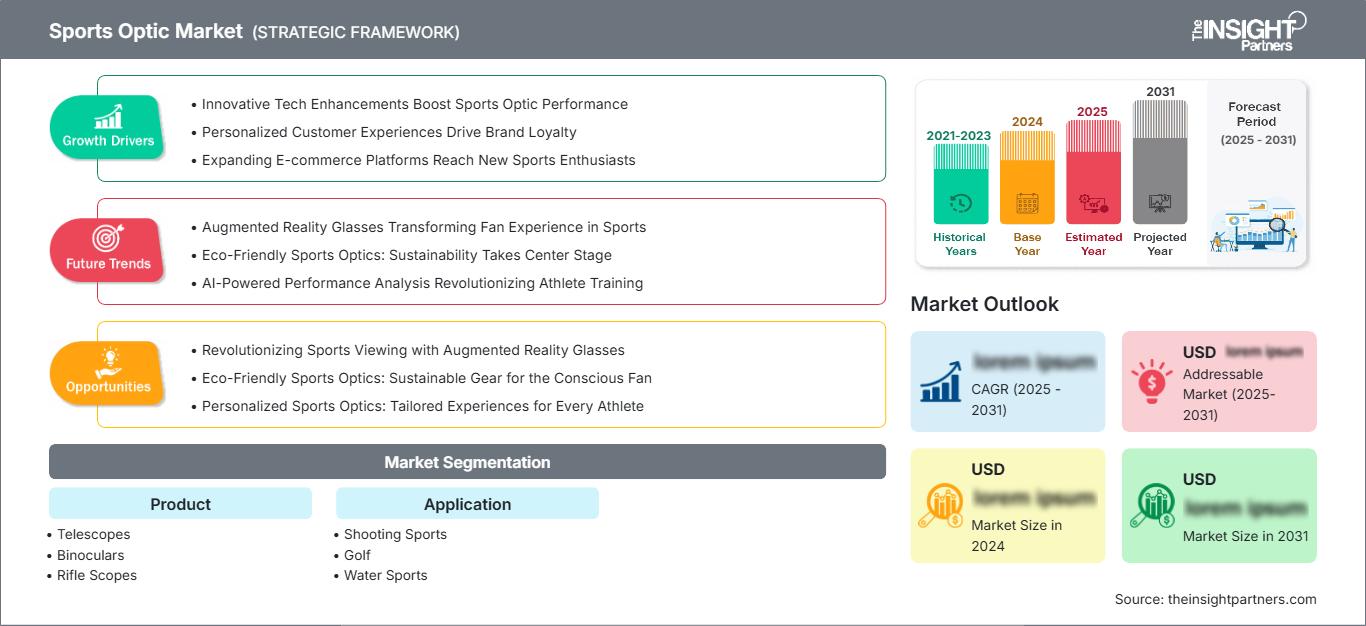
Sports Optic Market: Strategic Insights
Regional Insights
North America Sports Optic Market
North America is forecasted at a ~1% CAGR until 2034, based on revenue leadership and a mature customer base. The ~38% Sports Optic Market share in 2025 is built on an active shooting-sport scene, plentiful golf facilities, abundant wildlife watching, and distribution that includes specialty stores, sporting goods chains, and direct channels. Active participation in the United States justifies recurrent purchases, along with outdoor activities in Canada adding binoculars and rangefinders.
The replacement factor is what is going to drive growth. The consumer is going to get an upgraded product that offers better performance features such as light transmission, waterproofing, stability, laser speed, and application integration. The ability of the company to offer local design and after-sales services is the foundation for its high pricing; however, the cost becomes highly price-sensitive because of imported lenses and electronics.
U.S. Sports Optic Market
The US constitutes ~78% of the North America revenue share in 2025 and will generate an estimated ~1% CAGR till 2034. The prominence of this market owes to more than 52 million sport and target shooters, along with considerable engagement in golf, as per 2024. The combination of demand pools enables scopes and other products like binoculars and rangefinders in entry and premium segments.
The Leupold & Stevens, Inc., Burris Company, Inc., Bushnell, Trijicon, Inc., and American Technologies Network Corporation are key players in the products and distribution chain. Precision shooting needs consistency of turrets and ballistics, but in golf, ranging is small and quick. Penetration maturity hinders further unit growth, which means that income growth relies on premiumization and services.
Europe Sports Optic Market
Europe constitutes ~30% of worldwide revenue in 2025 and is expected to grow at ~1% CAGR to 2034. Germany is the largest country in the European segment based on optical engineering, superior manufacturing capabilities, tradition of hunting, and specialized retailing. Optical engineering is enhanced by Carl Zeiss AG and Leica Camera AG in the region whereas Austria-based SWAROVSKI OPTIK brings in the element of premium binocular and rifle scope expertise.
Golf, horse riding watching, observing nature, and shooting regulation requirements exist in the UK market. Binocular and telescope purchase is motivated by outdoor activities and astronomical observers in France. Italy is interested in retail sports, marine, and other specialized requirements. Spain possesses a balanced potential regarding golf tourism, hunting, and outdoors observing.
In all these markets, the laws affect riflescopes rather than binoculars and telescopes in their path to market thus making the process of assortment localization and regulation necessary. Regional maturity favors optical performance, repairability, ergonomics, and a warranty over quick and cheap replacement. Although the digitalization raises ASPs, premium analog optics stay relevant in those cases when the customers demand good light transmission and color performance over a long period of time. Therefore, growth potential in Europe is moderate.
APAC Sports Optic Market
Asia Pacific is forecast to have a ~24% Sports Optic Market share in 2025 and will be the fastest growing region, with a ~3% CAGR from 2024 to 2034. China will dominate in the region owing to its strengths in manufacturing capabilities, size of consumer population, and growing online channel distribution. Japan will provide optics expertise and golfing maturity, whereas South Korea will contribute technology-oriented golfing and leisure spending.
Opportunities in India exist in lower penetration areas like astronomy, outdoor and sporting goods retailing. Opportunities in Australia lie in the existing demand for shooting, nautical, racing and nature watching activities. Localisation, infrastructure development in tourism, e-commerce and domestic availability of components can generate more opportunities, but the price-sensitive environment would require well-segmented portfolio and good after-sales service.
Middle East & Africa Sports Optic Market
The Middle East & Africa is expected to expand at ~2% CAGR through 2034. The UAE is the leading country in the Middle East & Africa where premium retail, golf, equestrian events, tourism, and marine leisure support optics demand. Saudi Arabia’s tourism and sports investment broadens prospective use, while South Africa has established wildlife observation, hunting, and outdoor channels.
The demand becomes selective in nature for urban centers, tourist circuits, and specialty distributors. Bad weather makes value in sealed containers, durability of coatings, and heat-resistant electronics. Investment in infrastructure can bring about growth for golfing, race tracks, and destination experiences, but dependency on imports and imbalance in distribution hampers fast growth.
Segmentation Analysis
Product
The Product segment in the Sports Optic Market is projected to grow at ~2% CAGR from 2026 to 2034. The Sports Optic Market scope spans general viewing, astronomy, target acquisition, and distance measurement, creating distinct price-performance ladders. Optical quality, enclosure durability, weight, electronics integration, and channel specialization determine adoption. Replacement cycles are longest for conventional premium optics and shorter where connected functions or sensor improvements create demonstrable utility.
- Telescopes: Demand centers on astronomy education, hobbyist observation, and accessible computerized systems. Portable formats and guided setup improve entry-level adoption, while premium buyers seek larger apertures, tracking accuracy, and compatible imaging accessories.
- Binoculars: This is the broadest-use product class, serving races, water sports, outdoor viewing, and spectators. Compactness, image stabilization, low-light transmission, and waterproofing sustain strategic importance across mass and premium channels.
- Rifle Scopes: Purchases are concentrated among shooting-sports users who prioritize repeatable adjustment, reticle clarity, ruggedness, and low-light performance. Regulation, application fit, dealer knowledge, and trusted warranties strongly shape brand selection.
- Rangefinders: Golf and precision shooting provide the clearest adoption pathways. Fast acquisition, angle compensation, target discrimination, compact design, and application connectivity support upgrades where precise distance information directly improves execution.
Application
The Application segment in the Sports Optic Market is forecast to rise at ~1% CAGR from 2026 to 2034. Demand differs materially by activity: shooting emphasizes repeatability, golf favors rapid ranging, water sports require sealing, and racing applications value field of view. Suppliers benefit from translating shared optical platforms into activity-specific ergonomics, software, accessories, and retail messaging rather than treating all users as one audience.
- Shooting Sports: The application supports premium rifle scopes, binoculars, and rangefinders. Competitive and recreational users value repeatable mechanics, clear reticles, verified durability, and ballistic workflows, making specialist credibility and service decisive.
- Golf: Laser rangefinders dominate the purchase logic because users need fast, confidence-building distance information. Compact handling, slope functions where permitted, stabilization, and readable displays support replacement and gifting demand.
- Water Sports: Marine and shoreline users prioritize waterproofing, corrosion resistance, buoyant accessories, and wide fields of view. Binoculars remain central, with rugged construction and dependable grip carrying greater importance than extensive connectivity.
- Wheel Sports: Spectators and event personnel use compact binoculars for trackside visibility and rapid subject following. Lightweight design, broad field of view, and easy focus matter most in highly mobile viewing environments.
- Snow Sport: Cold-weather users require anti-fog performance, glove-friendly controls, sealing, and contrast in bright reflective conditions. Demand is seasonal, but premium durability and travel-friendly formats can support attractive value realization.
- Horse Racing: Binoculars are important for spectators, owners, and event professionals tracking movement across long courses. Compact premium optics, quick focusing, and visual comfort support purchases in established racing destinations.
Opportunity Snapshot
| Application | Revenue Contribution | Trend Tag | Adoption Stage |
| Shooting Sports | High | Ballistic Integration | Mature |
| Golf | High | Laser Assist | Scaling |
| Water Sports | Medium | Marine Durability | Mature |
| Wheel Sports | Low | Track Viewing | Mature |
| Snow Sport | Low | Anti-Fog Optics | Scaling |
| Horse Racing | Medium | Course Tracking | Mature |
Sports Optic Market Growth Drivers and Impact Analysis
Precision Features Create Measurable User Value
Advanced coatings, stable adjustment systems, laser measurement, angle compensation, and clearer displays convert engineering improvements into outcomes users can perceive. In shooting sports, repeatable mechanics and rapid data interpretation reduce setup friction. In golf, faster ranging shortens the distance-estimation step and supports club selection. For binocular users, stabilization and improved transmission extend useful viewing in motion or difficult light. These benefits encourage premium replacement even in mature markets, allowing suppliers to grow value without relying on equivalent unit expansion. The strongest impact occurs when features remain intuitive, withstand weather exposure, and integrate into existing routines rather than requiring extensive configuration.
Broad Outdoor and Sports Participation Supports Replacement
Large participation bases in shooting, golf, wildlife observation, marine leisure, racing, and astronomy create recurring demand across multiple product categories. U.S. research indicates more than 52 million sport and target shooting participants in 2024, while 2025 golf evidence shows sustained activity domestically and internationally. Participation does not translate one-for-one into purchases, but it enlarges the addressable installed base and supports accessories, gifts, upgrades, and replacements. Over time, users move from entry optics toward lighter, clearer, or more specialized equipment. This mechanism is especially important for the Sports Optic Market because durable products have long service lives and revenue growth depends on compelling upgrade cycles.
Omnichannel Distribution Expands Product Discovery
Specialist dealers remain influential where buyers need advice on magnification, reticles, range capability, or mounting, yet online channels have improved comparison and access. Detailed specifications, demonstrations, reviews, and direct brand education reduce uncertainty for mainstream binoculars, telescopes, and golf rangefinders. Omnichannel models also help manufacturers serve geographically dispersed enthusiasts without maintaining dense physical networks. The market impact is broader assortment visibility and more efficient launches, although returns and price transparency can pressure margins. Suppliers can improve conversion by pairing clear use-case guidance with dealer training, warranties, and regional service. This approach is particularly relevant in emerging Asian markets where specialist infrastructure is less uniform.
Sports Optic Market Future Trends
Connected Optics Move Toward Selective Intelligence
Sports Optic Market trends will increasingly center on purposeful digital assistance rather than feature accumulation. Rangefinders and selected rifle scopes are likely to combine sensing, stored profiles, environmental inputs, and app-based configuration while keeping critical controls available on the device. Golf products will further refine stabilization and display readability, and premium observation optics may add capture or identification functions selectively. Adoption will depend on battery life, interface simplicity, privacy, regulatory fit, and long-term software support. Analog premium products will not disappear; instead, portfolios will separate into durable optical instruments and connected systems whose value depends on both hardware and maintained digital services.
Platform Engineering Reshapes Portfolio Economics
Manufacturers are expected to reuse optical assemblies, housings, sensors, and firmware across product families while differentiating models through magnification, coatings, displays, and software. Platform engineering can shorten development cycles, improve component purchasing, and make quality control more consistent. It also enables clearer price ladders across entry, mid-range, and premium offerings. The risk is excessive commonality that weakens application fit or creates broad recall exposure. Successful suppliers will preserve specialized ergonomics for shooting, golf, marine, and astronomy users while standardizing invisible components. This balance can protect margins in a low-growth global environment and improve resilience when electronics or specialty glass supply tightens.
Sports Optic Market Opportunities
Build Mid-Priced Rangefinding Systems for Asia Pacific
Asia Pacific offers the clearest geographic opening because participation, e-commerce access, and local manufacturing capabilities are rising from a lower penetration base. Sports Optic Market Forecasts indicate that suppliers should prioritize compact rangefinders and binoculars designed around golf, outdoor recreation, and travel rather than simply transferring North American hunting assortments. Investment should combine localized interfaces, durable construction, regional service, and channel partnerships. A modular platform can support country-specific features and price points while controlling development cost. Companies that pair dependable hardware with straightforward demonstrations can reduce buyer uncertainty and accelerate adoption in China, India, South Korea, and selected Southeast Asian markets.
Monetize Replacement Through Service and Trade-Up Programs
Mature regions contain large installed bases but modest category growth, creating an opportunity to organize replacement rather than wait for failure. Brands can use inspection, refurbishment, trade-in credit, extended service, and accessory bundles to move users toward better coatings, stabilization, connected ranging, or lighter designs. Such programs can also generate certified secondary inventory and strengthen customer retention without relying on indiscriminate discounting. Execution requires transparent grading, parts availability, and data security for connected products. For premium manufacturers, service-led trade-up can reinforce trust and extract lifetime value while supporting sustainability goals through repair and controlled product recirculation.
Recent Developments
- September 2026: Meta Platforms, Inc. launched its new VR Glasses featuring 5K micro-OLED displays, Dolby Vision, Dolby Atmos, and IMAX Enhanced certification. The 100-gram glasses use a tethered computing puck and are designed for immersive movies, sports, gaming, and multi-screen workspaces.
- February 2026: Apex Optics announced the release of its Vapor 1–4×22 Variable Prism Sight and an exclusive US launch partnership with Not Just Guns. The optic combines prism-optic durability with variable magnification and was positioned for versatile shooting applications.
- September 2026: Meta Platforms, Inc. introduced Ray-Ban Meta Audio, its first dedicated audio glasses, along with expanded AI glasses styles and the Muse personal AI agent. The Ray-Ban Meta Audio glasses offer up to 12 hours of battery life, hands-free calls and audio, and are available in multiple frame and lens combinations.
Frequently Asked Questions

- Comprehensive Market Sizing and Forecast Analysis
- Detailed Segmentation Analysis
- In-Depth Market Dynamics Assessment
- Regional and Country-Level Insights
- Competitive Landscape and Company Benchmarking
- Strategic Business Intelligence
Recent Reports
Testimonials

The Insight Partners provided valuable market intelligence that supported our global go-to-market strategy. Their team was professional, responsive, and attentive to our feedback, providing thoughtful analysis and helpful methodological clarifications throughout the project.
Junmo Kim Chief Financial Officer (CFO), Enertech Co., Ltd.
The Insight Partners' SCADA System Market report is comprehensive, with valuable insights on current trends and future forecasts. The team was highly professional, responsive, and supportive throughout. We are very satisfied and highly recommend their services.
RAN KEDEM Partner, Reali Technologies LTDs
I requested a report on a very specific software market and the team produced the report in a few days. The information was very relevant and well presented. I then requested some changes and additions to the report. The team was again very responsive and I got the final report in less than a week.
JEAN-HERVE JENN Chairman, Future Analytica
We worked with The Insight Partners for an important market study and forecast. They gave us clear insights into opportunities and risks, which helped shape our plans. Their research was easy to use and based on solid data. It helped us make smart, confident decisions. We highly recommend them.
PIYUSH NAGPAL Sr. Vice President, High Beam Global
The Insight Partners delivered insightful, well-structured market research with strong domain expertise. Their team was professional and responsive throughout. The user-friendly website made accessing industry reports seamless. We highly recommend them for reliable, high-quality research services
YUKIHIKO ADACHI CEO, Deep Blue, LLC.
This is the first time I have purchased a market report from The Insight Partners.While I was unsure at first, I visited their web site and felt more comfortable to take the risk and purchase a market report.I am completely satisfied with the quality of the report and customer service. I had several questions and comments with the initial report, but after a couple of dialogs over email with their analyst I believe I have a report that I can use as input to our strategic planning process.Thank you so much for taking the extra time and making this a positive experience.I will definitely recommend your service to others and you will be my first call when we need further market data.
JOHN SUZUKI President and Chief Executive Officer, Board Director, BK Technologies
I wish to appreciate your support and the professionalism you displayed in the course of attending to my request for information regarding to infectious disease IVD market in Nigeria. I appreciate your patience, your guidance, and the fact that you were willing to offer a discount, which eventually made it possible for us to close a deal. I look forward to engaging The Insight Partners in the future, all thanks to the impression you have created in me as a result of this first encounter.
DR CHIJIOKE ONYIA MANAGING DIRECTOR, PineCrest Healthcare Ltd.Reason to Buy
- Informed Decision-Making
- Understanding Market Dynamics
- Competitive Analysis
- Identifying Emerging Markets
- Customer Insights
- Market Forecasts
- Risk Mitigation
- Boosting Operational Efficiency
- Strategic Planning
- Investment Justification
- Tracking Industry Innovations
- Aligning with Regulatory Trends





 Get Free Sample for