
Stud Welding Machine Market Share, Demand & Growth by 2034
Coverage: By Product Type (Arc stud welding, Submerged arc stud welding, Capacitor discharge stud welding); Application (Equipment, Engineering, Power Systems) , and Geography (North America, Europe, Asia Pacific, and South and Central America)
- Status : Data Released
- Report Code : TIPRE00022738
- Category : Manufacturing and Construction
- No. of Pages : 150
- Available Report Formats :


- Last update date : October 13, 2026


2025 Market Size
US$ 1.32 Bn
Base year value
2034 Forecast
US$ 1.94 Bn
Projected by 2034
CAGR 2026-2034
4.33 %
Growth rate
Addressable Market
US$ 14.77 Bn
(2026-2034)
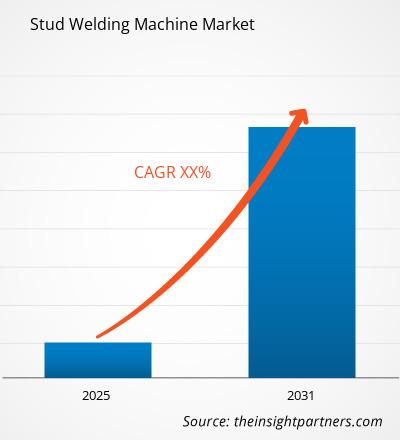
The Stud Welding Machine Market was valued at US$ 1.32 Billion in 2025 and is projected to reach US$ 1.94 Billion by 2034, expanding at a 4.33% CAGR during 2026–2034. The market covers equipment used for arc stud welding, submerged arc stud welding, and capacitor discharge stud welding across equipment, engineering, and power systems applications. Demand is supported by the need for fast, repeatable, single-side fastening in structural fabrication, industrial production, infrastructure, and specialized metalworking applications.
North America is supported by continued industrial investment, replacement of conventional fastening methods, and demand for productive joining processes in construction and manufacturing. The region is expected to expand at a modeled ~3% CAGR through 2034, with adoption strengthened by established fabrication capabilities, broad availability of welding equipment, and continued use of stud welding in structural and industrial applications.
Stud Welding Machine Market Assessment and Insights
Regional Outlook
- North America: ~28% of the global market in 2025 | ~3% CAGR through 2034. Market position: North America represents a mature demand center supported by structural fabrication, industrial machinery, power infrastructure, automotive production, and established welding distribution networks. Replacement demand and process automation sustain equipment purchases.
- US: ~78% of North American market revenue in 2025 | ~3% CAGR through 2034. Market position: The US represents the largest national market within North America, supported by extensive fabrication activity, industrial production, infrastructure projects, and broad availability of arc and capacitor discharge equipment.
- Europe: ~30% of the global market in 2025 | ~3% CAGR through 2034. Market position: Europe has a mature welding ecosystem, with Germany representing the leading country in Europe. Automotive manufacturing, structural steel, industrial equipment, and engineering applications provide a diversified installed base.
- Asia Pacific: ~32% of the global market in 2025 | ~6% CAGR through 2034. Market position: Asia Pacific is the fastest-growing region, supported by manufacturing expansion, infrastructure development, automotive production, and increasing industrial automation. China represents the leading country in Asia Pacific, followed by Japan, South Korea, India, and Australia.
Segment Outlook
- Arc stud welding: ~55% Share in 2025 | ~4% CAGR through 2034. Market position: Arc stud welding leads because of its suitability for structural steel, heavy fabrication, construction, shipbuilding, and applications requiring durable high-strength connections with larger studs.
- Power Systems: ~25% Share in 2025 | ~5% CAGR through 2034. Market position: Power Systems represents the high-growth main segment as utilities, industrial facilities, and infrastructure projects require dependable fastening solutions for electrical, structural, and supporting systems.
Competitive Coverage
Nelson Stud Welding / STANLEY Engineered Fastening, STANLEY Engineered Fastening, HBS Stud Welding, Taylor Studwelding Systems, Heinz Soyer GmbH, KÖCO GmbH, Tru-Weld, Image Industries Inc., Stud Welding Products Inc., THOMAS Welding Systems
Methodology
The Insight Partners follows Data Collection & Secondary Research, Primary Research, Data Analysis, and Data Triangulation & Final Review to validate market estimates and insights.
Source: The Insight Partners' analysis based on proprietary research, government publications, company annual reports, investor presentations, industry databases, and expert interviews.
The market has moved from traditional manual stud welding to equipment that offers better control over the welding current, timing, mobility, repeatability, and integration into manufacturing operations. Capacitor discharge systems are suitable for fastening thin metal, but the traditional arc welding remains essential for structural and large diameter fastening. Widespread adoption of digital systems, process control, automated feeding, computer numeric control and application-specific gun models favors moving from individual equipment to joined welding solutions. Equipment manufacturers are increasingly considering productivity, weld reliability, personnel needs, maintenance and compatibility with automation when buying equipment.
During the forecast period through 2034, investment will extend into Asia Pacific and specific industrial countries where automotive industry, construction, energy, fabrication and machine building manufacturing are growing. Attention to welding quality and procedures in legislation encourages demand for controlled processes. Introduction of new guidelines for international arc stud welding underlines the significance of procedure qualification, operator qualification and production weld testing.
Stud Welding Machine Market Report Scope
| Report Attribute | Details |
|---|---|
| Market size in 2025 | US$ 1.32 Billion |
| Market Size by 2034 | US$ 1.94 Billion |
| Global CAGR (2026 - 2034) | 4.33% |
| Historical Data | 2021-2024 |
| Forecast period | 2026-2034 |
Stud Welding Machine Market Analysis
The demand side is related directly to the amount of metal fabricating activity and the necessity of fastening without drilling holes through the parent material. There is demand for drawn arc type equipment due to construction and structural steel, and opportunities for capacitor discharge equipment arise from thin sheet fabrication, automobiles parts, appliance parts, and enclosures. The supply chain consists of equipment manufacturers, welding stud manufacturers, component makers, distributors, integrators, fabricators, engineering contractors, and end-users.
Supply side dynamics become increasingly differentiated by portability, capacity, automation friendly, and process control. Manufacturers of equipment that provide not only machines but also studs, guns, auxiliary parts, engineering and technical support, and application engineering are better able to service customer needs. Automatic stud feeding, computer numerical control, process control, and programmable power source are especially useful in cases where consistent output and minimal involvement of the operator are desired.
Competitive positioning entails a blend of product line, application engineering, geographic presence, and services. Both Nelson Stud Welding and STANLEY Engineered Fastening offer wide stud welding and fastening product lines, whereas HBS Stud Welding, Heinz Soyer GmbH, and KÖCO GmbH have focused on their specialization in stud welding equipment and applications. Taylor Studwelding Systems, Tru-Weld, Image Industries Inc., and THOMAS Welding Systems help increase competition through equipment specialization and automation and application-specific equipment.
The investments focus is shifting towards compact equipment, digitization, automation, and equipment that can process varied materials and fastening geometry. The vendors are also creating differentiation based on services like training, calibration, repair, and engineering because the quality of the welding depends on correct equipment setup and operating parameters.
● REPORT CUSTOMIZATION
Tailor This Report To Align With Your Specific Business Requirements
This report can be customized to align precisely with your business objectives, scope, and target markets. Customization options include tailored segmentation, geography, competitive analysis, and strategic insights to support informed decision-making.
Customize This Report →WHAT YOU CAN ADJUST
- ● Segmentations
- ● Geography
- ● Competitive Analysis
- ● Language Preferences
Stud Welding Machine Market: Strategic Insights

Regional Insights
North America Stud Welding Machine Market
North America accounted for a modeled ~28% of the global market in 2025 and is expected to expand at a ~3% CAGR through 2034. Industrial capacity exists in areas of construction, structural steel, automotive, heavy equipment, shipbuilding, and power generation. Older welding equipment upgrades and preferences for portable and computerized machines lead to repeat purchases.
The USA is the largest national market in North America, and Canada is the other important national market via construction, energy infrastructure, transportation equipment, and industrial fabrication. More and more equipment is demanded that can deliver consistent welding parameters and faster set-up times. There is a large base of distribution services and experienced welders in the region.
U.S. Stud Welding Machine Market
The US represented approximately ~78% of North American market revenue in 2025 and is expected to grow at a ~3% CAGR through 2034. The varied industrial sector in the nation results in an application need in construction, engineering, equipment manufacture, power generation, automobiles, and infrastructure. Both arc structural welders and capacitor discharge equipment have been used in practice.
Some of the market actions are by worldwide producers as well as specialized equipment manufacturers for fabrication companies, contractors, OEMs, and engineers. The need for portable equipment is related to the field installations and maintenance whereas the need for programmable and automatic equipment is related to high volume production.
Europe Stud Welding Machine Market
Europe represented approximately ~30% of the global market in 2025 and is projected to register a ~3% CAGR through 2034. Germany is the leading country in Europe due to its machinery, automotive, metal fabrication, engineering and industrial manufacturing capabilities. Additionally, there are a number of established stud welding technology suppliers in Germany that enhance the engineering knowledge and equipment in the area.
On the other hand, the UK derives demand from construction, fabrication and industrial maintenance, whereas France and Italy derive their demand from transportation equipment, machinery, construction and manufacturing. Opportunities in Spain are available in the areas of construction, industrial equipment, automotive and infrastructure. The customers in Europe give much importance to process efficiency, weld quality, qualification of operators and documentation of the equipment.
APAC Stud Welding Machine Market
Asia Pacific represented approximately ~32% of the global market in 2025 and is expected to expand at a ~6% CAGR through 2034, making it the fastest-growing region. China is the leading country in Asia Pacific because of its large manufacturing base, infrastructure activity, automotive production, and extensive fabrication ecosystem.
Japan and South Korea contribute through automotive, electronics-related equipment, shipbuilding, machinery, and advanced manufacturing. India is supported by infrastructure investment, industrialization, transportation equipment, power projects, and expanding fabrication capacity. Australia provides demand from infrastructure, mining-related equipment, construction, and industrial applications. Across the region, increased automation and localization of manufacturing capacity can support adoption of programmable and production-oriented welding equipment.
Middle East & Africa Stud Welding Machine Market
The Stud Welding Machine Market forecast shows that Middle East & Africa is expected to expand at a modeled ~5% CAGR through 2034. Saudi Arabia and the UAE provide demand from construction, industrial development, energy infrastructure, and large-scale projects, while South Africa contributes through mining, fabrication, power infrastructure, and industrial equipment.
The region's requirements vary substantially by application. Large construction and infrastructure projects favor durable equipment suitable for field conditions, while industrial facilities require repeatable joining and maintenance capabilities. Expansion of power systems, transportation infrastructure, commercial facilities, and industrial capacity can increase the addressable requirement for stud welding equipment. Equipment portability, service availability, and robustness remain important purchasing considerations where machines are deployed across dispersed worksites.
Segmentation Analysis
Product Type
Arc stud welding is the largest product type, with a modeled ~4% CAGR during 2026–2034. Its position reflects extensive use in structural steel, construction, heavy fabrication, shipbuilding, and applications requiring high-strength fastening. The process accommodates larger studs and demanding structural connections, making it important for engineering-intensive projects where weld integrity and load performance are central purchasing considerations.
- Arc stud welding: Widely used for structural steel, shear connectors, heavy fabrication, shipbuilding, and industrial assemblies requiring durable high-strength joints. Its established installed base and broad applicability support continued equipment replacement and project-related demand.
- Submerged arc stud welding: Used in specialized applications where controlled welding conditions and process consistency are required. Adoption is influenced by application geometry, production environment, and the need for specialized joining solutions rather than general-purpose portable equipment.
- Capacitor discharge stud welding: Particularly relevant to thin sheet and coated materials because the process can provide rapid attachment with comparatively low heat input. It supports automotive, appliance, enclosure, sheet-metal, and other lightweight fabrication applications.
Application
Power Systems is expected to register the highest growth among the application categories, with a modeled ~5% CAGR during 2026–2034. Expansion of electrical infrastructure, generation facilities, substations, industrial power systems, and supporting structures creates opportunities for permanent fastening. Equipment selection is influenced by field portability, connection reliability, operating conditions, and compatibility with project-specific structural requirements.
- Equipment: Includes fastening requirements associated with machinery, production equipment, industrial assemblies, and manufactured structures. Demand is influenced by manufacturing volumes, replacement cycles, equipment modernization, and increasing preference for repeatable joining processes.
- Engineering: Covers engineering-intensive fabrication and construction activities where connection quality, dimensional consistency, and documented procedures influence equipment selection. The category includes structural and specialized fabrication projects requiring application-specific welding configurations.
- Power Systems: Covers generation, transmission, distribution, electrical infrastructure, and related supporting structures. Demand benefits from infrastructure expansion, modernization, maintenance requirements, and the need for durable fastening in demanding operating environments.
Opportunity Snapshot
| Application | Revenue Contribution | Trend Tag | Adoption Stage |
|---|---|---|---|
| Equipment | High | Production Automation | Mature |
| Engineering | High | Structural Fabrication | Mature |
| Power Systems | Medium | Grid Expansion | Scaling |
Stud Welding Machine Market Growth Drivers and Impact Analysis
Expansion of Structural and Industrial Fabrication
Growth in structural fabrication, industrial machinery production, construction, and infrastructure projects creates a direct requirement for efficient fastening technologies. Stud welding can attach fasteners from one side of a workpiece, reducing the need for drilling, tapping, or accessing the opposite surface in suitable applications. This characteristic is valuable in structural steel, equipment frames, panels, enclosures, and engineered assemblies. As fabricators seek higher throughput, the ability to complete repeatable connections quickly can improve production efficiency and reduce secondary operations. Demand therefore extends beyond new equipment purchases to replacement of older power sources, guns, and accessories. The resulting market effect is particularly relevant for arc systems used in structural applications and capacitor discharge systems used in thin-sheet production.
Increasing Automation in Manufacturing Operations
Manufacturers are integrating automation into fastening and welding operations to improve repeatability, throughput, and production control. Stud welding equipment can be integrated with automated feeders, CNC positioning systems, robotic handling, fixtures, and programmable controls. This creates opportunities for equipment suppliers that can deliver complete systems rather than standalone power sources. Automated production is particularly relevant where large numbers of similar studs must be placed at repeatable positions. As manufacturers seek to reduce operator dependency and improve production consistency, automated systems can become economically attractive even when initial equipment costs are higher. The impact is expected to be strongest in automotive, industrial machinery, appliance, and high-volume fabrication applications, where cycle time and positioning accuracy directly affect manufacturing productivity.
Modernization of Power and Industrial Infrastructure
Modernization of power systems and industrial infrastructure supports demand for reliable joining solutions across new construction, expansion, and maintenance activities. Power generation facilities, substations, industrial plants, and supporting structures contain numerous metal assemblies requiring permanent fastening. Stud welding can be applied where one-sided access, connection strength, installation speed, or limited secondary finishing is important. Infrastructure modernization also generates replacement demand for portable equipment used by contractors and maintenance teams. The market impact extends across power systems and engineering applications, with purchasing decisions increasingly considering equipment reliability, portability, serviceability, and the ability to maintain consistent welding parameters in field conditions.
Stud Welding Machine Market Future Trends
Greater Integration of Digital Process Monitoring
The Stud Welding Machine Market trends show that future equipment development is likely to place greater emphasis on digital process monitoring, programmable welding parameters, data capture, and operator guidance. Digital controls can help standardize welding settings across production teams and make it easier to identify deviations from defined operating conditions. In automated environments, process information can potentially be integrated with broader manufacturing control systems. This direction can strengthen demand for modern power sources while gradually reducing the relative attractiveness of basic equipment in high-volume applications. Suppliers may increasingly differentiate through software-enabled controls, parameter libraries, diagnostics, and connectivity rather than power output alone. For customers, the value proposition will increasingly center on repeatability, traceability, reduced setup time, and maintenance efficiency.
Expansion of Portable and Energy-Efficient Equipment
Portable systems are expected to gain importance where welding operations move between fabrication areas, construction sites, maintenance locations, and infrastructure projects. Compact inverter-based designs, lower equipment weight, improved controls, and optimized power consumption can increase usability without requiring major changes to installation practices. Portable capacitor discharge systems are particularly relevant where thin materials must be joined quickly without extensive heat exposure. Meanwhile, portable arc equipment remains important for structural and field applications. Equipment suppliers that combine mobility with reliable process control can address contractors and maintenance teams seeking to reduce equipment transportation and setup time. This trend may also support greater adoption among smaller fabricators that require flexible equipment rather than dedicated production lines.
Stud Welding Machine Market Opportunities
Automation Solutions for High-Volume Manufacturing
High-volume manufacturers represent an opportunity for integrated stud welding systems combining power sources, welding heads, automatic stud feeding, positioning equipment, and process monitoring. Automotive, appliance, machinery, and industrial component manufacturers can benefit from systems that reduce manual placement and maintain consistent weld parameters across production cycles. Suppliers can expand their addressable opportunity by offering application engineering, fixture development, programming, commissioning, and service rather than limiting sales to individual machines. Retrofit solutions also offer potential where existing production lines require greater automation without complete replacement. The commercial opportunity is therefore strongest for vendors capable of integrating welding technology with broader factory automation requirements while maintaining application-specific weld quality.
Infrastructure and Power Project Equipment Packages
Large infrastructure and power projects create opportunities for equipment suppliers to provide complete packages covering welding machines, guns, cables, accessories, studs, technical support, training, and maintenance. Contractors often require equipment capable of operating across multiple locations and environmental conditions, making portability and service responsiveness important. Suppliers can strengthen customer relationships through equipment rental, calibration, field support, repair programs, and application engineering. Regional service networks can also reduce downtime and improve equipment utilization during extended projects. As power and infrastructure assets are constructed, upgraded, and maintained, suppliers with scalable equipment portfolios can address both project-based demand and recurring replacement requirements.
Recent Developments
- August 2026: HBS Welding Systems GmbH — HBS announced that Thomas Lüttgens became Managing Director of HBS Welding Systems GmbH. The development strengthens the company's management structure while the business continues to focus on stud and nut welding equipment, welding guns, automation, service, and application-specific joining technology. HBS operates internationally and maintains a portfolio covering manual, semi-automatic, and automated systems.
- June 2025: Heinz Soyer Bolzenschweißtechnik GmbH — SOYER introduced the BMK-12i stud welding device, a compact three-phase welding inverter with an 800 A welding capacity. The company highlighted its low weight, mobility, energy efficiency, and SRM technology for challenging welding positions. The product demonstrates continuing equipment development around portability, operating flexibility, and efficient stud welding for maintenance and assembly applications.
- September 2025: STANLEY Engineered Fastening — STANLEY Engineered Fastening showcased Nelson Stud Welding and Tucker solutions at SCHWEISSEN & SCHNEIDEN in Essen, Germany. The company presented industrial stud welding and automotive fastening technologies, including application-oriented joining systems and demonstrations. The participation highlighted the integration of stud welding with broader fastening and joining technologies for manufacturing and automation applications.
Frequently Asked Questions

- Comprehensive Market Sizing and Forecast Analysis
- Detailed Segmentation Analysis
- In-Depth Market Dynamics Assessment
- Regional and Country-Level Insights
- Competitive Landscape and Company Benchmarking
- Strategic Business Intelligence
Recent Reports
Testimonials

The Insight Partners provided valuable market intelligence that supported our global go-to-market strategy. Their team was professional, responsive, and attentive to our feedback, providing thoughtful analysis and helpful methodological clarifications throughout the project.
Junmo Kim Chief Financial Officer (CFO), Enertech Co., Ltd.
The Insight Partners' SCADA System Market report is comprehensive, with valuable insights on current trends and future forecasts. The team was highly professional, responsive, and supportive throughout. We are very satisfied and highly recommend their services.
RAN KEDEM Partner, Reali Technologies LTDs
I requested a report on a very specific software market and the team produced the report in a few days. The information was very relevant and well presented. I then requested some changes and additions to the report. The team was again very responsive and I got the final report in less than a week.
JEAN-HERVE JENN Chairman, Future Analytica
We worked with The Insight Partners for an important market study and forecast. They gave us clear insights into opportunities and risks, which helped shape our plans. Their research was easy to use and based on solid data. It helped us make smart, confident decisions. We highly recommend them.
PIYUSH NAGPAL Sr. Vice President, High Beam Global
The Insight Partners delivered insightful, well-structured market research with strong domain expertise. Their team was professional and responsive throughout. The user-friendly website made accessing industry reports seamless. We highly recommend them for reliable, high-quality research services
YUKIHIKO ADACHI CEO, Deep Blue, LLC.
This is the first time I have purchased a market report from The Insight Partners.While I was unsure at first, I visited their web site and felt more comfortable to take the risk and purchase a market report.I am completely satisfied with the quality of the report and customer service. I had several questions and comments with the initial report, but after a couple of dialogs over email with their analyst I believe I have a report that I can use as input to our strategic planning process.Thank you so much for taking the extra time and making this a positive experience.I will definitely recommend your service to others and you will be my first call when we need further market data.
JOHN SUZUKI President and Chief Executive Officer, Board Director, BK Technologies
I wish to appreciate your support and the professionalism you displayed in the course of attending to my request for information regarding to infectious disease IVD market in Nigeria. I appreciate your patience, your guidance, and the fact that you were willing to offer a discount, which eventually made it possible for us to close a deal. I look forward to engaging The Insight Partners in the future, all thanks to the impression you have created in me as a result of this first encounter.
DR CHIJIOKE ONYIA MANAGING DIRECTOR, PineCrest Healthcare Ltd.Reason to Buy
- Informed Decision-Making
- Understanding Market Dynamics
- Competitive Analysis
- Identifying Emerging Markets
- Customer Insights
- Market Forecasts
- Risk Mitigation
- Boosting Operational Efficiency
- Strategic Planning
- Investment Justification
- Tracking Industry Innovations
- Aligning with Regulatory Trends





 Get Free Sample for