
Stump Grinder Market Trends, Size & Forecast by 2034
Coverage: By Product (Stand Alone Equipment, Grinder Attachment); Application (Forest Areas, Agricultural Lands, Public and Private Parks, Others) , and Geography (North America, Europe, Asia Pacific, and South and Central America)
- Status : Data Released
- Report Code : TIPRE00017209
- Category : Manufacturing and Construction
- No. of Pages : 150
- Available Report Formats :


- Last update date : October 30, 2026


2025 Market Size
US$ 105.86 Mn
Base year value
2034 Forecast
US$ 139.33 Mn
Projected by 2034
CAGR 2026-2034
3.10 %
Growth rate
Addressable Market
US$ 1,113.31 Mn
(2026-2034)
The Stump Grinder Market was valued at US$ 105.86 Million in 2025 and is projected to reach US$ 139.33 Million by 2034, expanding at a CAGR of 3.10% during 2026–2034. The market covers purpose-built stand alone equipment and grinder attachments used to remove stumps in forest areas, agricultural lands, and public and private parks. Demand reflects recurring tree-care work, land restoration, site preparation, and the need to replace labor-intensive removal methods with controlled mechanical grinding.
North America remains the central commercial arena, with regional revenue expected to advance at an estimated ~3% CAGR through 2034. The Stump Grinder Market size is supported by a dense professional arborist base, broad rental availability, municipal vegetation-management budgets, and mature dealer service networks. Storm cleanup, utility corridor maintenance, suburban landscaping, wildfire-fuel reduction, and the replacement of aging compact equipment sustain purchases, while remote controls and narrow-access tracked platforms improve utilization across residential and public-space assignments.
Stump Grinder Market Assessment and Insights
Regional Outlook
- North America: ~43% of the global Stump Grinder Market share in 2025 | ~3% CAGR through 2034. Market position: The region leads through mechanized arboriculture, large rental fleets, established dealerships, recurring storm response, and strong contractor preference for productive self-propelled equipment.
- US: ~79% of North American market revenue in 2025 | ~3% CAGR through 2034. Market position: The country anchors regional demand through professional tree services, municipal contracts, utility clearance, equipment rental, and rapid adoption of remote operation and high-torque compact platforms.
- Europe: ~29% of the global market in 2025 | ~3% CAGR through 2034. Market position: A mature arboriculture sector, stringent non-road emissions rules, urban noise controls, and specialist manufacturing support demand, with Germany and the UK representing the leading national markets.
- Asia Pacific: ~20% of the global market in 2025 | ~5% CAGR through 2034. Market position: Asia Pacific is the fastest-growing region as mechanized landscaping, municipal greening, plantation renewal, and rental channels expand, led by China and followed by Japan, Australia, India, and South Korea.
Segment Outlook
- Product: ~58% Share in 2025 | ~3% CAGR through 2034. Market position: Product leads because dedicated machines deliver repeatable cutting performance, mobility, operator protection, and predictable ownership economics for professional contractors and rental fleets.
- Application: ~42% Share in 2025 | ~4% CAGR through 2034. Market position: Application revenue expands as public-space renewal, farm boundary clearing, forest restoration, and contracted vegetation management broaden the addressable workload.
Competitive Coverage
Avant Tecno Oy, Bandit Industries, Inc., Bobcat Company, Caterpillar Inc., Husqvarna AB, Morbark, LLC, Predator Power Ltd, The Toro Company, Tracmaster Ltd., Vermeer Corporation
Methodology
The Insight Partners follows Data Collection & Secondary Research, Primary Research, Data Analysis, and Data Triangulation & Final Review to validate market estimates and insights.
Source: The Insight Partners' analysis based on proprietary research, government publications, company annual reports, investor presentations, industry databases, and expert interviews.
The evolution from manually controlled cutting heads to tracked, self-propelled machines with load sensing sweeping systems, hydraulic drives, electronic fuel injection systems, and even remote capability improves productivity while minimizing the disruption to the turf surface and reducing operator exposure. The manufacturing process involves producing a fabricated frame, engine, hydraulic system, carbide teeth, control systems, and dealerships who offer additional equipment packages. Interchangeable attachments provide compact loaders and tractors with greater accessibility, although dedicated versions continue to satisfy the needs of contractors who operate equipment in high-utilization settings with consistent cutting geometry.
From 2024 to 2034, growth will be derived from municipalities, regions, and countries experiencing professionalization of the arboricultural market where the use of rented equipment decreases the need for capital investment. Asian-Pacific municipalities, landscaping contractors, and plantation owners represent a new market segment, although European equipment buyers value quieter and lower emission machinery. Spending will include investment into battery performance testing, telematics systems, remote diagnostics capability, dealer training, and parts availability. Regulations will have different impacts on each machine category, but noise restrictions, non-road emissions standards, and procurement policies will affect product design and replacement cycles.
Stump Grinder Market Report Scope
| Report Attribute | Details |
|---|---|
| Market size in 2025 | US$ 105.86 Million |
| Market Size by 2034 | US$ 139.33 Million |
| Global CAGR (2026 - 2034) | 3.10% |
| Historical Data | 2021-2024 |
| Forecast period | 2026-2034 |
Stump Grinder Market Analysis
Market growth in Stump Grinders will depend on the need for servicing rather than the occasional need created by the construction projects. After stump grinding follows the removal of stumps from the domestic areas, roadside, agricultural land, forests, and parks. The contractors seek machines that offer high productivity during working hours, can enter small gates, preserve the green cover, and make backfilling easy using soil. Rents have extended the target market to landscapers and property managers who have occasional service needs.
The eco-system in the Stump Grinder Market includes manufacturers of engines and hydraulics, steel makers, manufacturers of cutters and teeth, equipment manufacturers, distributors, rental firms, arborists, municipalities, and landowners. As such, competition among the suppliers will depend on the availability of spare parts, dealership, supply of spare parts, and after sales support. Load sensing sweeps could increase cutting efficiencies; however, ease of availability and tooth cost will matter much in cost of ownership.
The Stump Grinder Market analysis shows that competition in this industry is characterized by fragmentation, where brand image and after-sales service play equally important role as power rating. Vermeer Corporation, Bandit Industries, Inc., Morbark, LLC and The Toro Company utilize wide distribution networks and professional tree care product lines. Avant Tecno Oy, Bobcat Company and Caterpillar Inc. develop attachment-based marketing approaches, while Predator Power Ltd and Tracmaster Ltd serve specialist markets and compact models.
Capital spending trends in the Stump Grinder Market shift towards remote-control systems, electric designs, better chip containment solutions, fleet integration and modular cutters. Husqvarna AB brings relevance of outdoor power channel, while equipment manufacturers have an opportunity to upsell attachments in the existing compact loader fleet. Positioning of companies in future is likely to be based on a portfolio approach: machines for narrow access for urban operations, more powerful machines for big stumps and attachments for flexible assets.
● REPORT CUSTOMIZATION
Tailor This Report To Align With Your Specific Business Requirements
This report can be customized to align precisely with your business objectives, scope, and target markets. Customization options include tailored segmentation, geography, competitive analysis, and strategic insights to support informed decision-making.
Customize This Report →WHAT YOU CAN ADJUST
- ● Segmentations
- ● Geography
- ● Competitive Analysis
- ● Language Preferences
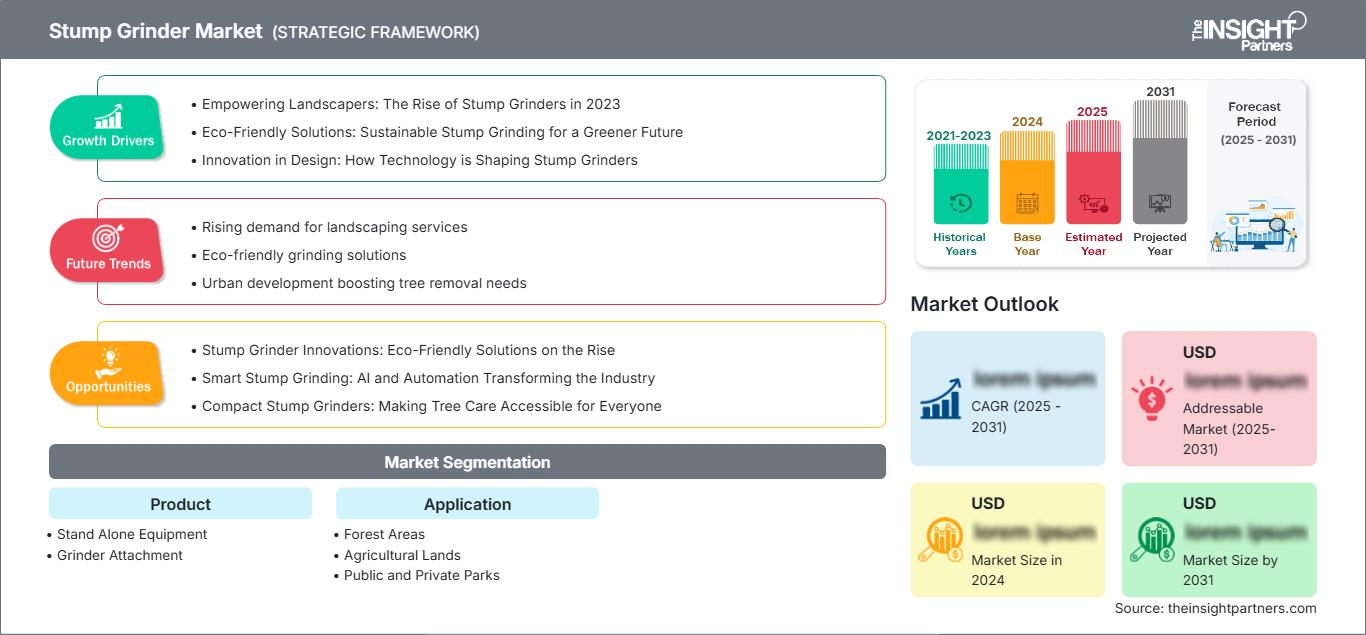
Stump Grinder Market: Strategic Insights
Regional Insights
North America Stump Grinder Market
North America accounts for an estimated ~43% of global revenue in 2025 and is forecast to expand at ~3% CAGR through 2034. Stump Grinder Market Share is influenced by a substantial fleet of tree care machinery, extensive mechanization, well-developed rental networks, and consistent municipal, utility, landscaping, and residential markets. Storms and fires cause additional usage events, but routine tree replacement maintains steady underlying consumption levels.
Buying considerations include the reach of distribution networks, uptime, financing, and residual values. Tracked stump grinders with small access are suitable for suburbia, but large wheeled or tracked stump grinders are best for land clearing and high production rates. Forestry and municipal maintenance contribute to the Canadian market; the rest is from the US.
U.S. Stump Grinder Market
The US represents approximately ~79% of North American revenue in 2025 and is expected to record ~3% CAGR through 2034. An extensive range of tree servicing companies, equipment rental firms, urban forestry initiatives, right-of-way contractors, and property maintenance enterprises facilitates consistent usage of such equipment. Requirements range from small yard equipment, mid-sized contractor equipment, high horsepower cutting machines to loader equipped attachments.
Vermeer Corporation, Bandit Industries, Inc., Morbark, LLC, The Toro Company, Bobcat Company, and Caterpillar Inc. are some of the firms offering equipment of relevance in the country. Customers evaluate various attributes, including remote visibility, auto sweep control, track width, gate entrance, cutter tooth replacement and financing options. While public parks and private properties require low impact machines, forests and right-of-way contractors need high torque and productivity.
Europe Stump Grinder Market
Europe holds an estimated ~29% of global revenue in 2025 and is projected to grow at ~3% CAGR through 2034. Maturation of landscaping services, municipal tree control, urban environment, and formalized equipment hire networks create conditions for the development of replacement demand. The requirements for non-road European emissions and noise regulations promote efficient engine, acoustic design, and early assessment of electric models.
Germany is the market leader in Europe, based on professional forestry activities, municipal green areas, and high-quality machinery distribution network. The second place is occupied by the UK, which benefits from well-developed arborists’ and hire services market, where compactness and agility are crucial factors. France benefits from municipal landscaping services and agriculture, estate demand. Italy encourages attachment use via tractors and compact carrier segments, whereas Spain’s activity is tied to urban parks, hospitality landscaping, orchards, and land-management services.
The competition consists of international companies and regional specialists. Finnish company Avant Tecno Oy supplies attachment-driven versatility, while Predator Power Ltd and Tracmaster Ltd. cater to specific users. The dealers capable of providing wear parts, training, and fast repair services have an advantage because small contractors cannot afford long downtimes.
APAC Stump Grinder Market
Asia Pacific accounts for approximately ~20% of global revenue in 2025 and is forecast to post ~5% CAGR through 2034, making it the fastest-growing region. China is the leading country in Asia Pacific, supported by municipal landscaping, infrastructure-related site preparation, plantation management, and expanding domestic machinery channels.
Japan and South Korea use small and dependable machines in densely populated cities; Australia has set up the practice of arboriculture and rentals; and India is becoming mechanized with respect to its municipal, real estate, and utility landscaping needs. The policy of urban greening along with safer work practices helps attachment grinders.
Middle East & Africa Stump Grinder Market
The Middle East & Africa is expected to expand at ~4% CAGR through 2034. The demand centers on landscaped projects, hospitality facilities, municipality parks, utility corridors, estates, and certain forestry applications. Machines favored by customers include durable equipment with reliable cooling, filtration, and dealer support when working under dusty or hot conditions.
United Arab Emirates dominates the Middle East & Africa as the leader in terms of commercial landscaping and large-scale property management for specialist contracting opportunities. Saudi Arabia has project-based growth prospects from urban development and public realm investments. South Africa adds diversity to arboriculture and forestry activities, while the Rest of MEA is driven by distributors and capital-intensive operations.
Segmentation Analysis
Product
Product is expected to advance at ~3% CAGR during 2026–2034, with dedicated equipment accounting for most value because professional users require integrated mobility, calibrated cutter systems, protection features, and high utilization. The Stump Grinder Market scope includes both stand alone equipment and grinder attachments. Portfolio breadth allows suppliers to serve rental fleets, arborists, farms, municipalities, and owners of compact carriers without forcing a single ownership model.
- Stand Alone Equipment: Dedicated machines lead professional demand through integrated propulsion, cutting controls, operator visibility, and predictable productivity. Compact tracked models serve restricted sites, while higher-power units address large hardwood stumps and intensive contractor workloads.
- Grinder Attachment: Attachments appeal to customers that already own tractors, mini loaders, skid steers, or excavators. They reduce incremental capital requirements, simplify transport planning, and expand carrier utilization across agricultural, forestry, and site-preparation tasks.
Application
Application demand is projected to rise at ~4% CAGR through 2034 as stump removal becomes integrated into broader vegetation-management, land-restoration, and public-space workflows. Procurement varies by terrain, stump size, acceptable ground disturbance, transport constraints, and work frequency. Public and private parks provide recurring maintenance, agricultural lands emphasize carrier compatibility, and forest areas require traction, durability, and high torque.
- Forest Areas: Forestry users prioritize rugged undercarriages, high cutter torque, chip containment, and service access. Demand arises from restoration, access-route maintenance, plantation renewal, wildfire-fuel management, and preparation of harvested land for replanting or alternate use.
- Agricultural Lands: Farms and contractors favor versatile attachments or transportable dedicated units for orchard renewal, field-edge clearing, fence-line work, and conversion of wooded parcels. Seasonal utilization strengthens the case for shared equipment and rental.
- Public and Private Parks: Park applications value low turf disturbance, narrow access, controllable debris, lower noise, and visible safety features. Recurring tree replacement and storm-response programs support compact self-propelled equipment and service-contractor procurement.
Opportunity Snapshot
| Application | Revenue Contribution | Trend Tag | Adoption Stage |
| Forest Areas | Medium | Restoration Work | Scaling |
| Agricultural Lands | Medium | Orchard Renewal | Scaling |
| Public and Private Parks | High | Urban Forestry | Mature |
Stump Grinder Market Growth Drivers and Impact Analysis
Professionalization of Tree Care and Contracting
Tree maintenance is progressing from random removal by manpower to professional contracting based on hourly rates dependent upon time, accessibility, risk, and restoration work quality. This trend encourages equipment investment since an efficient grinder turns stump removal into a scheduled and recurring activity. Professional tree maintenance contractors may employ small machinery in gated neighborhoods, heavy machinery for muddy sites, and powerful platforms for commercial contracts. The effect of all this is greater use of equipment in urban, suburban, and rural areas, and purchasing decisions will be based more on lifecycle cost, dealership performance, tooth consumption, and work performed in one shift than power output only.
Municipal Greening, Storm Recovery, and Public Safety
Trees have to be cut down in case they are sick, damaged by the storms, dangerous or conflicting with development activities, and the city has to reestablish its sidewalks, parks, verges and recreation spaces. The leftover stumps interfere with replanting, mowing, drainage and pedestrian activities. Thus, the removal of the stump is an obvious next step after cutting. The municipalities will either buy the equipment themselves or hire arborists; both options imply the sales and rentals of equipment. Weather variation caused by the climate change will result in the occasional bursts of demand, while the regular renewal of the urban forest will provide stable demand.
Productivity, Safety, and Total-Cost Improvements
Sweep control, hydraulic travel, wider but retractable undercarriages, remote control, electronic fuel injection, and serviceable cutter systems increase the cost-effectiveness of mechanical stumps cutting. Load-sensitive controls can ensure cutter efficiency and help reduce corrective actions by an operator, whereas remote consoles ensure better visibility in the cutting area. Hydraulic drive enables getting rid of some belts and pulleys, while modular teeth facilitate replacement of wear parts. This is important since downtime, transportation costs, labor, and consumables significantly affect a contractor’s margin. Since buyers get rid of old machinery, manufacturers who prove efficient performance under different conditions of wood density and terrain will be able to justify prices, sell more attachments for dealers, and promote standardization of their fleets.
Stump Grinder Market Future Trends
Electrified and Lower-Noise Tree-Care Platforms
Stump Grinder Market trends will increasingly include battery-electric concepts and hybridized support systems designed for noise-sensitive, emissions-regulated, and maintenance-conscious applications. Early field-validation programs indicate that manufacturers are testing whether electrification can preserve cutter performance while reducing idling, routine engine service, and worksite noise. Near-term adoption will remain selective because duty cycle, charging access, battery cost, and peak torque requirements vary widely. Public parks, campuses, hospitals, residential sites, and indoor or enclosed landscaping facilities are likely to become early use cases. Suppliers will need transparent runtime data, modular charging options, battery-health diagnostics, and dealer training before electric platforms can move beyond controlled commercial deployments.
Connected Controls and Semi-Automated Cutting
Remote controls, load-sensing sweep logic, utilization tracking, fault alerts, and maintenance scheduling will converge into more connected contractor platforms. The next design objective is not autonomous stump removal, but better consistency across operators and faster diagnosis of wear or hydraulic problems. Telematics can help rental fleets verify hours, schedule service, locate assets, and identify underused equipment. Manufacturers may also refine cutter-wheel control according to engine load and material resistance, reducing stalls and tooth shock. Commercial value will depend on simple interfaces and reliable connectivity rather than feature volume. Data-enabled service contracts could create recurring revenue while strengthening dealer relationships and residual values.
Stump Grinder Market Opportunities
Rental-Fleet Packages for Emerging Urban Markets
Rental operators in developing urban centers can aggregate intermittent demand from landscapers, municipalities, utilities, farms, and small contractors. A focused package should combine compact dimensions, intuitive controls, durable chip curtains, standardized wear parts, operator familiarization, and mobile service. Stump Grinder Market Forecasts indicate that Asia Pacific offers the strongest regional growth outlook, but penetration depends on financing and aftersales execution rather than product availability alone. Manufacturers can partner with local equipment dealers, offer seasonal payment structures, and create attachment-plus-carrier bundles. Utilization data should guide fleet mix between walk-behind, narrow tracked, mid-range remote, and carrier-mounted configurations.
Application-Specific Portfolios and Service Revenue
Vendors can increase account value by configuring machines around distinct job profiles instead of horsepower bands alone. Park contractors need low ground pressure and debris control; forestry users need traction and torque; agricultural buyers value carrier compatibility; and rental fleets prioritize intuitive controls and damage resistance. Modular cutter wheels, backfill blades, removable dual wheels, remote kits, and service plans enable differentiated packages without requiring entirely separate platforms. Dealers can supplement equipment margins with teeth, inspection kits, preventive maintenance, training, and uptime agreements. This approach also gives smaller specialists a defensible position against diversified machinery groups by turning application knowledge into faster configuration and support.
Recent Developments
- September 2026: Eterra Attachments launched the Mini Vortex Skid Steer Stump Grinder, designed for mini skid steers used in landscaping and tree-care applications. The attachment uses a radial piston motor and direct-drive system that converts approximately 95% of hydraulic flow energy into horsepower, and is rated for hydraulic flow rates of 12–20 GPM. It features a 20-inch high-strength alloy-steel wheel, three-sided flippable teeth with rock guards, three tooth options for different soil conditions, and an oil-bath enclosed hub designed to reduce maintenance requirements.
- April 2026: DR Power Equipment, a Generac company, launched the XD17 Commercial Stump Grinder as part of its expanding Commercial XD Series. The machine is powered by a commercial-grade Honda engine delivering 19.5 ft-lbs. of torque directly to a 17-inch solid-steel grinding wheel. It features a pivoting head with up to 16.5 degrees of movement, six 900 Series Greenteeth, dual disc brakes, transport tie-down points, onboard adjustment-tool and spare-tooth storage, and a centralized control panel. The XD17 is targeted at professionals, homeowners, and rental equipment businesses and is backed by a two-year commercial machine warranty and three-year commercial engine warranty.
- January 2024: Fecon LLC acquired Stumper Industries, a manufacturer of stump-grinder attachments for mini and standard skid steers, compact track loaders, excavators, and tractors. The acquisition added five quick-attach Stumper grinder models with cutting diameters ranging from 22 to 36 inches and cutting depths of up to 12 inches per pass. The products use lower-speed, high-torque cutting wheels and direct-drive systems without belts, pulleys, gearboxes, actuators, or electrical connections, expanding Fecon's land-maintenance and vegetation-management attachment portfolio.
Frequently Asked Questions

- Comprehensive Market Sizing and Forecast Analysis
- Detailed Segmentation Analysis
- In-Depth Market Dynamics Assessment
- Regional and Country-Level Insights
- Competitive Landscape and Company Benchmarking
- Strategic Business Intelligence
Recent Reports
Testimonials

The Insight Partners provided valuable market intelligence that supported our global go-to-market strategy. Their team was professional, responsive, and attentive to our feedback, providing thoughtful analysis and helpful methodological clarifications throughout the project.
Junmo Kim Chief Financial Officer (CFO), Enertech Co., Ltd.
The Insight Partners' SCADA System Market report is comprehensive, with valuable insights on current trends and future forecasts. The team was highly professional, responsive, and supportive throughout. We are very satisfied and highly recommend their services.
RAN KEDEM Partner, Reali Technologies LTDs
I requested a report on a very specific software market and the team produced the report in a few days. The information was very relevant and well presented. I then requested some changes and additions to the report. The team was again very responsive and I got the final report in less than a week.
JEAN-HERVE JENN Chairman, Future Analytica
We worked with The Insight Partners for an important market study and forecast. They gave us clear insights into opportunities and risks, which helped shape our plans. Their research was easy to use and based on solid data. It helped us make smart, confident decisions. We highly recommend them.
PIYUSH NAGPAL Sr. Vice President, High Beam Global
The Insight Partners delivered insightful, well-structured market research with strong domain expertise. Their team was professional and responsive throughout. The user-friendly website made accessing industry reports seamless. We highly recommend them for reliable, high-quality research services
YUKIHIKO ADACHI CEO, Deep Blue, LLC.
This is the first time I have purchased a market report from The Insight Partners.While I was unsure at first, I visited their web site and felt more comfortable to take the risk and purchase a market report.I am completely satisfied with the quality of the report and customer service. I had several questions and comments with the initial report, but after a couple of dialogs over email with their analyst I believe I have a report that I can use as input to our strategic planning process.Thank you so much for taking the extra time and making this a positive experience.I will definitely recommend your service to others and you will be my first call when we need further market data.
JOHN SUZUKI President and Chief Executive Officer, Board Director, BK Technologies
I wish to appreciate your support and the professionalism you displayed in the course of attending to my request for information regarding to infectious disease IVD market in Nigeria. I appreciate your patience, your guidance, and the fact that you were willing to offer a discount, which eventually made it possible for us to close a deal. I look forward to engaging The Insight Partners in the future, all thanks to the impression you have created in me as a result of this first encounter.
DR CHIJIOKE ONYIA MANAGING DIRECTOR, PineCrest Healthcare Ltd.Reason to Buy
- Informed Decision-Making
- Understanding Market Dynamics
- Competitive Analysis
- Identifying Emerging Markets
- Customer Insights
- Market Forecasts
- Risk Mitigation
- Boosting Operational Efficiency
- Strategic Planning
- Investment Justification
- Tracking Industry Innovations
- Aligning with Regulatory Trends





 Get Free Sample for