
Surface Concrete Vibrator Market Size, Share & Trends by 2034
Coverage: by Type (High Frequency, Medium Frequency, Low Frequency); Application (Architectural Engineering , Dam Engineering , Mine and Well Engineering , Others) , and Geography (North America, Europe, Asia Pacific, and South and Central America)
- Status : Data Released
- Report Code : TIPRE00012571
- Category : Manufacturing and Construction
- No. of Pages : 150
- Available Report Formats :


- Last update date : October 30, 2026


2025 Market Size
US$ 323.21 Mn
Base year value
2034 Forecast
US$ 499.8 Mn
Projected by 2034
CAGR 2026-2034
4.96 %
Growth rate
Addressable Market
US$ 3,734.51 Mn
(2026-2034)
The Surface Concrete Vibrator Market was valued at US$ 323.21 Million in 2025 and is projected to reach US$ 499.8 Million by 2034, expanding at a 4.96% CAGR during 2026–2034. The market covers equipment used to consolidate and finish concrete surfaces by transmitting controlled vibration through slabs, walls, columns, formwork, and related structural elements. Demand is linked to construction activity, concrete quality requirements, infrastructure development, and the increasing use of specialized equipment for architectural and civil engineering applications.
In North America, the Surface Concrete Vibrator Market growth is supported by infrastructure rehabilitation, commercial construction, bridge and transportation projects, and demand for consistent concrete finishing. The region is estimated to expand at approximately ~4% CAGR through 2034, supported by replacement demand, equipment modernization, and the continued use of mechanical and electric vibration equipment across construction and civil engineering activities.
Surface Concrete Vibrator Market Assessment and Insights
Regional Outlook
- North America: ~25% of the global Surface Concrete Vibrator Market share in 2025 | ~4% CAGR through 2034. Market position: A mature equipment market supported by infrastructure renewal, commercial construction, bridge programs, and established rental and distribution networks. The US represents the principal demand center within the region.
- US: ~80% of North American market revenue in 2025 | ~4% CAGR through 2034. Market position: The US has extensive construction equipment utilization across building, transportation, utility, and heavy civil projects. Demand is reinforced by infrastructure rehabilitation and established contractor and rental channels.
- Europe: ~27% of the global market in 2025 | ~4% CAGR through 2034. Market position: Europe represents a mature market with strong equipment standards, established precast manufacturing, and infrastructure refurbishment. Germany, France, Italy, and the UK provide substantial demand, while Spain remains important for civil construction activity.
- Asia Pacific: ~36% of the global market in 2025 | ~6% CAGR through 2034. Market position: Asia Pacific has the strongest expansion profile, supported by large construction volumes, urban infrastructure development, industrial facilities, and transportation investment. China, Japan, India, South Korea, and Australia form the principal demand markets.
- Middle East & Africa: ~12% of the global market in 2025 | ~5% CAGR through 2034. Market position: Infrastructure diversification, urban development, transport projects, industrial construction, and large-scale development programs support equipment demand. Saudi Arabia, the UAE, and South Africa represent important application centers.
Segment Outlook
- High Frequency: ~58% Share in 2025 | ~5% CAGR through 2034. Market position: High-frequency equipment supports consistent consolidation and surface quality, particularly where concrete placement requires efficient removal of trapped air and uniform finishing. Its suitability across professional construction and specialized concrete applications supports broad adoption.
- Dam Engineering: ~23% Share in 2025 | ~6% CAGR through 2034. Market position: Large concrete pours, mass-concrete structures, and infrastructure rehabilitation create demand for equipment capable of delivering controlled and repeatable vibration. Hydropower and water infrastructure projects provide a specific growth mechanism.
Competitive Coverage
Atlas Copco, Badger Meter, Enarco, Exen, Foshan Yunque, Multiquip, Vibco, Wamgroup, Wacker Neuson, Weber, Husqvarna Construction
Methodology
The Insight Partners follows Data Collection & Secondary Research, Primary Research, Data Analysis, and Data Triangulation & Final Review to validate market estimates and insights.
Source: The Insight Partners' analysis based on proprietary research, government publications, company annual reports, investor presentations, industry databases, and expert interviews.
Surface Concrete Vibrators Market have progressed from mechanical vibration equipment towards electric, high-frequency, pneumatic, and portable vibration equipment. The selection of equipment now depends on the properties of the concrete being used, shape of the formwork, degree of reinforcement, finish requirement, operating conditions, and availability of power sources. The products have widened along the lines of centrifugal force regulation, compact design, ease of handling, frequency regulation, and use of equipment in precast and complex construction conditions. Battery-operated equipment is also forming another product line where mobility and lower reliance on electricity is required.
In the future, economies requiring heavy infrastructure are likely to be significant demand centers. In developed economies, emphasis would be more on equipment performance, serviceability, operator ergonomics, and replacement of old equipment. Transportation infrastructure, water-related projects, industrial construction, urban construction, and precast manufacturing offer a wide range of applications. It can thus be seen that the Surface Concrete Vibrators Market goes beyond conventional construction into specialized civil engineering applications.
Surface Concrete Vibrator Market Report Scope
| Report Attribute | Details |
|---|---|
| Market size in 2025 | US$ 323.21 Million |
| Market Size by 2034 | US$ 499.8 Million |
| Global CAGR (2026 - 2034) | 4.96% |
| Historical Data | 2021-2024 |
| Forecast period | 2026-2034 |
Surface Concrete Vibrator Market Analysis
Demand is generated by contractors, civil engineering companies, precast manufacturers, infrastructure developers, and specialist concrete contractors that require controlled consolidation during placement. The value chain includes vibrator manufacturers, component suppliers, distributors, rental companies, contractors, and after-sales service providers. Product differentiation is concentrated around vibration frequency, centrifugal force, portability, power source, mounting configuration, durability, and ease of maintenance.
Supply factors include the availability of electric motors, vibration system parts, machine abilities, distribution channels, and services needed locally. Manufacturers that sell internationally tend to develop different machine models to cope with local electricity standards and application. External vibration becomes more pertinent when access internally is limited or when there is need for vibration from within molds and forms. Thus, the Surface Concrete Vibrator Market incorporates standardized machines with special application machines.
The market players include large companies dealing with construction machinery and small manufacturers offering vibration machinery. Some companies manufacture both types of machinery whereas others deal with only one type of machinery. In case of companies offering construction machinery, we have companies like Wacker Neuson and Atlas Copco. Some of the companies that offer vibration machinery are ENAR, EXEN, Multiquip, VIBCO, Weber, and Husqvarna Construction.
The Surface Concrete Vibrator Market forecast shows that investments are being made in the area of portable equipment, frequency control, battery-powered equipment, and vibration systems suited for particular applications. The products offered by EXEN Company clearly show the ongoing advancements in the development of equipment suited for tough concrete work such as the construction of dams. The high frequency inverter system offered by Multiquip shows yet another trend in which the output frequency may be adjusted based on concrete conditions.
● REPORT CUSTOMIZATION
Tailor This Report To Align With Your Specific Business Requirements
This report can be customized to align precisely with your business objectives, scope, and target markets. Customization options include tailored segmentation, geography, competitive analysis, and strategic insights to support informed decision-making.
Customize This Report →WHAT YOU CAN ADJUST
- ● Segmentations
- ● Geography
- ● Competitive Analysis
- ● Language Preferences
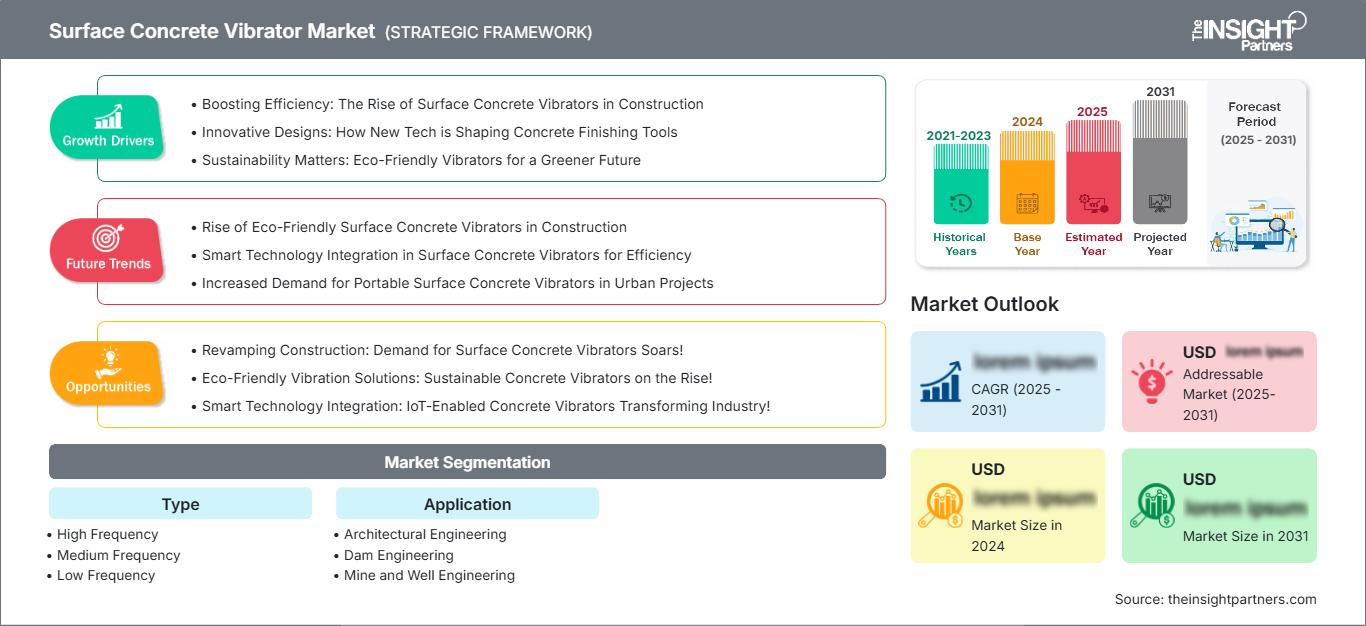
Surface Concrete Vibrator Market: Strategic Insights
Regional Insights
North America Surface Concrete Vibrator Market
North America represented approximately ~25% of the global market in 2025 and is expected to grow at approximately ~4% CAGR through 2034. The region benefits from an established construction-equipment ecosystem, extensive contractor networks, equipment rental channels, and continuing investment in transportation and public infrastructure. The US accounts for approximately ~80% of regional revenue, reflecting its larger construction base and broad heavy-civil engineering activity.
US demand includes commercial and institutional construction, transportation infrastructure, utilities, bridge repair work, and concrete-based civil engineering projects. Equipment replacement and productivity are important purchase criteria in a mature market. Additional demand is generated in Canada from infrastructure, commercial building, and resource-related construction work. Mexico generates demand from industrial and urban construction work. The regional market is one of mature brands, technical distribution, and growing interest in equipment that helps ease operator work and ensures consistent concrete compaction.
U.S. Surface Concrete Vibrator Market
The US accounts for approximately ~80% of North American market revenue and is projected to grow at approximately ~4% CAGR through 2034. Demand is driven by construction works in terms of building, highway, bridge, utility, water works, and civil engineering. The equipment consists of internal and external vibrating equipment with the latter being useful in formwork, precast manufacturing, and surface work.
There are leading suppliers with coverage of all regions of the country making it possible for contractors to acquire equipment that will be used in regular and short-term activities. The industry also gains through rental agreements that enable small-sized contractors to acquire specialized equipment without acquiring full sets. Surface quality, portability, serviceability, and vibration are among important considerations in procurement as labor is a consideration in all projects.
Europe Surface Concrete Vibrator Market
Europe accounted for approximately ~27% of the global market in 2025 and is projected to expand at approximately ~4% CAGR through 2034. Germany is the foremost nation within Europe, backed up by industrial construction, construction equipment manufacturing, and a good precast industry environment. There is additional demand coming from France, Italy, the UK, and Spain in construction, infrastructure, renovation, and special civil engineering.
Germany and Italy are key countries within the regional equipment supply chain, whereas France and the UK create demand through their infrastructure and building needs. Spain creates demand through transportation, commercial construction, and special civil engineering projects. Demand in Europe is also affected by the need for dependable equipment performance, minimal maintenance needs, ergonomic operator comfort, and good concrete surface finishes. Precast production is still an important application since external vibration can be incorporated within the mold and formwork.
APAC Surface Concrete Vibrator Market
APAC represented approximately ~36% of the global market in 2025 and is projected to grow at approximately ~6% CAGR through 2034, making it the fastest-growing region in the modeled market. China is the leading country in Asia Pacific, followed by significant demand from Japan, India, South Korea, and Australia. Large construction volumes and infrastructure activity provide the region with a broad equipment demand base.
In China, there is the presence of both huge infrastructure demands and considerable industrial capacities, while in India, the following factors play important role: transportation, infrastructure, industrialization, and construction works. In Japan and South Korea, there are already developed equipment markets with considerable demands for quality and efficiency, while in Australia, there are advantages related to infrastructure, construction associated with mining and civil engineering.
Middle East & Africa Surface Concrete Vibrator Market
Middle East & Africa is projected to expand at approximately ~5% CAGR through 2034. Saudi Arabia represents a major demand center in the Middle East & Africa region because of large-scale urban, transportation, tourism, industrial, and infrastructure development. The UAE provides additional demand through commercial, residential, transport, and large-scale development projects.
South Africa remains an important African market because of established construction activity and infrastructure requirements. Across the rest of MEA, demand is more project-driven and closely associated with public infrastructure, water systems, industrial facilities, and urban development. The regional market provides opportunities for portable and robust vibration equipment that can operate across varied site conditions and where access to service infrastructure can be less consistent.
Segmentation Analysis
Type
The Type segment is projected to expand at approximately ~5% CAGR during 2026–2034. Product selection is primarily influenced by concrete properties, required compaction intensity, structural geometry, operating environment, and access to power. High-frequency equipment supports applications requiring consistent vibration and efficient consolidation, while medium- and low-frequency configurations remain relevant for applications involving different aggregate characteristics and structural requirements. Manufacturers increasingly provide adjustable and application-specific configurations to improve operational flexibility.
- High Frequency: High-frequency equipment is widely applicable where rapid and consistent consolidation is required. It supports professional construction, exposed concrete, precast components, and applications where surface quality is a major consideration. Compact configurations and integrated frequency controls can improve mobility and operating flexibility.
- Medium Frequency: Medium-frequency equipment provides a balance between vibration intensity and operating control. It is relevant to general construction applications and concrete mixes where aggressive high-frequency vibration is not necessary. Its versatility supports contractors handling varied structural elements and project conditions.
- Low Frequency: Low-frequency equipment is suited to applications involving larger aggregate particles and concrete mixes requiring controlled movement rather than very rapid vibration. It can be relevant to heavy structural and mass-concrete applications where equipment selection must reflect material characteristics and formwork requirements.
Application
The Application segment is projected to grow at approximately ~5% CAGR during 2026–2034. Demand varies according to project scale, concrete placement method, structural design, accessibility, and required finishing standard. Building-related applications provide recurring equipment requirements, while major civil engineering projects can create concentrated demand for specialized equipment and vibration configurations.
- Architectural Engineering: Architectural concrete applications emphasize surface quality, dimensional consistency, and reduced defects. External and surface-oriented vibration systems are particularly relevant for visible concrete elements, precast components, decorative structures, walls, columns, and other applications where finishing quality directly influences project outcomes.
- Dam Engineering: Dam engineering requires controlled consolidation across large concrete volumes and complex structural sections. Specialized vibration systems can support mass-concrete placement and difficult access conditions. Hydropower and water infrastructure projects create opportunities for durable equipment capable of continuous operation under demanding construction conditions.
- Mine and Well Engineering: Mine and well engineering applications use concrete for underground structures, foundations, shafts, tunnels, support systems, and related infrastructure. Equipment requirements are shaped by restricted access, demanding operating environments, and the need for dependable consolidation around reinforcement and formwork.
Opportunity Snapshot
| Application | Revenue Contribution | Trend Tag | Adoption Stage |
|---|---|---|---|
| Architectural Engineering | High | Surface Finish | Mature |
| Dam Engineering | Medium | Mass Concrete | Scaling |
| Mine and Well Engineering | Low | Remote Access | Scaling |
Surface Concrete Vibrator Market Growth Drivers and Impact Analysis
Expansion of Transportation and Civil Infrastructure Construction
The transportation infrastructure is still one of the largest sources of concrete-related construction because roadways, bridges, tunnels, railroads, drainage networks and their related structures demand controlled concrete placement and compaction. Government-sponsored projects may create repeated demands for equipment from the participating contractors and sub-contractors in such markets. In mature markets, rehabilitation and replacement construction alone would be sufficient to create demand without any fresh constructions. Meanwhile, in emerging markets, urban development and improved transport linkages increase the number of available projects. All of these factors are favorable for manufacturers of robust, portable and maintainable concrete vibrators. It also has a larger effect because contractors now consider the productivity, portability, maintenance and appropriateness of machines for various types of concrete. This way, the Surface Concrete Vibrator Market is positively impacted by such investments.
Higher Requirements for Concrete Quality and Surface Finish
Concrete quality requirements increasingly influence equipment selection, particularly in exposed architectural concrete, precast production, structural elements, and projects where defects can create costly rework. Effective vibration helps release trapped air, improve consolidation, support aggregate distribution, and achieve more consistent surfaces. External vibration is especially relevant when internal access is restricted or when vibration must be transmitted through molds and formwork. As construction methods become more specialized, contractors and precast manufacturers need equipment matched to structural geometry and concrete characteristics rather than relying on a single generalized machine. This supports demand for high-frequency systems, adjustable centrifugal force, compact equipment, and application-specific mounting solutions. The resulting market effect is a gradual shift toward equipment selection based on concrete quality requirements and total operating performance.
Labor Productivity and Equipment Ergonomics
Construction contractors face pressure to maintain productivity while controlling operator fatigue and equipment handling requirements. Vibrators that reduce hand-arm vibration, simplify positioning, improve portability, or provide controlled frequency can help operators complete concrete placement more consistently. Battery-powered configurations can further improve mobility by reducing dependence on fixed electrical connections, while compact external vibrators can be positioned on formwork where internal access is difficult. These characteristics are particularly relevant on projects with repeated concrete pours, constrained workspaces, or dispersed work areas. Suppliers therefore compete not only on vibration performance but also on equipment weight, controls, cable management, serviceability, and ease of transport. Over time, these requirements support product development toward more ergonomic and flexible equipment rather than simple increases in vibration output.
Surface Concrete Vibrator Market Future Trends
Battery-Powered and More Portable Vibration Equipment
The Surface Concrete Vibrator Market trends show that battery-powered vibration equipment is likely to gain greater visibility where contractors value mobility, rapid deployment, and reduced dependence on electrical connections. Cordless configurations can be useful for renovation, small construction areas, difficult-to-access locations, and applications where cables create handling constraints. Product development is likely to focus on balancing battery runtime, equipment weight, vibration performance, charging time, and durability. The evolution of compact battery systems may allow manufacturers to expand cordless equipment from niche applications toward a broader set of professional construction tasks. For suppliers, battery platforms also create opportunities to share batteries and chargers across compatible construction tools, potentially increasing equipment ecosystem value. Adoption will remain dependent on workload duration, power requirements, site conditions, and the availability of charging infrastructure.
Application-Specific and Controlled Frequency Systems
The Surface Concrete Vibrator Market is also likely to move toward more application-specific equipment configurations. Concrete composition, aggregate size, reinforcement density, structural geometry, and formwork design can influence the required vibration characteristics. Systems with adjustable frequency or centrifugal force can allow contractors to modify operating conditions rather than using fixed-output equipment for every pour. Frequency-controlled systems can be particularly useful where concrete slump and placement conditions vary during a project. Future product development may therefore emphasize electronic controls, simplified adjustment, improved monitoring, and configurations optimized for precast production or specialized civil engineering. The trend could strengthen differentiation among manufacturers because equipment performance will increasingly be evaluated according to application outcomes rather than basic vibration capability alone.
Surface Concrete Vibrator Market Opportunities
Specialized Equipment for Large Civil Engineering Projects
Large civil engineering projects provide an opportunity for suppliers to develop equipment packages specifically for dams, tunnels, bridges, water infrastructure, and other concrete-intensive structures. These projects can require multiple vibration points, specialized mounting arrangements, high durability, and equipment capable of operating continuously in demanding conditions. Suppliers can differentiate through engineered vibration systems rather than standalone equipment, combining vibrators, mounting components, controls, and technical support. The opportunity is particularly relevant in regions where large infrastructure programs are expanding. Manufacturers with application engineering capabilities can also provide project-specific configurations that address formwork geometry, concrete volume, access limitations, and operating cycles. This approach can increase equipment value while creating service and replacement opportunities beyond the initial machine sale.
Precast and Architectural Concrete Production
Precast factories and architectural concrete producers provide another opportunity because repeatable production requires consistent consolidation and surface quality. External vibration systems can be integrated with molds and formwork to achieve repeatable results across panels, columns, beams, pipes, and other components. Suppliers can develop modular mounting systems, adjustable vibration controls, and equipment packages that support different mold sizes and production cycles. Automation and repeatability are especially relevant for manufacturers seeking to reduce defects and shorten production cycles. The opportunity extends across established precast markets and developing construction economies where off-site manufacturing is expanding. Equipment providers that combine vibration hardware with application guidance and after-sales support can address a broader portion of the production workflow.
Recent Developments
- October 2025: MILWAUKEE has expanded its MX FUEL Equipment System with the launch of a new MX FUEL™ High Frequency Concrete Vibrator, designed to support concrete contractors and professionals with faster setup, consistent consolidation, and improved job-site mobility. The new battery-powered concrete vibrator is designed to address limitations associated with petrol-powered and corded equipment, including fuel-related maintenance and extension-cord hazards.
- October 2024 – SurfacePrep, a provider of surface enhancement solutions, announced the strategic acquisition of PDJ Vibro, a UK-based company specializing in vibratory finishing solutions. The acquisition is part of SurfacePrep’s strategy to strengthen its presence in the United Kingdom and expand its surface enhancement capabilities.
Frequently Asked Questions

- Comprehensive Market Sizing and Forecast Analysis
- Detailed Segmentation Analysis
- In-Depth Market Dynamics Assessment
- Regional and Country-Level Insights
- Competitive Landscape and Company Benchmarking
- Strategic Business Intelligence
Recent Reports
Testimonials

The Insight Partners provided valuable market intelligence that supported our global go-to-market strategy. Their team was professional, responsive, and attentive to our feedback, providing thoughtful analysis and helpful methodological clarifications throughout the project.
Junmo Kim Chief Financial Officer (CFO), Enertech Co., Ltd.
The Insight Partners' SCADA System Market report is comprehensive, with valuable insights on current trends and future forecasts. The team was highly professional, responsive, and supportive throughout. We are very satisfied and highly recommend their services.
RAN KEDEM Partner, Reali Technologies LTDs
I requested a report on a very specific software market and the team produced the report in a few days. The information was very relevant and well presented. I then requested some changes and additions to the report. The team was again very responsive and I got the final report in less than a week.
JEAN-HERVE JENN Chairman, Future Analytica
We worked with The Insight Partners for an important market study and forecast. They gave us clear insights into opportunities and risks, which helped shape our plans. Their research was easy to use and based on solid data. It helped us make smart, confident decisions. We highly recommend them.
PIYUSH NAGPAL Sr. Vice President, High Beam Global
The Insight Partners delivered insightful, well-structured market research with strong domain expertise. Their team was professional and responsive throughout. The user-friendly website made accessing industry reports seamless. We highly recommend them for reliable, high-quality research services
YUKIHIKO ADACHI CEO, Deep Blue, LLC.
This is the first time I have purchased a market report from The Insight Partners.While I was unsure at first, I visited their web site and felt more comfortable to take the risk and purchase a market report.I am completely satisfied with the quality of the report and customer service. I had several questions and comments with the initial report, but after a couple of dialogs over email with their analyst I believe I have a report that I can use as input to our strategic planning process.Thank you so much for taking the extra time and making this a positive experience.I will definitely recommend your service to others and you will be my first call when we need further market data.
JOHN SUZUKI President and Chief Executive Officer, Board Director, BK Technologies
I wish to appreciate your support and the professionalism you displayed in the course of attending to my request for information regarding to infectious disease IVD market in Nigeria. I appreciate your patience, your guidance, and the fact that you were willing to offer a discount, which eventually made it possible for us to close a deal. I look forward to engaging The Insight Partners in the future, all thanks to the impression you have created in me as a result of this first encounter.
DR CHIJIOKE ONYIA MANAGING DIRECTOR, PineCrest Healthcare Ltd.Reason to Buy
- Informed Decision-Making
- Understanding Market Dynamics
- Competitive Analysis
- Identifying Emerging Markets
- Customer Insights
- Market Forecasts
- Risk Mitigation
- Boosting Operational Efficiency
- Strategic Planning
- Investment Justification
- Tracking Industry Innovations
- Aligning with Regulatory Trends





 Get Free Sample for